Music labels usually find pirated tracks and videos with content matching, not plain search. I’d sum it up like this: they use watermarking to trace leaks, fingerprinting to match edited copies, web and social scanning to find posts and pages, and evidence packets to support takedowns.
If you want the short answer, here it is:
- Watermarking helps me trace which copy leaked
- Fingerprinting helps me find the same song or video after edits
- Crawlers and scrapers help me scan search results, cyberlockers, social posts, and stream pages
- P2P monitoring helps me track torrents, peers, seeds, and swarm activity
- Evidence records help me prove ownership, match quality, and page context before sending a notice
In practice, labels are not just looking for file names like track01_final.mp3. Pirates change titles, strip metadata, crop video, trim clips, and re-encode files. So the file may look different on the surface, but the audio or video pattern can still match.
A few points matter most:
- Detection, attribution, and enforcement are separate jobs
- Edited files can still be matched
- Match data alone is not enough without page records and rights proof
- Higher-traffic torrent swarms often get pushed up the queue first
Here’s a quick side-by-side view:
| Method | What it does | Best for |
|---|---|---|
| Watermarking | Traces a file back to a source copy | Pre-release leaks, promo files |
| Fingerprinting | Matches the same media after edits or reposts | Released catalogs, re-uploads |
| Web/social scanning | Finds pages, posts, links, and embeds | Search engines, platforms, stream pages |
| P2P monitoring | Tracks torrent activity and swarm size | Torrents, magnet links, peer networks |
The big idea: I’d treat anti-piracy as a repeat process – mark files before release, fingerprint the catalog, scan the web, verify each match, then send takedowns with clean records.
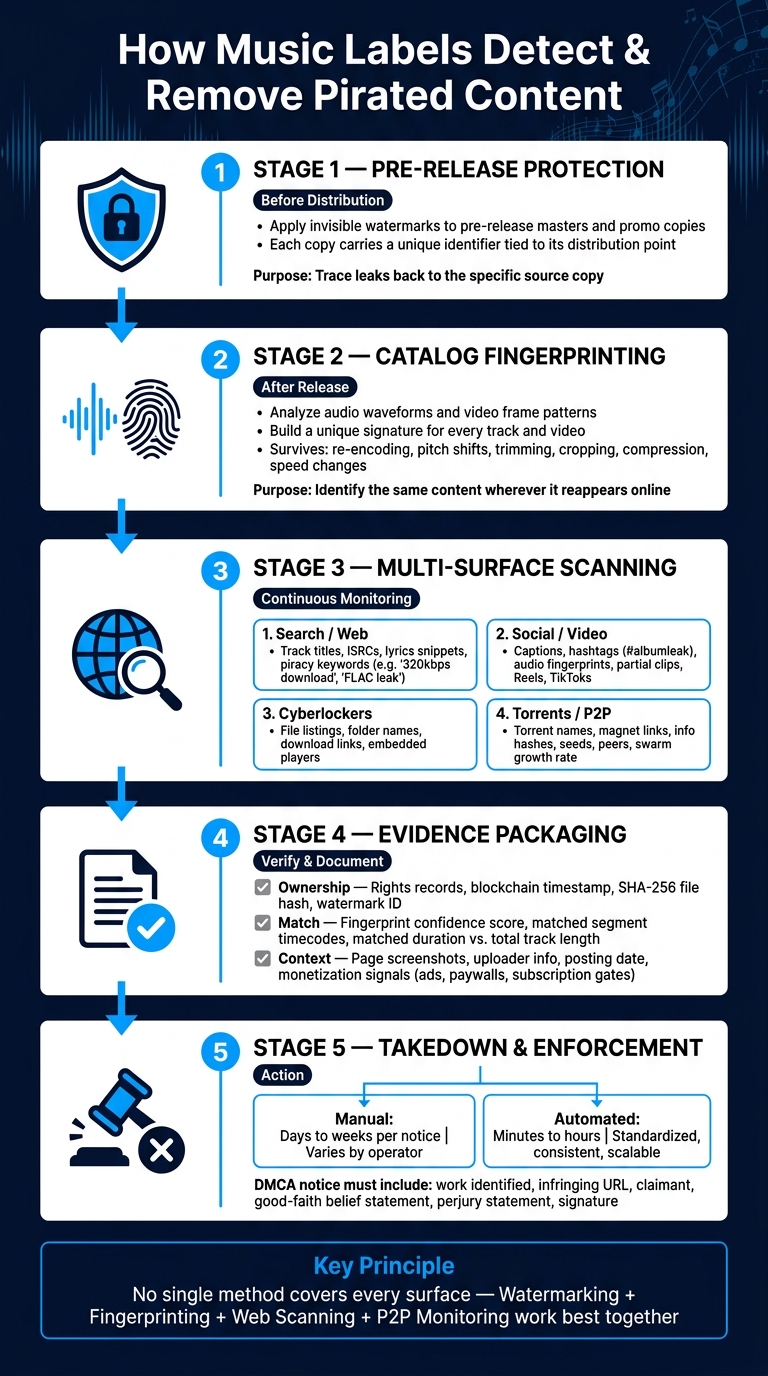
How Music Labels Detect & Remove Pirated Content: The Anti-Piracy Workflow
How Labels Identify Pirated Tracks and Videos After Files Are Edited or Reposted
Invisible Watermarking: Tracing Leaks Back to Their Source
Invisible watermarking adds hidden data to a file before it leaves the label. The track or video looks and sounds the same, but it carries an identifier tied to a certain copy or distribution point. That makes it a smart fit for pre-release masters and promo copies. If a file leaks, the label can trace it back to the copy that was sent out.
A big reason labels use watermarking is durability. Watermarks can survive re-encoding and format changes, so they still work even after a file has been converted or reposted in another format [1]. In plain terms: watermarking helps answer who leaked this copy?
Watermarking traces source; fingerprinting finds the same content wherever it reappears.
Audio and Video Fingerprinting: Content Matching at Scale
Fingerprinting tackles a different job. It identifies the same track or video even after someone edits and reposts it. Instead of hiding data inside the file, fingerprinting analyzes waveforms or frame patterns, builds a signature, and compares that signature against a reference catalog to spot matches across uploads and reposts.
The upside is speed. Labels can start using fingerprinting as soon as a release is out. They can fingerprint whole catalogs and begin finding unauthorized uploads right away, even for tracks that were never watermarked. Modern fingerprinting can still spot matches after major edits, including cropping, resizing, compression, trimming, or pitch and speed changes [1]. Once a match appears, labels can check it and back it up with measurable proof.
New uploads never stop, so manual review just doesn’t cut it. Labels need automated scanning to keep up.
When to Use Watermarking vs. Fingerprinting
These two methods solve different problems. Watermarking is best when a label needs to trace a leak to its origin. It shows who received or distributed a certain copy. Fingerprinting is better for broad discovery. It shows what content is being shared without permission across a catalog at scale.
| Invisible Watermarking | Audio/Video Fingerprinting | |
|---|---|---|
| Setup timing | Must be applied before distribution | Can be applied after content is created or released |
| Robustness to edits | Survives re-encoding and format changes | Survives compression, pitch shifts, trimming, cropping, resizing, and color changes |
| Leak traceability | Identifies the specific copy and its source | Identifies the content, not the individual copy |
| Best use case | Pre-release masters and promo copies | Catalog-wide monitoring across platforms |
| Primary outcome | Traces a distribution chain for a specific file | Confirms unauthorized use at scale |
In practice, labels that use both methods cover the blind spots each one leaves behind. Watermarking handles controlled pre-release distribution. Fingerprinting handles content that’s already out in the wild. From there, those matches feed into search and takedown work across platforms. After identification, labels move to platform-by-platform monitoring.
sbb-itb-738ac1e
Understanding Audio Fingerprinting: A Key to Digital Sound Identification
Where Labels Look for Piracy Across the Web and Closed Platforms
Once labels can match content, they start tracking where it shows up online. That sounds simple. It isn’t.
The scan area is broad: search engines, file-hosting services, social platforms, unauthorized streaming pages, and P2P networks. Each one leaves behind different clues, so labels don’t treat them the same way. They scan each surface on its own terms.
Search Engines, Websites, and Cyberlockers
Labels don’t sit there typing search queries by hand. They use automated crawlers that run scheduled searches across major search engines and directly across known piracy domains. Those systems mix together track titles, artist aliases, lyrics snippets, ISRCs, and piracy-heavy phrases like "320kbps download", "FLAC leak", or "free mp3."
On cyberlockers, scrapers look at file listings, folder names, and embedded players on landing pages. They also grab short audio or video clips for fingerprint or watermark checks. All of that flows into one review queue built from search hits, domain crawls, and cyberlocker indexes.
Each match logs the basics enforcement teams need before they act:
- URL
- Crawl time
- Screenshot
- File metadata like filename, size, codec, bitrate, and upload date
That record helps confirm the match instead of guessing from a page title alone.
Social Platforms, Video Hosts, and Unauthorized Streaming Pages
Social monitoring reaches more places than most people think. Labels scan public posts, Reels, TikToks, sound pages where audio gets reused as clips, creator ad libraries, hashtags like #albumleak or #freedownload, and links that send users to off-platform download sites.
Text signals catch the easy stuff. But pirates know that. They often post infringing clips under plain, generic titles that leave out the artist or label name. A text-only scraper can miss those without even slowing down.
So labels pull the audio from the clip itself and run content matching algorithms on it. Titles and hashtags are easy to swap out. Audio is harder to disguise. Fingerprinting can match a track from a short audio segment, even after edits, pitch shifts, or voice-overs. On unauthorized streaming pages, crawlers inspect player embed codes, playlist structures, and track-level metadata, then save screenshots and stream URLs as proof.
Torrent Indexes and P2P Swarm Monitoring
Torrent monitoring plays by different rules than web or social scanning. Labels watch torrent names, which often include album titles or terms like "WEB-FLAC", "Scene", or "Leak." They also inspect file lists inside torrents and magnet links, which point to content through info hashes.
From there, P2P tools join the swarm and track live activity. Dedicated surveillance systems spot new torrents that match a label’s catalog and monitor seeds, peers, geographic distribution, and swarm growth rate over time.
That data helps teams sort what matters most. A torrent with high seed and peer counts gets bumped up for review. One with low seed counts may stay on the watchlist but get pushed down the queue. That’s how labels keep P2P monitoring under control at scale. They focus on where measured reach is highest, not just where piracy is easiest to see.
The clues change from one surface to another, but the proof they save stays much the same: URL, time, and a page record.
| Surface | Primary Detection Signals | Evidence Captured |
|---|---|---|
| Search / Web | Track titles, ISRCs, lyrics snippets, piracy-related keywords, embedded players | URLs, timestamps, page screenshots, HTML snippets, file metadata (name, size, codec, hash) |
| Social / Video | Captions, hashtags, audio fingerprints, creator ads, partial clips, sound pages | Post IDs, platform URLs, screenshots, fingerprint match reports |
| Cyberlockers | File listings, folder names, download links, embedded players, watermark/fingerprint samples | File URLs, upload timestamps, uploader alias, file name and size, fingerprint or watermark check |
| Torrents / P2P | Torrent names, file lists, magnet links, info hashes, seeds, peers, swarm growth | Index page URLs, info hashes, magnet links, file lists, time-series swarm statistics |
Those records become the evidence package used for takedown action.
How Labels Verify Unauthorized Use and Build Enforceable Evidence
After a match is found, labels need to turn that finding into proof a platform can act on and a legal team can review. The job here is simple in theory but exacting in practice: package rights proof, match data, and page captures into a record that’s ready for a notice.
What a Usable Evidence Package Contains
A usable evidence package has to prove three things: ownership, match, and context.
That usually means including rights records, fingerprint or watermark match data, and SHA-256 hashes for both files. Before any action is taken, the fingerprint or watermark result should line up with the label’s rights records.
For fingerprint matches, the report should show:
- A confidence score
- Matched segment timecodes in both the reference file and the infringing file
- Total matched duration compared with total track length [6][7]
If psychoacoustic audio watermarking was used, include the watermark ID, the detection tool’s output, and the internal record that ties that ID to a specific promo batch or distribution event [8][9].
You also need page captures that show the uploader, posting date, ads, and any paywalls. Those monetization signals matter. Ads, subscription gates, and donation links help show commercial exploitation, which can support faster enforcement [11][14].
If rights records are thin or partly missing, timestamped hashes can help close that gap.
Using Blockchain Timestamps to Support Ownership Records
Labels also need a timestamped record showing when a master existed and who controlled it. The usual approach is to hash the final master, timestamp that hash on-chain, and store the certificate ID with the catalog record. That certificate can sum up the hash, timestamp, and registering entity for enforcement use [2][3][4].
A blockchain timestamp does not replace U.S. copyright registration. But it can still help. Courts have recognized it as credible corroborating evidence of prior existence and control [3][4][5].
From Confirmed Match to DMCA Notice or Delisting Request
Once the evidence package is ready, the handoff is pretty direct: confirm the match, attach the packet, and send the notice.
A U.S. DMCA notice must include the work, the infringing URL, the claimant, the good-faith belief statement, the perjury statement, and a signature [10][12][13]. Leave out any one of those, and a platform may reject the notice outright.
ScoreDetect Enterprise can automate delisting notices from confirmed match data and evidence packages. That helps teams cut manual drafting mistakes and keep notices consistent.
| Factor | Manual Enforcement | Automated Enforcement |
|---|---|---|
| Speed | Days to weeks per notice | Minutes to hours |
| Documentation quality | Varies by operator | Standardized, consistent |
| Consistency | Dependent on individual skill | Uniform across all cases |
| Scalability | Limited by headcount | Scales better across many cases |
With the packet complete, submit the notice.
Conclusion: Building a Repeatable Anti-Piracy Workflow for Music Releases
Anti-piracy work isn’t a one-and-done task. It’s a repeatable cycle that starts before a track or album goes live and keeps going through the full release window. Labels that protect their catalogs well don’t treat detection like a last-minute fire drill. They treat it like part of day-to-day operations. In plain English: build one repeatable process that runs from detection to enforcement.
The workflow itself is pretty straightforward: register assets, watermark pre-release copies, fingerprint the catalog, scan on a steady basis, verify matches with measured evidence, and move fast. The result is faster removals, cleaner notices, and steadier enforcement across large catalogs. ScoreDetect Enterprise supports this workflow with watermarking, scraping, timestamping, and automated takedown systems.
The main takeaway is simple:
- No single method covers every surface. Watermarking traces leaks back to a source, fingerprinting catches re-uploads at scale, web crawling finds unauthorized pages, and P2P monitoring catches torrent swarms. These methods work best when used together.
- Edits don’t stop modern matching. Pitch shifts, re-encoding, and added intros or outros don’t defeat fingerprinting systems built to identify content after transformation.
- Weak evidence can still sink a valid match. Every step, from timestamping to takedown, needs the same level of care.
FAQs
Can fingerprinting detect very short clips?
Yes. Modern fingerprinting can spot very short clips by looking at one-of-a-kind audio or visual patterns and matching them to the original work.
It can also catch clips that have been:
- trimmed
- resized
- compressed
- changed in pitch
- sped up or slowed down
Some systems can still find a match even when only 10% of the original content remains.
How accurate are watermark and fingerprint matches?
Modern detection methods are highly accurate. Some multimodal matching systems report success rates as high as 99%.
They also hold up well after major file changes. That includes files that have been cropped, re-encoded, compressed, or altered by up to 90%.
Fingerprinting can still lead to occasional false positives, so experts use scoring thresholds to confirm matches. Invisible watermarks add steady, persistent proof of ownership, even through complex digital changes.
What proof does a label need before sending a takedown?
Before sending a takedown, a label needs proof it can verify. The goal is simple: show that the detected content matches the original asset in a way that holds up under review.
A strong evidence package should include the reference file, fingerprint, suspected copy, match scores, source, upload date, timestamps, and frame-level overlap. That gives the label a clear paper trail from the original file to the alleged copy.
It can also include extra support, such as multimodal similarity analysis, invisible watermarking for source attribution, and blockchain-based checksums for a tamper-resistant ownership record. Think of it like building a case: the more clear, specific proof you have, the harder it is to dispute.