Audio piracy costs the music industry $2.7 billion annually, with over 30% of streams coming from illegal content. Traditional technology solutions struggle to combat advanced piracy tactics, leaving creators vulnerable.
Blockchain audio watermarking offers a cutting-edge solution by combining invisible watermarks – embedded into audio files to withstand edits – with blockchain technology to create tamper-proof ownership records. This dual-layer approach ensures:
- Proof of Ownership: Blockchain timestamps provide cryptographic evidence of content creation.
- Leak Detection: Watermarks trace pirated copies, even partial ones, to their source.
- Automated Enforcement: Smart contracts and tools like ScoreDetect simplify piracy monitoring and takedown requests.
This system achieves over 97% detection accuracy and is designed to protect creators while maintaining audio quality. However, challenges like watermark removal attacks and the need for standardization remain.
AI Music Copyright: The Watermarking Solution Explained
sbb-itb-738ac1e
How Blockchain Audio Watermarking Works
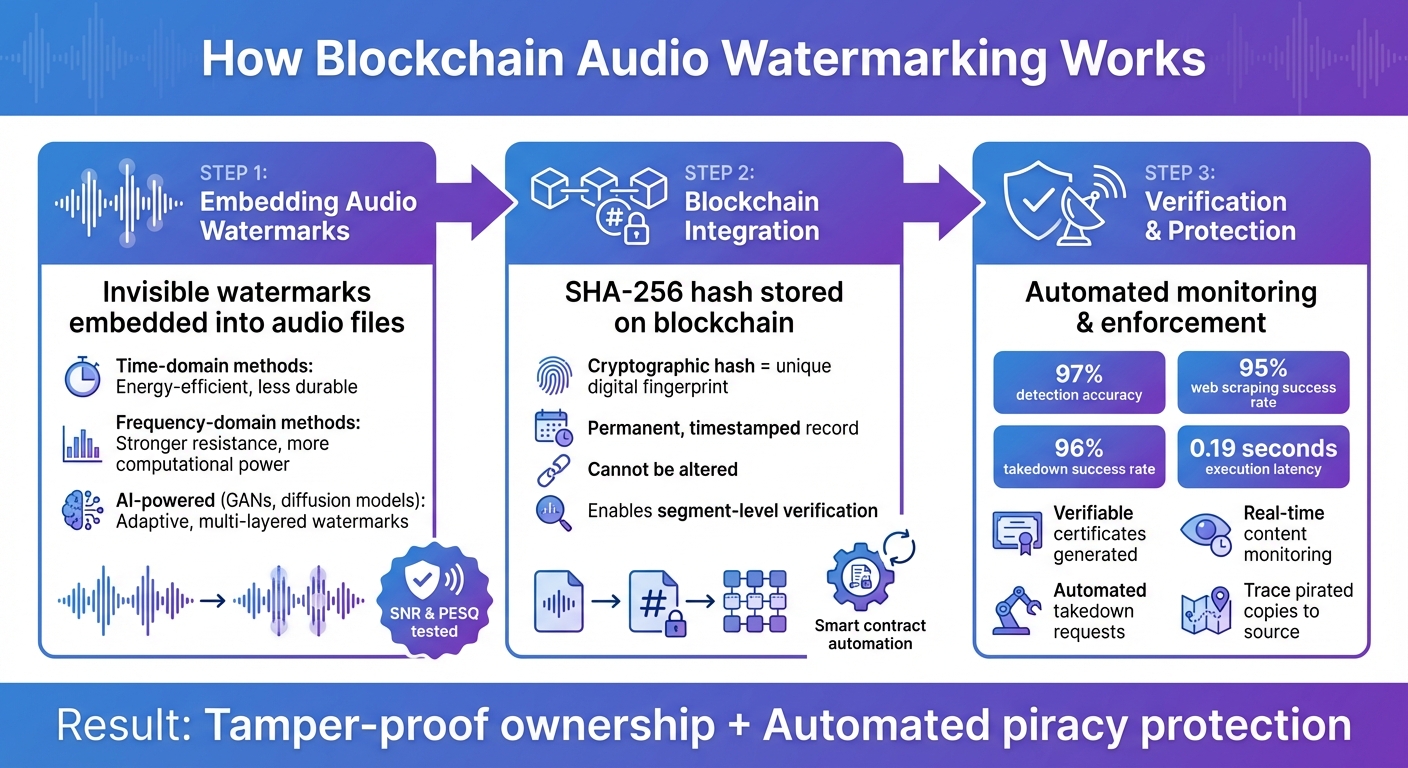
How Blockchain Audio Watermarking Works: 3-Step Protection System
Embedding Audio Watermarks
Audio watermarks are subtle, inaudible markers embedded into sound files. Despite being undetectable to listeners, these markers are designed to withstand challenges like compression, cropping, and noise interference.
Embedding methods generally fall into two categories: time-domain and frequency-domain. Time-domain techniques are more energy-efficient but less durable, while frequency-domain methods, which rely on Fourier or Wavelet transforms, offer stronger resistance to distortions but demand more computational power. Other approaches, like spread spectrum and patchwork methods, scatter the watermark across the audio spectrum, ensuring it stays intact even when attempts are made to remove it.
AI plays a key role in modern embedding techniques. Tools like Generative Adversarial Networks (GANs) and diffusion models enable the creation of adaptive, multi-layered watermarks that blend seamlessly with the unique properties of each audio file. These advanced watermarks maintain their durability while remaining imperceptible. To ensure quality, embedded watermarks are tested against strict metrics such as Signal-to-Noise Ratio (SNR) and Perceptual Evaluation of Speech Quality (PESQ), ensuring the audio remains indistinguishable from its original version.
These embedding strategies ensure the watermark is secure and ready for blockchain registration.
Blockchain Integration for Ownership Proof
After embedding the watermark, the system generates a cryptographic hash, often using SHA-256. This hash serves as a unique digital fingerprint for the audio file, ensuring ownership integrity without needing to repeatedly reference the original content. The hash is then stored on a blockchain, creating a permanent, timestamped record that cannot be altered.
Public blockchains add an extra layer of security with decentralization and open verification, making unauthorized modifications nearly impossible. This dual-layer approach combines the embedded watermark in the audio with the blockchain-anchored hash, enabling segment-level verification – even if only part of the audio is leaked. Smart contracts further enhance the process by automating registration and enabling real-time verification.
How ScoreDetect Uses Blockchain Watermarking
ScoreDetect takes these technologies a step further to simplify ownership verification for creators.
Instead of storing audio files, ScoreDetect records a content checksum on the blockchain. This process generates verifiable certificates that include essential details like registration dates, SHA-256 hashes, and public blockchain URLs, offering creators formal proof of ownership. The platform also integrates with over 6,000 web apps via Zapier, automating workflows for monitoring platforms and enforcing intellectual property rights.
For WordPress users, ScoreDetect provides a plugin that captures every audio file published or updated, automatically registering proof of ownership on the blockchain. This not only protects intellectual property but also boosts SEO by aligning with Google’s E-E-A-T (Experience, Expertise, Authoritativeness, Trustworthiness) guidelines. By combining invisible watermarking with blockchain-backed records, ScoreDetect delivers a robust solution for safeguarding audio against piracy and unauthorized use.
Benefits of Blockchain Audio Watermarking for Piracy Protection
Permanent Proof of Ownership
Blockchain technology creates an unchangeable record of content ownership and the date of creation. This timestamp acts as irrefutable proof, simplifying legal actions by providing cryptographic evidence that you owned the content at a specific point in time.
According to Michael Sumner from ScoreDetect, "Blockchain-anchored hashes and invisible audio watermarks enable tamper-proof ownership, segment-level verification, and smart-contract licensing on platforms."
This means that even if someone falsely claims they created your audio first, your blockchain record can serve as solid evidence in court or during takedown requests. Additionally, the technology supports segment-level verification, allowing you to demonstrate ownership of specific parts of an audio file – an essential feature when dealing with samples, remixes, or partial theft of your work.
Traceability and Leak Detection
In addition to proving ownership, blockchain watermarking allows for precise tracking of your content. Watermarks act as forensic audio watermarks that remain intact even after compression, cropping, or other modifications meant to obscure stolen material. When paired with blockchain records, these watermarks can trace pirated copies back to their source, whether it’s a specific user account, a distribution partner, or even a single streaming session.
Session-specific watermarking takes this a step further by embedding unique identifiers into every distributed copy. If a leak occurs – say, during a live broadcast or an exclusive release – the embedded watermark can pinpoint the exact recipient responsible. This approach has shown high effectiveness, with AI-driven watermarking combined with blockchain achieving traceability accuracy rates exceeding 97% [1].
By linking specific copies to individual recipients, the system discourages unauthorized distribution. When users and distributors know their identity is permanently tied to the content they receive, the risk of pirating becomes far greater.
As the Cardstack Team points out, "Blockchain’s transparency also allows for excellent multimedia fingerprinting since its technology is tamper-proof, peer-to-peer, and highly recordable" [9].
Automated Content Monitoring and Enforcement
Blockchain-integrated watermarking doesn’t just stop at ownership and tracking – it also simplifies enforcement through automation. Traditional piracy detection can be slow and expensive, but blockchain enables automated systems that monitor platforms, detect infringing content, and initiate takedown actions without requiring manual effort.
For example, ScoreDetect showcases the potential of automation. Its intelligent web scraping achieves a 95% success rate in bypassing piracy prevention tools, while automated takedown notices boast over 96% success rates. With integration into over 6,000 web apps via Zapier, creators can set up workflows to monitor specific platforms, compare discovered content against blockchain records, and instantly generate takedown requests – allowing creators to focus on their work instead of chasing pirates.
Smart contracts also enhance enforcement by automating verification processes. Research shows that these blockchain-based copyright systems can operate with an average execution latency as low as 0.19 seconds [8]. This near-instant response is especially important for protecting content like live events or exclusive releases, where delays in enforcement could result in significant financial losses.
Together, these capabilities make blockchain audio watermarking a powerful tool for combating piracy, aligning with ScoreDetect’s mission to protect digital content.
Implementation Techniques and Practical Steps
Choosing the Right Watermarking Method
To effectively identify signs of digital piracy and protect your audio assets, start by selecting a watermarking technique that aligns with your specific security needs.
Spread spectrum watermarking is a robust option, embedding undetectable messages across the frequency spectrum. This technique is particularly resilient against compression and signal processing attacks, with deep learning advancements achieving up to 95% detection rates in compressed files [10][4]. It’s an excellent choice for high-security applications, such as broadcast monitoring, where content undergoes multiple format conversions.
For scenarios where audio quality is critical, phase coding is a better fit. This method alters phase components in the frequency domain (using transforms like DFT or DWT) to embed data without noticeable quality loss [10][4]. It’s ideal for music distribution, where fidelity matters most. Meanwhile, live broadcasts can benefit from frequency shift tones or phase coding, as these methods handle environmental noise effectively and allow real-time decoding [11].
Here’s a quick comparison of popular watermarking methods:
| Watermarking Method | Best For | Key Strength | Limitation |
|---|---|---|---|
| Spread Spectrum | Broadcast monitoring, high-security needs | Resilient to compression and noise (95% detection in compressed files) | Requires higher computational resources |
| Phase Coding | Music distribution, authentication | High imperceptibility with minimal quality impact | Less robust against certain transformations |
| Echo-Based | Live broadcasts | Handles environmental noise well | Detectable via cepstral analysis |
Once you’ve chosen the right method, the next step is integrating it with blockchain technology for copyright protection and enhanced ownership verification.
Integrating Blockchain with Watermarking
After embedding your watermark, generate a unique SHA-256 fingerprint of the audio file and record it on the blockchain. This cryptographic hash acts as a secure identifier, eliminating the need to store the actual audio file on the blockchain.
You can also embed metadata – such as timestamps and digital signatures – into the watermark payload using techniques like spread spectrum [2][3]. Record this metadata along with the hash as a blockchain transaction. This creates an immutable ledger, which is invaluable for resolving copyright disputes and issuing takedown requests.
Smart contracts further streamline this process by automating ownership rights. These contracts can manage licensing, track usage, and enforce penalties for infringement – all without manual intervention [6][7]. Verification becomes seamless through perceptual hashes, allowing you to confirm ownership by comparing media to blockchain records without needing the original file [2][7][5].
Using ScoreDetect for Easy Integration
For a simplified implementation, ScoreDetect offers a user-friendly platform with automated workflows designed to protect your digital assets.
ScoreDetect secures your content by anchoring its SHA-256 checksum to the blockchain. This ensures privacy and security without storing the actual files. It’s a practical solution for creators and businesses seeking enterprise-level protection.
Non-technical users can take advantage of the WordPress plugin, which automatically hashes every uploaded or updated audio file. This not only safeguards your content but also boosts SEO by signaling verified authorship. Plus, with Zapier integration, you can connect to over 6,000 web apps to automate tasks like monitoring platforms for unauthorized use, analyzing discovered content, and generating takedown notices. The platform boasts a 96% success rate for takedown requests.
Here’s how to get started with ScoreDetect in four simple steps:
- Step 1: Sign up and install the WordPress plugin or integrate via API.
- Step 2: Use Zapier workflows to automate discovery with ScoreDetect’s web scraping tools, which bypass piracy prevention measures with a 95% success rate.
- Step 3: Monitor for unauthorized use and verify ownership with quantitative proof.
- Step 4: Issue automated takedown notices or upgrade to access advanced AI-driven features tailored for industries like media and entertainment.
This streamlined approach makes high-level content protection accessible to everyone, from independent creators to large studios.
Challenges and Future Trends in Blockchain Audio Watermarking
Overcoming Watermark Removal Attacks
Even with blockchain integration bolstering watermark strength, attackers continue to find ways to exploit vulnerabilities. Techniques like time stretching, pitch shifting, equalization, and filtering are commonly used to strip audio of ownership signals. The challenge escalates with the rise of neural networks and machine learning tools, which can completely erase watermarks.
"Three neural audio watermarking systems are critically vulnerable: overwriting attacks succeed nearly 100% and neural codecs can erase watermarks – key-based defenses are needed." – Michael Sumner, ScoreDetect [1]
To combat these threats, multi-feature fusion has become a promising solution. By combining features like MFCCs, chroma, CQT, and spectral contrast, and using DTW for realignment, this approach enhances watermark durability [12]. For example, the HashWave framework, which integrates blockchain with multi-feature hashing, achieved impressive results: an AUC of 0.957 and a TPR of 0.952 at a 1% FPR [12].
Additionally, key-based cryptographic protections are now critical to prevent unauthorized overwriting of watermarks [1]. Using a layered approach – integrating invisible watermarking with blockchain-anchored hashes – creates a more resilient defense than traditional methods alone.
Standardization and Industry Adoption
One of the biggest hurdles to widespread adoption is the lack of unified industry standards. Without standardized protocols, watermarks risk being unintentionally removed during routine audio processing, and cross-platform verification becomes a significant challenge [1]. Unified protocols are necessary to maintain the integrity of blockchain-based ownership proofs across different platforms.
To advance, the industry needs standardized evaluation metrics like Signal-to-Noise Ratio (SNR), Perceptual Evaluation of Speech Quality (PESQ), and Bit Error Rate (BER) [1]. These benchmarks are essential for balancing audio quality with watermark robustness, ensuring that security measures don’t compromise the listening experience. Furthermore, smart-contract integration must also be standardized so that blockchain-anchored watermarks can automate licensing and royalty payments across streaming platforms [1].
Adopting multi-layered verification systems that combine invisible perceptual watermarks with blockchain hashes could provide immutable ownership proof [1]. As more companies embrace these practices, the demand for industry-wide standards will increase, potentially transforming blockchain audio watermarking into a mainstream tool rather than a niche solution.
AI-Driven Developments
AI is playing a pivotal role in shaping the future of watermarking. It’s revolutionizing how watermarks are created, detected, and protected. Neural networks, for instance, can now analyze frequency features to detect invisible watermarks with over 97% accuracy [1], making them highly resistant to both manual and automated edits. Generative AI tools, like GANs and diffusion models, are also being used to create adaptive watermarks that blend seamlessly into audio, making them much harder to remove compared to static patterns [1].
Adversarial training has become a standard in watermark development. By simulating various attacks, developers can ensure watermarks survive regeneration, AI-driven edits, and intentional tampering [1]. AI-powered resynchronization tools are also proving effective against desynchronization attacks, such as time and frequency shifts, which have historically defeated conventional watermarks [1].
Platforms like ScoreDetect are leveraging these advancements to provide creators and businesses with robust protection. By combining invisible watermarking with blockchain-anchored hashes and IPFS storage, ScoreDetect offers tamper-proof ownership records and segment-level verification [1]. Its intelligent web scraping bypasses piracy defenses with a 95% success rate, while automated takedown notices achieve a 96% success rate [1], making scalable enforcement a reality.
The HashWave framework further showcases the efficiency of blockchain integration. With an average contract execution time of just 0.044 seconds on Ethereum [12], it enables real-time protection for even the largest content libraries. Combined with AI-powered detection, this makes safeguarding digital assets more practical than ever.
Conclusion
Blockchain audio watermarking has become a critical tool for protecting intellectual property in the digital age. By combining invisible perceptual watermarks with blockchain-anchored cryptographic hashes, creators and businesses can establish tamper-proof ownership records. These records are designed to withstand compression, AI-driven edits, and even the most sophisticated removal attempts. With features like session-specific watermarking, multi-feature fusion, and real-time traceability, this approach achieves over 97% detection accuracy while maintaining audio quality [1].
That said, challenges remain. Neural codecs can effectively erase traditional watermarks, and unprotected systems are highly vulnerable to overwriting attacks, which can succeed nearly 100% of the time [1]. To counter these threats, advanced techniques like key-based defenses, content-adaptive methods, and adversarial training are being implemented to bolster resilience against even the most advanced attacks.
As Michael Sumner from ScoreDetect explains, "Blockchain-anchored hashes and invisible audio watermarks enable tamper-proof ownership, segment-level verification, and smart-contract licensing on platforms" [1].
For businesses managing large audio libraries, automation is a game-changer. Companies like ScoreDetect simplify the process with a four-stage system – Prevent, Discover, Analyze, and Take Down – which automates enforcement and achieves a takedown success rate of over 96%. This removes the need for manual tracking of infringements and enables real-time action at scale.
Looking ahead, the industry is moving toward standardized protocols that could revolutionize digital rights management. These include cross-platform verification, smart-contract integration for automated royalty payments, and AI-driven watermarking that adapts to new threats. Whether it’s live streams, high-value recordings, or entire catalogs, blockchain audio watermarking offers a robust solution to combat piracy.
Investing in these technologies today lays the groundwork for a future where creators maintain control over their work. By integrating blockchain with cutting-edge watermarking, businesses and artists can secure their digital assets, ensure transparency, and automate enforcement – all while staying ahead of evolving threats.
FAQs
Will watermarking change my audio quality?
When done properly, audio watermarking doesn’t compromise sound quality. Today’s advanced methods insert marks that are virtually undetectable, ensuring your content stays protected without altering the listening experience.
What edits can the watermark survive?
The watermark is built to endure a range of modifications, such as desynchronization, temporal cuts, and signal-processing attacks. This durability ensures it remains intact and effective, even when faced with challenging or intentional tampering.
How do I prove ownership in court with blockchain records?
To establish ownership in court with blockchain, you can use its immutable, timestamped records as evidence. By storing a checksum or hash of your content on the blockchain, you create a tamper-proof digital fingerprint. This serves as undeniable proof of ownership tied to a specific date and time. Since blockchain records are highly reliable in legal contexts, they can streamline copyright disputes. Importantly, the blockchain doesn’t need to store the actual digital assets – just the cryptographic proof of ownership.