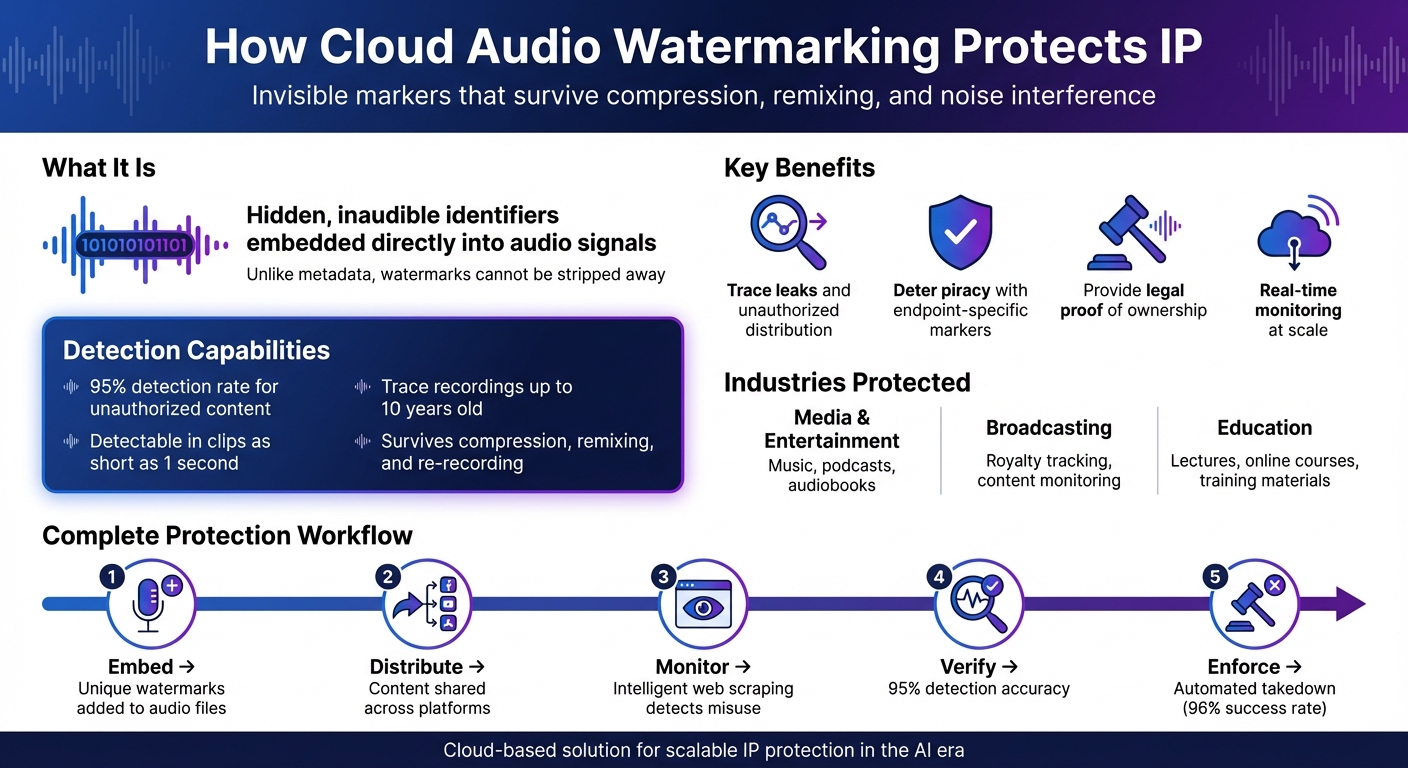
Cloud audio watermarking is a powerful way to protect digital audio content like music, podcasts, and recordings. It embeds hidden, inaudible markers directly into audio files, making it possible to trace ownership and detect misuse even after compression, remixing, or noise interference. Unlike metadata, which can be stripped away, these markers stay intact and provide a reliable method for tracking where and how audio is shared.
Key benefits include:
- Tracking misuse: Watermarks allow creators to trace leaks or unauthorized distribution.
- Deterring piracy: Endpoint-specific markers link files to individuals, discouraging misuse.
- Legal proof: Watermarks serve as evidence in disputes over ownership or copyright.
- Real-time monitoring: Cloud-based systems make it easy to scale, embed, and detect watermarks.
Industries like media, broadcasting, and education rely on this technology to secure royalties, protect intellectual property, and ensure compliance. Tools like Digimarc and Webex offer advanced solutions, including the ability to detect watermarks in clips as short as one second or trace recordings up to 10 years old. Platforms like ScoreDetect even combine watermarking with blockchain and automated takedown tools for a layered approach to IP protection.
Cloud audio watermarking is a practical solution for creators and organizations looking to secure their digital content in an increasingly AI-driven landscape.
How Cloud Audio Watermarking Protects Intellectual Property
What is Cloud Audio Watermarking?
Audio Watermarking Basics
Audio watermarking involves embedding hidden data directly within the audio signal – either in the waveform or spectral properties – without relying on easily removable metadata. This embedded information often includes identifiers, copyright details, or markers of ownership, and it remains intact through processes like compression, transcoding, or even remixing[4][5].
The technique works by subtly altering the audio signal in ways that are inaudible to humans but detectable by algorithms. Unlike audio fingerprinting, which requires longer audio segments for identification, watermarks are more resistant to distortions. This makes them particularly useful for copyright protection, authentication, and tracing the origin of audio files online. They also serve as legal tools for combating digital piracy by verifying ownership and help content creators monitor where their work appears on the internet[4].
As AI-generated audio becomes more prevalent, watermarking has taken on a new role. It helps identify synthetic or manipulated content, making it easier to tell authentic recordings apart from deepfakes or unauthorized AI reproductions[4].
Cloud-based systems build on these techniques, offering a more streamlined way to manage and detect watermarks.
Benefits of Cloud-Based Systems
Shifting watermarking processes to the cloud eliminates the need for local computing resources, as remote servers handle embedding, detection, and monitoring. This makes it easier to scale operations and track unauthorized use of audio files in real time[5]. For creators, this means they can process large volumes of audio quickly and efficiently.
Cloud platforms also integrate advanced methods. While traditional signal processing techniques handle basic distortions, AI-based approaches adaptively embed watermarks that can persist even in AI-generated content trained on watermarked data[4]. By combining these methods, cloud systems provide real-time forensic tools for industries like streaming services, broadcasting, and collaboration platforms. For example, tools like Webex generate unique identifiers for each participant and device, embedding them into audio streams continuously[3]. This ensures precise tracking and accountability at scale.
sbb-itb-738ac1e
How Cloud Audio Watermarking Protects IP
Detecting Unauthorized Content Use
Cloud-based watermarking embeds unique, inaudible identifiers – such as User IDs, organization names, or timestamps – directly into audio files. These markers create a lasting connection between the content and its rightful owner, making it easier to track unauthorized use online. Unlike traditional metadata, which can be stripped during file transfers, these watermarks are embedded in the audio signal itself. This ensures they survive across platforms and distribution channels.
Modern AI-enhanced watermarking technology is designed to endure even when audio undergoes changes like compression, filtering, noise suppression, or re-recording through external devices. Brent Phillips, Chief Technology Officer at SourceAudio, highlights this durability:
Digimarc’s audio watermarking is completely inaudible… yet it is reliably detectable in clips as short as one second – even after compression, remixing, or voiceovers[2].
This resilience means creators can trace unauthorized use, even in heavily edited or degraded audio files.
Cloud platforms now provide self-serve forensic tools that allow compliance teams to upload suspected leaked files and pinpoint their source instantly. For example, Webex Control Hub enables organizations to trace recordings without needing to contact the service provider. Some tools are so advanced they can identify the origin of a leak even if the recording is up to 10 years old[6].
This robust detection capability naturally lays the groundwork for proactive AI-driven piracy detection measures, which we’ll explore next.
Preventing Piracy
Watermarking doesn’t just detect unauthorized use – it also acts as a deterrent. By embedding endpoint-specific watermarks – unique signals assigned to each recipient – organizations can trace leaked files back to the individual or device responsible. Knowing their actions can be tracked discourages potential pirates from distributing content without permission.
The financial stakes are enormous. Every year, billions of dollars in audio royalties are lost because traditional fingerprinting struggles with short or noisy clips, and metadata is easily removed[2]. Cloud watermarking solves these issues by ensuring ownership details remain intact, no matter how the file is shared or altered.
Proving Ownership in Legal Cases
Watermarking also provides creators with critical evidence in copyright disputes. The resilient data embedded in audio files serves as forensic proof, linking the content to its original creator or authorized distributor. This is especially important as AI-generated audio becomes more common – watermarks help differentiate between human-created and synthetic content, allowing creators to prove their authorship.
Chris Rowen, VP of Engineering at Cisco, underscores the legal significance:
Finding the source of a leaked recording… and holding perpetrators responsible is key to deterring future such leaks and protecting an organization’s reputation and intellectual property[6].
While visible watermarks can act as a deterrent, invisible forensic watermarks are much harder for pirates to detect or remove. These hidden markers are particularly effective as legal evidence. Organizations sharing sensitive audio should consider using role-based watermarking, embedding unique identifiers for each user to ensure any leaks can be traced directly to the source.
Industries Using Cloud Audio Watermarking
Media and Entertainment
The media and entertainment industry leans on cloud audio watermarking to safeguard music, podcasts, and audiobooks from unauthorized use. Music labels embed subtle markers into tracks to trace leaks on streaming platforms and curb illegal downloads. Broadcasters also use this technology to track royalties more accurately across digital channels.
Digimarc’s solution is a great example. It can detect watermarks even after content has been compressed or remixed, making it a powerful tool for identifying pirated material across various platforms[2]. Podcast producers and audiobook publishers also benefit, as this technology helps reduce illegal sharing and secures their revenue streams.
The rise of AI-generated audio has added complexities to content protection. Companies like Resemble AI address this by integrating cloud-based watermarking into commercials, voiceovers, and branded audio. This ensures traceability and helps maintain clear ownership records, whether the content is human-made or AI-generated[1]. These advancements are becoming just as crucial in other industries grappling with intellectual property issues.
Education and E-Learning
Educational institutions and e-learning platforms face challenges with the unauthorized recording and sharing of course materials. Cloud audio watermarking helps secure lectures, online courses, and other educational audio by embedding unique, inaudible signals that withstand compression, filtering, and background noise – common hurdles in virtual learning environments.
This technology can embed identifiers that are specific to individual users or endpoints. These markers allow institutions to trace pirated content back to its source, making it easier to pinpoint and address leakages. Protecting educational content is a key part of managing digital assets effectively.
ScoreDetect: A Complete Protection Platform
ScoreDetect takes watermarking to the next level by combining it with cloud technology to deliver a robust solution for protecting audio intellectual property. The platform uses invisible watermarking alongside blockchain-based copyright protection, creating a layered defense against piracy – all without requiring the storage of actual digital assets.
With a detection rate of 95% for unauthorized content, ScoreDetect employs intelligent web scraping and verification tools to uncover misuse. Once flagged, its automated takedown system generates delisting notices, achieving a 96% success rate in removing infringing material. Integration with over 6,000 web apps via Zapier allows users to automate workflows, making the system accessible for both tech-savvy and less technical users. This end-to-end approach ensures content creators can focus on their work while knowing their intellectual property is well-protected.
AI Music Copyright: The Watermarking Solution Explained
Conclusion
In today’s digital world, protecting intellectual property has become more critical than ever, and cloud audio watermarking plays a key role in safeguarding creative content. By embedding unnoticeable markers, this technology helps content owners trace leaks, combat piracy, and establish ownership in legal disputes.
Challenges like lost royalties from stripped metadata and the limitations of traditional fingerprinting methods have left content creators exposed to risks. Cloud audio watermarking tackles these issues head-on, enabling accurate tracking, authorship verification, and forensic analysis across diverse platforms and formats. These advancements not only fight piracy but also set new benchmarks for industry practices.
For sectors such as media, entertainment, and education, these tools provide a robust defense against unauthorized usage, ensure copyright compliance, and build confidence in digital ecosystems.
ScoreDetect is a standout example of this approach, combining invisible watermarking, smart web scraping, and automated takedown tools. Its blockchain-based ownership verification and seamless integration with over 6,000 apps via Zapier demonstrate how layered, cloud-based solutions can empower creators to retain control over their work.
As the digital landscape shifts, the demand for dependable IP protection remains steady. Embracing cloud audio watermarking now ensures creators stay a step ahead of piracy while safeguarding their creative efforts.
FAQs
Will watermarking affect audio quality?
When done correctly, watermarking is designed to blend seamlessly into the audio, leaving no noticeable impact on sound quality. Modern methods ensure the watermark stays hidden while maintaining the integrity of the listening experience.
Can watermarks survive edits and compression?
Watermarks can be crafted to withstand edits and compression by using adversarial resistance techniques. These approaches help ensure the watermark remains detectable, even when faced with issues like desynchronization or temporal cuts, preserving its reliability and integrity.
How do watermarks prove ownership in court?
Watermarks act as legal proof of ownership by embedding an invisible, tamper-resistant mark directly into audio files. This mark can be verified to confirm the original creator and trace unauthorized use or distribution. Because of this, watermarks can be used as evidence in court to support intellectual property claims.