Video watermarking has become a key method to protect digital content from piracy. But modern challenges like compression, editing, and AI-driven removal techniques make it harder to secure videos without affecting quality. This article explains how new methods, such as embedding AI watermarking in specific video textures or during video creation, are helping to solve these issues.
Key Points:
- What it is: Adaptive watermarking embeds marks based on video characteristics (e.g., motion, texture) to make them invisible yet durable.
- Challenges: Balancing invisibility and durability, resisting attacks (e.g., cropping, compression), and ensuring fast processing.
- Solutions: Techniques like frame texture analysis, singular value decomposition (SVD), and real-time embedding improve efficiency and resilience.
- Tools like ScoreDetect: Combine watermarking with AI monitoring and blockchain for copyright tracking and protection.
These advancements aim to protect video content while maintaining quality and processing efficiency.
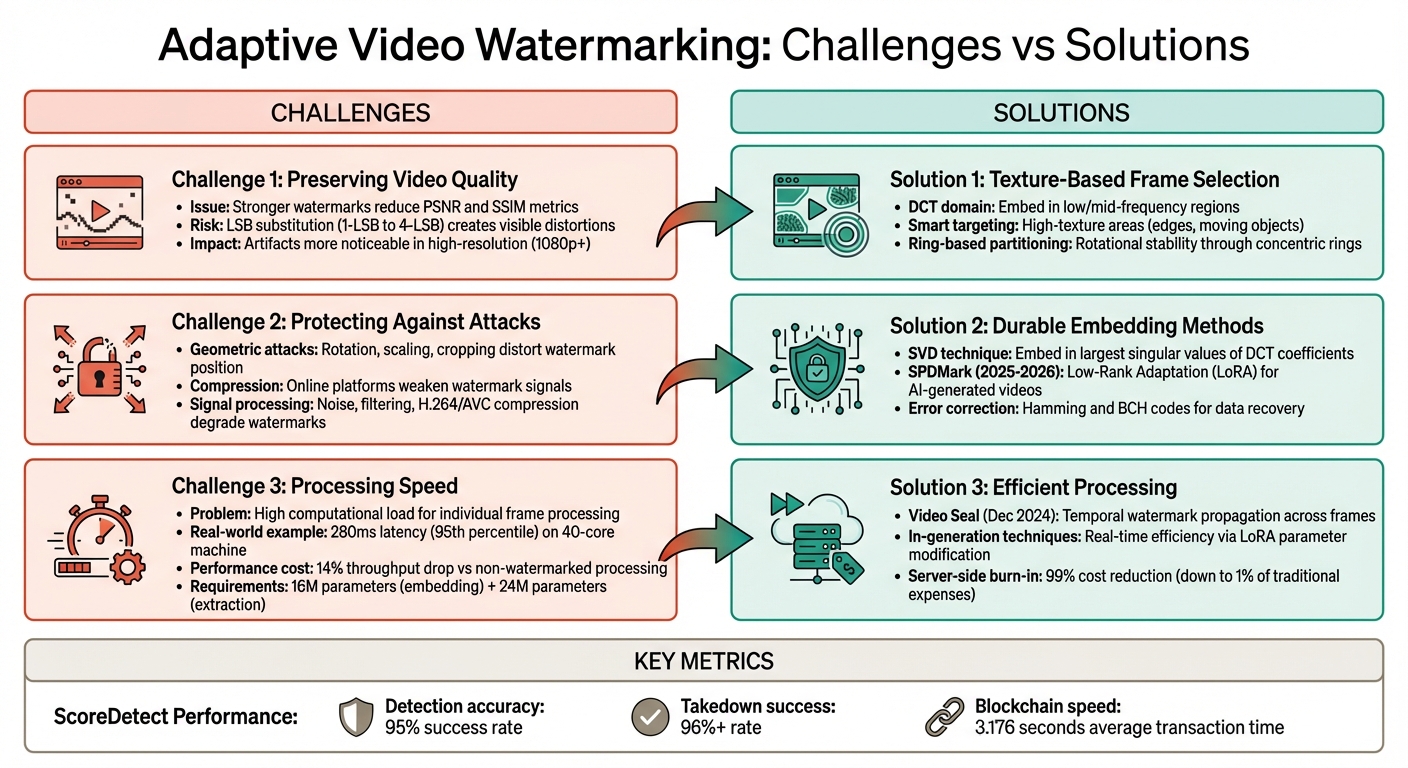
Adaptive Video Watermarking: Challenges vs Solutions Comparison
Invisible Watermarking: Content Provenance for Videos at Scale | Wes Castro, Meta

sbb-itb-738ac1e
Challenges in Adaptive Video Watermarking
Adaptive watermarking offers a clever way to protect digital content, but it comes with its own set of hurdles. High-resolution videos, live streaming, and advanced tampering techniques make this process technically demanding.
Preserving Video Quality
One of the biggest challenges is maintaining video quality while embedding watermarks. The more data you embed, the more likely you are to see a drop in metrics like Peak Signal-to-Noise Ratio (PSNR) and Structural Similarity Index (SSIM). In simple terms, stronger watermarks can leave visible artifacts, ruining the viewing experience. For instance, methods like LSB (Least Significant Bit) substitution can create noticeable distortions if too many bits are embedded – going from 1-LSB to 4-LSB, for example, increases the risk of visible flaws [4].
To tackle this, adaptive methods focus on embedding data in areas where changes are harder to notice. Techniques include using Canny edge detection to target edges, embedding in moving objects identified by motion attention indices, or working with non-uniform color blocks that have high histogram dispersion. These methods avoid flat, uniform areas where artifacts are more obvious [4]. However, the challenge grows with higher resolutions like 1080p or above, where even small flaws become glaring on larger screens.
And it’s not just about looking good – watermarks also need to survive intentional tampering and accidental damage.
Protecting Against Attacks and Manipulation
Watermarks face threats from both deliberate attacks and routine processing. Geometric attacks, such as rotation, scaling, or cropping, can be particularly problematic. These distort the watermark’s position, causing traditional block-based methods to fail at extracting the hidden data [3].
Then there’s compression. Online platforms often compress and re-encode videos, weakening watermark signals. On top of that, signal processing techniques like noise addition, filtering, or H.264/AVC compression further degrade the watermark [5]. To counteract these threats, many systems preprocess the embedded data with error-correcting codes, such as Hamming or BCH codes, which help recover lost information during extraction [4].
Processing Speed Requirements
Speed is another critical factor. For adaptive watermarking to work in real-world applications, it needs to be fast. As Meta FAIR researchers point out:
"The computational load of watermarking every individual frame is prohibitively high, particularly for high-resolution videos with high frame rates" [5].
For example, in October 2017, Creative Market rolled out a real-time adaptive watermarking system for millions of images. Running on a 40-core machine, it achieved a 95th percentile latency of 280 milliseconds in production. However, this came at a cost – a 14% drop in throughput compared to non-watermarked processing [6].
Handling high-resolution videos in real time is especially taxing. Hardware limitations can lead to memory bottlenecks and synchronization problems. Streaming platforms and digital marketplaces need watermarking solutions that work instantly, without batch processing entire libraries [6]. Modern watermarking systems require significant resources – about 16 million parameters for embedding and 24 million for extraction – to remain efficient, even for mobile applications [5]. This creates a tough balancing act between performance and practicality in real-time scenarios.
Solutions to Adaptive Watermarking Challenges
Recent advancements have introduced practical ways to tackle the challenges of adaptive watermarking. These approaches focus on intelligent frame selection, durable embedding techniques, and efficient processing – all while maintaining video quality.
Texture-Based Frame Selection
Adaptive systems now use frame texture analysis to identify the best embedding areas, ensuring watermarks remain discreet. By embedding data in the low-frequency and mid-frequency regions of the Discrete Cosine Transform (DCT) domain, these methods minimize visible distortion while keeping the watermark signal strong [3]. This strategy ensures watermarks blend into high-texture areas, such as edges or moving objects, where changes are harder for the human eye to detect. Flat backgrounds, where artifacts can be more noticeable, are avoided.
Another method, ring-based partitioning, divides the low-frequency domain into concentric rings. This technique provides rotational stability, preserving the watermark’s position even after transformations like rotation or deformation [3].
Durable Embedding Methods
For watermarks to withstand compression, cropping, and other alterations, they need to be embedded in stable regions. Singular Value Decomposition (SVD) is one effective method, embedding watermarks into the largest singular values of DCT coefficients, which remain stable during typical video processing operations [3].
For AI-generated videos, Selective Parameter Displacement (SPDMark) offers an innovative approach. Introduced by researchers Samar Fares, Nurbek Tastan, and Karthik Nandakumar in December 2025 (revised April 2026), SPDMark uses Low-Rank Adaptation (LoRA) to embed watermarks directly into video diffusion models during the generation process. This method also incorporates cryptographic hashing for frame-specific messages and employs maximum bipartite matching to adapt to temporal changes, achieving high recovery accuracy against attacks [1].
"The advent of high-quality video generation models has amplified the need for robust watermarking schemes that can be used to reliably detect and track the provenance of generated videos." – Samar Fares, Researcher, SPDMark [1]
These techniques ensure watermarks are durable enough to handle the demands of real-world applications.
Efficient Processing for Large-Scale Use
Efficiency is critical for platforms managing millions of videos. Robust techniques are only useful if they can scale effectively. In December 2024, Meta Research introduced Video Seal, an open-source framework that employs temporal watermark propagation. Instead of processing every frame individually, this method propagates watermark signals across frames, significantly reducing the computational burden [7]. This approach allows image watermarking models to transition smoothly into video models without compromising robustness. As Meta researcher Pierre Fernandez explained:
"Video Seal achieves higher robustness compared to strong baselines especially under challenging distortions combining geometric transformations and video compression." [7]
Similarly, in-generation techniques like SPDMark modify a subset of parameters using LoRA, eliminating the need for post-hoc processing. This ensures real-time efficiency, even for high-resolution content [1]. Together, these innovations make large-scale watermarking a feasible solution for modern video platforms.
How ScoreDetect Supports Adaptive Watermarking

Adaptive watermarking is a powerful tool, but it often struggles with maintaining video quality and resisting various attacks. ScoreDetect steps in with integrated solutions to tackle these challenges effectively.
Invisible Watermarking with ScoreDetect
The Enterprise plan from ScoreDetect includes invisible watermarking that safeguards video content without compromising its quality. It uses advanced frequency domain embedding techniques, such as DTCWT and DCT, to embed watermarks securely in the frequency domain [3]. ScoreDetect’s ring-based embedding ensures that the watermark remains detectable even after geometric distortions like rotation, making it highly reliable for real-world applications [3].
This capability is especially beneficial for industries like media and entertainment, marketing, and content creation, where videos often undergo processes like cropping, compression, or other modifications during distribution across multiple platforms.
In addition to embedding robust watermarks, ScoreDetect ensures comprehensive online monitoring to keep content safe.
AI-Powered Content Discovery and Takedown
ScoreDetect employs AI-driven web scraping to monitor the internet for unauthorized content usage. The platform boasts an impressive 95% success rate in identifying such instances [8]. Once unauthorized use is detected, ScoreDetect generates quantitative proof of infringement and automates the takedown process. This automation ensures a consistent takedown success rate of over 96% [8].
"ScoreDetect is exactly what you need to protect your intellectual property in this age of hyper-digitization. Truly an innovative product, I highly recommend it!" [8]
Blockchain for Copyright Verification
To reinforce copyright protection, ScoreDetect integrates with the SKALE blockchain. This system creates a unique checksum of your content locally and records it on the blockchain, providing an immutable timestamp [8]. Even if the video undergoes compression or transformations, its origin can still be verified.
Verification certificates include both the content’s checksum and blockchain transaction details, offering solid proof of ownership. With an average transaction speed of approximately 3.176 seconds [8], businesses can secure copyright protection quickly. For those managing large-scale video content, ScoreDetect also supports integration with over 6,000 web apps through Zapier. Additionally, its WordPress plugin automatically captures new content, helping to strengthen SEO by enhancing Google E-E-A-T signals.
Conclusion
Key Takeaways
Adaptive watermarking requires a careful balance to make watermarks both invisible and resistant to tampering. Modern advancements tackle major challenges like geometric distortions, heavy compression, and real-time processing. Techniques such as ring-based embedding provide rotational stability, while DTCWT and SVD methods enhance frequency domain robustness. Efficient codecs like H.264 also help reduce CPU load during re-encoding, making the process more practical [3][2].
The shift to server-side burn-in watermarking has drastically reduced costs – down to about 1% of traditional expenses – making large-scale video protection much more affordable [9]. Tools like ScoreDetect combine these innovations with AI monitoring and blockchain verification to create a robust defense system. This system embeds invisible watermarks, detects unauthorized use with a 95% success rate, and achieves takedown rates exceeding 96%. These advancements set the stage for smarter and more effective video watermarking strategies.
Next Steps for Businesses
To protect video assets effectively, businesses need to embrace server-side watermarking solutions that operate directly at the CDN edge. This ensures the watermarks are embedded into the video bitstream and remain intact across platforms [9]. Compatibility with leading DRM systems and universal streaming formats is also essential for seamless integration [2].
For industries like media, entertainment, and marketing – where video content is a critical asset – implementing session-based tracking is a must. Embedding unique identifiers, such as user IDs or IP addresses, into video frames turns watermarks into powerful forensic tools that can trace leaks back to their source [2]. ScoreDetect’s Enterprise plan offers a scalable solution, combining these features with automated workflows through tools like Zapier and WordPress plugins. Additionally, it boosts SEO by enhancing Google E-E-A-T signals, making it a valuable investment for businesses looking to protect and optimize their digital assets.
FAQs
How do I choose where to embed a watermark in a video?
When adding a watermark to a video, it’s important to think about the codec being used and how the watermark might affect viewers’ perception of the video. To preserve quality, aim to embed the watermark in areas that are less noticeable. This can be done by considering the video’s spectral, statistical, and perceptual properties.
Using adaptive techniques can make this process even more effective. These methods analyze the video’s content to find the best spots for embedding, like regions with low motion or areas that aren’t visually significant. This approach helps ensure the watermark remains durable while causing minimal interference with the viewing experience.
Will my watermark survive re-encoding, cropping, and rotation?
When it comes to keeping your watermark intact through re-encoding, cropping, or rotation, it largely depends on how strong the watermarking technique is. Advanced strategies often place watermarks in stable or visually important areas, making them harder to remove during compression, geometric changes, or transcoding. While no method can promise complete survival, robust techniques aim to ensure the watermark stays detectable even after these changes. However, the success of this depends on the intensity of the manipulation and the specific algorithm used.
Can ScoreDetect watermark videos in real time for streaming?
Yes, ScoreDetect offers real-time video watermarking during streaming. It uses advanced algorithms and dynamic live video watermarking processes to provide strong protection for content on online sharing platforms.