Invisible video watermarking embeds hidden data into video files, making it undetectable to viewers but readable by software. This technology helps trace the origin of leaks and protect intellectual property. Here’s what you need to know:
- How It Works: Subtle changes are made to pixel values or video bitstreams, invisible to the human eye. Techniques like A/B segment watermarking and frequency-based methods (e.g., DCT, DWT) ensure watermarks stay intact even after compression or editing.
- Purpose: It combats piracy, which costs industries billions annually, by enabling forensic tracking of content leaks.
- Applications: Streaming platforms, eLearning providers, social media, and stock media agencies use it to safeguard content.
- Integration with DRM: While DRM restricts access, watermarking identifies the source of breaches, creating a layered defense system.
- Tools: Platforms like ScoreDetect combine watermarking with AI to detect, analyze, and take down pirated content efficiently.
This approach is critical for protecting digital assets in today’s piracy-prone environment.
Invisible Watermarking: Content Provenance for Videos at Scale | Wes Castro, Meta

sbb-itb-738ac1e
How Invisible Video Watermarking Works
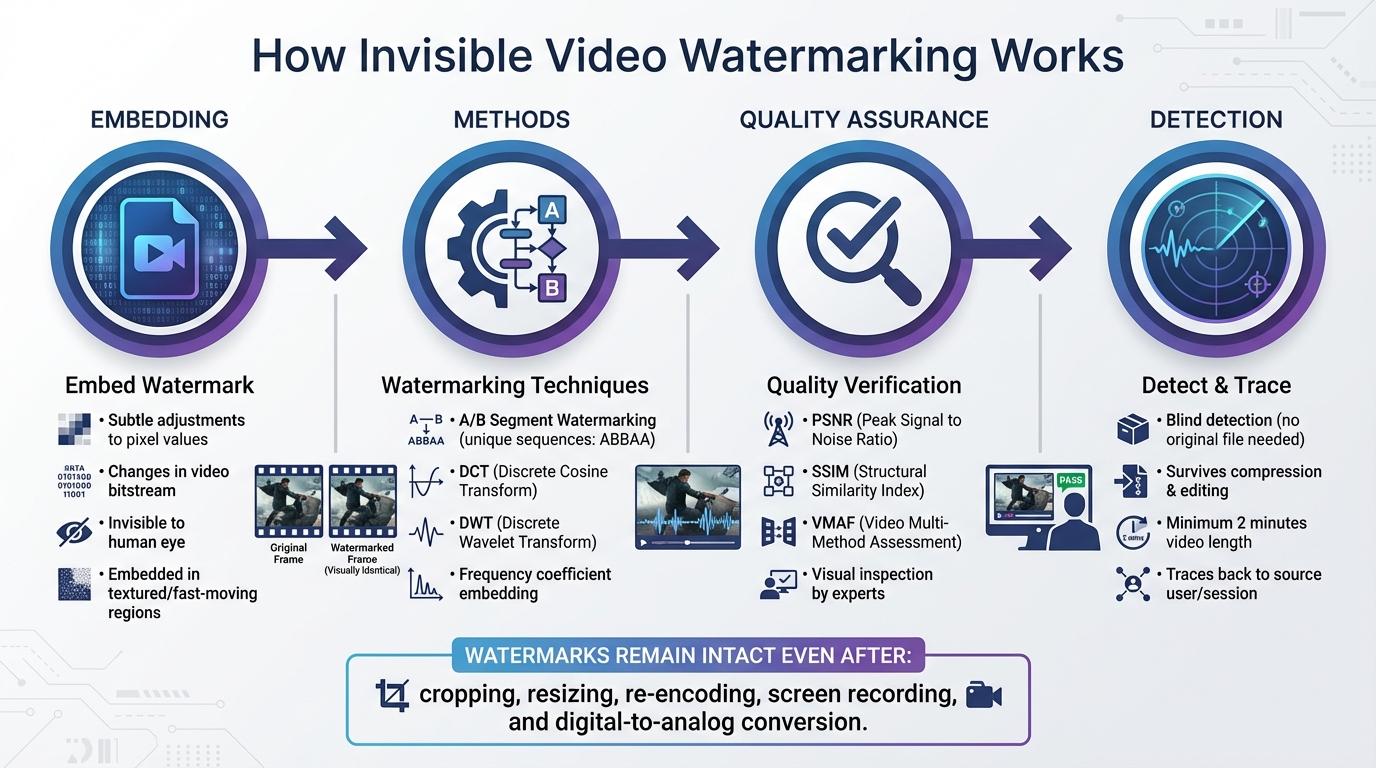
How Invisible Video Watermarking Works: Embedding to Detection Process
Embedding Codes in Video Files
Invisible video watermarking involves making subtle adjustments to pixel values or altering specific parts of a video’s bitstream – the digital code that forms the video. While these changes are invisible to viewers, specialized tools can detect and interpret them [3][6].
To maintain video quality, watermarks are embedded in areas where human vision is less sensitive. For example, textured or fast-moving regions are ideal, while flat areas like clear skies are avoided since changes there would stand out [1].
One common method, A/B segment watermarking, creates two versions of video segments (A and B). By delivering a unique sequence of these segments (e.g., ABBAA) to each user via a CDN, a forensic trail is established without affecting playback quality [7]. More advanced techniques, like the Discrete Cosine Transform (DCT) or Discrete Wavelet Transform (DWT), embed data into frequency coefficients, ensuring the watermark remains intact while preserving video fidelity [1].
In November 2025, Meta adopted CPU-based invisible watermarking for its platforms, replacing GPU-based systems. By optimizing FFmpeg and PyTorch for parallel processing, they achieved performance within 5% of GPU speeds. This upgrade supports tracking for AI-generated videos and identifies the original source of uploaded Reels [3].
Detecting and Reading Watermarks
Once embedded, the watermark must be reliably detected to trace misuse. Specialized software can extract and analyze the watermark, even without access to the original, unmarked file – a feature known as "blind detection" [1]. This capability simplifies forensic investigations, making them faster and more efficient.
To ensure watermarked videos closely match the original, developers rely on metrics like Peak Signal to Noise Ratio (PSNR), Structural Similarity Index (SSIM), and Video Multi-Method Assessment Fusion (VMAF) [5][1]. These automated tools assess quality, but experts also perform visual inspections to catch any artifacts that algorithms might miss [3][6]. Such checks are crucial for deployments like the Flow Capture and ContentArmor collaboration, which integrates watermarking into video workflows.
In April 2026, Flow Capture teamed up with ContentArmor to implement forensic watermarking that profiles a video’s bitstream after upload. Unique viewer identifiers are embedded into proxy files when content is downloaded. Experts verified that this system preserves the quality of HDR10 and Dolby Vision formats [6]. For optimal detection, videos should be at least two minutes long, as clips shorter than 10 seconds are often unsuitable for watermarking [6].
"The watermark itself is capable of surviving a range of signal processing attacks, as well as conversion from digital-to-analog or analog-to-digital." – Flow Capture Guides (2026) [6]
This resilience ensures that watermarks remain detectable even after various transformations, making them a reliable tool for tracking leaks and safeguarding intellectual property.
Where Invisible Video Watermarking Is Used
Industry Applications
Invisible watermarking plays a critical role in protecting digital content across various industries that face the threat of unauthorized distribution. For example, OTT and streaming platforms embed unique identifiers – like user IDs, IP addresses, and timestamps – into every video stream. This allows them to trace illegal restreaming or leaks back to the responsible subscriber. With piracy costing the video industry billions of dollars annually, this technology has become a key tool for safeguarding revenue [4].
Similarly, eLearning and online education providers rely on invisible watermarks to secure paid courses and private lectures. This ensures that content isn’t shared without permission, while still providing students with an uninterrupted learning experience [4]. In the same vein, enterprise and corporate training programs use this technology to protect their internal videos, promotional content, and sensitive executive communications from being leaked by employees [4].
On the social media front, platforms like Instagram and Facebook have adopted invisible watermarking to manage content provenance. In November 2025, Meta’s engineering team, led by Wes Castro and Zeki Yalniz, launched a CPU-based invisible watermarking solution. This system identifies the original uploader of videos, detects AI-generated media, and monitors how content is remixed or shared across the platform. As Castro and Yalniz explained:
"Invisible watermarking serves a number of use cases, including detecting AI-generated videos, verifying who posted a video first, and identifying the source and tools used to create a video" [3].
Stock media agencies also use invisible watermarking to protect preview clips. This allows potential buyers to review high-quality content while ensuring proof of ownership if the material is used without proper licensing [4]. Additionally, military and government organizations depend on this technology to verify the authenticity and integrity of video data used in operations and secure communications [8].
These applications highlight how invisible watermarking supports robust forensic tracking across industries.
Tracking Leaks and Identifying Sources
Beyond its industry applications, invisible watermarking excels at tracking leaks and identifying sources of unauthorized distribution. Unlike metadata, which can be easily removed, invisible watermarks remain intact even after cropping, resizing, re-encoding, or screen recording. Essentially, they act as an embedded serial number for each video [1]. This capability empowers security teams to trace unauthorized distribution back to its origin, even when videos are heavily compressed or re-recorded for social media [2].
A notable example of this technology in action occurred in April 2026, when Irdeto‘s Anti-Piracy division showcased the effectiveness of its TraceMark™ forensic watermarking system. Under the leadership of Solutions Director Lau Zuydervelt, the system identified sources of piracy in a scenario involving 25 colluders among 1 million users, providing actionable evidence to combat organized piracy rings [9]. This precision turns what could be chaotic, uncontrolled distribution into a manageable enforcement process.
Additionally, the blind detection capability of invisible watermarking allows for quick scanning of third-party assets to identify unauthorized copies. Organizations using dynamic watermarking have reported a 70% drop in leaked copies within six months, with an average detection-to-response time of just 90 minutes [2]. This rapid turnaround makes it an indispensable tool for combating piracy and unauthorized sharing.
Using Watermarking with Digital Rights Management (DRM)
How DRM and Watermarking Work Together
DRM and invisible watermarking work in tandem to secure digital content, each addressing different vulnerabilities in the protection process [12]. DRM relies on encryption, often AES-128, to control access. It ensures that only authorized users with valid license keys can view the content, effectively acting as the first barrier against unauthorized usage [13].
However, DRM has its limitations. It can be bypassed through methods like screen recording or capturing content with external devices [11][13]. This is where invisible watermarking steps in. While DRM blocks unauthorized access, watermarking embeds a unique, traceable identifier directly into the video frames. This identifier remains intact even if the video is decrypted or re-recorded. Roman K. from BuyDRM emphasizes the importance of this dual-layered approach:
"With a combination of DRM, business and license rules, and session-based watermarking, your streaming service stands a great chance at preventing piracy and ensuring that your business rightfully can make money" [13].
The integration of watermarking typically occurs during the video processing stage. For example, watermarking can be applied as a filter in tools like FFmpeg during the final transcoding process [3][10]. However, this process requires balancing four factors: speed, reliability, quality, and efficiency [3]. Initial setups might increase bandwidth usage by roughly 20%, but advanced frame-selection techniques can help reduce this impact [3]. Together, these technologies create a robust security framework.
Benefits of Using Both Technologies
By combining DRM’s access control with the traceability of invisible watermarking, content providers can achieve defense in depth – a digital content protection strategy [12][13]. DRM blocks unauthorized access at the outset, while watermarking ensures accountability if breaches occur. This dual approach is especially critical for premium content providers who must meet stringent security standards set by Hollywood studios and major sports organizations [11][12][13].
One standout feature is session-based watermarking, which creates a unique version of the video for every user. If pirated content appears online, investigators can trace it back to the exact subscriber or distribution channel responsible for the leak [13]. This level of accountability has proven effective in protecting revenues for both Transactional Video on Demand (TVOD) and Subscription Video on Demand (SVOD) models [12][13].
Invisible watermarks offer a reliable way to maintain traceability, even when pirates use common tactics to bypass other security measures [3][12].
ScoreDetect: Digital Content Protection

ScoreDetect Features
ScoreDetect is a platform designed to protect digital content using invisible watermarking combined with AI-powered tools. Its technology is built to safeguard video files and other digital assets through a series of specialized features, each addressing a critical stage of content protection.
- Prevent: Embeds invisible watermarks into video files. These watermarks are undetectable during playback but remain traceable, making enforcement possible.
- Discover: Uses targeted web scraping to locate unauthorized content with an impressive 95% success rate.
- Analyze: Confirms unauthorized use by comparing the discovered content to the original, providing concrete, measurable evidence of infringement.
- Take Down: Automates the process of sending delisting notices, achieving a 96% success rate in removing infringing content.
In addition to watermarking, ScoreDetect creates a content checksum stored on the blockchain. This enhances digital watermarking and ensures proof of ownership without requiring the original digital asset to be stored. With Zapier integration, the platform connects to over 6,000 web apps, enabling automated workflows. For WordPress users, a plugin captures published articles and creates blockchain-verified ownership records, which can also boost SEO efforts.
How ScoreDetect Helps Businesses
ScoreDetect’s comprehensive features make it a go-to solution for businesses looking to protect their digital assets while simplifying enforcement. Industries such as Media & Entertainment, Content Creation, Legal & Law Firms, and Marketing & Advertising rely on the platform to combat piracy and reduce revenue loss.
The invisible watermarking technology is robust enough to withstand screen recording, compression, and re-encoding. This ensures that even when pirated videos surface online, the embedded identifiers can trace the content back to its original distribution point or user session. The automated takedown system significantly reduces the time and effort needed to issue DMCA notices, freeing up resources for other priorities.
Conclusion
Invisible video watermarking has emerged as a key tool in the fight against digital piracy. By embedding hidden data into video files, it enables content creators to track ownership and pinpoint unauthorized distribution. What makes it particularly effective is its ability to remain intact even after common transformations, ensuring traceability across platforms.
The strongest approach to content protection combines invisible watermarking with DRM (Digital Rights Management) technologies. While DRM restricts access and encrypts content, watermarking ensures that even if content bypasses initial defenses, it can still be traced back to its source. This layered strategy creates a robust defense system, encrypting access, tracking breaches, and automating enforcement. Together, these measures reduce risks and bolster confidence across the market.
The demand for these solutions is growing rapidly. The global digital watermarking market is expected to expand from $1.53 billion in 2023 to $4.21 billion by 2030, with a compound annual growth rate of 15.6%. This surge is fueled by increasing concerns over video piracy across various industries.
Platforms like ScoreDetect showcase the power of this technology by combining invisible watermarking with AI-driven detection and automated takedown tools, offering scalable and effective content protection.
As piracy methods evolve alongside the digital landscape, implementing watermarking early in your workflow is crucial. Whether you’re a content creator, a media company, or an enterprise managing digital assets, integrating invisible watermarking with active monitoring and enforcement provides a strong foundation for safeguarding your valuable content in the long term.
FAQs
Will invisible watermarking reduce video quality?
Invisible watermarking usually has little to no noticeable impact on video quality. In some cases, it might cause a slight increase in bitrate or entropy, which could affect encoding efficiency. However, this is rare, and any changes are typically so minor that viewers won’t notice them.
Can a watermark survive screen recording or re-encoding?
Invisible watermarks are built to endure processes like screen recording and re-encoding. These watermarks are embedded directly into the media’s frequency components or pixel values, making them tough to remove or alter – even when the media undergoes compression or resizing.
When should I use watermarking versus DRM (or both)?
Watermarking and DRM work together to safeguard content effectively. Watermarking involves embedding subtle, often invisible, identifiers into media files. These identifiers help confirm ownership, track how content is distributed, and even detect misuse – whether the content has been edited or transcoded. On the other hand, DRM (Digital Rights Management) focuses on controlling access and usage, such as preventing copying or enforcing licensing agreements. By combining these tools, content creators get a dual layer of protection: DRM restricts access, while watermarking ensures traceability and provides evidence of ownership if unauthorized use occurs.