Blockchain is transforming audio watermarking by adding tamper-proof ownership verification. Traditional watermarking embeds signals into audio files to protect against piracy, but it struggles with manipulation like splicing or transcoding. Blockchain bridges this gap by anchoring cryptographic fingerprints of audio files on an immutable ledger, creating a permanent record of ownership and timestamps.
Key Takeaways:
- How It Works: Watermarks embed signals into audio; blockchain stores cryptographic hashes for proof of ownership.
- Benefits: Resistant to file edits, metadata stripping, and platform changes. Publicly verifiable without private keys.
- Smart Contracts: Automates licensing, royalties, and takedowns in real-time.
- Real-World Use: Systems like MerkleSpeech and HashWave achieve over 99% verification rates for audio segments, even after edits.
- Challenges: Scalability and quantum computing risks require solutions like off-chain storage and post-quantum cryptography.
By integrating invisible watermarking with blockchain, platforms like ScoreDetect ensure secure, traceable audio distribution. This approach is reshaping content protection for creators and enterprises alike.
AI Music Copyright: The Watermarking Solution Explained
sbb-itb-738ac1e
How Blockchain Improves Audio Watermarking
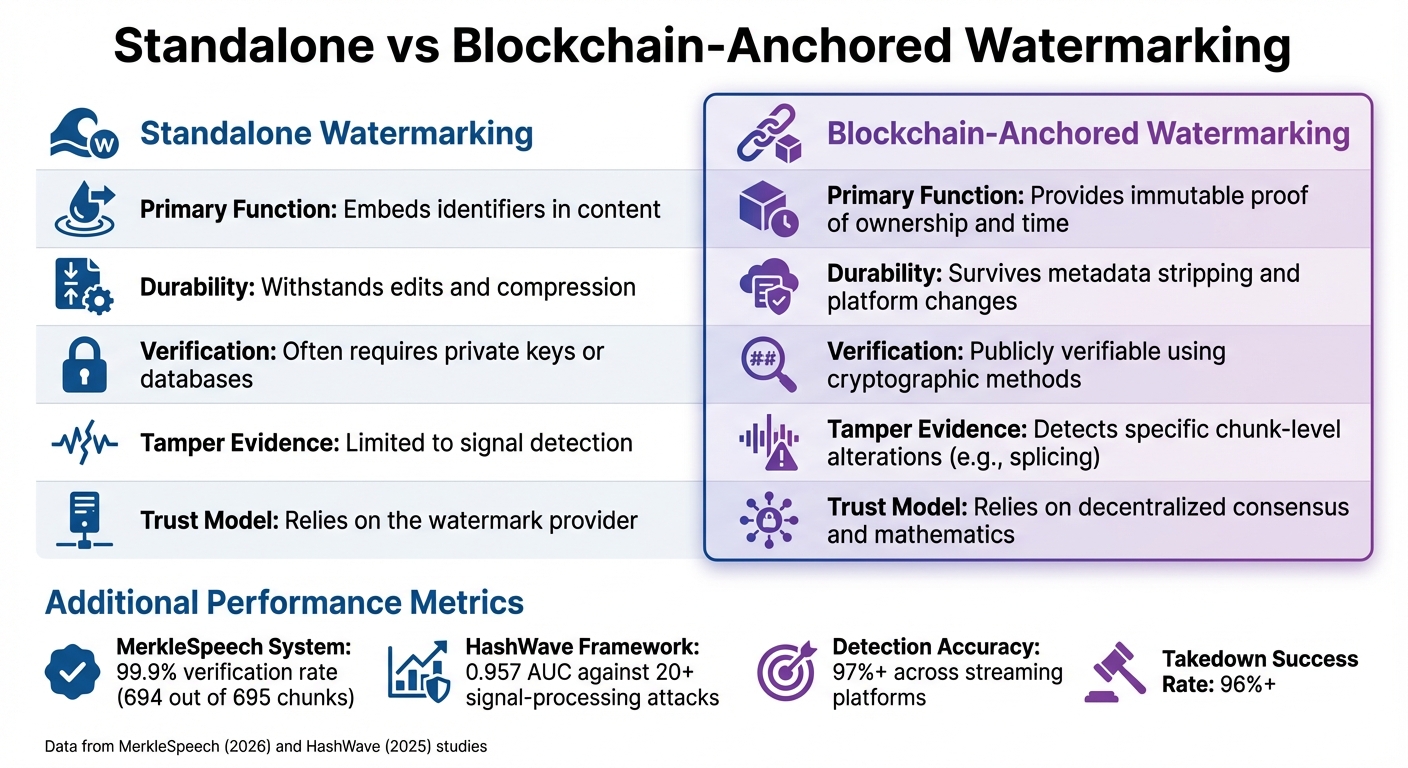
Blockchain-Anchored vs Traditional Audio Watermarking Comparison
Blockchain doesn’t replace audio watermarking – it enhances it by adding a cryptographic layer of proof. While watermarks embed unique identifiers directly into audio signals, blockchain provides a tamper-proof record of asset creation and ownership. Together, they transform copyright disputes into objective, verifiable claims backed by mathematics.
Permanent and Transparent Copyright Protection
Instead of storing entire audio files on a blockchain – which would be costly and inefficient – systems record a cryptographic hash. This hash acts as a unique digital fingerprint, proving the existence of a specific audio file at a particular time without exposing the file itself [2].
To scale this process for large audio collections, Merkle tree batching combines thousands of audio fingerprints into a single Merkle root. This root is then stored on the blockchain in one transaction. A small "inclusion proof" can later confirm that any segment of audio belongs to the original work [2][4].
In February 2026, Tatsunori Ono from the University of Warwick demonstrated the MerkleSpeech system using 2,620 audio files (about 5.4 hours) from the LibriSpeech dataset. The system divided the audio into 2.0-second chunks and achieved a 99.9% verification rate (694 out of 695 chunks) for clean, watermarked audio. This showed that fingerprints created during enrollment could be reliably reproduced for blockchain verification [4].
"By anchoring content fingerprints and provenance claims on a suitable chain, asset owners gain an immutable log of when an assertion was made, who signed it, and how it relates to specific files." – Nikhil John, InCyan Research [2]
Public-key verification makes it easy for anyone to validate a watermark. Once the watermark payload is decoded from an audio file, users can check its signature, recompute the fingerprint, and verify its inclusion in the Merkle tree – all using publicly available data, with no need for secret keys [4]. This creates a splice-aware protection system that identifies authentic segments of a recording and flags edited portions [4].
| Feature | Standalone Watermarking | Blockchain-Anchored Watermarking |
|---|---|---|
| Primary Function | Embeds identifiers in content | Provides immutable proof of ownership and time |
| Durability | Withstands edits and compression | Survives metadata stripping and platform changes |
| Verification | Often requires private keys or databases | Publicly verifiable using cryptographic methods |
| Tamper Evidence | Limited to signal detection | Detects specific chunk-level alterations (e.g., splicing) |
| Trust Model | Relies on the watermark provider | Relies on decentralized consensus and mathematics |
This foundation opens the door to automated processes like smart contracts for managing rights and royalties.
Smart Contracts for Automated Enforcement
Smart contracts are self-executing agreements that automatically enforce rules when conditions are met. In audio watermarking, they handle tasks like token generation for embedding watermarks securely and royalty distribution to copyright owners when licensing terms are fulfilled [5].
They also streamline rights enforcement. For example, when a platform detects a watermarked audio file, a smart contract can instantly verify whether it’s licensed for specific uses, regions, or timeframes [2]. This eliminates the need for manual takedowns, shifting enforcement to real-time checks.
"Smart contracts… unalterably implement both the conditions set out in an agreement reached by distinct web parties and the rules and events that can trigger the automatic execution of the contracts." – Franco Frattolillo, Department of Engineering, University of Sannio [5]
Smart contracts also maintain provenance for derivative works. If an audio file is edited, remixed, or transcoded, the blockchain records its relationship to the original file, ensuring the derivative remains linked to its source [2].
These automated systems make blockchain-integrated watermarking adaptable to a wide range of platforms.
Compatibility Across Different Platforms
By anchoring watermarks to a decentralized ledger, blockchain ensures compatibility across devices and platforms. It serves as a neutral ledger, allowing any system to query ownership data without relying on a single vendor. Watermarks embedded directly into audio signals survive transformations like compression, resampling, or codec changes, ensuring the blockchain record remains accessible [2][6].
This in-band to out-of-band linking embeds a durable identifier (Content Identifier or CID) into the audio itself. Even after the file undergoes significant changes, the watermark still points to the blockchain record containing ownership and rights data [2][6].
"Blockchain anchored content provenance should be understood as infrastructure rather than as a stand alone product. Its real value emerges when it is woven into the everyday systems that create, transform, and distribute media." – Nikhil John, InCyan [2]
The segment-level verification used by systems like MerkleSpeech allows verification of specific time segments, even if the audio has been spliced, trimmed, or remixed. Each 2.0-second chunk maintains its own verifiable record, making it easier to detect unauthorized edits [4].
With AI-powered invisible watermarking and blockchain verification, detection accuracy now exceeds 97% across streaming platforms [1]. This level of reliability makes blockchain-anchored watermarking a practical solution for large-scale content protection, where errors can lead to costly consequences.
Case Studies and Practical Applications
Examples from the real world show how blockchain-anchored audio watermarking is actively being used. These systems combine cryptographic timestamping with invisible identifiers to safeguard audio files across streaming platforms, mobile apps, and decentralized networks. Here are three cases that highlight how this technology is applied.
Case Study: Blockchain Music Wallet for Audio Files
The Blockchain Music Wallet creates a secure ecosystem for audio files by turning them into blockchain-linked digital assets. This method ensures that every play, download, or transfer of an audio file can be traced.
This system works with a two-layer protection model. First, it embeds an invisible watermark to detect any tampering. Second, it uses a SHA-256 hash recorded on the blockchain and IPFS for instant verification [1]. If a user tries to access an audio file, the wallet checks its blockchain record to confirm ownership. Even the slightest alteration to the file causes the watermark to break, triggering an alert.
This setup allows audio files to move seamlessly across platforms while keeping a clear and unchangeable provenance trail. Now, let’s look at how blockchain enhances digital watermarking and audio fingerprinting.
Case Study: Cross-Platform Fingerprinting with Blockchain
In November 2025, researchers Stuti Pandey, Akhilendra Pratap Singh, and their team at NIT Meghalaya introduced the HashWave framework. This system uses Ethereum and IPFS to create a decentralized network for detecting audio piracy. It employs a sophisticated multi-feature perceptual hash that combines MFCC, chroma-CENS, and CQT with Dynamic Time Warping (DTW). This approach achieved a 0.957 AUC against over 20 signal-processing attacks, such as pitch shifting and time stretching [3].
HashWave was tested using the GTZAN and FMA datasets, demonstrating impressive results. It achieved a matching latency of under one second, making it suitable for real-time enforcement. The system also recorded an average upload time of 0.017 seconds and a contract execution time of 0.044 seconds [3].
"HashWave is the first system that tightly couples operation-specific multi-feature audio hashing with blockchain-based registration and verification, optimised to resist complex signal-processing attacks." – Stuti Pandey, Department of Computer Science and Engineering, NIT Meghalaya [3]
The framework ensures that unauthorized resale is impossible by recording audio fingerprints on-chain. This enables real-time detection of duplicate uploads and facilitates royalty distribution. If a user tries to upload a duplicate file, the smart contract flags and blocks the transaction immediately [3].
Building on these features, another application focuses on streaming platforms and real-time protection.
Example: Blockchain-Enabled Streaming Services
In February 2026, Tatsunori Ono, a researcher at the University of Warwick, introduced MerkleSpeech, a system designed to verify speech provenance using public-key cryptography. It employs a QIM-STFT watermark that carries a 32-byte payload, which includes a 96-bit Content Identifier linked to a Merkle tree root signed with an Ed25519 issuer key [4].
MerkleSpeech was tested with the LibriSpeech test-clean dataset (2,620 files), achieving a 99.9% verification rate for enrolled chunks and maintaining a zero false-positive rate across 1.5 million negative test windows. The system showed resilience against distribution transforms like bandpass filtering and resampling while offering a splice-aware verification timeline [4].
"The result is a splice-aware timeline indicating which regions pass each tier and why any given region fails." – Tatsunori Ono, Department of Computer Science, University of Warwick [4]
This technology enables streaming services to trace leaks back to specific user sessions. For instance, if pirated content surfaces on an unauthorized site, the platform can pinpoint which user account was active during the leak, down to the exact 2.0-second chunk. Smart contracts can then automate takedowns [1].
These advancements, backed by industry investments, underline the growing confidence in blockchain as a robust tool for content protection.
ScoreDetect‘s Blockchain Audio Watermarking Solutions
ScoreDetect stands out as a prime example of how blockchain and watermarking technologies can work together to safeguard audio content. By combining blockchain timestamps for content security with invisible watermarking, it creates a powerful, two-layer protection system for audio assets. Instead of storing the actual content, the platform records each file’s SHA-256 checksum on the blockchain and IPFS, providing an unchangeable timestamp. This method turns ownership disputes into clear-cut cases backed by cryptographic evidence.
Blockchain Timestamping for Audio Assets
With ScoreDetect, registering an audio file is straightforward. The system generates a SHA-256 checksum for the file and logs it on the blockchain. This creates a permanent timestamp, proving the file’s existence at a specific point in time. If anyone tampers with the file, the hash changes, making alterations immediately detectable.
In recognition of its innovation, ScoreDetect was named the #1 Blockchain Trailblazer in 2024. The platform issues verifiable certificates containing essential details such as the registration date, copyright owner, SHA-256 hash, and public blockchain URLs. These certificates provide undeniable legal proof for resolving copyright disputes, offering validation through both Web3 and Web2 systems.
Cross-Platform Workflows with Zapier Integration
Beyond timestamping, ScoreDetect simplifies the process of protecting audio files through automation. Thanks to its integration with Zapier, the platform connects with over 6,000 web applications, enabling automated workflows across streaming services, cloud storage platforms, and distribution networks. This ensures that audio files are watermarked and registered on the blockchain as soon as they’re created, even before they’re distributed.
For instance, a music production company could set up a workflow where every file uploaded to Dropbox is automatically watermarked and registered on the blockchain by ScoreDetect. This automation not only reduces the chance of human error but also scales effortlessly to protect thousands of files.
Invisible Watermarking for Enterprise Protection
For enterprise users, ScoreDetect offers invisible watermarking technology that embeds subtle signals into audio files without affecting their quality. These watermarks are designed to withstand typical challenges like compression, re-recording, and even AI-based attacks aimed at removing them.
With a detection accuracy of over 97%, this technology is highly effective in tracking leaks and unauthorized sharing. Michael Sumner, Founder and CEO of ScoreDetect, explains:
"AI-driven watermarking paired with blockchain provides robust detection (97%+ accuracy) and traceability to combat media piracy."
The Enterprise plan also includes automated takedown capabilities. ScoreDetect generates delisting notices that achieve an impressive takedown success rate of over 96%. This comprehensive solution covers every stage of audio asset protection – from prevention to detection and enforcement – making it a reliable choice for safeguarding content across platforms. By combining blockchain and watermarking, ScoreDetect sets a high standard for cross-platform audio security.
Challenges and Future Developments
As blockchain technology continues to improve cross-platform audio watermarking, addressing scalability and new security threats remains a critical focus. Identifying signs your content needs piracy detection is the first step in implementing these advanced safeguards.
Scalability and Network Performance
Storing large audio files directly on a blockchain isn’t practical due to high costs and storage limitations [7]. Blockchain’s consensus mechanisms, while ensuring security, also introduce delays that make real-time applications like live streaming or VoIP difficult [7][8].
A promising solution involves off-chain storage with on-chain verification. For instance, audio files can be stored off-chain using systems like IPFS, while their cryptographic hashes are recorded on-chain [7]. This method reduces costs and improves speed. Additionally, Layer-2 solutions are emerging to handle high-volume scenarios, particularly for creator-focused entertainment and AI applications [1].
Another challenge lies in maintaining watermark integrity as files move across different codecs and platforms. Modern perceptual hashing offers a solution by creating stable, compact data representations, which also lighten the computational load for blockchain indexing [1][7].
These scalability issues highlight the need for continued innovation to counter emerging threats.
Quantum Computing and Security Risks
Quantum computing represents a significant risk to blockchain-based copyright systems. Algorithms like Shor’s can exploit quantum capabilities to break current cryptographic standards such as Elliptic Curve Cryptography (ECC) and RSA, which underpin blockchain security [10][12][13]. Arthur Herman, Senior Fellow at the Hudson Institute, explains:
"In short, blockchains that use the same cryptographic building blocks as other forms of DLT will be just as much at risk to the quantum computer threat as other digital technologies." [10]
A successful quantum attack on Bitcoin could lead to losses exceeding $3 trillion [10]. While quantum computers are not yet fully operational, adversaries may already be archiving encrypted data, intending to decrypt it once quantum technology becomes viable [11][12].
To counter this, defense measures are already in progress. Quantum Error Correction (QEC) has shown promise, reducing the average Bit Error Rate by 62.5% at a 0.10 qubit error probability [9]. Hybrid encryption systems, which combine classical algorithms with post-quantum-secure methods, offer another layer of protection. However, these come with trade-offs; post-quantum signatures are 40 to 70 times larger than current ones, requiring systems to handle significantly larger data payloads [11].
Future Developments in Blockchain Watermarking
In response to these challenges, new approaches are being developed to strengthen blockchain watermarking. Future systems will focus on improving efficiency and interoperability. For example, Merkle tree batching allows the combination of millions of asset hashes into a single root hash. This method makes it more affordable to anchor extensive libraries on public ledgers while preserving individual verifiability [2]. Another trend is the adoption of hybrid blockchain models, where detailed records remain in private environments for privacy and performance, while compact commitments are periodically anchored to public chains for transparency [2].
AI-powered detection systems are also advancing rapidly. The HashWave framework, for instance, achieved average upload times of just 0.017 seconds and contract execution times of 0.044 seconds on decentralized networks. It also demonstrated an Area Under the Curve (AUC) of 0.957 across major music datasets [3]. Stuti Pandey and her team highlight:
"HashWave is the first system that tightly couples operation-specific multi-feature audio hashing with blockchain-based registration and verification, optimised to resist complex signal-processing attacks." [3]
Integration with standards like the Coalition for Content Provenance and Authenticity (C2PA) will further enhance compatibility, enabling provenance data to travel seamlessly across different platforms [2]. Edge deployment frameworks are also emerging, allowing audio screening without the need for heavy GPU resources or frequent model retraining [3]. These advancements aim to make blockchain-based audio protection faster, more cost-effective, and more resilient to both technical and quantum threats.
Conclusion
Blockchain technology has introduced a game-changing approach to audio watermarking – making it permanent, transparent, and resilient to format changes and compression. With an immutable timestamp, ownership is recorded beyond dispute, while smart contracts enable real-time licensing verification and automated enforcement. As Nikhil John from InCyan Research aptly puts it:
"Blockchain anchored content provenance should be understood as infrastructure rather than as a stand alone product." [2]
By building on established case studies, blockchain verification now delivers unmatched efficiency. Combining invisible watermarking with blockchain verification tackles the growing threats posed by AI-driven attacks and advanced piracy detection techniques. This multi-layered protection makes blockchain-based solutions practical for high-volume enterprise use, spanning streaming platforms and content distribution networks.
ScoreDetect illustrates this perfectly by using blockchain to anchor SHA-256 hashes, creating an indisputable trail of ownership. This approach aligns seamlessly with the promise of cross-platform watermarking. ScoreDetect secures assets without storing the actual files, leveraging SHA-256 fingerprinting and automated workflows to generate tamper-proof ownership records. These workflows integrate directly into content creation and publishing pipelines, cutting down on manual tasks while ensuring evidentiary readiness for potential legal disputes [2].
Beyond securing ownership, this system enhances content management. Proactively registering assets during creation – whether through ScoreDetect’s WordPress plugin or API – builds a strong provenance trail. This not only deters piracy but also simplifies licensing and royalty processes with mathematically verifiable ownership records that third parties can independently validate [2].
FAQs
What’s the difference between an audio watermark and a blockchain hash?
An audio watermark is a subtle marker integrated into an audio file. It’s designed to confirm ownership or monitor distribution without disrupting the listener’s experience. In contrast, a blockchain hash is a cryptographic checksum recorded on a blockchain. This serves as a secure way to verify the content’s integrity and ownership. While watermarks focus on identification, hashes offer tamper-resistant proof of authenticity. Together, they often work hand-in-hand to provide stronger protection for audio content.
Can blockchain-anchored watermarks verify audio after trimming or remixing?
Blockchain-anchored watermarks are capable of verifying audio even after edits like trimming or remixing. Tools such as MerkleSpeech and HashWave are built to handle these challenges, providing localized verification. This ensures that the watermark stays intact, even when the audio undergoes typical modifications.
What should be stored on-chain vs off-chain for audio proof?
In blockchain-based audio watermarking, the audio content itself isn’t stored directly on the blockchain. Why? Because storing large files on-chain can be expensive and create scalability problems. Instead, a cryptographic hash of the audio file is saved on-chain. This hash acts as a unique digital fingerprint for the audio.
When it’s time to verify the file, the hash of the off-chain audio is recalculated and compared to the one stored on the blockchain. If they match, it confirms the audio’s authenticity and ensures its integrity – all without burdening the blockchain with heavy data.