Social media is now dominated by images and videos, making traditional text-based monitoring tools outdated. Over 50% of brand-related posts today involve visuals, and 80% of these lack direct text mentions of the brand. This shift demands multimodal AI, a technology that analyzes text, visuals, video, audio, and metadata together, providing a unified way to monitor online content.
Key takeaways:
- Multimodal AI detects brand mentions in images, videos, and audio where text is absent.
- It helps counter threats like deepfakes and counterfeit products and digital piracy, which evade traditional tools.
- Advanced systems analyze 20,000+ images per hour with high accuracy, reducing manual review time by up to 80%.
- Tools like Idem and ScoreDetect enable content protection through advanced matching and blockchain timestamping.
This technology is essential for staying ahead of risks in today’s visual-first social media landscape.
Key Signals in Multimodal Social Media Monitoring
Text, Visuals, Video, Audio, and Metadata Analysis
Multimodal AI combines five distinct layers – text, visuals, video, audio, and metadata – to capture details that single-mode systems often miss. Each layer contributes uniquely, filling gaps left by the others.
Text analysis has evolved far beyond basic keyword searches. Advanced AI can now interpret semantic intent, overcoming evasive tactics like leetspeak (e.g., "h4te"), Unicode tricks, and intentional misspellings [5]. Visual analysis leverages computer vision to identify brand logos, even in challenging scenarios like low-resolution images or when logos are partially obscured or tilted. Optical Character Recognition (OCR) further enhances this by extracting embedded text from memes and infographics [1][2]. This is especially crucial since most visuals don’t include direct brand mentions [2].
Video analysis employs techniques like frame sampling and scene detection to zero in on problematic segments in lengthy content. This approach balances accuracy with computational efficiency, catching fleeting violations like a one-second logo appearance or a deceptive thumbnail [5][3]. Audio analysis transcribes speech into searchable text, making it possible to detect spoken brand mentions in podcasts, livestreams, or voice messages that don’t appear in captions [1][5]. A notable example occurred in January 2026, when content creator Jezreel Ely discovered AI-generated TikTok videos using his likeness to promote the "ArenaPlus" sportsbook app. Detecting and addressing this required both facial recognition and audio matching [2].
Metadata and social graph analysis provides additional context by examining hashtags, timestamps, geolocation, and account relationships. This layer is particularly useful for identifying coordinated inauthentic behavior and tracking how unauthorized content spreads through networks [1][4]. However, metadata alone isn’t sufficient for detection, as bad actors often omit or manipulate tags and descriptions to avoid detection. Instead, it serves best as a tool for prioritizing and routing content for further analysis.
"Text-only monitoring is reading the captions while missing the content." – Dahye Lee, Senior Marketing Innovation Lead, Pulsar [1]
Common Challenges in Signal Analysis
While the integration of multiple signals strengthens detection capabilities, it also introduces new complexities.
One major challenge is cross-modal attacks, where harmless text is paired with violating visuals or audio. These combinations often slip past text-only systems, highlighting the need for multimodal AI’s integrated approach [5].
Another hurdle is adversarial noise, where subtle alterations – like filters, invisible distortions, or modified watermarks – are deliberately introduced to evade detection systems [5][4]. Video analysis, in particular, is resource-intensive, costing roughly 10 times more than text analysis. To manage this, techniques like frame sampling and weighted scoring are crucial for identifying short but impactful violations without wasting resources on unnecessary frames [5][3].
Despite these challenges, well-designed multimodal systems deliver impressive results. They achieve F1 accuracy scores ranging from 0.88 to 0.93 for images and 0.85 to 0.90 for short videos [5]. Additionally, they can reduce the time required for human review of mixed-media user-generated content by 60–80% [5].
"The intelligence gap between text-only monitoring and visual social listening is structural, not incidental. It is not about tool quality. It is about what text monitoring is architecturally capable of seeing." – Dahye Lee, Senior Marketing Innovation Lead, Pulsar [1]
sbb-itb-738ac1e
Multimodal Techniques for Detecting Unauthorized Content
Similarity Detection and Resistance to Content Modifications
One of the toughest challenges in content protection is identifying altered content designed to evade detection. Instead of just spotting exact duplicates, modern multimodal AI systems focus on semantic feature extraction. This process converts content into high-dimensional embeddings, capturing its essence and structure. Even if two images look different due to edits like cropping, filters, or compression, their embeddings can remain nearly identical if their core content is the same. This makes these systems highly effective against common evasion tactics.
By analyzing multiple modalities – text, visuals, and audio – simultaneously, these systems can catch infringing content that might otherwise go unnoticed. For instance, pairing infringing visuals with a harmless caption or clean audio track won’t bypass detection [5].
Dynamic adversarial training further strengthens these models. When subjected to adversarial attacks, these advanced systems experience only a 3.8% drop in performance, compared to the 15–30% drop seen in traditional models [4]. This resilience is crucial for tackling large-scale, organized infringement efforts.
"When counterfeit packaging becomes visually indistinguishable from genuine products, text‑based monitoring provides no protection." – Aishwarya Suresh, Content Writer, Sprinklr [2]
The February 2026 Estée Lauder vs. Walmart case highlights this issue. Counterfeit listings for La Mer and Clinique products avoided using brand keywords, leaving visual signature matching as the only effective detection method [2].
With these advanced techniques, brands now have the tools to enforce content protection on a large scale.
Tools for Multimodal Content Matching
Implementing these sophisticated detection methods requires specialized tools designed for the task.
Idem, a solution by InCyan, is a powerful AI-based multimodal matching engine. It excels at identifying ownership even when content has undergone significant transformations, such as mobile edits, memes, cropping, or compression. Remarkably, Idem can confirm content ownership even when only 10% of the original asset remains, making it an invaluable tool for tackling real-world cases where infringing content is rarely left untouched.
For text-based intellectual property, InCyan offers Txtmatch. This tool uses forensic-level precision to match text – whether it’s articles, scripts, captions, or transcripts – against a proprietary database. It quickly detects unauthorized or plagiarized material with a level of speed and accuracy that manual reviews simply cannot achieve.
When it comes to processing multimodal content, AI agents significantly outpace human reviewers. These systems can handle over 20,000 images per hour with F1 accuracy scores ranging from 0.88 to 0.93. In comparison, human reviewers manage only 200–400 images per hour [5]. For brands operating across multiple platforms, automated multimodal matching isn’t just helpful – it’s essential.
Steal This AI-Powered Social Media Listening System (100% Automated)
How to Set Up a Social Media Monitoring Workflow
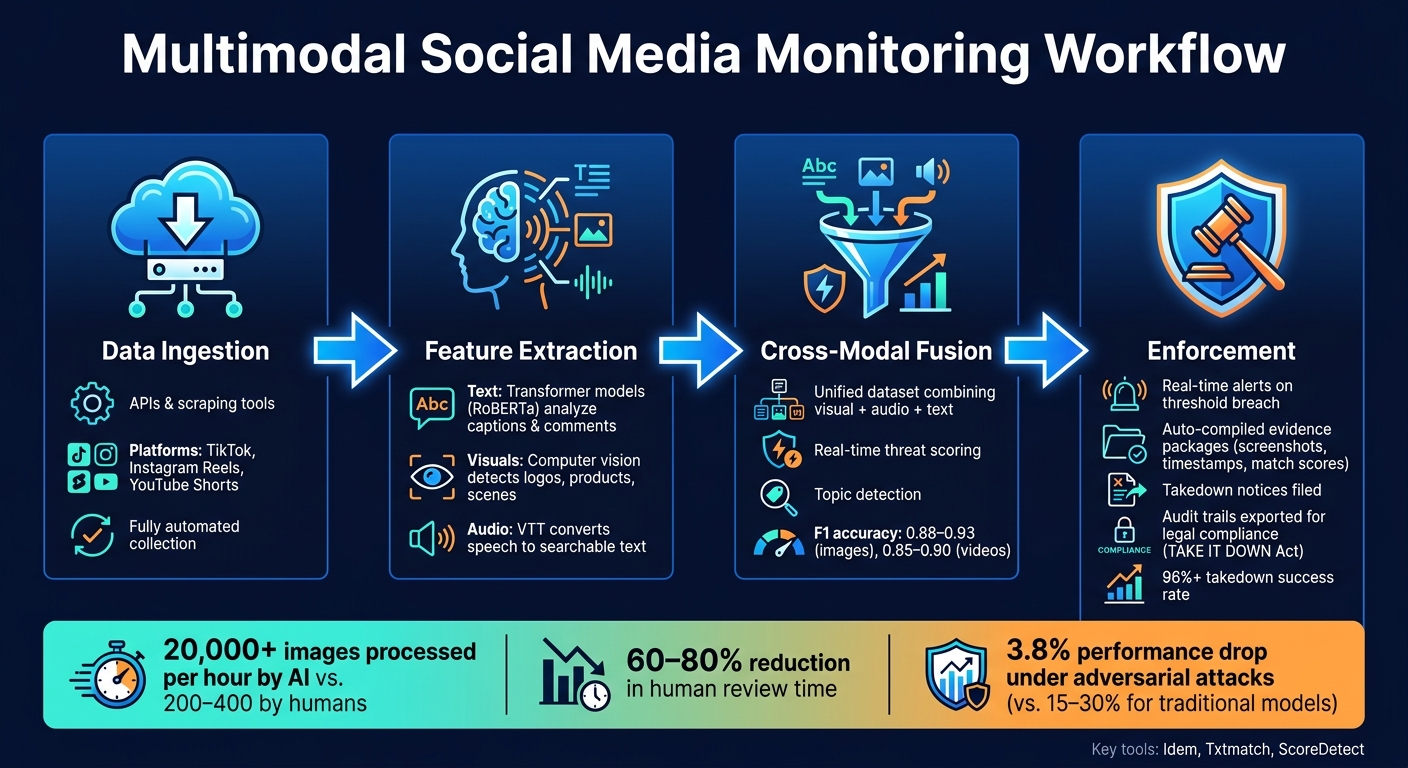
Multimodal Social Media Monitoring Workflow: End-to-End Process
End-to-End Monitoring Workflow
A monitoring workflow is like a chain – every stage plays a critical role in identifying and stopping unauthorized content. If one link is weak, infringing material can slip through unnoticed.
The process begins with data ingestion. Using APIs and specialized scraping tools, content is pulled from platforms like TikTok, Instagram Reels, and YouTube Shorts simultaneously [2][3]. Considering the enormous amount of content uploaded daily [2], automation at this stage is non-negotiable.
Next comes multimodal feature extraction. Here’s how it works: text captions and comments are analyzed using transformer models like RoBERTa, visuals are processed through computer vision pipelines to detect logos, products, and scenes, and spoken audio is converted to text using Video Transcription (VTT) [1]. These streams of data are then combined in a cross-modal fusion layer, which unifies visual, audio, and text information into a single dataset. This dataset is used for real-time threat scoring and topic detection [1][4].
"Proactive brand protection requires logo, packaging, face, and video-frame analysis, backed by auditability and governance before damage becomes visible in sentiment data." – Aishwarya Suresh, Content Writer, Sprinklr [2]
The final step is enforcement. Real-time alerts are triggered when brand safety thresholds are breached. Evidence packages, including screenshots, timestamps, and match scores, are automatically compiled to support takedown notices. Audit trails and debug logs are exported at every stage to meet legal and regulatory requirements, such as those outlined in the U.S. TAKE IT DOWN Act [2].
How ScoreDetect Supports Content Protection

Once the enforcement stage identifies violations, proving ownership of your content becomes critical. That’s where ScoreDetect comes in. It uses blockchain timestamping to create an unchangeable public record of your content’s creation by generating a cryptographic checksum (SHA-256 hash). This ensures you can verify ownership without storing the original file.
Here’s how it works: when your monitoring pipeline flags unauthorized use of your content – whether it’s an image, video, or article – you already have a blockchain-verified certificate proving you were the original owner. Each Verification Certificate includes the registration date, copyright owner’s name, the SHA-256 hash, and links to the public blockchain and ledger. These details provide everything needed to file takedown requests or legal claims.
For content teams that publish frequently, ScoreDetect offers tools to simplify the process. Its WordPress plugin automatically timestamps every article upon publication or update, creating ownership records without requiring any manual input. Additionally, its Zapier integration connects with over 6,000 web apps, automating timestamping for even the most complex workflows. The Enterprise plan takes it further with features like 24/7 content monitoring, invisible watermarking enhanced by blockchain, and automated takedown notifications. Impressively, ScoreDetect boasts a 96%+ takedown success rate, making it a powerful tool in your content protection strategy. This is especially effective for safeguarding educational content and other high-value intellectual property.
Building a Multimodal Monitoring System That Works
Once your workflow is set up, the next step is ensuring your monitoring system is effective and reliable. This involves carefully evaluating tools and tackling deployment challenges head-on.
How to Evaluate Monitoring Tools
When assessing monitoring tools, modification resistance should be a top priority. This ensures your system can identify content even if it’s cropped, resized, compressed, or re-uploaded. Tools like PhotoDNA and PDQ, which use perceptual hashing, excel at detecting known harmful material despite minor changes. For new and previously unseen content, AI classifiers are essential since they can go beyond fixed hash databases to identify emerging threats.
Another critical factor is platform coverage. Your tools must monitor fast-growing visual platforms like TikTok, Instagram Reels, and YouTube Shorts. Visual content often lacks direct brand mentions, so relying solely on text monitoring will leave gaps. Dahye Lee, Senior Marketing Innovation Lead at Pulsar, highlights this perfectly:
"Text-only monitoring is reading the captions while missing the content." [1]
Beyond detection capabilities, evaluate tools based on detection speed, workflow integration, and governance features like audit trail exports and configurable toxicity filters. Here’s a quick summary of the criteria to consider:
| Evaluation Criteria | What to Look For |
|---|---|
| Modification Resistance | Perceptual hashing + AI classifiers for new content |
| Platform Coverage | TikTok, Reels, YouTube Shorts; APAC platforms if relevant |
| Detection Speed | Real-time or near-real-time alerts |
| Workflow Integration | JSON APIs, Zapier connectors, or enterprise stack compatibility |
| Governance & Compliance | Exportable audit trails, toxicity filters, debug logs |
For large-scale operations, platforms like InCyan’s Idem are designed for multimodal matching and integrate seamlessly into broader enforcement workflows.
Deployment Challenges and Best Practices
Even the best tools can fail if deployment isn’t handled properly. To ensure consistent and accurate monitoring, address these three core requirements: high-quality reference assets, stable platform access, and clear content policies.
Start with high-quality reference assets. Low-resolution logos or poorly stored video originals can drastically reduce detection accuracy. For video monitoring, focus on sampling keyframes where there’s significant motion or human presence. This helps reduce data volume while retaining the most critical information. [3]
False positives are another challenge in large-scale systems. A two-stage moderation workflow can help manage this effectively. First, a lightweight binary model filters out obviously safe content. Then, a more advanced multimodal model handles the remaining 20% of potentially risky material, offering fine-grained classification. [6] This setup balances cost control with accuracy.
Lastly, audit trails are essential. Regulations like the U.S. TAKE IT DOWN Act and the EU Digital Services Act require swift removal of flagged AI-generated content. To meet these legal standards, your system must generate exportable debug logs and decision records. Make compliance documentation a priority during vendor evaluation – it’s far easier to build this in from the start than to retrofit it later.
Conclusion: Where Social Media Monitoring with Multimodal AI Is Headed
Social media monitoring is undergoing a major transformation. Aishwarya Suresh from Sprinklr highlights this shift: "2026 marks the turning point where brand monitoring must evolve from tracking words to interpreting visuals – from hearing to seeing." [2] This change is essential as more than 50% of brand content by 2026 will be image or video-based, with 80% of it lacking explicit brand mentions. [1][2] Relying solely on text-based tools leaves brands exposed to gaps they can’t afford.
At the same time, the challenges are growing. Deepfake media, for instance, has exploded – from 500,000 instances in 2023 to an estimated 8 million by 2025, a staggering 900% increase. [2] Real-world cases have already shown the risks when monitoring systems fail to detect non-textual threats, emphasizing the need for more advanced solutions.
The next generation of monitoring tools will go beyond treating text, images, video, and audio as separate signals. Instead, they’ll merge these elements into a single, unified dataset, which aligns with earlier findings. [1] Meeting these challenges also requires innovative approaches. For example, privacy-preserving technologies like Federated Cross-Modal Graph Transformers (FCMGT) are already achieving impressive results, such as F1-scores of 0.927 in decentralized threat detection scenarios. [4] These advancements are crucial for monitoring across fragmented, privacy-focused platforms.
Organizations managing large-scale digital content can turn to tools like InCyan’s Idem, which offers evasion-proof asset matching, or Tectus, which uses invisible watermarking for enhanced enforcement. Content creators and publishers looking for simpler solutions can explore ScoreDetect, which provides blockchain timestamping to create verifiable ownership records at the time of publication. Together, these tools help build a robust defense against emerging threats.
The future of social media monitoring is clear: it’s proactive, visual, and multimodal. Brands relying solely on keyword-based monitoring will find themselves reacting to problems too late, while those embracing unified multimodal systems will be equipped to identify and address threats before they escalate.
FAQs
What is multimodal AI monitoring?
Multimodal AI monitoring leverages artificial intelligence to assess social media content across multiple formats – images, videos, audio, and text. This approach aims to detect threats that might not be evident in captions or metadata alone. By analyzing visual elements like logos or manipulated media, processing audio and video content, and combining these findings with text analysis, it can identify altered or partially transformed material. This ensures quicker detection and response, enhancing protection and enforcement efforts.
How does it detect brand misuse without text mentions?
Brand misuse can now be spotted even when text mentions are missing, thanks to advanced visual intelligence that processes images and video frames. Using multimodal AI, this technology identifies logos, products, faces, and packaging – even when brand names aren’t included in captions or hashtags. InCyan’s Idem engine takes it a step further by accurately matching content, even after alterations like cropping or compression. This allows organizations to detect unsponsored product usage and unauthorized brand associations that text-only monitoring might miss.
How does ScoreDetect prove content ownership for takedowns?
ScoreDetect leverages blockchain-based timestamping to deliver tamper-proof proof of ownership. It generates a cryptographically verifiable checksum for your digital assets, ensuring a secure and legally defensible chain of custody. When paired with InCyan tools such as Tectus for invisible watermarking and Idem for multimodal matching, ScoreDetect provides a comprehensive evidence package. This includes HTML snapshots, access logs, and hash values, all designed to support strong copyright enforcement efforts.