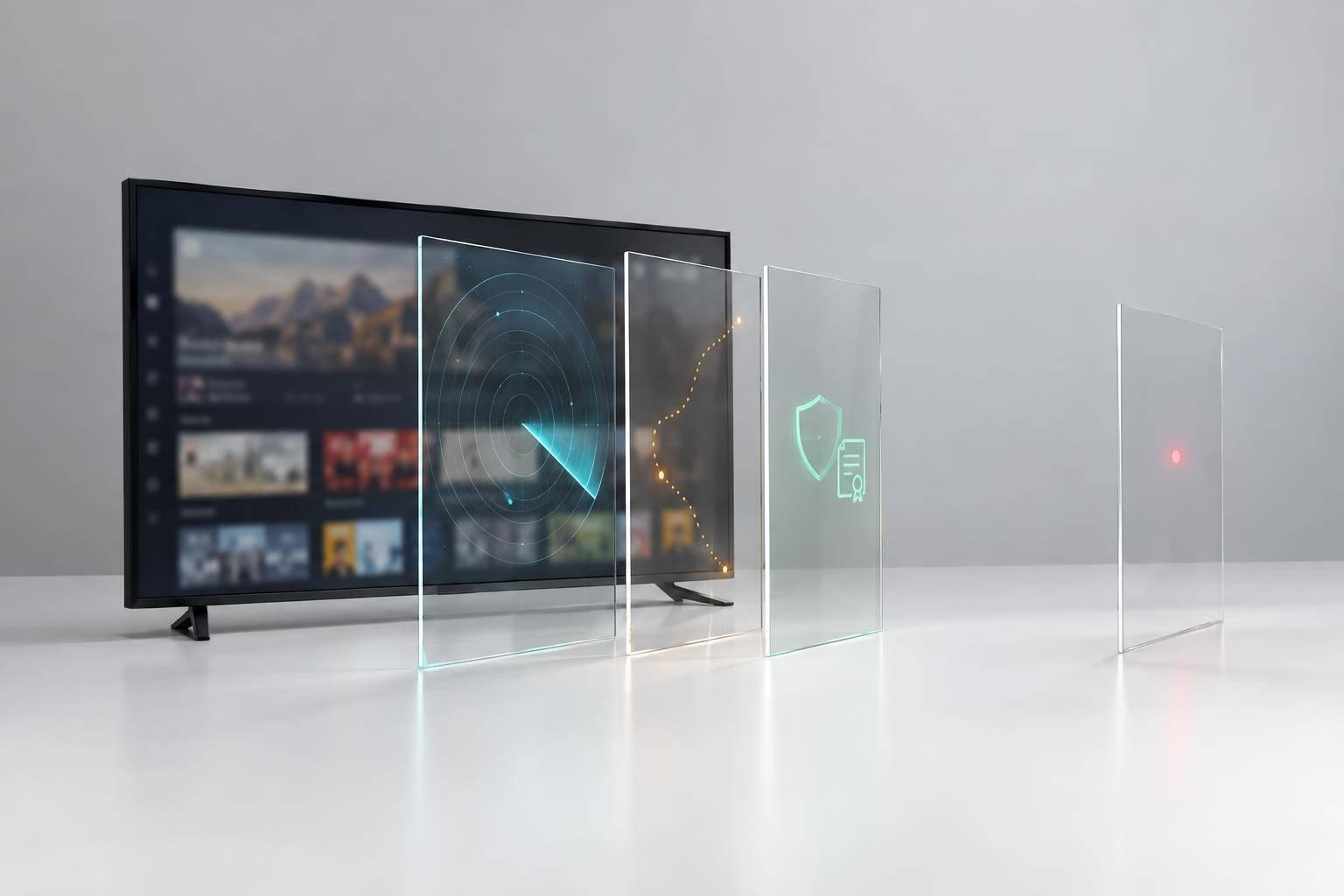
Digimarc built its reputation on watermarks that survive the jump from physical to digital: packaging, print, retail scanning, broadcast. InCyan’s Tectus invisible watermarking and InCyan ProofChain blockchain-anchored watermarking are built for a narrower but different bar: surviving aggressive digital transformation and producing proof that doesn’t depend on trusting a single vendor’s registry. Both are legitimate approaches to durability, aimed at different failure modes.
Digimarc’s real strength
Digimarc has decades of enterprise deployment across physical-to-digital contexts: watermarks embedded in product packaging that survive printing, scanning, and photocopying, and industrial applications where a physical object needs a machine-readable identity that a phone camera can pick up. That’s a genuinely hard problem, and Digimarc’s track record there is long and well documented, including deployments like the OMRON industrial identification integration.
sbb-itb-738ac1e
What Tectus is built to survive
InCyan’s Tectus is purely a digital watermarking service, and its claims are specific: the watermark survives aggressive JPEG and MP4 re-compression, cropping, resizing, rotation, colour adjustment, and format conversion. It supports both blind watermarking (detecting the mark without needing the original asset, useful for automated enforcement at scale) and non-blind watermarking (using the original for a stronger, more resilient signal). Each distributed copy can carry a unique payload, so if a leak occurs, scanning the leaked file identifies which specific copy was compromised.
Where ProofChain changes the verification model
Digimarc’s verification runs through its own detection infrastructure. InCyan’s ProofChain takes a different approach: it hashes and time-stamps the watermark’s ownership metadata on a public blockchain ledger, so anyone can verify authenticity and provenance independently, without relying on a centralized registry controlled by one vendor. That’s a direct answer to a fair question: what happens to your proof of ownership if the vendor providing it disappears or changes its terms?
Why durability is worth the scrutiny
The market both companies compete in is growing quickly: the global digital watermarking market was valued at roughly USD 1.45 billion in 2024 and is projected to reach USD 3.80 billion by 2033, a compound annual growth rate of about 11.4%, according to Grand View Research’s digital watermarking market report. Invisible watermarking, the category Tectus and Digimarc’s digital watermarks both belong to, already held the largest revenue share of that market in 2024, which is part of why durability claims get scrutinized this closely.
Durability comparison
| Digimarc | InCyan Tectus invisible watermarking / InCyan ProofChain blockchain-anchored watermarking | |
|---|---|---|
| Physical-to-digital survivability | Strong, industry-leading track record | Not the design target; purely digital |
| JPEG/MP4 recompression | Strong | Strong, explicitly claimed and tested |
| Cropping and resizing | Strong, with redundancy across the asset | Strong, part of core InCyan Tectus invisible watermarking design |
| Format conversion | Strong | Strong |
| Verification model | Vendor-operated detection infrastructure | Public blockchain ledger, independently verifiable |
| Per-copy leak tracing | Available | Yes, unique payload per distributed copy |
| Blind detection (no original needed) | Available | Yes, supported alongside non-blind detection |
The honest gap
Neither InCyan nor Digimarc has published an independent, third-party benchmark putting the two head-to-head on identical test conditions. Both companies’ durability claims come from their own testing. If a truly apples-to-apples comparison matters for your decision, that benchmark doesn’t currently exist publicly for either vendor, and it’s worth saying so plainly rather than pretending otherwise.
Frequently asked questions
Which is better for physical products like packaging?
Digimarc has the stronger, longer track record for physical-to-digital use cases, including packaging and retail scanning. Tectus is a purely digital watermarking solution and isn’t built for that physical layer.
Does Tectus survive heavy compression the way Digimarc claims to?
Tectus is specifically designed and claimed to survive aggressive JPEG and MP4 re-compression, along with cropping, resizing, rotation, and format conversion. Neither InCyan’s nor Digimarc’s claims here have independent third-party verification.
What does blockchain anchoring actually add over Digimarc’s approach?
It changes who you have to trust. Digimarc’s verification runs through Digimarc’s own systems. ProofChain’s blockchain record can be checked independently by anyone, without needing to trust or rely on a single vendor’s registry staying operational.
Can a leaked asset be traced back to a specific recipient?
Yes, with Tectus. Each distributed copy can carry a unique watermark payload, so a leaked file reveals which specific copy was compromised.
Is there an independent benchmark comparing the two?
No. Both companies’ durability claims are based on internal testing. No public, independent, apples-to-apples benchmark currently exists comparing InCyan and Digimarc directly.
Does Digimarc offer blockchain-anchored verification the way ProofChain does?
Not as its primary approach. Digimarc’s authenticity work increasingly aligns with C2PA, which uses cryptographic hashing and digital signatures rather than blockchain by default, though C2PA is designed to be compatible with blockchain-based implementations some ecosystem members have built separately.
What’s the difference between blind and non-blind watermarking, and does it affect durability?
Blind watermarking detects and extracts the mark without needing the original asset, which matters for large-scale automated enforcement. Non-blind watermarking uses the original during detection, producing a stronger, more resilient signal against aggressive transformations. Tectus supports both, and InCyan’s team selects the appropriate technique based on the distribution workflow.
Can Tectus watermark video and audio, or only images?
Tectus supports images, video, and audio within one platform, with common formats including JPEG, PNG, TIFF, MP4, MOV, WAV, and MP3, among others.
Does Digimarc’s physical-to-digital strength matter for a purely digital-distribution rights holder?
Not directly. If a catalogue never touches physical packaging, print, or retail scanning, Digimarc’s core differentiator is less relevant, and the comparison narrows to how each vendor’s purely digital watermarking performs, which is where the durability table above applies most.
How fast can a watermarked asset be verified through ProofChain’s API?
ProofChain’s verification is described as API-based and instant: submitting an asset or its hash returns a response confirming authenticity, ownership, and registration timestamp within seconds.
What happens if I need to prove ownership of an asset watermarked years ago?
With ProofChain, the blockchain record persists independently of InCyan’s own infrastructure staying operational, since verification runs against a public ledger rather than a vendor-controlled database. That’s specifically the scenario the blockchain-anchoring approach is designed to hold up under.
Related reading
- InCyan vs. Digimarc for Content Authenticity & Provenance
- InCyan vs. Google SynthID for Content Authenticity
- InCyan Tectus vs. IMATAG for Invisible Watermarking
- How Does Digital Watermarking Actually Work? (YouTube, Digimarc CEO interview)
Request a demo of Tectus and ProofChain to see how they handle the specific transformation cases relevant to your catalogue.