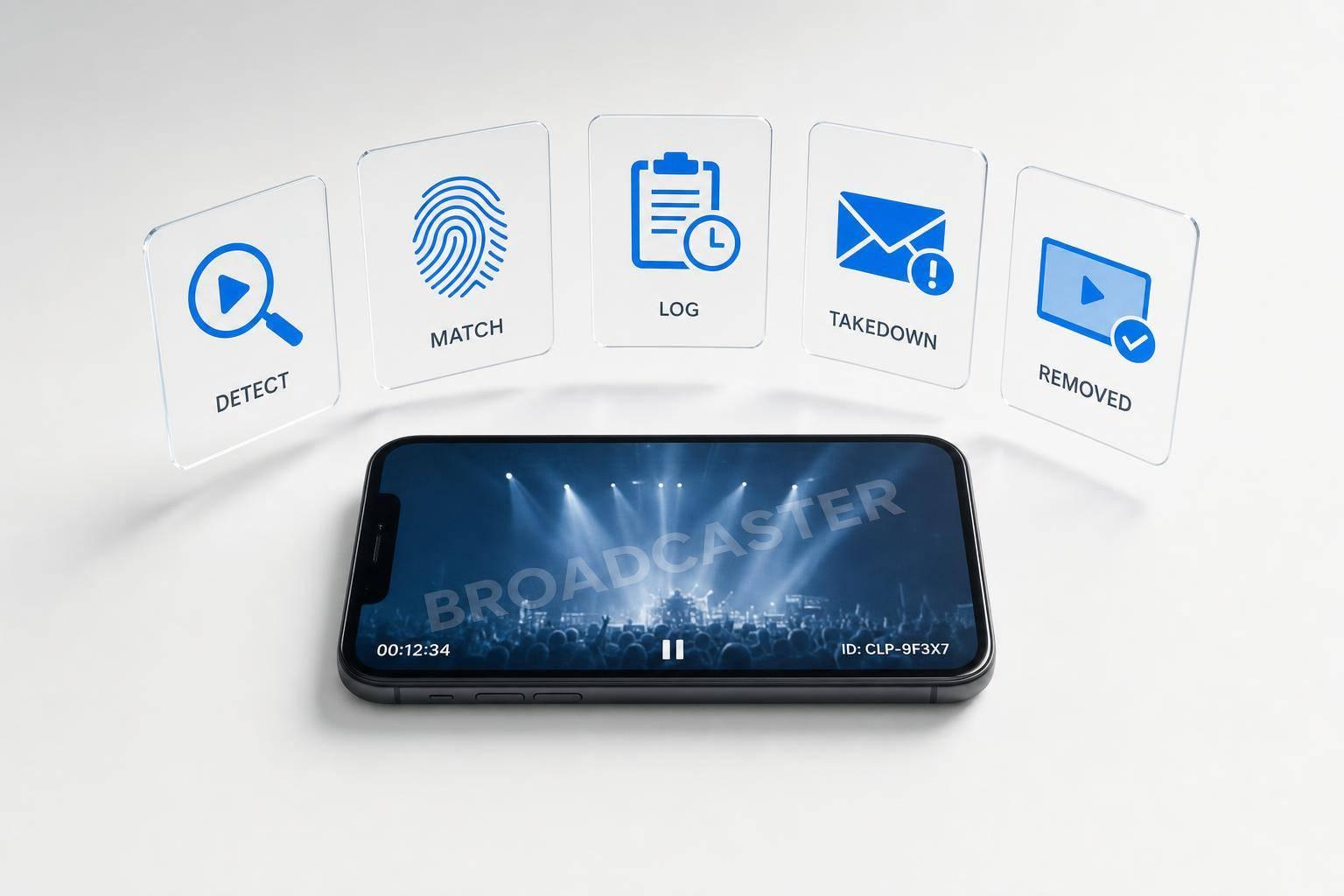
If you manage a large catalog of digital assets, basic copyright tools are not enough. An enterprise platform needs to find misuse across many channels, prove ownership with records that hold up, and help your team send takedowns, de-index search results, and track repeat cases.
In plain terms, I’d sum it up like this: the platform works when it does three jobs well:
- Finds copied material across websites, search engines, marketplaces, social platforms, and BitTorrent
- Builds a case file with timestamps, hashes, page records, and ownership proof
- Moves cases into action through notices, de-indexing, blocking checks, and status tracking
That matters because piracy and misuse move fast. The article points to 229.4 billion visits to piracy websites in 2023, up 6.7% from 2022. And the problem is no longer limited to one channel. A single leaked file can spread across search results, forums, social posts, torrent sites, and seller listings within minutes.
Here’s the core idea in one line:
Watermarking helps show where an asset came from, fingerprinting helps match edited copies, and crawling helps find those copies in the first place.
I’d break the article’s main points into this short checklist:
- Watermarking adds a hidden ownership signal to images, video, and audio
- Fingerprinting and AI matching detect copied material even after edits, clips, paraphrasing, or re-encoding
- Scraping and crawling keep watch across hard-to-reach pages and networks
- Evidence workflows store URLs, screenshots, file hashes, timestamps, and history
- Enforcement workflows send takedowns, remove search visibility, log actions, and support escalation
- Reporting tracks time to detection, time to takedown, success rate, repeat offenders, and revenue protected in USD
A few takeaways stand out:
- A screenshot and spreadsheet are not enough for legal review at scale
- Monitoring without enforcement leaves teams stuck doing manual case work
- Registration, watermarking, matching, and takedowns work best as one connected process
- KPI tracking should focus on exposure, response time, and case readiness, not raw detection counts
If I were explaining the article to a teammate, I’d say this: the goal is not just to spot infringement. The goal is to turn detections into proof, proof into action, and action into lower loss and better reporting.
The rest of the article explains how that system works from asset registration through recovery.
Episode 43 – Pursue online IP infringement swiftly, lawfully, and effectively
sbb-itb-738ac1e
Core detection methods that make monitoring work
Enterprise monitoring works like a stack. Watermarking identifies assets, fingerprinting spots altered copies, and crawling finds those copies across the web. Each one handles a different job.
Invisible watermarking for traceable ownership signals
Invisible watermarking embeds a machine-readable ownership signal into an asset without changing the user experience. It can survive compression, cropping, resizing, and re-encoding.
The EUIPO Anti-Counterfeiting and Anti-Piracy Technology Guide describes a digital watermark as information permanently embedded in a digital file that certifies authenticity and source, and invisible watermarks can only be decoded by machines.
InCyan’s Tectus uses blind watermarking for images, video, and audio. It embeds a unique ownership signal at creation or distribution. That signal lets teams trace a later match back to a specific rights holder, licensee, or distribution channel. ScoreDetect Enterprise adds blockchain timestamping to this workflow, giving teams a verifiable ownership record they can use alongside the watermark match.
This matters in plain, everyday cases. Say a PDF training document gets extracted and uploaded to an unauthorized document library. The watermark can provide ownership proof that metadata alone can’t.
When a watermark is missing or has been changed, fingerprinting takes over.
Fingerprinting and AI matching for altered copies
Fingerprinting builds stable signatures from image, video, audio, and text features, so altered copies can still be matched. Put simply: watermarking proves origin, while fingerprinting proves reuse after changes.
InCyan’s Idem does this with proprietary AI-powered multimodal matching. Its resistance to edits lets it detect content ownership even when only a small part of the original asset is left. That matters when someone clips a segment from a training video or re-encodes an audio track before uploading it. Idem Text uses the same idea for written content, catching excerpts, paraphrases, and transcribed speech pulled from original recordings.
The best setup combines deterministic fingerprinting for exact or near-exact reuse with AI matching for derivative copies. Fingerprinting brings precision at scale. AI matching helps with the long tail of modified content that fingerprinting alone would miss.
High-success scraping and crawling for continuous discovery
Detection still depends on finding the copy in the first place. Watermarking and fingerprinting only work on content that has actually been found. If crawling misses a regional marketplace, a lightly modified copy on a forum, or a hotlinked image on a low-traffic blog, that infringement stays out of sight.
ScoreDetect’s discovery layer runs continuous, targeted web scraping across the open web. Its high success rate against anti-bot and blocking measures expands coverage across hard-to-reach pages. In practice, that means fewer missed infringements and faster identification of previously unknown infringements. Once found, detections can move into evidence collection and takedown workflows.
How the platform turns detections into proof and enforcement
Finding an infringement is only half the job. The next part is what makes enforcement work: turning a match into proof that a host, search engine, or court can use.
Evidence collection and ownership verification
Once a match is confirmed, the platform creates a structured incident record. That record includes the URL, domain, source, timestamp, page snapshot, screenshots, and file hashes. From there, the goal is simple: turn a detection into a case file that can support action.
Match found → evidence captured → ownership verified → enforcement ready.
At this stage, the notice and case file should include the certificate, hash, and blockchain transaction ID. The platform should also track repeat appearances, first-seen and last-seen dates, and any prior takedown failures. That history matters. It helps with escalation and can support higher damages claims.
Automated takedowns, de-indexing, and escalation paths
With ownership verified, the platform sends the case down the fastest enforcement route. Legal teams usually set this up in advance with notice templates and rules that decide whether the system sends notices automatically or holds them for one-click approval.
The notice can be pre-filled with:
- Signature
- Work ID
- Location
- Contact details
- Good-faith statement
- Authority statement
That cuts delay and helps improve takedown completion. The same workflow can also handle search de-indexing, torrent evidence, and ISP-block verification.
| Enforcement Channel | Speed | Evidence | Best-Use Scenario |
|---|---|---|---|
| Direct takedown (ScoreDetect Enterprise) | Fast to medium | URL, screenshots, file hashes, certificate | Host responds quickly |
| Search de-indexing (Indago) | Very fast (under 60 minutes) | URL, ownership proof, screenshots | Host is unresponsive or offshore; users find the copy through search |
| Torrent enforcement (TorrentWatch) | Medium | Info hash, tracker URLs, seed/peer counts, torrent index snapshots | Content is distributed via BitTorrent; scale of piracy needs to be shown |
| ISP blocking verification (BlockWatch) | Ongoing monitoring | Probe results across DNS, IP, HTTP/HTTPS layers | Court or regulatory block is in place; compliance needs to be independently verified |
Log every action with the user, role, and timestamp.
How InCyan and ScoreDetect fit into an enterprise monitoring stack
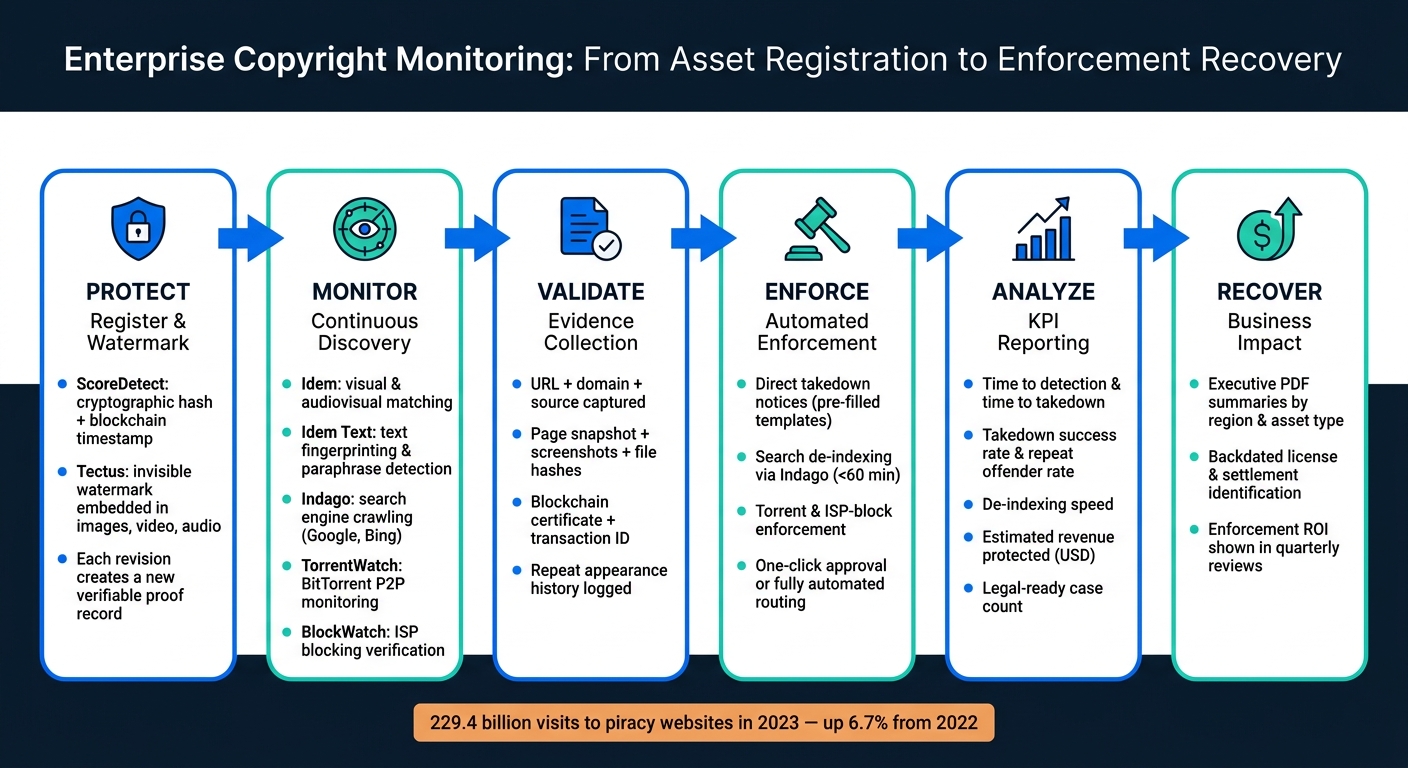
Enterprise Copyright Monitoring: From Asset Registration to Enforcement Recovery
These parts work as one pipeline, from asset registration all the way to enforcement. ScoreDetect registers assets and records tamper-evident proof. Tectus adds an invisible watermark to visual and audiovisual files. The workflow below shows how those signals move from registration to recovery.
A layered workflow from protection to recovery
The stack moves through a clear sequence: protect → monitor → validate → enforce → analyze → recover.
New assets go into ScoreDetect before they go live. That creates cryptographic hashes, ownership metadata, and timestamped proof. Each revision creates a new proof record, which builds a verifiable change history for version disputes. Tectus embeds an invisible watermark during or right after registration.
Once assets are live, Idem, Idem Text, Indago, TorrentWatch, and BlockWatch cover visual, text, search, P2P, and ISP surfaces. Detections then move into ownership verification and enforcement. At that stage, ScoreDetect timestamps and Tectus watermarks help confirm ownership, while automated workflows handle notices, de-indexing, and escalation. Business Intelligence and Insights turns case data into prioritization and ROI reporting.
Once detections are confirmed, the stack should feed them into existing enterprise workflows. That’s where this setup starts to save time instead of adding more admin work.
Integrations, automation, and reporting for enterprise teams
ScoreDetect and InCyan connect to existing tools through Zapier, routing high-priority detections into Jira, Slack, or other workflow tools without manual re-entry. The WordPress plugin timestamps new or updated pages automatically, which cuts down on missed registrations.
Legal teams get case-level views with jurisdiction, infringement severity, and evidence bundles. Licensing teams can cross-reference unauthorized commercial use against CRM records to pursue backdated licenses or settlements. Executive stakeholders get PDF summaries that show reductions in indexed infringing pages, improvements in time-to-takedown, and estimated recovered revenue by region.
The table below maps each component to its monitoring role and business outcome.
Table: InCyan and ScoreDetect components by role and outcome
| Component | Primary Function | Supported Asset Types | Monitored Channels | Enterprise Outcome |
|---|---|---|---|---|
| ScoreDetect | Asset registration and blockchain timestamping | Images, video, audio, documents, text | WordPress, API, Zapier-connected systems | Stronger ownership evidence; revision history for disputes |
| Tectus | Invisible watermarking | Images, video, audio | Applied during or immediately after registration | Traceable ownership signal in distributed copies |
| Idem | Visual and audiovisual content matching | Images, video, audio | Websites, marketplaces, social platforms | Faster identification of unauthorized visual reuse |
| Idem Text | Text fingerprinting and similarity detection | Documents, articles, marketing copy | Blogs, news sites, search-driven pages | Detection of copied or paraphrased text; SEO risk visibility |
| Indago | Search-indexed infringement discovery | Any indexed file or page | Google, Bing, and other search engines | Rapid de-indexing of infringing URLs |
| TorrentWatch | P2P distribution monitoring | Video, audio, software, large files | BitTorrent ecosystem | Quantified piracy scale; prioritized ISP and legal action |
| BlockWatch | ISP access and blocking verification | Any domain or URL | DNS, IP, HTTP/HTTPS layers across U.S. ISPs | Confirmed enforcement compliance; overblocking prevention and that legitimate properties remain reachable |
| InCyan Business Intelligence and Insights | Analytics and decision reporting | All asset types | Aggregated across all InCyan tools | Executive reporting; revenue impact; enforcement ROI |
How to measure results and plan your rollout
KPIs that show business impact, not just activity
Detection volume on its own doesn’t prove piracy dropped. What matters is less exposure, faster enforcement, and stronger legal readiness.
The KPIs worth tracking are detection coverage across priority assets, channels, and markets; average time to detection; average time to takedown; de-indexing speed; takedown success rate; repeat offender rate; estimated revenue protected or recovered; and legal-ready cases. Automated workflows can improve takedown success rates and cut enforcement delays. InCyan Business Intelligence and Insights turns this data into region, asset-type, and trend reporting, which makes it possible to show enforcement ROI in USD terms during a quarterly business review.
These metrics should guide which assets and channels you bring into the rollout first.
A staged rollout plan for medium and large organizations
Use KPI results to phase deployment instead of trying to monitor everything at once. That approach is usually easier to manage and easier to defend internally.
- Phase 1 – Register and protect: Identify your highest-value asset classes and register ownership records in ScoreDetect before those assets go live. Start with high-value assets, then turn on monitoring across search, marketplaces, and high-traffic social platforms.
- Phase 2 – Automate evidence and enforcement: Add automated evidence capture, workflow routing, and takedown playbooks so analysts can move faster and work from better documentation.
- Phase 3 – Expand and refine: Extend monitoring to historical content libraries, more geographies, file-sharing networks, and repeat offender tracking. Then adjust escalation thresholds based on real case data from Business Intelligence and Insights.
Organizations with large legacy catalogs should start by auditing and registering the works that get pirated most often. Teams centered on new releases should put more weight on immediate registration and real-time monitoring during launch windows, when unauthorized distribution can do the most damage.
Track the same KPIs after launch so you can tighten thresholds and enforcement rules over time.
Conclusion: The core components of an enterprise monitoring platform
An enterprise monitoring platform earns its place when it delivers continuous discovery, verified ownership, and scalable enforcement that cuts revenue loss and supports long-term rights enforcement.
FAQs
How is ownership proven in a dispute?
Ownership is shown by combining match evidence with a tamper-evident ownership record. After registration, ScoreDetect creates a SHA-256 hash of the original file, anchors that hash to a public blockchain, and issues a verification certificate that includes the hash, the registration date, and the copyright owner’s name.
Later, that same hash can be recalculated to confirm the work existed at that earlier point and that it hasn’t been changed. For cases that need extra support, media can also include invisible watermark extraction as an in-file ownership signal.
What content types can the platform monitor?
The platform monitors four main content types: images, video, audio, and text.
It uses multimodal matching to spot unauthorized use, even when the content has been cropped, compressed, re-encoded, pitch-shifted, or paraphrased.
That means it doesn’t just look for exact copies. It can detect visual signals like logos and frame patterns, review speech and soundtracks, and use semantic models plus OCR to find copied or rewritten text.
The system checks for this activity across websites, social media, marketplaces, and file-sharing channels.
How do teams prioritize which infringements to act on first?
Teams sort infringements with risk-aware scoring. That score blends AI confidence with business signals like the asset’s commercial value, the infringing platform’s audience size, and the jurisdiction tied to the violation.
Cases involving high-value assets on high-traffic platforms get flagged for immediate action. Lower-priority issues are grouped into batches instead. Related detections are also clustered into a single case, which helps cut reviewer fatigue and keeps attention on the threats that matter most.