The best enterprise software for stock photo misuse in 2026 combines four jobs in one workflow: pre-release marking, web-scale image matching, proof records, and takedown tracking across sites, marketplaces, social apps, and ad channels.
If I were reviewing this market, I’d sort each tool by discovery, proof, and enforcement instead of by brand claims. The article compares ScoreDetect, Pixsy Enterprise, Copytrack, Imatag, Digimarc, and Red Points and shows where each one fits.
Here’s the short version:
- ScoreDetect focuses on search, proof records, and takedowns
- Pixsy Enterprise centers on image monitoring plus case handling
- Copytrack leans toward licensing claims and payment recovery
- Imatag focuses on invisible watermark tracing
- Digimarc fits teams that mark files before release
- Red Points focuses on broad multi-channel removals
IMAGE PLAGIARISM CHECKER AND DETECTION TOOLS | DMCA VIOLATION MONITORING | COMBAT CONTENT THEFT
sbb-itb-738ac1e
Quick Comparison
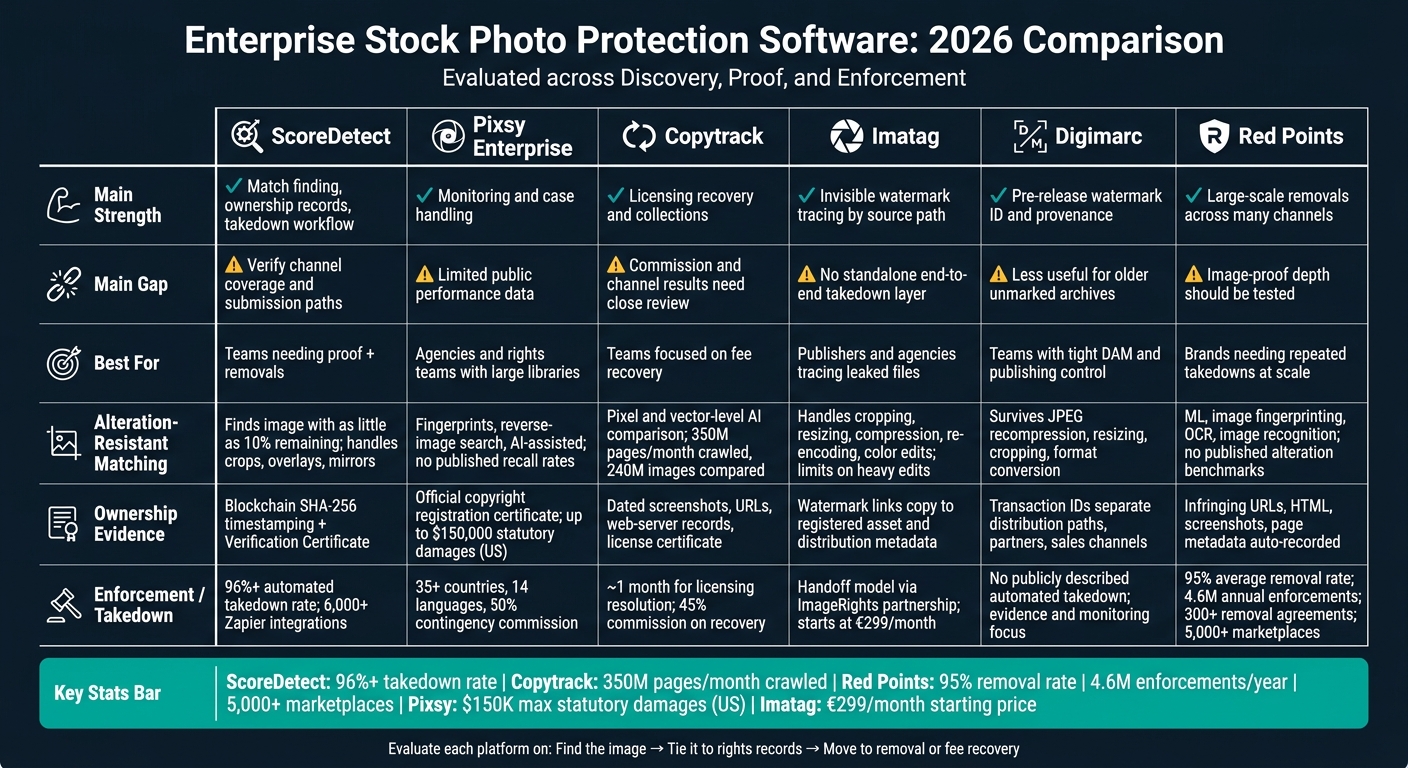
Enterprise Stock Photo Protection Software Comparison 2026
| Platform | Main strength | Main gap | Best for |
|---|---|---|---|
| ScoreDetect | Match finding, ownership records, takedown workflow | Buyers should verify channel coverage and submission paths | Teams that want proof plus removals |
| Pixsy Enterprise | Monitoring and case handling | Public performance data is limited | Agencies and rights teams with large libraries |
| Copytrack | Licensing recovery and collections | Commission and channel results need close review | Teams focused on fee recovery |
| Imatag | Invisible watermark tracing by source path | No end-to-end takedown layer on its own | Publishers and agencies tracing leaked files |
| Digimarc | Pre-release watermark ID and provenance | Less useful for older unmarked archives | Teams with tight DAM and publishing control |
| Red Points | Large-scale removals across many channels | Image-proof depth should be tested | Brands that need repeated takedowns at scale |
The core takeaway is simple: reverse-image search alone is not enough. I’d use this comparison to check whether each platform can find the image, tie it to my ownership records, and move the case to removal or fee recovery without extra manual work.
1. ScoreDetect
ScoreDetect is InCyan‘s enterprise content protection platform. It brings search, proof, and takedown work into one place for stock-photo protection. The goal is simple: help teams find misuse, show ownership, and send takedowns. It starts with broad monitoring, because if you can’t find the misuse, you can’t act on it.
Discovery Coverage
For discovery, the main issue is reach. Indago and Idem – InCyan’s search enforcement and multimodal matching tools – scan websites, marketplaces, and social platforms, with a reported 95% success rate against anti-bot defenses.
That sounds strong on paper. But buyers should still check the details before moving ahead. In particular, ask about coverage for:
- Login-gated pages
- Dynamically rendered pages
- Social posts
Those edge cases can make a big difference in day-to-day use.
Alteration-Resistant Matching
When copies have been changed, matching quality matters most. Idem can identify an image even when as little as 10% of the image remains. That includes crops, compression, mobile edits, color changes, text overlays, mirrored images, and composites.
In plain English, it can still find a file after someone has chopped it up, slapped text on top, flipped it, or stitched it into something else. That’s a big deal for stock-photo owners, since misuse often doesn’t look like a clean duplicate.
InCyan’s Tectus product adds invisible watermarking as extra proof. But it isn’t the only way detection happens. Visual matching can still find copies that were never watermarked.
Ownership Evidence
Once a match is found, proof moves to the front of the line. ScoreDetect’s blockchain vs traditional timestamping records a SHA-256 checksum of the original file on a public ledger, establishing that a file existed in a specific form at a specific time.[1]
The Verification Certificate includes:
- Asset ID
- Owner name
- Registration date
- File hash
- Blockchain URL
It can also be exported as a PDF. That certificate works best as supporting proof, not as the only evidence of ownership or infringement.
Enforcement Workflow
After proof is assembled, the case moves into takedown. Before sending any notice, confirm the license. That’s step one, and it matters.
Automated takedown notices report a 96%+ removal rate. Verified matches can also move into existing systems through Zapier connections across more than 6,000 web apps. For enterprise accounts, a dedicated success manager is included, which can help if an initial notice doesn’t work.
Before deployment, buyers should confirm a few practical points: which destinations allow automated submission, how counter-notices are handled, and what reporting is available by asset, platform, and recovered licensing value.
2. Pixsy Enterprise
Pixsy is an image-protection platform built for monitoring, takedown, and recovery. It brings discovery and enforcement into one interface, which makes it a fit for stock-photo agencies and brands with large image libraries.[5][2]
Discovery Coverage
Pixsy monitors the public web and lets teams upload images in batches or connect existing image platforms.[2][3] Country and domain filters help teams sort high-priority commercial infringements from authorized placements, editorial uses, or results that don’t matter.
Before rollout, check coverage where misuse is most likely to hurt you: marketplaces, social platforms, and login-protected sites.[7]
That leads to the next check: can it still find copies after the image has been changed?
Alteration-Resistant Matching
Pixsy uses fingerprints, reverse-image search, and AI-assisted matching to find resized, recompressed, cropped, mirrored, color-shifted, and text-overlaid copies.[2][4][6] That matters because image theft rarely shows up as a perfect duplicate.
Pixsy does not publish independent recall rates, so it’s smart to test representative edits before purchase.
Ownership Evidence
Once Pixsy finds a match, the next issue is ownership proof. That’s what decides whether a case can move ahead. Pixsy offers copyright registration services that produce an official copyright registration certificate.[3]
For U.S. stock-photo owners, registration can support statutory damages of up to $150,000 per work in qualifying cases.[3] But detection and registration are not the same thing. A match report can flag possible misuse, but by itself it does not prove infringement.
Enforcement Workflow
After proof is in place, the process moves to takedown. Pixsy sends localized takedown requests across more than 35 countries and 14 languages, keeps watching the page after notice, and alerts teams when removal happens.[4][5]
If removal alone doesn’t solve the problem, Pixsy also pursues compensation recovery on a contingency basis. It takes a 50% share of successfully resolved cases.[3][8]
3. Copytrack
For teams that want enforcement tied straight to licensing recovery, Copytrack uses a case-based workflow. It combines image monitoring with case handling for retroactive licensing, payment collection, and legal escalation.[11][16] That makes it a fit for stock-photo agencies and brands that want a partner to chase licensing revenue, not just hand over a list of matches.
Discovery Coverage
Copytrack says its monitoring runs continuously and worldwide across registered images online.[9] The company also says its crawlers visit up to 350 million pages a month and compare more than 240 million images.[10]
Those figures come from the vendor, so don’t treat them as a verified 2026 benchmark. In an enterprise rollout, the smart move is to test coverage against your highest-value channels and measure how many known infringements the system actually finds.
Alteration-Resistant Matching
Copytrack states that its AI compares images at the pixel and vector levels instead of relying only on filenames or metadata.[10][11] The goal is simple: catch duplicated or modified images, including common stock-photo misuse.
At the same time, older vendor accuracy claims shouldn’t be used as current benchmarks.[12][14] If you’re reviewing tools for 2026, check precision and recall on your own test set before you accept any vendor-reported figure.
Ownership Evidence
Once a match appears, the evidence package matters just as much as detection. When Copytrack identifies a suspected use, its evidence materials can include dated screenshots, the image URL, web-server records, and a license certificate.[13][15] Copytrack also refers to an online Evidence Report tied to a case ID.[18]
Have your own records lined up before a case starts:
- Original files
- Contributor agreements
- Creation dates
- License records
Enforcement Workflow
Copytrack’s workflow moves from verification to contact, retroactive licensing, collection, and legal enforcement through local counsel or collection partners.[11][14] Licensing resolution usually takes about one month, while legal enforcement takes longer.[11]
There’s also the money side. Copytrack’s published terms list a 45% commission across licensing, collection, and judicial enforcement, so you need to factor that into expected net recovery before assigning a case.[17] It helps to set an internal rate card by territory, duration, media type, and placement before cases are filed.[16]
The next decision point is whether a platform also strengthens proof of ownership before enforcement begins.
4. Imatag
Imatag combines invisible watermarking with visual search. In plain English, it can confirm a registered copy or surface visually similar matches across the web. That gives stock-photo owners a way to trace leaked or reposted images back to a specific distribution channel, not just spot duplicates.
Discovery Coverage
Imatag monitors web, social, marketplace, and custom sources through its API and scheduled searches.[19][23] It processes tens of millions of reverse-image searches each day, and its recognition is built to handle geometric changes, cropping, resizing, and compression.[22]
Public sources don’t spell out exact platform coverage. So if you’re buying at the enterprise level, ask for a channel-by-channel coverage map and test data against your own catalog.
Alteration-Resistant Matching
Imatag’s invisible watermark can still be detected after common changes like cropping, resizing, compression, re-encoding, screenshots, and color or contrast edits.[20][21][25] Its matching flow starts with a downscaled copy of the original image to find the match, then reads the embedded code.[29] That watermark check helps separate registered copies from images that only look similar.[20]
There is a limit, though. Imatag’s technical materials say that heavily changed images can hit a point where detection no longer works.[27] Before a full rollout, test the cases most likely to cause trouble, such as:
- AI-assisted edits
- Thumbnail crops
- Print scans
- Other close variations based on your own files
Ownership Evidence
Because the watermark links a detected copy back to a registered asset and its distribution metadata, it can trace a detected copy to a specific file, recipient, and distribution path.[26][29] That trail can help support licensing claims and sort high-value cases from lower-priority ones.
Enforcement Workflow
Imatag stops at detection and verification. Takedowns, claims, and recovery still need a partner or your own legal team. Its partnership with ImageRights describes a handoff model where confirmed unauthorized uses can be sent to copyright experts and law firms for resolution and recovery.[24]
Public pricing starts at €299/month for monitoring, with enterprise volume priced by quote.[28] Before you sign, ask for a current USD quote and pin down the details around API access, per-image limits, taxes, contract length, onboarding, implementation costs, and any fees tied to enforcement partners.
The next comparison looks at platforms that go further on scale and enforcement.
5. Digimarc
For teams that add watermarks at ingestion, the job changes a bit. Instead of hunting across the open web first, you can verify the file itself. Digimarc uses invisible, machine-readable watermarks embedded directly in the image before distribution, then detects those marks later when the image shows up in reuse. That setup fits stock-photo teams that can watermark assets early and then investigate later use.
Discovery Coverage
Digimarc’s web-crawling reports are designed to help customers find unlicensed uses of watermarked images on the internet.[36] In practice, Digimarc works best for assets that were protected before release and is less useful for older stock libraries that were never watermarked. That matters if the original distribution path is part of the case. If you’re dealing with unwatermarked legacy images, you’ll still need a separate crawler or reverse-image-search tool.
Alteration-Resistant Matching
The watermark should survive JPEG recompression, resizing, cropping, format conversion, and editing.[35] Digimarc also states that its watermarking technology can help recover provenance information even when metadata or Content Credentials have been stripped or swapped.[30][31][32] That’s a big deal, because metadata alone can disappear fast once a file starts bouncing around online. Still, don’t assume every edit behaves the same way. Before a full rollout, test detection against the exact transformations your images are likely to face.
Ownership Evidence
Because the watermark is applied before distribution, a detected copy can be tied back to a specific asset and rights holder. Transaction IDs can separate distribution paths, partners, sales channels, and internal teams.[33][34] That kind of asset-level provenance gives enforcement teams a much firmer paper trail than filename or metadata checks alone. Put simply, it’s stronger evidence than relying on a stripped EXIF field.
Enforcement Workflow
Detection and proof are strong, but enforcement is not fully automated. Digimarc does not publicly describe automated takedown support, so buyers should ask whether the contract includes DMCA notice generation, platform-specific delisting submissions, counter-notice handling, and removal tracking – or whether Digimarc is providing evidence and monitoring only. Use Digimarc when you control the image pipeline. If your main goal is finding unwatermarked copies already online, pair it with a crawler built for unwatermarked archives.
6. Red Points
Red Points takes a broad detection-and-removal approach. It’s built for teams that need unauthorized stock-photo uses taken down fast across many channels. That makes it a strong fit when the main goal is fast enforcement after an image has already spread online.
Discovery Coverage
The platform’s bots scan more than 5,000 marketplaces along with social networks like Facebook, Instagram, X, TikTok, Pinterest, and YouTube, plus standalone websites, search engines, ads, and AI shopping tools.[37][40][41] That kind of reach lines up with the main ways stock photos get reused: marketplaces, ads, social posts, and publisher sites.
Still, broad reach on paper isn’t enough by itself. You’ll want to confirm coverage in the places where your images are most likely to show up.
Coverage also matters only if the platform can spot altered copies, not just exact matches.
Alteration-Resistant Matching
Red Points uses automated crawling, machine learning, image fingerprinting, OCR, and image recognition to find reused photos even when nearby text changes.[40][41] That said, its public documentation does not put numbers on performance after heavy cropping, resizing, compression, mirroring, color changes, overlays, or partial-image use.
That’s a key gap. Before signing on, buyers should test sample images that reflect how their content usually gets reused in the wild.
Ownership Evidence
Every confirmed incident automatically records infringing URLs, HTML, screenshots, and page metadata.[37][38] That gives enforcement teams more than a bare link. It gives them a proof package they can use for licensing recovery and follow-up action.
Enforcement Workflow
It supports automated DMCA notices, de-indexing requests, host outreach, and API connections to major platforms, backed by 300+ removal agreements.[37][39][41][42] The company reports a 95% average removal success rate across 4.6 million annual enforcements.[41]
Those numbers sound strong, but they’re aggregate figures. If image copyright is your main issue, ask for results tied to that use case instead of relying on platform-wide averages.
Some matches also need a human check. Sublicensed campaigns or editorial uses can get messy fast, so unclear cases should go to manual review instead of automatic submission. Broad automation tends to work best when the same image appears across many channels and needs to be removed again and again.
The next question is whether that removal speed is worth more than deeper proof or watermark-based tracing.
How These Platforms Compare on Detection, Proof, and Removal
These platforms usually fit into two buckets: crawl-based detection and pre-distribution watermarking. The main choice comes down to this: do you need better discovery, stronger proof, or faster removal?
That distinction matters more than it might seem at first glance. Some tools are built to scan the web and surface likely misuse. Others are built to tie a copy back to a protected source before the file spreads. One helps you find the problem. The other helps you prove the connection.
The table below breaks down what each type of platform does, what kind of evidence it creates, and why that evidence matters.
| What it does | Evidence produced | Why it matters |
|---|---|---|
| Web crawling and reverse-image matching | URLs, page captures, matched-image files, similarity results | Finds unauthorized copies for review and prioritizes likely infringements |
| Marketplace and social monitoring | Listing IDs, seller or account data, post URLs, timestamps, screenshots | Supports fast action against commercial listings and public social posts |
| Watermark or embedded ID | Watermark-detection record, asset ID, distribution or registration link | Links a copy to a protected source |
| Cryptographic hashing and blockchain timestamping | Hash, timestamp, public verification reference, exportable certificate | Establishes that a defined digital fingerprint was recorded by a particular date |
| AI or perceptual matching | Match score, transformation details, comparison image, confidence classification | Detects resized, cropped, compressed, or edited copies and reduces manual review |
| Automated notice generation | DMCA notice, marketplace form, search de-indexing request, rights declaration | Converts validated findings into channel-specific enforcement actions |
| Takedown tracking and escalation | Submission ID, status history, response, removal date, rejection reason | Measures outcomes and identifies cases requiring resubmission or legal review |
| Rights and license records | Ownership documents, license terms, claimant identity, authorization history | Prevents incorrect claims and supports licensing recovery or settlement discussions |
This is the tradeoff that separates tools built to verify ownership from tools built to remove misuse at scale. If you only have detection, you may still need extra documentation before a platform acts. If you only have proof, you may still need a way to find where the content is being used.
And even then, removal is never automatic. Results depend on the strength of the rights proof, the quality of the notice, and the rules of the platform receiving it.
The next section weighs those tradeoffs in plain pros and cons.
Pros and Cons
No single platform does everything equally well. This table cuts the choice down to the tradeoff that matters most: proof, discovery, or removal.
| Product | Key pros | Key cons | Best-fit buyer |
|---|---|---|---|
| ScoreDetect | Web monitoring, match validation backed by documented evidence, and a 96%+ takedown rate | Blockchain timestamping alone does not watermark or discover copies; buyers needing invisible watermarking, alteration-resistant matching, or search-result delisting should add the corresponding InCyan tools | Stock photo owners and agencies that need proof, monitoring, and takedowns |
| Pixsy Enterprise | Strong case handling and enforcement support | Enterprise coverage and jurisdictional handling need verification before rollout | Photographers, agencies, and rights teams managing image cases at scale |
| Copytrack | Connects confirmed infringements to licensing claims and settlements | Pricing, success fees, and jurisdictional coverage need review before signing | Stock-photo owners focused on turning infringements into licensing recovery |
| Imatag | Invisible watermarking without changing the image’s appearance; traces copies to a specific distribution path | Does not independently find unwatermarked copies; requires a separate discovery or takedown layer | Agencies and publishers distributing previews, proofs, or licensed files who need provenance traceability |
| Digimarc | Enterprise-grade watermarking and content identification | Works best before release; does not retroactively protect copies already in circulation | Large publishers, media companies, and stock libraries with mature DAM and publishing pipelines |
| Red Points | One enforcement program across multiple IP types with broad channel reach | Less specialized for stock-photo provenance and licensing recovery; image-recognition depth and evidence standards should be verified | Brands and enterprises needing centralized, multi-channel IP enforcement beyond photography |
Use the table to line up your main gap with the right platform category:
- Proof: pick tools built for documented evidence and match validation
- Discovery: pick tools that can find copies across the web
- Enforcement: pick tools built to remove infringing use or recover licensing value
If you need more than one outcome, you may need a stack rather than a single product. That’s often the real dividing line here.
Conclusion
In 2026, pick software that does more than spot copies. It should find copied stock photos at scale, prove ownership, and turn detections into confirmed removals or recovered licensing fees. Before you roll anything out, test that full process from start to finish.
A smart place to begin is a controlled ScoreDetect evaluation. Its web monitoring, documented evidence, and 96%+ takedown rate make it a practical starting point. If you also need invisible watermarking, resilient matching, or de-indexing, bring in Tectus, Idem, and Indago.
Then use the pilot to track what matters once this is live. Run a 30–90 day pilot on high-value images, common edits, and the channels where misuse shows up most often. Watch metrics like:
- false-positive rate
- percentage of alerts with complete ownership evidence
- average time from discovery to a case ready for submission
- removal or delisting success rate
- licensing fees recovered, where applicable
Define success as four separate outcomes:
- notice submitted
- notice accepted by the platform
- content removed
- licensing fee recovered
Before you automate enforcement, make sure the platform supports U.S. DMCA workflows, counter-notice handling, and chain-of-title documentation.
The right fit depends on your rights records, channel coverage, and recovery workflow. If the pilot passes, move from test cases to full portfolio coverage. Roll out only after the pilot shows acceptable accuracy, complete evidence, and repeatable removals across the channels you use – commercial websites, marketplaces, social posts, and image-search results.
FAQs
How do I test image-matching accuracy before rollout?
Run a pilot phase before the full rollout, usually around week 9 of deployment.
Use real-world results to fine-tune confidence thresholds and balance detection rates against false positives, which usually fall between 5% and 15%. That matters because a system can look good in testing and still get messy once it meets actual user behavior.
It’s also smart to test how the system holds up after compression, editing, and AI-driven regeneration. Those changes can throw off detection if you don’t account for them early. For edge cases, bring in human review so the system is calibrated properly before you scale.
What proof do I need before sending takedowns?
First, make sure the use is in fact unauthorized. Check your rights records for any active licenses, territory limits, or fair use issues.
Then put together a solid evidence package. Include the infringing URL, a timestamped full-page capture or HTML snapshot, and the original file with its internal asset ID.
If you want to make the file stronger, add:
- blockchain-verified ownership certificates
- SHA-256 checksums
- invisible watermark detection results
That way, you’re not just saying, “This is mine.” You’re showing a clear paper trail that can hold up under scrutiny.
Can one platform cover websites, marketplaces, and social media?
Yes. ScoreDetect brings discovery, analysis, and enforcement into one workflow, which means you can monitor websites, marketplaces, and social media at the same time.
It uses web scraping and AI-driven image matching to spot unauthorized use. Then it generates evidence and automates takedown notices based on each platform’s requirements.