The best image watermarking and monitoring platform for publishers in 2026 is the one that handles all four jobs in one flow: watermarking, web monitoring, proof, and takedowns. Among the options reviewed, only one platform covers all four, while the others focus on one or two parts.
If I were picking from this list, I’d split them like this: one for end-to-end use, one for watermark-first identity checks, one for watermarking plus monitoring, and one for monitoring plus claims. That matters because 95% bot-defense handling, 96%+ takedown rates, 40 billion indexed images, and pricing from $11.31/month to $399/month point to very different use cases.
Here’s the short version:
- ScoreDetect: best if I want one system for proof, hidden watermarking, monitoring, and takedowns
- Digimarc: best if I care most about hidden image identity and file verification
- Imatag: best if I want hidden watermarking with large-scale web search
- Pixsy: best if I mainly need match finding and claim handling
Quick comparison
| Platform | Hidden watermark | Web monitoring | Proof/evidence | Takedown workflow | Best for |
|---|---|---|---|---|---|
| ScoreDetect | Yes, Enterprise | Yes, Enterprise | Yes | Yes, Enterprise | Publishers that want one workflow |
| Digimarc | Yes | Limited in reviewed material | Yes | Not clearly shown | Identity and verification |
| Imatag | Yes | Yes | Yes | Not clearly shown | Tracking reuse across the web |
| Pixsy | No | Yes | Partial, manual file building | Yes | Monitoring and recovery |
That’s the lens I’d use for the rest of this piece: not just who watermarks images, but who helps me trace misuse from upload to removal.
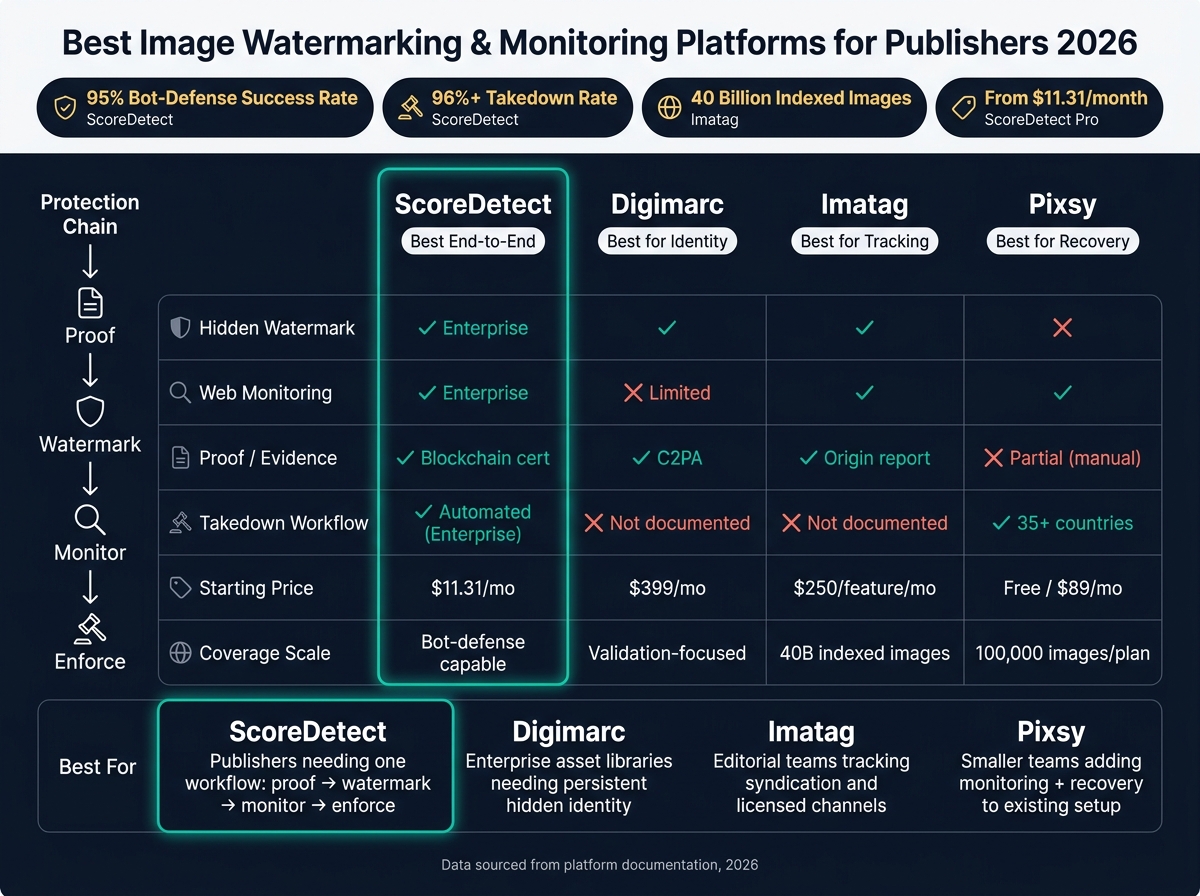
Best Image Watermarking & Monitoring Platforms for Publishers 2026
1. ScoreDetect
ScoreDetect brings together blockchain timestamping, invisible watermarking, monitoring, evidence generation, and automated enforcement. In plain English, it aims to cover the full chain: prove ownership, find copied content, and act on it.
Watermark Persistence
Invisible watermarking is available only on the Enterprise plan and is delivered through InCyan‘s Tectus blind watermarking solution. The watermark is made to stay out of sight and avoid altering the file in a noticeable way. That helps with rights checks and syndication tracking from the moment an image leaves your hands.
Idem is built to survive cropping, compression, memes, and mobile edits. It can still identify content even when only 10% of the original remains. That staying power is what makes later monitoring worth doing.
Discovery Coverage
Enterprise-tier discovery runs through InCyan’s Indago and Idem platforms. Indago uses high-speed search and forensic matching to remove unauthorized listings from search results in under 60 minutes. Idem handles multimodal matching across images, video, and audio against a proprietary database.
ScoreDetect says it has a 95% success rate against bot defenses [10][11]. That matters when the goal is revenue protection or anti-piracy monitoring, especially on sites that push back against crawlers and make stolen images harder to track down.
Evidence Quality
When a match is confirmed, ScoreDetect creates verifiable certificates with:
- the SHA-256 hash
- the public blockchain URL
- the registration date
- the copyright owner name
- a formal notice for authorities and platforms
Pro users get 100 certificates per month included. Extra certificates cost about $0.1131 each [11]. These certificates can back up claims during licensing disputes and enforcement work. Once infringement is confirmed, the process shifts from proof to action.
Enforcement Workflow
Automated takedown notifications are available only on Enterprise. ScoreDetect reports a takedown rate of more than 96% on automated delisting notices [10][11]. Enterprise also includes a dedicated success manager and 24/7/365 premium support.
Pro users don’t get automated enforcement. They handle that part themselves, using the certificates as support when filing complaints or sending notices.
| Capability | Pro | Enterprise |
|---|---|---|
| Blockchain timestamping | ✓ | ✓ |
| Verifiable certificates (100/mo included) | ✓ | ✓ |
| Invisible watermarking (images, video, audio, docs) | ✗ | ✓ (via InCyan/Tectus) |
| 24/7 content & brand monitoring | ✗ | ✓ |
| Automated takedown notifications | ✗ | ✓ |
| Dedicated success manager | ✗ | ✓ |
| SSO, white labeling, custom domain | ✗ | ✓ |
| Pricing | $11.31/month billed annually; $12/month billed monthly | Custom quote |
These plan differences matter most for publishers who want ownership proof tied straight into monitoring and takedown action.
sbb-itb-738ac1e
2. Digimarc
Digimarc places an imperceptible digital watermark inside an image’s pixels, giving the file a persistent identity signal without changing what readers see.[8][7][9] In plain English, the image looks the same, but it carries a hidden marker that can be checked later. This section looks at Digimarc mainly as a watermark-first system for identity and verification.
Watermark Persistence
Digimarc’s technical material separates its watermarks into Chroma and Classic. Chroma can usually be recovered after an image is scaled to about 25% of its original size, and in some cases down to 15%. Classic is usually recoverable after scaling to about 60%.[15]
The watermark is built to survive compression, resizing, cropping, and format changes.[12] That sounds good on paper, but there’s a catch: publishers still need to test their own pipeline. A CMS, CDN, thumbnail generator, screenshot flow, or social-media export can change an image in ways that affect detection.[12][15] A watermark that survives editing is useful only if it can still be read dependably at scale.
Discovery Coverage
Validate scans an uploaded image for a watermark and confirms ownership or unauthorized use.[13][14] The public material puts the focus on reading the watermark and verifying it, not on broad web-wide monitoring.[1][13]
That distinction matters. If a publisher needs steady monitoring across news sites, social platforms, and image marketplaces, Digimarc makes more sense as an identity and verification layer than as a full discovery stack. In other words, it can help answer Is this ours? But it may not be the thing that finds every use across the web. Once a watermark is found, the next step is whether it can help prove the claim.
Evidence Quality
When Digimarc detects a watermark, it can resolve that signal to a digital identity and related metadata, including ownership, provenance, and editing history through C2PA Content Credentials.[13][16] It can also relink an image to its credentials if those credentials have been detached from the file.[16]
That’s a strong trait for evidence building. Still, the watermark alone usually shouldn’t do all the work. It makes more sense to pair the detection with:
- a timestamped URL capture
- the original watermarked file
- ownership records
That mix gives a publisher a cleaner record if the case moves from verification to a complaint or dispute.
Enforcement Workflow
Documented enforcement features aimed at publishers appear limited in the reviewed material.[13][8] Validate pricing starts at $399 per month.[5] So if a publisher is weighing Digimarc, the smart move is to ask direct questions early: What does the enforcement workflow look like? Which platforms are supported? Is takedown execution part of the service, or does it sit somewhere else?
| Evaluation area | Digimarc’s documented capability | Publisher implication |
|---|---|---|
| Watermark persistence | Designed to survive compression, resizing, cropping, and format changes; Chroma recoverable at about 25% of original size, in some cases 15%.[12][15] | Strong, but test against your CMS/CDN pipeline. |
| Discovery coverage | Focuses on detecting and resolving embedded watermarks; web-wide monitoring is not clearly documented.[13][14] | Pair with a monitoring service. |
| Evidence quality | Can resolve a watermark to digital identity and C2PA provenance information.[13][16] | Combine with URL captures and asset records. |
| Enforcement workflow | Automated takedown, delisting partners, and success-rate data are not documented in reviewed sources.[13][8] | Plan for a separate enforcement workflow. |
3. Imatag
Imatag embeds an invisible identifier into an image so publishers can trace reused files back to the source. To the eye, the file looks the same. But under the hood, that hidden ID can support later ownership checks. For publishers, the main draw is simple: it helps connect reuse back to a licensed source.
In May 2026, dpa Picture Alliance selected Imatag to support licensing enforcement, unauthorized-use monitoring, and content authenticity.[20]
Watermark Persistence
Imatag says its watermark can still be detected after common changes like resizing, cropping, compression, format conversion, and re-encoding.[17][18][20] That sounds strong on paper. Still, publishers should test it in the places where images actually move around: the CMS, CDN, social exports, and screenshot-heavy workflows.
That leads to the next issue: finding copies at scale. A watermark only helps if the system can locate reused images out on the web.
Discovery Coverage
Imatag crawls the web and uses reverse-image indexes such as Google and Bing to find registered images across websites and documents, including PDFs, catalogs, and magazines.[17][19][22] Its API docs mention a web image index of 40 billion indexed web images and support scheduled searches for registered media.[19]
That kind of reach matters because reuse usually happens after publication and syndication. If an image gets picked up, altered a bit, and reposted elsewhere, web-wide detection can help protect licensing revenue.
There are still gaps to check before rollout. Private pages, newly published content, and posts locked inside closed platforms may not show up. So it makes sense to confirm crawl frequency, geographic coverage, and search limits before deployment.
Evidence Quality
When Imatag finds a match, it can return watermark-verified copies and visually similar matches, including images that were cropped, resized, compressed, or geometrically altered.[17][18][19] Its authenticity workflow links the detected copy back to the registered source asset and can generate an origin-and-alteration report.[23]
That gives publishers more than a "looks similar" result. It ties the found image to the source asset in a way that is more useful for enforcement. Even so, a solid evidence file should also include:
- The matched image
- The URL
- The hosting domain
- The page title
- The discovery date
- The original asset
Enforcement Workflow
Strong matches are only part of the job. They still need to turn into notices, follow-up, and, when needed, takedown action. Imatag’s documented features focus on identification, web discovery, certified matching, and reporting, not a clearly documented end-to-end automated takedown service.[19][21][22]
So the safer read is this: use Imatag as a discovery and evidence layer unless takedown execution is clearly included in your plan.
| Evaluation area | Imatag’s documented capability | Publisher implication |
|---|---|---|
| Watermark persistence | Invisible identifier embedded in visual content; described as surviving common transformations such as resizing, cropping, compression, format conversion, and re-encoding.[17][18][20] | Test against your actual CMS, CDN, and social export pipeline before relying on automated alerts. |
| Discovery coverage | Web crawling plus reverse-image indexes such as Google and Bing; 40 billion indexed web images; Coverage includes PDFs and digital publications.[17][19][22] | Useful for broad reuse tracking, but confirm crawl frequency, platform scope, and geographic coverage contractually. |
| Evidence quality | Watermark verification links a detected copy to the registered source; origin-and-alteration reporting available.[23] | Stronger than visual similarity alone; pair with URL captures and ownership records for a complete enforcement package. |
| Enforcement workflow | Detection, reporting, and web discovery are documented; end-to-end automated takedown is not clearly documented.[19][21][22] Monitoring starts at $250 per feature per month for 10,000 monitored assets.[4][24][25] | Use Imatag as a discovery and evidence layer unless takedown execution is explicitly included in your plan. |
4. Pixsy
Pixsy fits the discovery-and-enforcement part of publisher protection. It uses reverse-image matching to spot reused images across the web. In plain English, it’s much better at finding and acting on image misuse than proving a lasting image identity over time.
There’s no documented invisible or embedded watermark.[27] So Pixsy helps with monitoring and enforcement, not prevention.
Watermark Persistence
no invisible or embedded watermark is documented.[27]
Discovery Coverage
Publishers can connect websites, link social accounts, or upload images by hand, and Pixsy will show possible online matches.[29][30] Pixsy also advertises 24/7 active monitoring, and higher-tier plans get higher scan priority.[2][30]
That said, coverage can fall short on private pages, closed communities, and content locked down by platform rules.
Once a match shows up, the next step is building a record that can support removal or recovery.
Evidence Quality
Pixsy identifies the matching page, but publishers still need a standard evidence file. Its guidance recommends:
- capturing a high-resolution screenshot that shows both the image and the URL
- saving a timestamped PDF of the page
- archiving the page in a service such as Archive.org[28]
That gives publishers a usable evidence packet: the matched page, screenshot, PDF, and archive, ready for removal or recovery. For U.S. enforcement, copyright registration with the U.S. Copyright Office still matters if the publisher wants to pursue a federal infringement lawsuit and certain remedies.[27]
Enforcement Workflow
After review, publishers can send a takedown notice or submit the case for compensation recovery.[2][26] Pixsy says its takedown notices can be generated for more than 35 countries and 19 languages.[31]
Compensation cases are submitted at no cost, and Pixsy takes 50% of any amount it recovers.[26] The top paid tier costs $89/month, covers up to 100,000 monitored images, and includes 900 takedown notices per month.[2]
| Evaluation area | Pixsy’s documented capability | Publisher implication |
|---|---|---|
| Watermark persistence | Reverse-image monitoring and image matching; no invisible embedded watermark documented[27] | Best used alongside a separate watermarking or asset-registration system |
| Discovery coverage | Website, social-account, and manual image monitoring; higher scan priority on higher tiers[2][29][30] | Useful for finding reposts, but confirm coverage of priority channels |
| Evidence quality | Matching-page identification plus publisher-captured screenshots, PDFs, and archives[28] | Build an internal evidence process before enforcement |
| Enforcement workflow | Takedown notices in 35+ countries and 19 languages; compensation recovery with a 50% fee[26][31] | Practical for multinational removal requests, with shared recovery economics |
Pros and cons for publishers
Use the summary below to map each platform to a publisher workflow: proof, discovery, evidence, or enforcement.
ScoreDetect covers all four stages. What sets it apart is the mix of blockchain-backed ownership proof, invisible watermarking, web monitoring that can get past bot defenses, and automated takedown execution. The main catch is simple: watermarking and 24/7 monitoring are only available on the Enterprise plan.
Digimarc Validate makes sense when persistent hidden identification and asset authentication matter most. Its hidden signal survives copying and redistribution.[9] The trade-off is that public material leans more toward validation than automated enforcement, and pricing requires a sales conversation.
Imatag fits editorial teams that want invisible watermarking plus monitoring across known channels. The big caveat is enforcement: end-to-end automated takedown is not clearly documented across every plan level.
Pixsy is about discovery and recovery, not prevention. It’s a good match for smaller teams that need monitoring and recovery support, but not a prevention layer. Before signing up, publishers should check whether the plan’s notice caps and evidence package match how their team works.
In practice, the right pick comes down to which protection stage matters most.
| Platform | Key strengths | Main limitations | Best-fit publisher type | Plan scope caveats |
|---|---|---|---|---|
| ScoreDetect | Full-stack: proof of ownership, invisible watermarking, web monitoring, 96%+ takedown rate; WordPress plugin; API access | Watermarking and 24/7 monitoring are Enterprise-only | Publishers needing end-to-end protection from proof to enforcement | Pro includes 100 certificates/month; additional certificates cost about $0.1131 each; 200,000-certificate lifetime ceiling applies[11] |
| Digimarc Validate | Hidden signal survives copying and redistribution; Adobe and Acquia integrations[13] | Validation-focused; takedown automation not clearly documented | Publishers with structured asset libraries and enterprise creative stacks | Custom quote required; repeated watermarking of the same image counts toward usage[32] |
| Imatag | Invisible watermarking plus monitoring of known channels; supports authenticating digital images and licensing reconciliation[6] | Automated global enforcement not clearly included at every tier | Editorial teams tracking syndication partners and licensed channels | Asset, site, user, and frequency limits vary by plan[4] |
| Pixsy | Free monitoring for up to 500 images; paid tiers add larger libraries, priority scanning, and takedown allowances[2][3] | Discovery and recovery only; no prevention layer | Smaller publishers or freelance-heavy teams adding monitoring to an existing setup | Success-based fee is 50% of recovered compensation[2][3] |
Next, weigh these trade-offs against your own monitoring volume and enforcement needs.
Conclusion
When you stack up protection, discovery, proof, and enforcement side by side, one thing becomes pretty clear: the best platform handles the entire chain from start to finish. For publishers, that means more than just finding copied content. It means helping protect revenue, verify rights, track syndication, and act on piracy.
ScoreDetect is the clearest fit for publishers that want one workflow from registration to takedown. It brings together ownership proof, invisible watermarking, monitoring, and automated takedowns in one platform. During procurement, don’t just take performance claims at face value. Ask for comparable publisher results, platform coverage, geographic scope, and reporting periods.
Teams with heavier rights operations may land elsewhere. Large media organizations with big asset libraries and multi-channel rights operations should look closely at the broader enterprise stack.
Before you sign anything, get clear on who owns each step. Which tasks will stay with your team, and which ones should the platform handle on its own? That line matters. The right pick is the platform that turns every match into a documented enforcement action.
FAQs
How do I test watermark durability in my publishing workflow?
Run a pilot before full deployment. Build a test set from your own assets that mirrors the kinds of changes you see in production, like resizing, heavy compression, cropping, color edits, and format conversions.
Then send those files through your detection system and check three things:
- The watermark is still recoverable
- The edited copy links back to the original registered asset
- False positives stay within an acceptable range
This step gives you a clear read on how the system holds up once files get changed, compressed, and republished in the wild.
What evidence should I collect before sending a takedown?
First, confirm the use is unauthorized. Check your rights records for active licenses, territory limits, or fair use. Then put together a clear evidence package with a documented chain of custody.
Include:
- The infringing page and hosting details
- A timestamped full-page capture or HTML snapshot
- The original file and asset ID
- Proof of ownership
- Watermark detection results
- A side-by-side comparison
- Access logs
This gives you a clean record of what was used, where it appeared, and why the use falls outside your rights terms.
Which plan do I need for automated monitoring and enforcement?
You’ll need the ScoreDetect Enterprise plan if you want automated monitoring and enforcement.
The Pro plan covers ownership proof and timestamped records. The Enterprise plan adds 24/7 content monitoring, invisible watermarking for image, video, and audio, plus automated takedown workflows for continuous protection at scale.