If you want to match edited media, single-frame or single-file checks are not enough. I’d sum this topic up like this: multimodal sequence feature extraction turns text, audio, and video over time into embeddings a model can compare, align, and match – even when clips are cropped, compressed, or only partly reused.
Here’s the short version:
- I start with separate encoders for each input type:
- text → token embeddings
- audio → spectrogram-based features
- video → frame or clip features
- Then I model time order with:
- RNNs for step-by-step streaming
- TCNs for parallel time modeling
- Transformers for full-sequence context
- After that, I deal with alignment across streams that run at different speeds:
- timestamp matching
- dynamic time warping
- attention-based matching
- Last, I fuse the streams:
- early fusion
- mid-level fusion
- late fusion
What matters most is the output: a shared sequence representation that can support subsequence matching, not just full-copy detection. That means a system may still flag reuse when only 10% of an original asset is left, and research surveys now cover 260+ studies on alignment and fusion methods.
If I were explaining why this matters in one line, I’d say this: the model is not just looking at what appears, but when it appears and how signals line up across media.
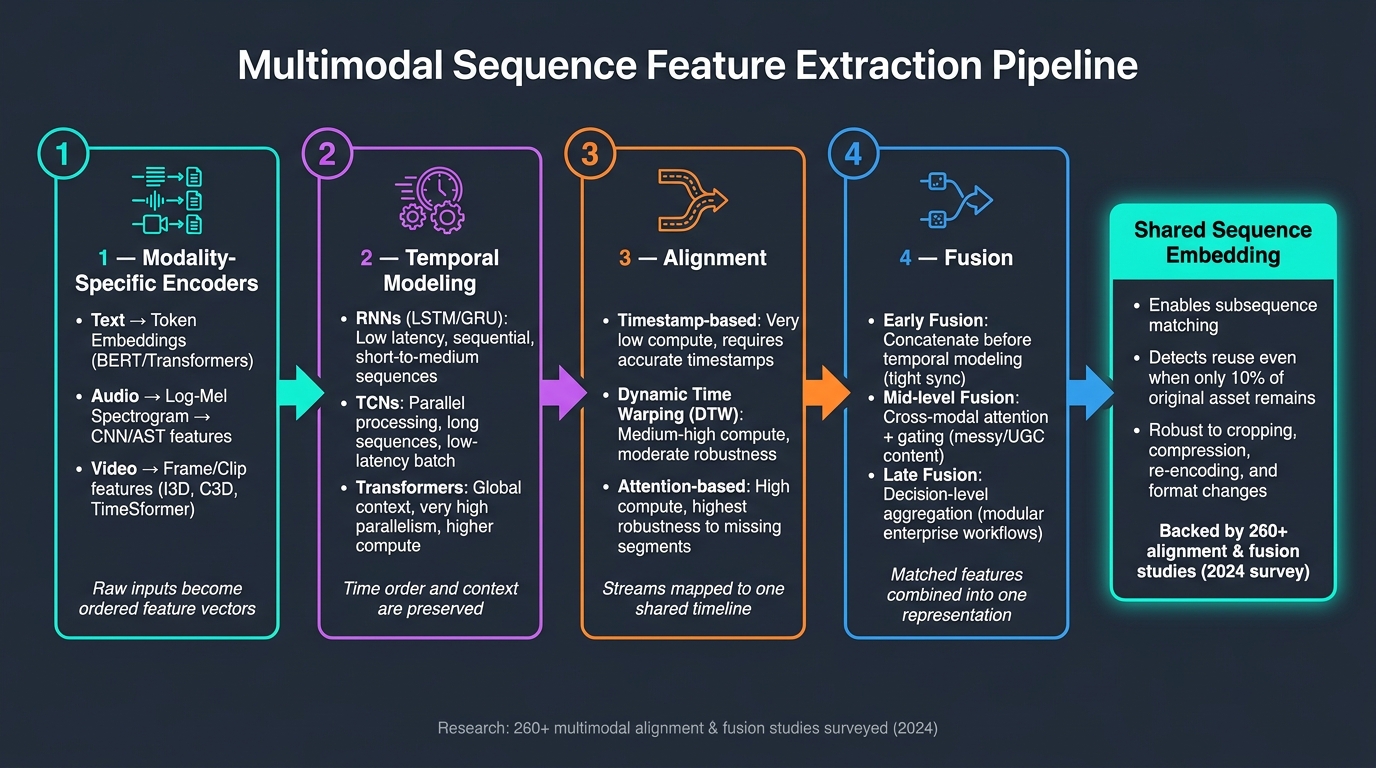
Multimodal Sequence Feature Extraction: 4-Step Pipeline Explained
Quick comparison
| Part | What it does | Main trade-off |
|---|---|---|
| Modality encoders | Turn raw text, audio, and video into ordered feature vectors | Each stream needs its own preprocessing |
| Temporal models | Learn order, timing, and long-range context | Longer sequences cost more compute |
| Alignment | Match events across streams on one timeline | Better matching often means more compute |
| Fusion | Combine matched features into one representation | Bad sync can hurt joint representations |
| Sequence matching | Find reused segments across edits and partial copies | Similarity still needs review and policy rules |
In other words: this is the layer that helps media systems move from raw inputs to time-aware similarity signals for matching, monitoring, and ownership support.
sbb-itb-738ac1e
How neural networks extract features from each modality over time
The first step is modality-specific encoding. Each input stream keeps its own structure before the system starts modeling time. In plain English, the model first turns raw text, audio, and video into ordered feature sequences that later temporal models can read. Each encoder outputs a sequence of feature vectors that keeps the original time order intact.
Text, audio, and video encoders
Text encoders start with tokenized text and map each token to an embedding. Transformer-based models like BERT process the entire token sequence in one pass using self-attention, which gives every token a context-aware representation. That makes Transformers a strong fit for longer or more complex text, since they handle long-range context well and support parallel processing.
Audio encoders usually begin by converting raw waveforms into time-frequency representations. One common option is the log-Mel spectrogram. Here, the waveform is split into time-frequency frames, and each frame becomes a frequency snapshot. A CNN or Transformer then reads those snapshots and produces one feature vector per frame or window. A well-known example is the Audio Spectrogram Transformer (AST), which applies attention directly to spectrogram patches without convolutions and shows that pure Transformer encoders can reach state-of-the-art audio classification results.[1][2]
Video encoders often use CNNs or Vision Transformers on individual frames or short clips, producing one feature vector per frame or clip. 3D CNN models such as I3D and C3D go a step further by processing spatiotemporal volumes directly, which helps them pick up local motion patterns across short frame windows. Transformer-based video models like TimeSformer extend this idea by applying self-attention across both space and time. The result is a compact sequence of vectors that makes later alignment and fusion much easier, even across long, edited video. These techniques are foundational for content matching algorithms used in digital rights management.
Temporal models: RNNs, TCNs, and Transformers
Once each modality has been encoded, the next job is modeling relationships over time. The three main options – RNNs, Temporal Convolutional Networks (TCNs), and Transformers – take different paths here. The best pick depends on sequence length, latency needs, and how much compute you can spend.
RNNs, including LSTMs and GRUs, update a hidden state one step at a time. That makes them a natural fit for streaming setups, where the model needs to emit features as new data arrives.
TCNs use causal dilated convolutions, so they can process many time steps in parallel instead of moving one step at a time. An empirical study that introduced TCNs found that they can beat RNNs on a range of sequence modeling benchmarks, pushing back on the idea that recurrence should be the default for temporal data.[3][4]
Transformers use self-attention across the full sequence at once. That gives them a strong view of global context, but memory use climbs fast as sequences get longer. So they can be powerful, but they also get expensive.
| Model type | Sequence length | Parallelism | Latency |
|---|---|---|---|
| RNNs (LSTM/GRU) | Short to medium | Low | Naturally low |
| TCNs | Long, efficient | High | Low-latency batch |
| Transformers | Strong global context | Very high | Higher for long sequences |
This temporal stage keeps both order and context in place, which matters a lot for similarity analysis across audio, text, and video. After that, the per-modality sequences can be aligned and fused into a shared representation.
How multimodal sequences are aligned and fused
After the system turns audio, video, and text into feature sequences, it still has two jobs left: figure out what lines up and combine what matches.
That first step is alignment. It tells the model which events across different streams belong together. The second step is fusion. It blends those matched features into one shared representation. In many newer systems, the model learns both at the same time. Still, keeping the two ideas separate makes the design much easier to understand. A 2024 survey looked at more than 260 studies focused on multimodal alignment and fusion.[7]
Temporal alignment across modalities
Different streams don’t move in lockstep. Audio, video, and subtitles often run at different rates, so systems usually map them to one shared time scale before matching features.
Timestamp-based alignment is the simplest route. Each stream is normalized to the same timeline, then features are resampled or grouped into fixed windows and matched by time index. In a controlled pipeline, per-frame visual embeddings, ASR speech features, and subtitle embeddings can all be joined through shared timecodes. It’s also the cheapest option.
Dynamic time warping (DTW) bends one sequence to fit another. The catch is cost: standard DTW grows quadratically with sequence length. GTW cuts down that bottleneck for multimodal time series.[5][8] In practice, teams often run DTW on coarser chunks, like sentence-level or shot-level features, instead of every fine-grained step.
Attention-based alignment is the most flexible of the three. A cross-modal attention module lets steps from one modality query another, which means the model learns match scores instead of relying on hard index matches. That helps when streams are only partly synchronized or full of noise, because the model can learn to ignore weak or missing regions. The price is compute. Attention is usually O(T²) for each modality pair, so long-form media often needs windowed or hierarchical designs.
| Alignment method | Data requirements | Robustness to missing segments | Compute cost |
|---|---|---|---|
| Timestamp-based | Accurate timestamps, shared clock | Low – gaps need explicit masking or interpolation | Very low |
| DTW | Sequential feature vectors, meaningful similarity metric | Moderate – handles small gaps; struggles with large edits | Medium to high (quadratic; bands reduce cost) |
| Attention-based | Large labeled or weakly labeled datasets | High – learns to down-weight noisy or missing regions | High (quadratic; needs windowing for long sequences) |
Once the streams sit on a common timeline, fusion can turn them into one representation.
Early, mid, and late fusion in neural architectures
Early fusion concatenates per-step features from all modalities into a single joint vector before temporal modeling starts. This tends to work well when the streams are tightly synchronized and the task depends on moment-level cues. The downside is simple: if the streams drift, forced concatenation can blend events that don’t belong together.
Mid-level fusion waits until each modality’s temporal encoder has built its own sequence representation. Then it combines those representations with cross-modal attention or gated fusion. Cross-modal attention lets text tokens query the video frames that matter, or lets visual features attend to narrative context in text. Gating networks learn modality-specific weights at each time step, so the model can down-weight noisy or missing video and lean more on speech and text. That makes mid-level fusion a better fit for user-generated content, where capture conditions are messy and streams often slip out of sync.
Late fusion, also called decision fusion, combines outputs from fully separate modality-specific models at the prediction stage. Each model produces its own score or embedding, and a light aggregator makes the final call. This setup is modular. New detectors can be added to the fusion layer without retraining the base encoders, which matters in enterprise workflows where audio fingerprinting, visual matching, and text analysis often sit in separate systems.
Common architecture patterns
These methods usually show up in three main architecture patterns.
Multimodal CNN-LSTM pipelines use CNNs to encode individual frames or spectrogram patches, then send those features into LSTMs or GRUs for temporal modeling. Fusion can happen early or at the mid level. These pipelines work well for medium-length sequences, but very long content can cause trouble because of recurrent bottlenecks and vanishing gradients.
Multimodal Transformers use self-attention and cross-modal attention across modality sequences, so they depend less on strict timestamps. A 2024 video-captioning framework used a unified encoder-decoder with a Modalities Combiner block that handled alignment and fusion in one learned step.[6] That’s a good example of how newer systems often fold both stages into a single mechanism. The trade-off, again, is compute: Transformers scale quadratically with sequence length, so long-form media usually needs hierarchical or sparse attention.
Parallel temporal branches keep separate encoders for each modality running side by side, then merge their outputs at a chosen fusion stage. This lets each branch specialize without getting in each other’s way, and it also makes encoder swaps much easier. In protection workflows, the aim is a stable signal that survives compression, cropping, and re-encoding. Those fused sequences then feed the similarity models used for content matching and protection. Downstream systems compare that shared representation across edits, re-uploads, and partial copies.
| Architecture | Alignment needs | Interpretability | Scalability | Fit for long-form media |
|---|---|---|---|---|
| CNN-LSTM pipeline | Moderate – timestamp or windowed | Partial | Medium – recurrent bottleneck limits length | Better for short clips or heavily subsampled streams |
| Multimodal Transformer | Low – attention handles soft alignment | Moderate to high | High compute per step; needs sparse/hierarchical attention for long sequences | Strong with windowing or hierarchical structure |
| Parallel temporal branches | Low – fusion point decoupled from encoding | Moderate | High – branches scale independently | Good; each branch can specialize to its modality’s length |
Why multimodal sequence features matter for content matching and protection
Once alignment and fusion produce stable embeddings, the next step is matching. That’s where these features start doing practical work. They help systems spot reused segments across edits, re-encodes, and partial copies.
From feature extraction to multimodal similarity
Unified sequence embeddings let systems compare media inside one shared vector space and flag reused subsequences, not just full copies. That’s the big win here: subsequence matching. A system doesn’t need a full-asset match to catch reuse. It can identify a 10-second clip pulled from a 2-hour film by matching the embedding pattern for that short segment against the original sequence.
This matters because infringers almost never copy content in a clean, untouched form. They crop it, compress it, add filters, or shuffle segments around to slip past detection. Exact file hashes fail the moment a file changes, even a little. Single-modality fingerprints also lose ground when the format changes. A multimodal sequence representation looks at the pattern of visual, audio, and dialogue signals over time, so even heavily edited content can still leave a traceable pattern.
Academic research on multimedia digital fingerprints backs this up: combining modalities improves both robustness and discriminability compared to single-media approaches.[9] A 2025 university thesis on video copy detection showed this in practice. It used multimodal analysis with face detection, spatiotemporal sequence matching, and low-level visual features to identify heavily manipulated clips, including versions changed through frame-dropping and picture-in-picture transforms.[10]
The table below shows where each matching method works best – and where it starts to fall apart:
| Approach | Detects best | Key limitation |
|---|---|---|
| Exact file hash | Identical copies | Misses any edit, crop, or re-encode |
| Single-modality fingerprinting | Same-format near-duplicates | Weaker on cross-format or multimodal edits |
| Multimodal sequence similarity | Reuse across formats and transformations | Requires thresholding and policy review |
How this supports enterprise protection workflows
That matching step is what turns sequence features into enforcement signals. In production, these embeddings move into a discovery-and-verification pipeline.
InCyan’s Idem platform is built around this exact model. Its AI-powered multimodal matching is designed to hold up through major transformations, including mobile edits, memes, cropping, and compression. It can detect content ownership even when only 10% of the original asset remains, which gives teams something they can act on.
Sequence-level matching, though, only proves similarity. It does not prove who owned the content first. That’s where ScoreDetect – InCyan’s blockchain timestamping layer – fills the gap. ScoreDetect captures a cryptographic checksum of an asset at or near the time of publication and writes it to the blockchain. That creates an immutable record of prior existence without storing the actual content. When Idem flags a match, that timestamp serves as an evidentiary anchor for takedown requests, licensing disputes, and legal proceedings.
In production, the flow is simple:
- Discovery tools collect candidate assets
- Sequence embeddings are matched against protected content
- Timestamping verifies prior existence
Conclusion: Key points to take away
Multimodal sequence feature extraction turns time-based text, audio, and video into embeddings that keep both meaning and order intact.
In practice, the system moves through four steps: modality-specific encoders, temporal modeling, alignment, and fusion. Each step helps improve match accuracy.
That matters for content protection. These embeddings pick up time-based patterns, not just isolated frames, which makes downstream matching more reliable.
For stronger protection, pair sequence matching with invisible watermarking such as InCyan‘s Tectus and blockchain timestamping through ScoreDetect. Get the feature-extraction design right early on, and every protection layer that follows gets stronger.
FAQs
Why isn’t single-frame matching enough?
Single-frame matching falls short because it checks just one instant or one kind of signal. Multimodal sequence feature extraction brings images, video, audio, and text together in shared embeddings, so neural networks can spot links across those modes.
That matters when content is noisy, cut up, missing pieces, or edited hard. For content protection and asset management, InCyan uses this approach in enterprise-scale solutions such as Idem.
Which temporal model should I use?
Choose based on the level of accuracy you need and how much compute you can spend. Static fusion is the low-cost starting point. Self-attention sharpens each modality on its own. Cross-attention lets one modality line up with another. Co-attention works in both directions. And transformer fusion stacks these interactions to push alignment further, but it comes with a higher compute bill.
In practice, these methods combine per-modality embeddings from inputs like vision, audio, and text into a single similarity score or match decision.
How does the system handle unsynced media?
It turns images, video, audio, and text into shared numerical representations, which lets neural networks compare signals across formats. Put simply, the system can spot related content even when the media doesn’t line up perfectly or has been changed through cropping, compression, or paraphrasing.
These systems usually blend format-specific features with fusion methods. More advanced transformer-based pipelines improve alignment across formats, and tools like InCyan’s Idem can support matching even after major transformations.