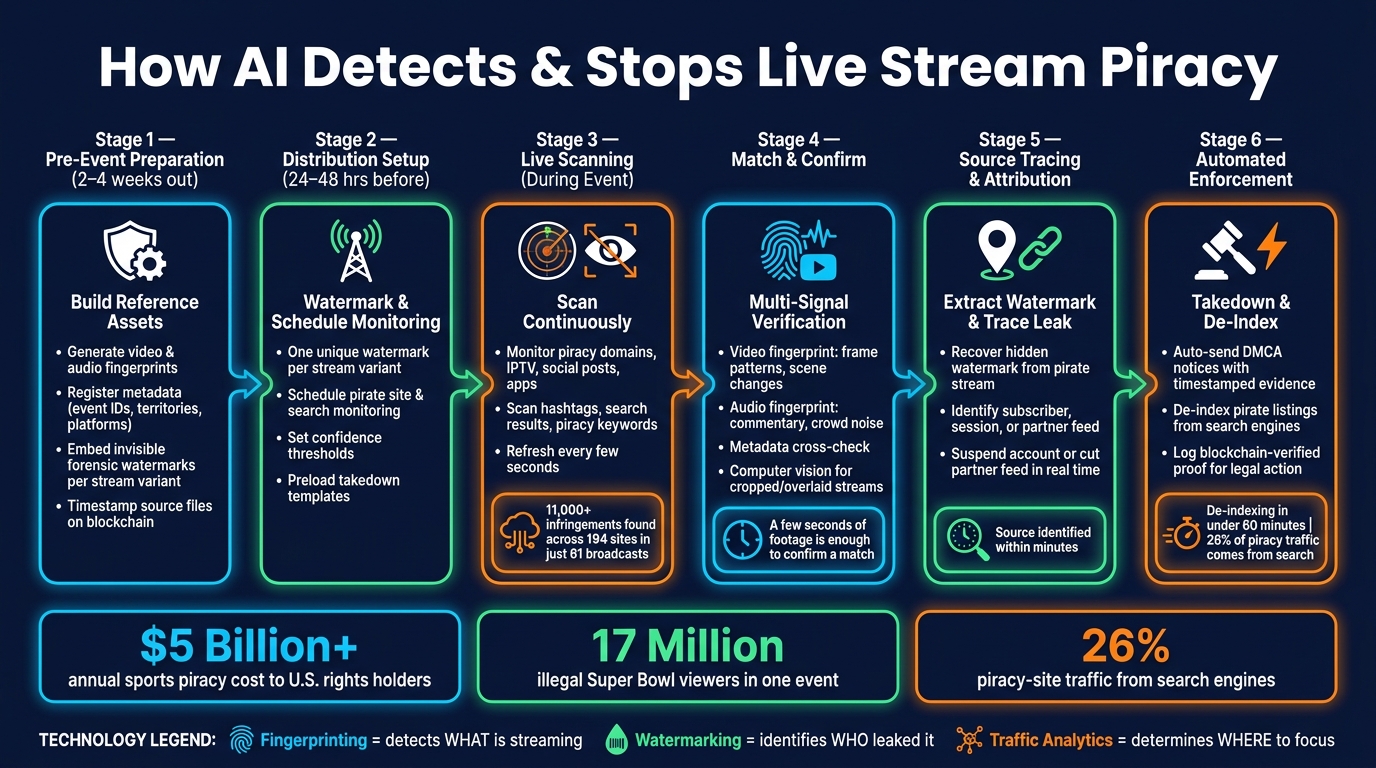
Live stream piracy can drain revenue in minutes, so detection has to happen while the event is still on. I’d boil the process down to this: build reference files before the broadcast, scan risky sites and platforms nonstop, match suspect streams with video and audio signals, trace the leak with watermarks, and log proof for takedowns and disputes.
Here’s the core idea in plain English: fingerprints show what stream is being rebroadcast, watermarks show where it leaked from, and traffic data shows which cases need attention first. That matters when sports piracy alone costs U.S. rights holders more than $5 billion per year, and one Super Bowl reportedly drew 17 million illegal viewers. In one monitoring sample of just 61 live sports broadcasts, analysts found more than 11,000 infringements across 194 sites and social platforms.
If you want the short version, this article explains how I would think about the workflow:
- Before the event: create video, audio, and metadata reference sets
- At distribution: add invisible forensic watermarks to each stream variant
- During the event: scan pirate sites, IPTV services, apps, social posts, and search results
- When a match appears: confirm it with multi-signal checks, not one signal alone
- After confirmation: trace the source, send takedowns, request de-indexing, and log timestamped proof
- After the event: review misses, false alarms, and response time
A few points stand out:
- Live content loses value fast
- Manual monitoring does not scale
- A few seconds of video or audio can be enough to confirm a match
- Search matters, since about 26% of piracy-site traffic comes from search engines
- Proof records matter for DMCA notices, platform reports, and later legal action
In short: if you wait until the event ends, you’re too late. The article shows how AI helps rights holders spot illegal live streams, link them back to the source feed, and act while the viewing window still matters.
AI Live Stream Piracy Detection: Step-by-Step Workflow
Traceory_AI – Google Solution Challenge 2026 | AI-Powered Anti-Piracy System for Digital Content |
sbb-itb-738ac1e
Prepare the Authorized Live Feed for AI Detection
Without a solid set of reference signals and ownership records in place ahead of time, automated systems have nothing dependable to compare against when they spot a suspect stream.
Build Video, Audio, and Metadata Reference Assets
Before a broadcast starts, rights holders need to create a reference set. That includes video fingerprints pulled from keyframes across the full event schedule, audio fingerprints from the official commentary and program audio, and a complete metadata record with event IDs, channel IDs, scheduled start and end times, distribution territories, and platform or affiliate identifiers.
This is what makes fingerprinting hold up under pressure. A pirate can re-encode the stream, lower the bitrate, or crop the picture, and the fingerprint can still match. Audio fingerprints work the same way. Even when video quality takes a major hit, the commentary track or crowd noise often stays in place and can still be recognized.
Store all of this in a fast, searchable repository so detection systems can pull it programmatically in milliseconds during a live event. Fingerprint generation and metadata registration should be a required pre-broadcast step. Once those reference signals are in place, AI can compare suspect streams against the official feed in real time.
Embed Invisible Watermarks for Source Tracing
Fingerprints tell you what the content is. Watermarks tell you where it leaked from. That difference matters a lot when you’re trying to act during a live event, not hours later.
Forensic (invisible) watermarking places an imperceptible, machine-readable identifier into each copy of the stream, tied to a specific subscriber account, CDN edge node, or affiliate partner. These marks survive recompression, cropping, color changes, and screen recording. When a pirate stream appears, analysts can pull the watermark from even a short captured sample and pinpoint the exact distribution path that leaked the content. Subscriber-level watermarking can identify the leak source within minutes.[1][2]
Tectus by InCyan supports blind invisible watermarking for images, video, and audio.
Blind means the watermark can be verified without the original file. That’s a major advantage when automated monitoring needs to check suspect streams at scale. Tectus is built to survive compression, mobile screen recordings, and social re-uploads. That gives investigators source data before takedown starts.
Timestamp Source Assets and Evidence with ScoreDetect

Ownership records finish this prep work. After reference assets and watermarked outputs are ready, timestamp proof of ownership before the event with ScoreDetect, a product of InCyan.
ScoreDetect computes a cryptographic hash of your source files, such as the master video, key graphics, and representative keyframes, and writes that hash, along with a timestamp, into a blockchain transaction. ScoreDetect then creates a verification certificate with the hash, transaction reference, and registration date, which third parties can verify on their own.
A timestamped certificate proves both integrity – the content hasn’t been altered since it was registered – and priority – you had the content before anyone else distributed it. Rights holders should timestamp pre-event masters, then timestamp captured broadcast segments and any piracy evidence found during or after the event. That creates a chain of custody for takedowns and disputes.
With references, watermarks, and timestamps ready, AI can move from preparation to live detection.
How AI Finds and Confirms Pirated Live Streams in Real Time
Scan High-Risk Sites and Platforms Continuously
Once reference assets are ready, detection begins where leaks are most likely to show up. AI watches known piracy domains, social posts, IPTV services, and link hubs, then checks them again every few seconds during major live events. It also scans hashtags, search results, and piracy keywords at the same time.
When a candidate URL appears, the system opens it in a controlled browser and grabs a short audio and video sample to verify that it carries live content. Indago by InCyan pushes this even further by monitoring search-engine-indexed content. That helps teams detect and de-index unauthorized listings fast, so pirate streams lose organic traffic while the event is still live.
Match Suspect Streams Using Fingerprints and Computer Vision
Next comes the hard proof. AI matches the suspect clip against the authorized feed in real time. The point is confirmation, not a rough guess.
Video fingerprints follow frame patterns, motion, scene changes, and broadcast graphics. Audio fingerprints follow commentary and crowd noise. In many cases, just a few seconds of footage is enough to confirm a match.
Pirates rarely leave streams untouched. They re-encode video, crop the frame, add overlay logos, or use picture-in-picture layouts to dodge basic detection. Computer vision deals with that by focusing on stable scene elements instead of logos or overlays. Idem by InCyan is built for this exact problem. Its multimodal AI matching platform is engineered to hold up through major changes, including cropping, compression, and partial-screen rebroadcasts.
To avoid bad takedowns, enforcement should only move forward when video, audio, and metadata all line up. That cuts false positives in a big way. A generic stadium shot, for example, should not trigger enforcement unless the audio and event metadata match too.
Use Traffic and Access Analytics to Spot Abuse Patterns
Once matching confirms the stream, analytics help rank the damage it may be doing. Recognition tells you what the stream is. Traffic analytics show how much it matters. AI engines track concurrent viewer counts, geographic distribution, session duration, and referral sources in real time.
Legal platforms tend to follow patterns you can predict: traffic ramps up around event start times, and regional peaks usually match broadcast rights territories. Pirated streams tend to look different. Common signs include:
- Sharp viewer spikes right after a new link appears on social media
- Heavy viewer concentrations in territories where no legal access exists
- Long session durations on domains with known infringement histories
Access analytics also flag credential abuse. That can look like a single subscription account generating dozens of concurrent sessions, license requests coming from multiple countries within minutes, or repeated token validation from IP addresses linked to data centers and proxy services.
AI models build a baseline for normal viewer behavior, then surface accounts that drift far from it. They also connect those anomalies with outside signals, such as pirate sites advertising "premium streams" powered by stolen credentials. That makes it easier to put the highest-risk streams at the top of the queue.
Trace the Source and Automate Enforcement While the Stream Is Live
Extract Watermarks and Identify the Leak Source
Once you confirm a pirate stream, the next step is simple: pull the watermark and find the source.
Every authorized stream includes a hidden identifier added at the distribution stage. That identifier ties back to a specific subscriber session, partner feed, or distribution node. When someone captures and restreams that feed, watermark extraction software checks the video and audio signal and recovers the hidden code. It can still do that even after the stream has been re-encoded, cropped, or compressed.
That recovered code points back to the source of the leak. From there, teams can suspend the account, cut the partner feed, or move traffic to backup delivery while the event is still in progress.
That kind of attribution changes the response. Instead of chasing copies one by one, teams can go straight to the account, partner, or delivery path that caused the leak.
InCyan’s Tectus is built for this exact job. It uses blind watermarking across video and audio and is designed to stay invisible to viewers while holding up under heavy stream changes.
Once the source is known, the response can shift from manual review to automatic action – without waiting for the event to end.
Send Takedowns and De-Index Pirate Listings Automatically
After a detection is confirmed, enforcement should kick off right away. That usually means automated DMCA notices, delisting requests, and platform reports, packaged with the captured segment, watermark report, and related metadata.
Search still plays a big role here. About 26% of piracy-site traffic comes from search engines, so de-indexing matters during the live window, not hours later.[3]
Indago by InCyan is built for that part of the workflow. It monitors search-engine-indexed content at high speed and sends de-indexing requests against unauthorized listings in under 60 minutes in many cases. That cuts the route between a viewer searching for a free stream and the pirate site serving it – while the match, concert, or broadcast is still on.
ScoreDetect adds proof to every notice. It captures a cryptographic checksum of the authorized feed, the pirate segment, and the related logs, then records that data on a blockchain. The result is a tamper-evident timestamp showing the evidence existed at a specific time and was not changed afterward.
That matters for:
- DMCA notices
- Platform takedown requests
- Later legal action
ScoreDetect also connects to more than 6,000 web apps through Zapier, so timestamping can start automatically the moment a detection is confirmed.
Fingerprinting, Watermarking, and Traffic Analytics Compared
Each method handles a different part of the enforcement chain. One tool alone won’t do the full job.
| Method | Detection Speed | Source Attribution | Resistance to Tampering | Best Use Case in Live Workflow |
|---|---|---|---|---|
| Fingerprinting | Near real-time | Low – confirms what is streaming, not who leaked it | Robust to re-encoding and resizing | Rapid content confirmation to trigger enforcement |
| Watermarking | Fast to moderate | High – identifies the specific subscriber, session, or partner feed | Survives compression, cropping, and edits | Source tracing and targeted containment during the event |
| Traffic Analytics | Continuous and proactive | Indirect – flags suspicious access patterns and high-risk IP ranges | High – focuses on behavior, not content, making it harder to mask | Tracks behavior, not content |
Here’s the plain-English version:
Fingerprinting and content matching tell you what is being streamed.
Watermarking tells you who leaked it.
Traffic analytics help decide where to focus next.
Used together, they turn detection into action while the stream is still live.
Build a Practical AI Anti-Piracy Workflow
A Step-by-Step Workflow for Rights Holders
Once detection and source tracing are set up, the next move is simple: turn them into a repeatable live-response workflow.
In a live event, the clock moves fast. You have minutes, not hours. The job is to detect, sample, identify, attribute, block, and timestamp evidence before the event is over.
Here’s how those stages connect in practice:
- Pre-event (2–4 weeks out): Register all authorized feed variants, embed one invisible watermark for each variant, generate fingerprints, and preload takedown templates.
- 24–48 hours before the event: Schedule search and torrent monitoring, set confidence thresholds, and automate evidence timestamping.
- During the event: Confirm matches, extract the watermark, trigger de-indexing, and send pre-approved takedowns automatically.
- Post-event: Review false positives, missed sources, and detection latency, then tighten thresholds.
Where ScoreDetect and InCyan Fit in the Process
These tools work best when each one handles one job in the chain.
| Stage | Tool | Role |
|---|---|---|
| Feed preparation | Tectus | Embeds invisible watermarks |
| Feed and rights management | Blueprint | Centralizes feed variants and rights records |
| Search enforcement | Indago | De-indexes pirate listings fast |
| BitTorrent surveillance | TorrentWatch | Monitors BitTorrent infringement |
| Content matching | Idem | Matches modified pirated streams |
| Evidence preservation | ScoreDetect | Timestamps ownership and evidence on blockchain |
ScoreDetect sits in the evidence layer. It creates a cryptographic checksum for each asset, detection log, and takedown notice, then records that data on the blockchain without storing the source content itself. That gives you a tamper-evident timestamp that can support legal proceedings.
And this is where automation starts to pay off. Because ScoreDetect connects to more than 6,000 web apps through Zapier, timestamping can run the moment a detection is confirmed. No manual handoff. No scramble in the middle of a live event.
Key Points to Remember
The workflow matters because every lost minute cuts into the value of enforcement.
At its core, AI-based live piracy detection follows four steps: fingerprint or watermark the authorized feed, scan platforms nonstop, match suspect streams back to the source, and trigger enforcement before the live window closes.
Manual takedowns don’t scale when piracy spikes during a live event. Automation is the only practical way to respond at that volume. Timestamp every confirmed match, every watermark report, and every takedown notice.
FAQs
How is fingerprinting different from watermarking?
Fingerprinting spots content by reading its one-of-a-kind traits. Watermarking, on the other hand, hides an invisible ID inside the stream at the pixel or bitstream level.
For live-stream piracy detection, AI leans mostly on invisible watermarking. Why? Because it can stay in place even after compression, editing, and restreaming. That makes it much easier to trace an unauthorized stream back to a specific session or device.
Can AI still detect a stream after cropping or re-encoding?
Yes. AI can still detect pirated live streams after cropping or re-encoding by using invisible watermarking and AI-driven matching.
Invisible, pixel-level markers can survive compression, editing, and re-streaming. And AI monitoring can still match unauthorized copies even when the video has been altered.
Why does live-stream piracy need real-time detection?
Because live piracy spreads during the event, detection has to happen right away. AI helps on two fronts: invisible watermarking can trace leaked streams, and automated monitoring can scan platforms and match pirated content in real time.
InCyan backs this up with ScoreDetect for verifiable proof of ownership, along with tools like Idem, Indago, and Blueprint to spot infringements, handle rights, and automate takedowns.