AI watermarking protects live streaming content by embedding invisible identifiers into video streams. These identifiers help trace piracy back to specific users or devices, even if the content is compressed, edited, or re-uploaded. The process involves three main steps:
- Embedding: Watermarks are added at the pixel level during live encoding without affecting video quality.
- Delivery: Streams are distributed through CDNs with session-based watermarks for each viewer.
- Detection: Forensic analysis identifies the source of leaked streams, enabling swift enforcement actions.
Two approaches exist: server-side watermarking, which embeds identifiers directly in the encoded stream for resistance to removal attacks, and client-side watermarking, which applies user-specific tracking on devices but is less secure. Tools like ScoreDetect combine these methods with automated detection, achieving a 96% takedown rate for pirated content.
This technology is widely used in sports, entertainment, education, and even healthcare to protect live content and maintain accountability.
Invisible Watermarking: Content Provenance for Videos at Scale | Wes Castro, Meta

sbb-itb-738ac1e
What Is AI Watermarking and Why It Matters
AI watermarking embeds invisible, unique signals at the pixel level into live streams. Unlike visible logos or text overlays that can be spotted by the human eye, these watermarks are undetectable and act as digital fingerprints. Each viewer receives a unique watermark pattern, allowing broadcasters to trace unauthorized redistribution back to specific user accounts or devices[1].
This technology is crucial because it protects valuable content without lowering stream quality. For broadcasters of premium live events, watermarking ensures accountability by making leaks traceable[1]. These features provide a strong layer of security for live streams.
AI watermarking also plays a role in verifying content authenticity and originality. At Meta, invisible watermarking is used for multiple purposes: identifying AI-generated videos, verifying who posted content first, and tracking the tools or sources used to create videos[2]. This is especially useful for combating deepfakes and manipulated content that could harm a brand’s reputation during live broadcasts[2].
Key Benefits of AI Watermarking
The ability to detect piracy in real-time is one of the technology’s standout features. Automated systems can immediately identify pirated streams online and trace them back to the originating set-top box or user account[1]. Some advanced solutions even include CDN revocation capabilities, allowing providers to cut off content delivery to detected pirate users instantly[1]. These systems have achieved takedown rates of more than 96% through automated detection and de-listing[1].
Another advantage is its seamless integration into existing workflows. Unlike visible overlays that may distract viewers or lower perceived quality, server-side watermarking solutions integrate across OTT devices without the need for visible changes. They also bypass DRM complexities, making deployment and maintenance far simpler than client-side approaches[1]. Automated reporting systems further enhance efficiency by generating detailed piracy detection reports, including information about detected streams, their sources, and geographic locations. This gives content owners actionable insights for quick enforcement[1].
These benefits explain why AI watermarking is becoming a go-to solution for securing live streams.
Applications in Live Streaming
AI watermarking is widely used to protect high-value live events. Live sports streaming is one of the most common applications, where client-side watermarking ensures faster extraction cycles to safeguard time-sensitive content[1]. Media and entertainment companies rely on this technology to protect exclusive broadcasts, premium live events, and original programming from unauthorized redistribution. Its effectiveness makes it essential for securing revenue streams.
The technology’s applications extend far beyond entertainment. Industries that deal with high-stakes live content also benefit from its forensic traceability. For example:
- Premium webinars and conferences
- Exclusive news coverage
- Live entertainment performances
Even sectors like education, finance, and healthcare are adopting watermarking. Universities use it to secure proprietary lectures, financial services rely on it for investor briefings, and healthcare providers implement it during telemedicine sessions to ensure content control and authenticity[2].
AI watermarking is proving to be a versatile tool for protecting content across a wide range of industries.
How AI Watermarking Works in Live Streaming
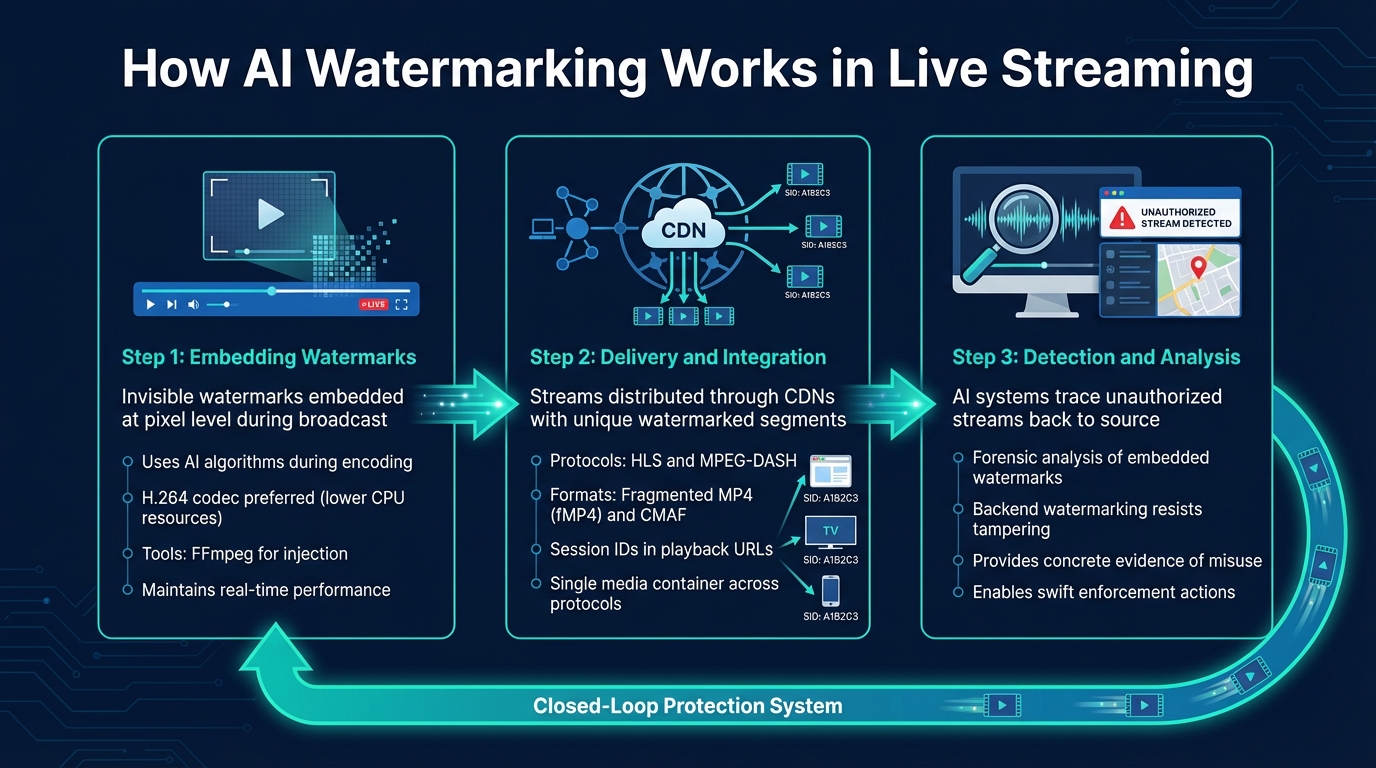
How AI Watermarking Works in Live Streaming: 3-Step Process
AI watermarking in live streaming relies on a three-step process: embedding, delivery, and detection. This entire workflow operates in real time, ensuring that the viewing experience remains smooth and the stream quality stays intact.
Step 1: Embedding Watermarks
Invisible watermarks are embedded into video frames during the broadcast using AI algorithms. These watermarks are added at the pixel level, which means they integrate seamlessly into each frame without altering the visual experience for viewers. Tools like FFmpeg are commonly used to inject these identifiers during the encoding process[3][5].
To maintain real-time performance, efficient codecs are essential. H.264, introduced in 2003, remains the go-to codec for watermarking because it demands fewer CPU resources during re-encoding compared to newer codecs like H.265 or VP9[3]. Additionally, modern systems allow watermarking to occur directly in the video processing pipeline, enabling smooth integration between video capture and output[4][5].
Step 2: Delivery and Integration
Once watermarks are embedded, the streams are distributed through content delivery networks (CDNs) to reach viewers worldwide. These systems generate unique watermarked segments while maintaining compatibility with widely used streaming protocols like HLS (HTTP Live Streaming) and MPEG-DASH. These protocols are supported by most modern browsers and devices, ensuring seamless playback[3].
Formats like Fragmented MP4 (fMP4) and the Common Media Application Format (CMAF) simplify the process. They allow broadcasters to use a single media container and codec across different protocols, eliminating the need for separate encoding pipelines. Dynamically generated HLS and DASH manifests reference specific watermarked segments, streamlining the integration process for broadcasters[3].
To enhance accountability, session IDs are included in playback URLs. These session IDs ensure the system retrieves the correct watermark configuration for each unique stream, making it easier to track and monitor[3].
Step 3: Detection and Analysis
When unauthorized streams are detected, AI systems analyze the embedded watermarks to trace the source. This forensic analysis provides concrete evidence of misuse.
For better security, backend watermarking is preferred. This method hardcodes identifiers directly into the video stream, making it resistant to tampering through browser-based manipulations[5]. Unlike frontend watermarking, which handles identifiers in the browser and is more vulnerable to skilled attackers, backend watermarking offers a more robust solution.
This detection phase closes the loop, enabling rapid responses to piracy. The evidence collected allows for swift enforcement actions, creating a closed-loop protection system that safeguards live streams through comprehensive AI content protection from start to finish.
Server-Side vs Client-Side Watermarking
When it comes to server-side and client-side watermarking, the choice largely depends on your streaming requirements and how much emphasis you place on security. Server-side watermarking embeds identifiers during the encoding process, while client-side watermarking applies them directly on the viewer’s device through the player or SDK. Both methods have their own strengths, making them suitable for different live streaming scenarios.
Comparison of Server-Side and Client-Side Methods
Here’s a breakdown of how these two approaches differ:
| Feature | Server-Side Watermarking | Client-Side Watermarking |
|---|---|---|
| Deployment | Embedded in the encoding process [6][7] | Integrated into the Web SDK or video player [4] |
| Tracking Capability | Confirms content origin and authenticity [6][8] | Tracks user sessions and forensic data [4] |
| Tamper Resistance | High; deeply embedded in the video signal or pixels [6][8] | Lower; can be bypassed by altering client code [8] |
| Computational Cost | High; requires server-side processing for each stream [8] | Low; processed on the viewer’s device [4] |
| Primary Use Case | Protecting live sports and combating deepfakes [7] | Preventing internal leaks and tracking copyright violations [4] |
Server-side watermarking is particularly effective for high-value content, such as live sports broadcasts. By embedding the watermark directly at the source, it remains intact even after compression, cropping, or re-encoding, making it extremely hard to remove [6][8].
On the other hand, client-side watermarking is ideal for scenarios requiring user-specific tracking. For example, in 2024/2025, Agora introduced a Watermark extension for its Web SDK (v4.24.0 or later), enabling developers to overlay image watermarks onto live streams with customizable opacity and positioning [4]. This approach minimizes server-side processing and is well-suited for interactive use cases where performance and security need to be balanced. However, it’s less resistant to tampering, as attackers can potentially modify the client-side code.
Choosing the Right Approach
For live sports or premium entertainment, server-side watermarking is the preferred choice. It ensures that your stream’s authenticity can be verified even after it’s been heavily compressed or restreamed [6][7]. A great example of this is Google DeepMind’s SynthID, which embeds invisible watermarks into AI-generated content at the creation stage, ensuring traceability even after edits [8].
For enterprise meetings, private events, or anti-piracy measures, client-side watermarking offers a practical solution. By embedding unique viewer IDs, platforms can trace unauthorized restreams back to specific users [4].
To maximize security, many organizations are now combining both methods. Server-side watermarking ensures content authenticity, while client-side watermarking provides granular tracking at the user level [7]. This layered approach creates a robust system for combating piracy with watermarking solutions and maintaining accountability in real time.
Next, we’ll dive into the common challenges and emerging solutions in real-time watermarking.
Challenges and Solutions in Real-Time AI Watermarking
Common Challenges in AI Watermarking
Implementing real-time watermarking for live streams comes with a host of technical challenges that can impact both performance and security. One of the biggest concerns is balancing quality and latency – embedding watermarks on the fly demands significant processing power, which can slow down the stream. Arthur Knoepflin from TrackIt explains:
"H.264 boasts a significant advantage over its successors… in that it demands fewer CPU resources for encoding content. This advantage is critical because real-time watermarking requires immediate re-encoding." [3]
Another issue is resistance to transcoding. When streams are compressed, cropped, or reformatted during distribution, watermarks can degrade or even disappear. This makes them vulnerable to unauthorized changes. The problem becomes even more complex with resolution and bitrate adjustments, as watermarks need to survive these transformations while staying invisible to viewers and detectable by analysis tools.
There’s also the challenge of integration complexity. Setting up watermarking across multiple streaming protocols like HLS and DASH, managing session-based data for individual viewers, and handling multi-DRM strategies (such as Widevine for Chrome/Edge/Firefox and Fairplay for Safari) requires precise coordination [3]. Without standardized formats like Fragmented MP4 (fMP4) and the Common Media Application Format (CMAF), maintaining consistency across platforms becomes a daunting task [3].
Using ScoreDetect for Content Protection
To tackle these challenges, ScoreDetect offers a comprehensive solution that combines advanced watermarking and forensic analysis to streamline enforcement.
ScoreDetect addresses latency, transcoding issues, and integration hurdles with a real-time framework designed to embed invisible watermarks into live streams. These watermarks are non-intrusive, ensuring they persist through compression and reformatting without disrupting the viewer experience.
The platform’s discovery layer uses web scraping to locate unauthorized restreams, achieving a 95% success rate in bypassing common prevention tactics. Once unauthorized content is identified, ScoreDetect’s analysis engine verifies infringement by matching the content to protected assets, even when watermarks have been altered by multiple transformations.
For enforcement, ScoreDetect automates the process with delisting notices, boasting a 96% takedown rate. This reduces the need for manual intervention in anti-piracy efforts. The platform also integrates with over 6,000 web apps via Zapier, allowing users to create custom workflows for alerts, incident logging, or escalation of enforcement actions.
Additionally, ScoreDetect incorporates blockchain timestamping to capture a checksum of the content without storing the actual assets. This provides verifiable proof of ownership, making copyright claims stronger while maintaining efficiency for organizations managing high-value live content in the media and entertainment industry.
Conclusion
AI watermarking offers a powerful defense against piracy, which is projected to cost nearly $1 billion in the U.S. and over $67 billion worldwide by 2023. By embedding invisible, unique identifiers into video streams, this technology enables content creators to trace leaks back to their source – even after decryption, screen capture, or redistribution – making it a critical tool in the fight against piracy [9].
Andy Francis, Technical Content Lead at Bitmovin, highlights its importance:
"Video watermarking complements DRM and encryption, providing traceability even after content is decrypted and screen-captured, thereby strengthening end-to-end anti-piracy strategies" [9].
For high-value live events, where real-time enforcement is crucial, watermarking serves as an essential layer of protection. The technology balances two key factors: robustness, ensuring watermarks withstand compression and cropping, and invisibility, keeping them undetectable to viewers. Organizations can choose between server-side and client-side implementations based on their security needs and operational priorities, tailoring the approach to maximize effectiveness.
ScoreDetect takes this a step further by integrating real-time watermark embedding with blockchain timestamping and forensic analysis. This solution consistently achieves a 96% takedown rate, offering media and entertainment companies a reliable way to combat piracy while preserving the viewer experience. Blockchain timestamping also provides verifiable proof of ownership, adding another layer of credibility to the system.
As AI-generated content and deepfakes grow more sophisticated, tools like ScoreDetect will play an increasingly important role in protecting content integrity. Watermarking will remain indispensable for verifying authenticity and accountability in the ever-evolving digital streaming landscape.
FAQs
Can AI watermarks survive screen recording?
Invisible AI watermarks are built to withstand a range of changes, such as compression, resizing, and edits. Their durability ensures they remain intact even after screen recording or other methods of content duplication, maintaining their functionality.
Will watermarking add delay to my live stream?
Watermarking in live streaming can introduce a minor delay because of the extra processing involved. However, advanced approaches like invisible watermarking are specifically designed to keep this delay minimal. These techniques ensure that the streaming experience remains as close to real-time as possible.
Do I need DRM if I use AI watermarking?
AI watermarking operates separately from Digital Rights Management (DRM) systems, as the two address different goals. Watermarking involves embedding hidden markers into content to confirm its origin, track its distribution, and deter misuse – all without affecting the quality of the content. On the other hand, DRM relies on encryption and access controls to limit how content is used. While AI watermarking doesn’t depend on DRM, using both together can provide stronger content protection, depending on your specific security requirements.