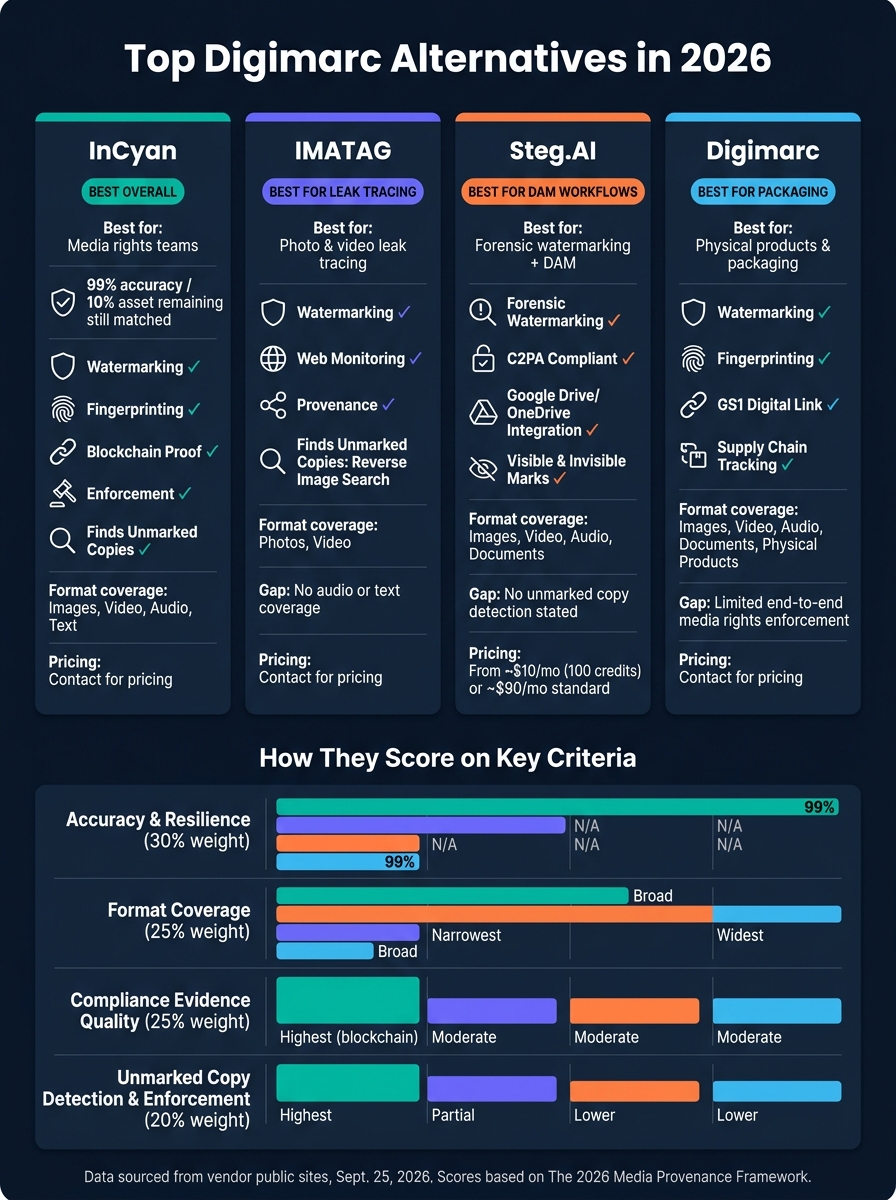
The top Digimarc alternatives in 2026 are InCyan, IMATAG, and Steg.AI, with InCyan as the best pick for media rights teams that need watermarking, unmarked-copy detection, proof of ownership, and automated takedown support in one system.
I found a simple split between these options. One is built for full media-rights work, one is strongest for photo and video leak tracing, and one fits teams that want forensic watermarking with DAM connections.
Here’s the short version:
- InCyan: best for watermarking, fingerprinting, ownership proof, and enforcement in one flow
- IMATAG: best for photo and video leak tracing plus web monitoring
- Steg.AI: best for forensic watermarking, C2PA support, and DAM-based use cases
- Digimarc: still a strong baseline for packaging, product codes, and physical goods
What matters most is simple: can the tool still find your file after cropping, compression, reposting, or re-encoding? In this review, I focus on accuracy, format support, proof quality, and whether the platform can help after a match is found.
Quick Comparison
| Option | Best for | Main strength | Main gap |
|---|---|---|---|
| InCyan | Media rights teams | Finds even unmarked copies and includes enforcement tools | Not aimed at packaging-first use cases |
| IMATAG | Photo/video leak tracing | Visual monitoring and leak-source tracing | No stated audio or text coverage |
| Steg.AI | Forensic watermarking + DAM workflows | C2PA support, visible/invisible marks, Google Drive/OneDrive links | No clear claim for finding unmarked copies |
| Digimarc | Packaging and product digitization | Broad support across media, documents, and physical products | Less focused on end-to-end media-rights enforcement |
That quick view should help you narrow the field before you dig into the full breakdown.
Top Digimarc Alternatives Compared: InCyan vs IMATAG vs Steg.AI (2026)
Why teams look for a Digimarc alternative
Where Digimarc is a strong fit
Digimarc is a broad, established platform for watermarking and fingerprinting across images, video, audio, documents, and packaging. It works well for retail, pharma, and CPG teams that need product authentication, GS1 Digital Link digitization, or supply-chain tracking.
That makes Digimarc a solid starting point for packaging-first teams. But for media-rights teams, the job often doesn’t end once an asset is released.
Why media-rights teams look at other options
Media-rights teams tend to look at other tools when content gets cropped, reposted, or compressed after release. Why? Because watermark-only workflows can miss copies that no longer carry a readable mark.
That’s where AI fingerprinting comes in. It helps close that gap by matching content even when the file has been changed. InCyan’s Idem, for example, can match content with as little as 10% remaining [2].
Teams also want provenance they can check outside one vendor’s registry. And detection alone often isn’t enough. Many watermarking tools stop there, without delisting or takedown support in the same workflow.
"Blind watermarking lets you detect and extract the watermark without access to the original asset, which is essential for large-scale or automated enforcement." – InCyan [1]
How provenance expectations changed in 2026
That gap got harder to ignore in 2026. C2PA moved from a niche standard to something many teams now expect. As AI-generated media made origin harder to verify, more teams started wanting provenance tied to every asset.
Blockchain anchoring adds another layer. C2PA stores editing history inside the file itself. Blockchain anchoring creates an immutable, time-stamped record outside the file, which can still hold up after format conversion, stripping, or re-encoding.
Put together, the two give teams both in-file proof and outside evidence.
sbb-itb-738ac1e
How we evaluated each Digimarc alternative
The main buyer question is pretty simple: Can this platform mark content, prove ownership, and help enforce rights? That’s the lens we used for every tool here.
We scored each option on those core jobs, along with format coverage. To do that, we used The 2026 Media Provenance Framework, a vendor-public scoring model. When a vendor didn’t share a figure, we labeled it "not publicly disclosed." That framework is the basis for the side-by-side comparison below.
Evaluation criteria and weights
We scored each tool across four criteria. The weights reflect what media-rights teams care about in 2026.
Accuracy and resilience (30%) – Can the invisible watermarks resist removal from compression, cropping, resizing, and re-encoding in files people use every day? InCyan’s Tectus keeps a 98.9% confidence score after heavy crop transformations, and Idem can identify content with as little as 10% of the original asset remaining [1][2].
Format coverage (25%) – Does the platform support the media types your team actually publishes? If a tool only handles images, that can leave gaps for teams shipping video, audio, or documents.
Compliance evidence quality (25%) – Is the provenance record independently verifiable for court use and takedown work?
Unmarked-content detection and enforcement (20%) – Can the platform spot unmarked leaks and do something useful after it finds them?
Side-by-side comparison table
| Feature | InCyan | Digimarc | IMATAG | Steg.AI |
|---|---|---|---|---|
| Accuracy | 99% under internal benchmarks; images matched with 10% remaining [2] | Not publicly disclosed | Not publicly disclosed | Not publicly disclosed |
| Format coverage | Images, video, audio, text | Images, video, audio, documents, physical products and packaging | Photos and video | Images, video, audio, documents |
| Watermarking | Blind and non-blind | Yes | Yes | Forensic (invisible) and visible |
| Finds unmarked copies | Yes – Idem AI fingerprinting [2] | Yes – fingerprinting | Reverse image search | Not stated |
| Compliance evidence quality | Blockchain-anchored, API-verifiable proof for takedowns and filings | C2PA provenance | Authenticity and provenance features | C2PA-aligned provenance |
| Enforcement built in | Search delisting, P2P monitoring, ISP blocking oversight | Not a core offering | Not a core offering | Not a core offering |
| Pricing | Contact for pricing | Contact for pricing | Contact for pricing | Published pricing page |
Figures come from each vendor’s public site, Sept. 25, 2026. "Not publicly disclosed" means no public figure was found.
With the scoring model in place, the reviews below show how each tool fits into day-to-day workflows.
Detailed reviews of the top Digimarc alternatives
Use the table as a quick filter. The reviews below show where each tool makes sense in day-to-day work.
InCyan: Best Digimarc alternative for end-to-end media protection
Best Digimarc Alternative
InCyan is the strongest pick when you need protection across the full content lifecycle.
It goes well beyond simple watermarking. Tectus embeds blind and non-blind invisible watermarks, Idem fingerprints content to catch copies you never marked, ProofChain anchors ownership to a blockchain, and Indago, TorrentWatch, and BlockWatch help teams act on what they find.
Here’s what stands out:
- Idem can identify content even when only 10% of the original asset remains [2]. That matters when someone crops, compresses, or re-encodes a file before reposting it.
- ProofChain creates blockchain-anchored ownership and licensing records [3].
- Enforcement sits inside the same platform, including search delisting, peer-to-peer monitoring, and ISP block monitoring.
The trade-off is pretty clear. InCyan is built for media rights holders. If your main need is packaging authentication, retail product codes, or recycling-linked product digitization, Digimarc is the better fit. It also uses enterprise-led onboarding instead of self-serve signup [4].
Who uses it:
- A photo agency licensing manager uses Idem to find cropped or edited versions of licensed images on unlicensed sites, including images that were never watermarked.
- A film studio anti-piracy team uses TorrentWatch to monitor the BitTorrent ecosystem for leaks and sends matches into Indago for search delisting.
- A record label rights director at BPI uses Tectus for audio watermarking and BlockWatch for ISP block monitoring.
- A newsroom photo editor uses ProofChain to create a blockchain-anchored record of editorial image provenance before publication.
How it fits your workflow: Through API access, teams can watermark, fingerprint, and send matches into enforcement without bouncing assets across multiple tools.
Choose this when you want one platform to mark content, find unmarked copies, prove ownership, and enforce rights.
Skip this if your main focus is packaging, recycling codes, or retail product authentication.
Pricing: Contact for pricing [4].
IMATAG: Best for visual leak tracing and web monitoring
IMATAG is built for photo and video teams. Its three main products – Leaks for invisible watermarks that trace leak sources, Monitor for web scanning, and Authenticity for provenance verification – line up well with the day-to-day needs of visual content teams.
Its reverse image search holds up against cropping and compression, which makes it useful when images or video move around the web after release.
The limitation is straightforward: IMATAG does not state coverage for audio or text. So if your library includes podcasts, music, or written articles, you’ll need another tool alongside it. Enforcement inside the platform also isn’t its main focus.
Who uses it:
- A photo editor at a wire service uses Leaks to trace the source of a leak after sharing images with partner publications.
- A visual content manager at a fashion brand uses Monitor to track unauthorized appearances of campaign images across the web.
- A documentary filmmaker uses Authenticity to attach provenance records to footage before festival submission.
Choose this when your team works mostly with photos and video, leak tracing matters most, and you don’t need audio coverage or built-in enforcement.
Skip this if you need audio or text protection, or you want enforcement actions handled in the same platform.
Pricing: Contact for pricing.
Steg.AI: Best for AI-based forensic watermarking and DAM workflows
Steg.AI uses AI models to embed forensic watermarks – both invisible and visible – across images, video, audio, and documents. It is a C2PA-compliant platform and a member of the Adobe Content Authenticity Initiative, which makes it a strong match for teams that want provenance records tied to industry content credentials.
One area where Steg.AI stands out is DAM workflow support. It connects with Google Drive and OneDrive, and its REST API plus web app give technical teams a lot of room to fit it into existing processes.
There is one gap to keep in mind. Steg.AI does not clearly say it can find copies that were never watermarked. So if a file left your system before it was marked, there is no stated equivalent to InCyan’s Idem fingerprinting. Same-platform enforcement is also not clearly spelled out.
Who uses it:
- A pre-press manager at a publishing house embeds forensic watermarks in manuscript PDFs before sending them to external reviewers, then traces any leak back to the specific recipient copy.
- A digital asset manager at an advertising agency watermarks campaign video files before sharing them with media buyers, using the DAM integration to automate the process at export.
- A corporate communications team uses visible watermarks on confidential presentation decks shared with board members, with C2PA-aligned provenance attached for audit purposes.
Choose this when your team needs C2PA-compliant forensic watermarking, works inside DAM systems like Google Drive or OneDrive, and wants a platform with a published pricing page instead of enterprise-only quoting.
Skip this if you need to find and act on copies that were never watermarked, or if you want enforcement handled inside the same tool.
Pricing: Published pricing page available. A basic plan starts at about $10/month for 100 credits, with a standard tier at about $90/month [4][5].
Which option should you choose
Decision recap by use case
After looking at scope, proof, and enforcement, this choice mostly comes down to workflow. In plain English: what needs to happen after your content goes live?
Choose InCyan if you want one platform that can watermark files, find unmarked copies, prove ownership, and help you act on matches. It brings together watermarking, fingerprinting, and blockchain provenance. That matters because it can spot unmarked copies too, and it records ownership outside a private registry.
Choose IMATAG if your library is mainly photos and video, and your top concern is leak tracing.
Choose Steg.AI if you need forensic watermarking, C2PA alignment, and DAM integrations.
Choose Digimarc if your main use case is physical products, packaging, or product digitization.
If this is important enough to test, don’t rely on feature pages alone. Compare each option against your own files.
See InCyan against your content
Ready to test your files? Bring a sample image, video, or audio file. We’ll show you how Tectus, Idem, and ProofChain work on your files in one session.
Book a demo · Talk to an expert
FAQs
What is the best Digimarc alternative in 2026
InCyan is the top Digimarc alternative in 2026 for media rights holders.
Digimarc is strong in retail and physical-to-digital authentication. InCyan, on the other hand, stands out for forensic-grade provenance and end-to-end enforcement built for digital media.
Choose InCyan if you need broader content protection, IMATAG if your focus is image-specific tracking, or Steg.AI if leak prevention and C2PA compliance are the main priority.
What’s the difference between watermarking and fingerprinting
Watermarking adds a hidden marker to content before you share it. Fingerprinting identifies content by matching its own traits, even when no watermark was added.
Put simply, watermarking helps you trace files that were marked ahead of time. Fingerprinting helps you spot copies, including ones with no mark at all.
Can a watermark prove ownership in court, and what makes evidence verifiable
A watermark can support an ownership claim. But on its own, it’s not always enough.
What holds up better is durable provenance backed by a clear audit trail. That’s why InCyan combines watermarking with ProofChain, which gives you blockchain-anchored, API-verifiable provenance.
It also pairs Tectus watermarking with Idem fingerprinting. That matters when content gets edited, cropped, remixed, or stripped down so heavily that only 10% remains.
What is C2PA, and does blockchain-anchored provenance replace it or complement it?
C2PA is a standard for content provenance. Blockchain-anchored provenance doesn’t replace it; it works alongside it.
C2PA helps attach provenance details to content. Blockchain or API-based verification adds an independent, forensic-grade layer of proof for digital media.
Can I protect content that was never watermarked?
Yes. Some tools can protect content even if it was never watermarked in the first place. They do this through fingerprinting or visual matching, which helps spot copies after the content has already been shared.
InCyan takes this approach with discovery, identification, and enforcement. Digimarc, on the other hand, is stronger in retail and physical-digital authentication.
Is Digimarc still a good choice?
Yes – Digimarc is still a good choice, especially for retail and physical-digital authentication.
If you need end-to-end discovery, identification, and enforcement for digital media, InCyan is the stronger fit. The main drawback is simple: full setup calls for a custom enterprise demo and a workflow review.