If your AI eval does not match your field, the score can mislead you. I’d judge these systems by risk, speed, privacy, and proof – not by one accuracy number.
Here’s the short version:
- I’d split evaluation into protection, detection, and evidence
- I’d map each business risk to a clear metric and a pass/fail rule
- I’d test with production-like edits and dispute cases, not clean lab samples
- I’d measure both single-run results and repeat-run reliability
- I’d log model version, rubric, hardware, and timestamps for every run
A few numbers from the article make the point fast:
- Teams should review 20–50 past failures before setting criteria
- Automated graders should be checked on a 50–100 item human-reviewed set
- The target for grader agreement is at least 75%
- A system that gets 60% on one run may drop to 25% reliability across 8 repeated runs
What I take from this is simple: evaluation should mirror the job. For watermarking, I’d test edit survival and image or video quality loss. For matching, I’d test recall, false alarms, and performance after cropping or compression. For evidence, I’d test certificate integrity, traceability, and whether the record can support legal review.
A short comparison helps:
| Area | What I’d test first | Main failure to watch |
|---|---|---|
| Protection | Watermark survival, quality loss | Mark disappears after edits |
| Detection | Recall, false positive rate, latency | Missed use or late alert |
| Evidence | Blockchain vs traditional timestamping integrity, audit trail, certificate validity | Weak proof chain |
If I were building this kind of framework, I’d treat evaluation as a system with scheduled checks: nightly regression tests, weekly failure updates, quarterly benchmark resets, and extra reviews when formats, rules, or attack patterns change.
That’s the core idea of the article: use the same eval shape as the work you need the system to do.
Why Benchmarks Matter: Building Better AI Evaluation Frameworks
sbb-itb-738ac1e
Map business and domain requirements to evaluation criteria
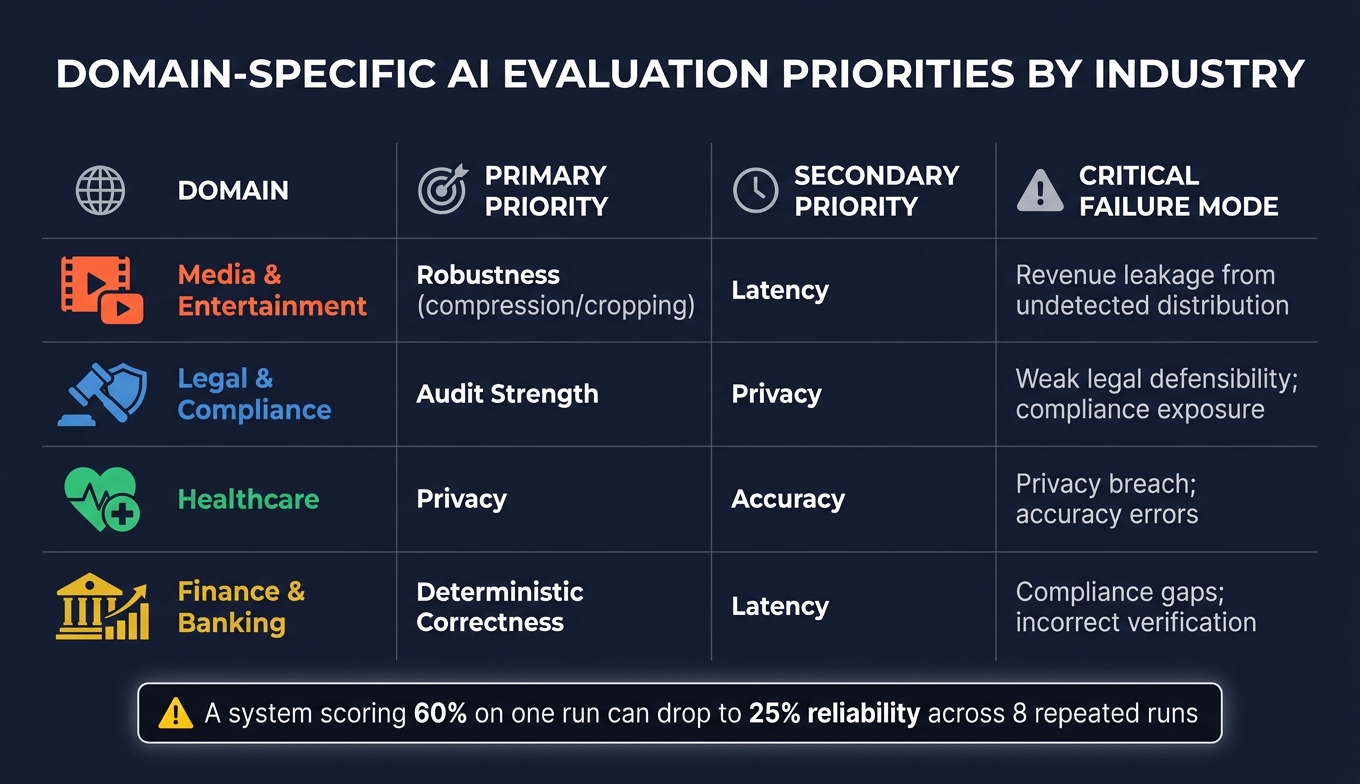
Domain-Specific AI Evaluation Priorities by Industry
Using the protection, detection, and evidence split above, turn each business goal into a testable evaluation spec. That spec should spell out what success looks like, which metric measures it, and what decision the score will trigger [1]. Skip this step, and teams often end up tuning for the wrong outcome.
Define the risk profile and set your targets
Start with the cost of failure. Different domains break in different ways: revenue loss, weak legal defense, or privacy exposure. Build this list from production failures you’ve already seen, not made-up edge cases. Catalog 20–50 real failures to show what your evaluation needs to catch [1].
Then set clear thresholds. That might mean required detection speed, acceptable resistance to compression and cropping, or the amount of traceable proof a certificate must include. Those failure modes should become the pass/fail rules your framework uses.
InCyan workflows should tie each requirement to the product-level check it needs to pass. Indago, for example, sets the latency benchmark for search-enforcement workflows. ScoreDetect‘s blockchain timestamping must be judged on certificate integrity and traceability.
Prioritize the right dimensions: accuracy, robustness, privacy, latency, and audit strength
Not every domain gives the same weight to these five dimensions. Media and entertainment teams usually need robustness first. Their content gets cropped, compressed, re-encoded, and re-uploaded all the time. If a detection system breaks when media is transformed, it isn’t ready for production, no matter how well it did on a benchmark.
Legal and healthcare teams look first at traceability and privacy. They need to know whether every action is logged, whether sensitive data stays protected, and whether the output can hold up under formal review [1].
The table below maps common U.S. enterprise domains to their main evaluation priorities:
| Domain | Primary Priority | Secondary Priority | Critical Failure Mode |
|---|---|---|---|
| Media & Entertainment | Robustness (compression/cropping) | Latency | Revenue leakage from undetected distribution |
| Legal & Compliance | Audit strength | Privacy | Weak legal defensibility; compliance exposure |
| Healthcare | Privacy | Accuracy | Privacy breach; accuracy errors |
| Finance & Banking | Deterministic correctness | Latency | Compliance gaps; incorrect verification |
One reporting issue shows up again and again: teams mix up single-run success with repeat-run reliability. Those are not the same thing. A system that scores 60% on one detection attempt can fall to 25% reliability when that same task runs eight consecutive times [1]. Both figures should appear in an honest evaluation report. Use these domain priorities to pick the metrics and benchmark data that fit the job.
Design custom metrics and benchmark datasets
Once you’ve set your criteria, the next step is simple: turn them into tests you can measure. Custom metrics map your domain priorities to actual scoring. Custom datasets show whether those scores still hold up when content gets changed in the wild.
That matters because generic accuracy numbers often hide risk. A model can post a strong top-line score and still fail in the cases that matter most. And when teams optimize around one score, that score can stop being a useful yardstick and start becoming the target instead [3].
If a scenario never appears in your eval set, your model will not handle it.
Metrics for watermarking, matching, and text piracy detection
For blind watermarking, track two things: imperceptibility and edit survival. Imperceptibility checks that the embedded signal doesn’t hurt the source asset. Edit survival checks whether the watermark stays intact after crops, compression, re-encoding, or format conversion.
For multimodal matching, measure retrieval rate and match quality under transformation. Retrieval rate answers a blunt question: did the system find the asset or not? Match quality goes one step further and asks how well the returned result still lines up with the source after edits. Idem is built to detect content ownership even when only 10% of the original asset remains, so your benchmarks need plenty of heavily changed samples.
For text piracy detection, score with enforcement risk in mind. In most cases, a missed infringement costs more than a false alarm, so recall should carry more weight than precision in the final formula [3].
For torrent monitoring, focus on latency and coverage. In plain English: how fast does the system detect activity, and how much of the BitTorrent ecosystem does it scan?
| Product | Task Type | Primary Metric | Secondary Metric |
|---|---|---|---|
| Tectus | Blind watermarking | Robustness (edit survival rate) | Imperceptibility (quality score) |
| Idem | Multimodal matching | Retrieval rate | Similarity score after transformation |
| Txtmatch | Text piracy detection | Recall | Precision |
| TorrentWatch | BitTorrent monitoring | Detection latency | Ecosystem coverage breadth |
Build benchmark datasets from real transformations and dispute scenarios
Your dataset should look like production, not a lab demo. For image and video assets, that means crops, compression, and re-encoding. For text, it means OCR errors, paraphrases, and translation. Label each transformation by type and severity so you can see exactly which edits break detection, and how often they do it.
Legal and enforcement work needs a separate, evidence-focused test set. Dispute scenarios deserve their own dataset partition. Pull examples from actual enforcement cases, such as DMCA takedown disputes, licensing disagreements, or court-ready evidence packages. Those cases test something different. They’re not just about finding a match; they test whether the system can support a claim.
ScoreDetect can tie each source checksum to a blockchain timestamp, which creates a tamper-evident record for later verification. And for teams with large source libraries, Blueprint, InCyan’s digital asset management platform, can organize and version benchmark assets so the eval set stays in sync with the content being protected.
These datasets become the inputs for end-to-end protocol testing.
Build end-to-end evaluation protocols for each framework
Custom metrics alone won’t cut it. Your protocol needs to reflect the full workflow: registration, detection, review, and enforcement. Use the same protection, detection, and evidence split here, but test it across the whole operating flow.
Use a three-layer protocol: automated scoring, expert review, and audit logs
Use three layers: automated scoring, expert review, and audit logs.
Automated scoring handles the deterministic checks: exact fingerprint matches, JSON validation, bit error rates, and latency measurements. This is the part machines should handle.
Expert review comes in for borderline or high-stakes cases. That means human review with clear scoring rubrics. Clear rubrics lead to more reliable judgments than vague quality scores.
The third layer is the audit log. Log the model version, prompt template, rubric version, hardware, and timestamp for every run. If you’re using ScoreDetect, blockchain timestamping and certificates can preserve proof of ownership and the exact timing of evaluation runs, which helps create an immutable audit trail for legal review.
There’s also a reliability issue you don’t want to miss. Production agents that score around 60% on a single attempt often fall to roughly 25% when the same task is run eight consecutive times [1]. You won’t see that gap if you only run pass@1 checks. That’s why repeat-run tests should be part of your protocol cadence from the start.
Before you trust any automated grader, test it against a golden subset of 50 to 100 items reviewed by human experts. Set a 75% minimum agreement threshold [1]. If the grader misses that mark, fix the rubric before moving it into production.
Protocol examples across the InCyan product stack

Each InCyan product works in a different domain, so each one needs its own protocol shape. The table below maps the workflow, metrics, review level, cadence, and certificate link for each one.
| Framework | Data Pipeline | Key Metrics | Review Level | Cadence | Certificate Integration |
|---|---|---|---|---|---|
| Tectus (Watermarking) | Registration → Stress Transformation → Detection | Robustness, Bit Error Rate, PSNR | Expert visual quality review | Per release | ScoreDetect Ownership Proof |
| Idem (Multimodal Matching) | Reference Set → Evasion/Transformation → Matching | Precision/Recall, Evasion Resistance | Human review for borderline matches | Weekly | Match Validation Cert |
| Txtmatch (Text Piracy) | Corpus → Plagiarism Check → Infringement Report | Semantic Similarity, Overlap % | Legal/Expert Review | Daily | Infringement Evidence Log |
| TorrentWatch (Torrent Monitoring) | Torrent Index → Crawl → Infringement Alert | Detection Latency, Ecosystem Coverage | Audit Log Review | Continuous | Infringement Detection Cert |
| BlockWatch (Network Monitoring) | Site List → Crawl/Probe → Block Status | Latency, Coverage, Verification Accuracy | Audit Log Review | Nightly | ISP Blocking Status Cert |
Each row points to the failure mode that matters most in that workflow.
For Tectus, the protocol should use worst-case stress tests. A watermark only matters if it survives the kind of edits people make in the wild.
For Idem, evasion resistance is the key metric. The whole point is to detect ownership even after heavy content changes.
For Txtmatch, daily evaluation fits the job. Text infringement moves fast, and a missed detection can affect enforcement right away.
For BlockWatch, separate true ISP blocks from plain site outages by testing across DNS, IP, and HTTP/HTTPS layers. Then store the results in a timestamped record.
If a protocol leaves out the main failure mode, it isn’t finished.
Maintain and govern evaluation over time
Update protocols as attacks, regulations, and content channels change
Once scoring, review, and audit logs are in place, the next job is maintenance. That’s what keeps the protocol tied to what’s happening in the field.
Evaluation drifts as attacks, regulations, and channels shift. New editing tools open the door to evasion tactics your first test set never saw coming. Social platforms change how infringing content moves. Regulatory standards get tighter. When that happens, thresholds that made sense last quarter can stop meaning much today.
A fixed refresh schedule helps keep the protocol current.
| Cadence | Purpose | Key Action |
|---|---|---|
| Nightly | Regression tracking | Run automated tests against the latest API updates to catch silent slips [2] |
| Weekly | Production feedback | Add real production failures to your dataset [1] |
| Quarterly | Benchmark refresh | Update datasets and thresholds to limit overfitting to the benchmark [3] |
| Ad-hoc | Change-triggered refresh | Refresh on regulation, format, or attack changes [1] |
Tag every run with the model, prompt, rubric, and benchmark versions [1]. That way, when scores move, you can trace the change back to an actual shift in capability instead of config drift.
Conclusion: Key rules for domain-specific evaluation
The rule here is simple: domain-specific evaluation only works when it mirrors real risk, real transformations, and auditable evidence.
Start with your domain’s risk profile. Pick metrics that map straight to business loss – missed detections, false positives, and legal exposure – instead of abstract accuracy scores. Build benchmark datasets from real transformations and dispute scenarios. Tie those metrics to the full end-to-end workflow. Preserve auditable evidence with blockchain timestamps at every step.
"A maintained benchmark is an institution, not a one-off project." – Kili Technology [1]
Treat evaluation as an ongoing system.
FAQs
How do I choose the right metrics for my domain?
Start with a clear construct spec that links the evaluation to a specific business decision. That keeps the work grounded in what the company needs, not just what looks good on a dashboard.
To avoid getting stuck on one number, pick three to four metrics that match your domain. For enterprise tasks, the CLEAR framework is a good fit:
- Cost
- Latency
- Efficacy
- Assurance
- Reliability
If standard metrics don’t do the job, build custom ones. You can use rule-based checks or LLM-as-a-judge methods to score things that off-the-shelf benchmarks miss.
At scale, include both universal and situated subjects. That split helps you tell the difference between general capability and domain-specific performance.
Why isn’t one accuracy score enough?
A single accuracy score can create tunnel vision. It can hide how a model actually performs in production, where things get messy fast.
A high benchmark score may just mean the model was tuned for that one test. That doesn’t always tell you how well it will work in your domain, with your data, and under your constraints.
A better evaluation looks at more than accuracy. It should also account for:
- latency
- cost
- reliability
- fairness
- domain-specific needs that generic metrics can miss
That broader view gives you a much clearer picture of whether a model will hold up when people start using it for actual work.
How often should domain-specific evaluations be updated?
Domain-specific evaluations need regular updates. They should be part of an iterative process, not something you set up once and leave alone.
A common place to start is with 20 to 50 test cases drawn from real production failures. From there, you can grow the set over time. When you keep benchmarks inside your normal release process, it becomes much easier to check the impact of changes to prompts, models, or retrieval settings as soon as they happen.