Adversarial attack resilience ensures digital content remains protected under manipulations like compression, cropping, or color changes. This is critical for safeguarding ownership, especially as 85% of online images are used without proper licensing and deepfake videos have surged 900% since 2019. Traditional methods like visible watermarks or metadata often fail during uploads or re-encoding, making advanced systems essential.
Key takeaways:
- Common attacks: Compression, cropping, screenshots, and metadata stripping.
- Evaluation metrics: Survival after transformations, tamper detection accuracy, and verification speed.
- Testing methods: Simulating attacks like re-encoding or resizing to assess system performance.
- Challenges: Balancing sensitivity to avoid false positives and scaling for large content libraries.
Tools like invisible watermarking paired with blockchain anchoring provide strong protection, ensuring content traceability and ownership proof. For enterprises, embedding these systems at the creation stage is critical to prevent gaps in security.
Watermarking in Generative AI: Opportunities and Threats
sbb-itb-738ac1e
Key Factors for Evaluating Resilience
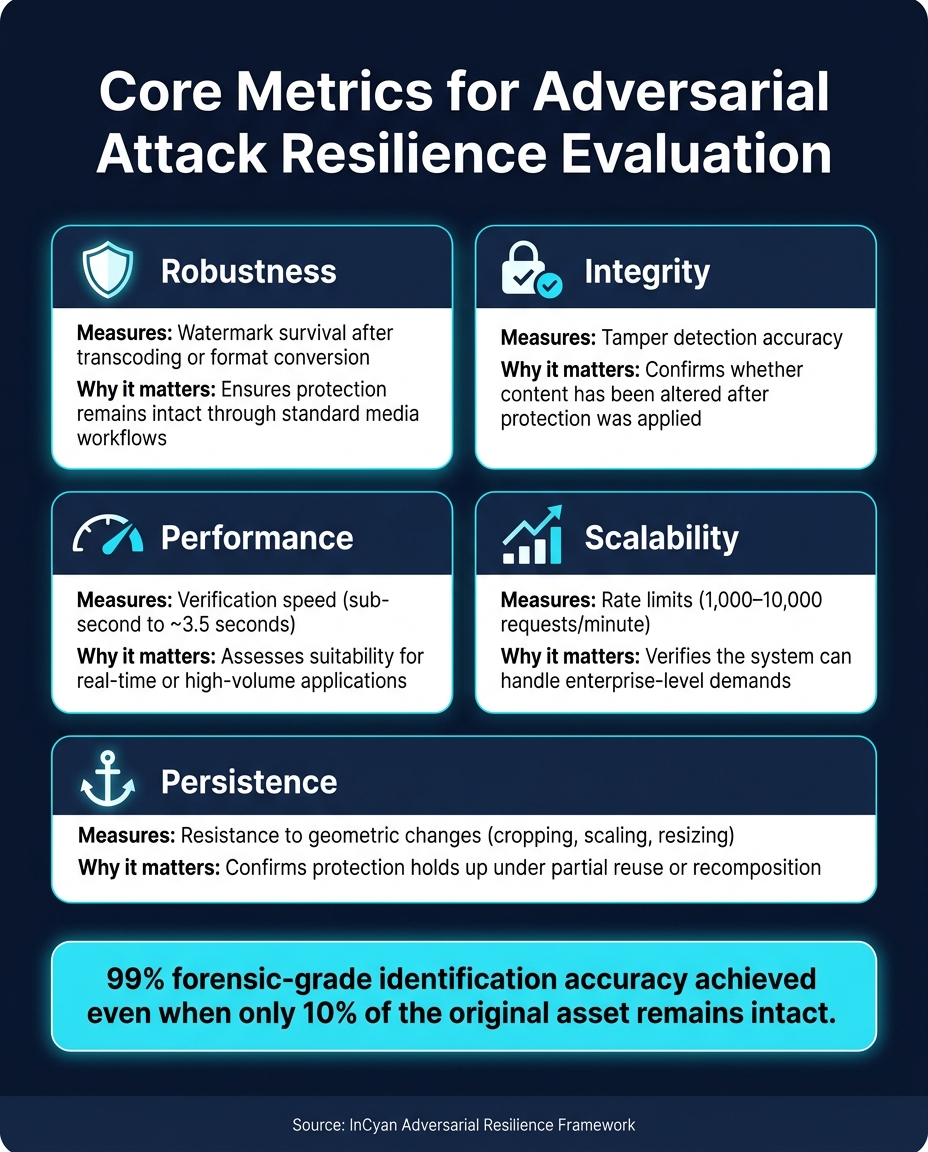
Adversarial Attack Resilience: Core Evaluation Metrics at a Glance
Types of Adversarial Attacks
Content protection systems face a wide range of attacks, each requiring specific defenses. Among the most common are signal and geometric transformations, such as compression, re-encoding, and transcoding. These processes are standard in many content workflows, which makes them particularly risky as they can easily strip protection markers without raising suspicion [3][2].
Attackers also use content recomposition strategies like cropping, taking screenshots, applying color filters, or overlaying text and graphics. On a more advanced level, threats like deepfakes, face swaps, and fabricated audio have surged – growing by 900% since 2019 [2]. At the metadata level, adversaries often strip EXIF data or overwrite custom tags during uploads to social platforms [3]. The most deliberate attacks involve provenance forgery, where attackers manipulate ownership claims or exploit opaque registries to challenge the content’s origin [3].
"A simple hash does not capture how content might appear after it has been transposed into another format, recompressed, or partially reused." – InCyan [3]
Understanding these attack methods is just the first step. The next is evaluating how well a system can counter them using measurable performance metrics.
Core Metrics for Resilience Evaluation
Identifying potential attacks is only helpful if you can measure your system’s ability to withstand them. Below is a breakdown of critical metrics to evaluate:
| Metric Category | What It Measures | Why It Matters |
|---|---|---|
| Robustness | Watermark survival after transcoding or format conversion | Ensures protection remains intact through standard media workflows [4] |
| Integrity | Tamper detection accuracy | Confirms whether content has been altered after protection was applied [4] |
| Performance | Verification speed (e.g., sub-second to ~3.5 seconds) | Assesses suitability for real-time or high-volume applications [1][2] |
| Scalability | Rate limits (1,000–10,000 requests/minute) | Verifies the system can handle enterprise-level demands [4] |
| Persistence | Resistance to geometric changes (cropping, scaling, resizing) | Confirms protection holds up under partial reuse or recomposition [2][4] |
A standout metric is the minimum detectable source threshold. Advanced systems can achieve 99% forensic-grade identification accuracy even when only 10% of the original asset remains intact [5]. This level of precision is crucial for legal disputes and high-stakes scenarios.
These metrics form the foundation for testing methodologies that simulate real-world attacks.
Testing Methodologies
Using these metrics, resilience testing involves running protected content through a variety of adversarial transformations – like compression, re-encoding, cropping, and color adjustments – to assess whether the protective markers survive [2][5]. This process is critical for ensuring the reliability of content protection systems, such as those developed by InCyan.
For audio and video content, testing should also include speed adjustments to reveal vulnerabilities that hash-based tools might miss [5]. Multimodal evaluation is equally important – dedicated AI models for images, videos, audio, and text help identify unique weaknesses in each medium [5]. As InCyan explains:
"Our algorithms are continuously refined as the threat landscape evolves, keeping your protection ahead of new forms of infringement." [5]
Another vital aspect is cross-media detection. For example, verifying a watermark from a screenshot of a video demonstrates a system’s ability to handle diverse scenarios [2]. The ultimate goal is to identify and address weaknesses in your system before attackers can exploit them.
Challenges and Tradeoffs in Measuring Resilience
Building on the discussion of key evaluation metrics, let’s dive into the real-world challenges and tradeoffs involved in resilience testing.
Balancing Sensitivity and Precision
One of the toughest hurdles is finding the right balance between detecting threats and avoiding false positives. If a system is too sensitive, it overwhelms teams with false alarms. On the other hand, being too conservative risks overlooking actual attacks.
This challenge becomes particularly clear when comparing cryptographic provenance with statistical detection. Cryptographic methods provide absolute verification – either a signature is valid, or it isn’t. However, even small changes can break these methods. In contrast, statistical detection is more adaptable, but it relies on probability scores, which can mistakenly flag legitimate content as problematic [6].
"A cryptographic watermark does not produce a probability score – it produces a verified signature or a failed verification." [7]
Fine-tuning these systems isn’t just about operational efficiency; there’s also a legal angle. Embedding machine-readable rights can significantly raise statutory damages in cases of willful infringement, from $30,000 to as much as $150,000 per work [6].
The most practical approach? Layering both methods. Cryptographic provenance should serve as the primary, definitive proof of ownership, while statistical watermarking acts as a secondary safety net. Neither is perfect on its own, but together they cover more potential scenarios [6].
These tradeoffs naturally lead to the next challenge: scaling this process for large-scale operations.
Scaling Resilience Testing
Scaling resilience testing for extensive content libraries is no small feat. Each asset needs to be tested against various attack vectors, which becomes resource-intensive when dealing with over 31 MIME types, including 13 image and 5 document formats [6].
A practical solution for this complexity is Merkle tree batching. Instead of anchoring each asset on a blockchain individually, millions of asset hashes can be grouped into a single root hash. This method ensures verifiability while keeping costs manageable, even for high-volume workflows [3].
"The goal is to preserve verifiability while keeping per-asset cost low enough for large libraries and high-volume workflows." – Nikhil John, InCyan [3]
For text-heavy collections, innovations like sentence-level Merkle tree attribution allow for verifying smaller excerpts or fragments without reprocessing the entire document. This is particularly useful in cases of partial reuse or paraphrasing [7]. Another efficiency booster? Automating the registration process at the moment of content creation. This ensures resilience markers are embedded right from the start, eliminating the need for retroactive fixes [3].
Applying Resilient Content Protection in Practice
Turning Resilience Results into Action
Resilience testing is only as useful as the decisions it informs. Here’s the key: statistical detection provides a probability score, making it ideal for monitoring large volumes of content, while cryptographic verification offers binary proof, which is essential for legal actions.
Why does this distinction matter? If you’re dealing with B2B data licensing or formal copyright disputes, you need deterministic proof – clear, undeniable evidence. On the other hand, for monitoring AI-generated content at scale, probabilistic signals often get the job done. The trick is to adjust confidence thresholds based on your specific use case. Legal and regulatory scenarios demand higher certainty, so deterministic methods should take precedence in these cases.
The good news? These insights can be seamlessly applied in production environments using advanced tools.
Tools That Support Resilient Systems
To translate these insights into action, resilient systems like those from InCyan offer specialized tools designed to protect content under real-world adversarial conditions. These tools operationalize the resilience metrics discussed earlier.
- Idem: This AI-powered tool excels at multimodal matching, identifying assets even after they’ve been heavily altered – think cropping, compression, or mobile edits.
- Tectus: A blind watermarking solution that embeds invisible ownership proof into images, videos, and audio. The protection holds up even if metadata is stripped or files are re-encoded.
- ScoreDetect: This tool secures proof of ownership by adding an blockchain vs traditional timestamping methods to your content. It integrates effortlessly via REST API, WordPress, and Zapier. With an average transaction speed of about 3.516 seconds on the SKALE blockchain (with zero gas fees), every registered asset gets a tamper-proof record of its original state and ownership.
Joshua Chung, CEO of a startup consultancy, shared his experience:
"As a SaaS company owner, I find ScoreDetect to be a highly valuable tool for ensuring the integrity of our digital content." [1]
For enterprises managing large content libraries, these tools make resilience testing scalable, transforming it from a one-off task into an automated process. This level of automation is key for staying ahead in today’s fast-moving digital landscape.
Conclusion: Building Confidence in Resilient Systems
Key Takeaways for Enterprises
Adversarial resilience calls for a multi-layered approach. Combining invisible watermarking – which can withstand physical alterations like cropping and compression – with blockchain anchoring provides a solid defense. Blockchain anchoring adds an immutable, timestamped record of ownership, while watermarking ensures traceability even after transformations. Together, they address each other’s weaknesses, forming a cohesive strategy.
Here’s what matters most: watermark assets as soon as they’re created, store only cryptographic checksums on the blockchain, and generate timestamped records suitable for legal proceedings. Registering assets at the point of creation avoids gaps in provenance caused by stripped metadata during early edits. Meanwhile, cryptographic checksums safeguard privacy without compromising verification.
"Blockchain anchored content provenance should be understood as infrastructure rather than as a stand alone product. Its real value emerges when it is woven into the everyday systems that create, transform, and distribute media." – Nikhil John, InCyan [3]
By integrating these practices with earlier methods, enterprises can ensure strong, practical protection in real-world scenarios.
What to Watch for in Content Protection
As threats evolve, so must protection strategies. Adversarial techniques are advancing at a rapid pace – voice clones, for instance, can now be created in minutes. Detection tools are keeping up, offering forensic-level accuracy even with limited content. However, staying ahead requires constant adaptation.
Two critical trends are shaping the future of content protection. First, regulatory frameworks like the EU AI Act are pushing for mandatory labeling of AI-generated content. This raises the bar for documenting provenance. Second, industry standards are gaining traction. Aligning with content authenticity verification tools and initiatives like C2PA (Coalition for Content Provenance and Authenticity) or IPTC metadata profiles ensures that protection methods remain effective across platforms as these standards take hold [3]. Enterprises that embed content provenance into their core systems, rather than treating it as an add-on, will be better equipped to navigate these changes.
FAQs
What attacks should I test for first?
When starting, focus on attacks that maintain "usable" content while testing the limits of protection. These include methods like compression and re-encoding (e.g., JPEG for images or AAC for audio), along with geometric edits such as cropping, scaling, or rotation.
From there, you can move on to techniques like format conversions, resizing, or transcoding, which may also involve removing metadata. For multimodal setups, consider partial adjustments, such as clipping, speed or pitch changes in audio or video, adding background noise, or paraphrasing and reformatting text-based content. These steps help evaluate how well protection mechanisms hold up under practical, real-world changes.
How do I choose the right detection threshold?
Choosing the right detection threshold is all about finding the balance between minimizing false positives and achieving high recall. The ideal threshold depends on how much tolerance your workflow has for errors. Higher thresholds prioritize precision, reducing false positives, while lower thresholds focus on sensitivity, making it easier to catch altered content.
To fine-tune this balance, test your settings against typical transformations such as compression, cropping, or format changes. This ensures your system remains effective in real-world scenarios. With its scalable design, ScoreDetect makes this calibration process easier, helping you maintain consistent accuracy across various digital environments.
When should I use watermarking vs blockchain proof?
Invisible watermarks are a powerful tool for actively tracking and safeguarding your content. These watermarks remain intact even after transformations like cropping or compression, allowing you to verify ownership even when metadata is stripped away.
For an extra layer of security, blockchain technology offers a tamper-proof, time-stamped record. This ensures legal authenticity by creating an unchangeable proof of ownership.
The best approach? Combine both methods. Use watermarks for ongoing tracking, and pair them with tools like ScoreDetect to generate blockchain-based certificates. This dual strategy ensures secure and reliable ownership verification.