Watermarking systems rely on two distinct qualities to protect digital content: resilience and robustness. While they may seem similar, they address different challenges:
- Robustness ensures the watermark survives specific, predictable changes, like compression or resizing.
- Resilience focuses on enduring unpredictable, multi-step transformations, such as social media uploads, AI-based edits, or file re-encoding.
Both are critical for safeguarding digital assets, but they excel in different scenarios. Robustness is ideal for controlled environments, like broadcasting, while resilience is better suited for content that faces unpredictable changes, like social media or user edits.
Quick Comparison
| Feature | Robustness | Resilience |
|---|---|---|
| Focus | Withstanding specific changes | Surviving unpredictable processes |
| Environment | Controlled, predictable workflows | Multi-step, dynamic transformations |
| Threats Addressed | Compression, resizing, format shifts | AI edits, metadata stripping |
| Best Use Case | Broadcasting, professional workflows | Social media, user-generated content |
Balancing these qualities is key to creating watermarks that are both durable and effective in protecting your digital content.
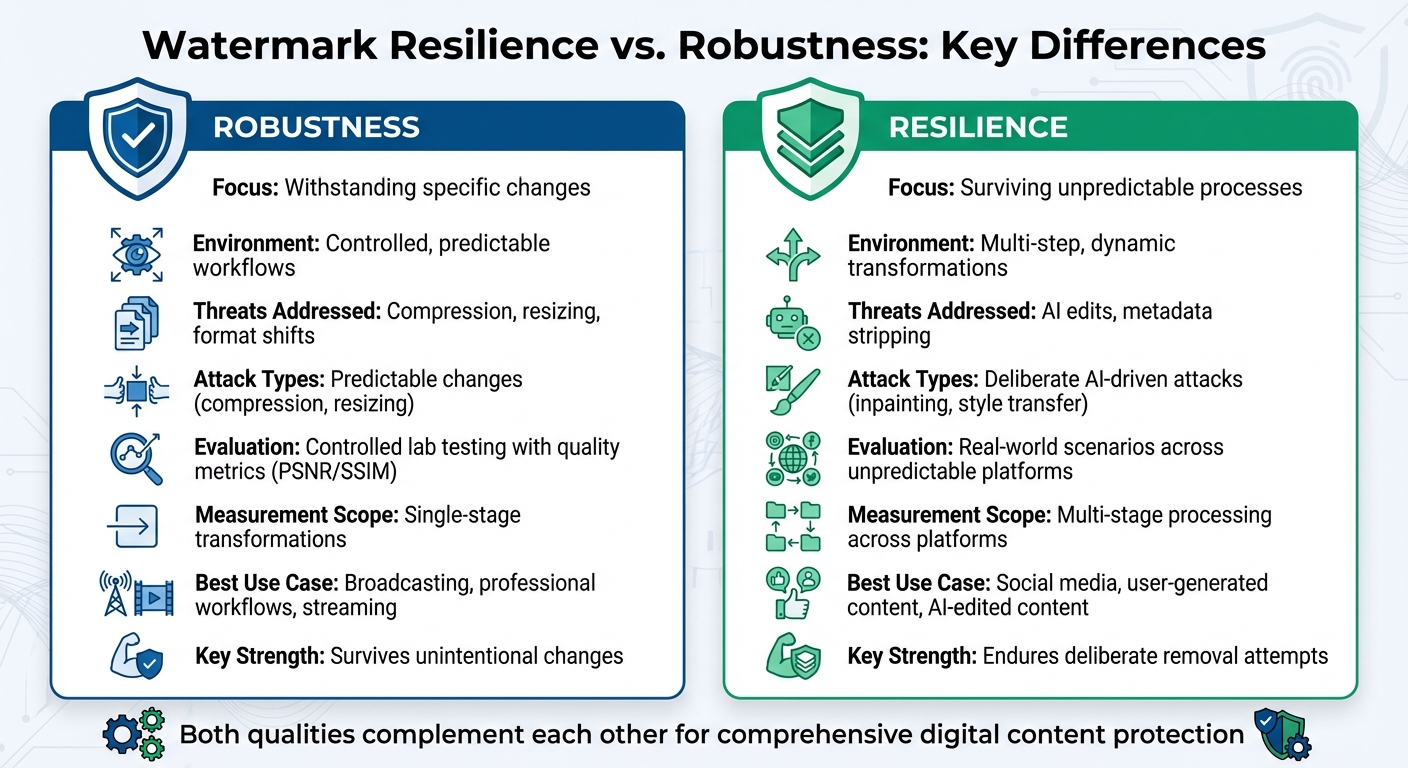
Watermark Robustness vs Resilience Comparison Chart
Robust Distortion-free Watermarks for Language Models
sbb-itb-738ac1e
What is Watermark Robustness?
Watermark robustness refers to how well a watermark can endure transformations, compression, or deliberate tampering without being destroyed or removed [1]. In simple terms, it measures the watermark’s ability to stick around even after the content it’s embedded in has been altered. Unlike metadata, which can be stripped away easily, or visible logos that can be cropped out, robust watermarks are deeply embedded into the media itself, making them much harder to erase.
This concept is best explained by the Watermarking Triangle, which highlights the balancing act between three factors: robustness, imperceptibility (keeping the quality of the content intact), and capacity (how much data the watermark can hold). As Nikhil John from InCyan puts it:
"Attempts to maximise one corner [of the watermarking triangle] inevitably put pressure on the others" [1].
So, while robustness is important, it often comes with trade-offs in other areas. Below, we’ll explore how robustness is tested and measured.
Technical Definition of Robustness
Robustness is assessed by challenging a watermark with different types of "attacks" to see how well it holds up. These tests usually fall into four main categories:
- Geometric changes: Modifications like cropping, rotating, or resizing the content.
- Signal processing: Techniques such as compression (e.g., JPEG for images, AAC for audio), noise reduction, or sharpening.
- Format conversion: Transcoding between formats, like switching from H.264 to H.265.
- AI-based edits: Complex alterations like inpainting, style transfer, or frame interpolation.
The method used to embed the watermark plays a big role in its robustness. For example, spatial domain methods directly alter pixel or sample values. These are quick but often break down under compression or filtering. On the other hand, transform domain techniques embed the watermark into frequency coefficients using methods like the Discrete Cosine Transform (DCT) or Discrete Wavelet Transform (DWT). These align with how compression codecs handle data, making them more resilient.
Another key feature of robust systems is blind detection. This allows verification of the watermark without needing the original file, relying instead on shared parameters. Blind detection is crucial for scalability, especially when verifying watermarks across large volumes of content.
To evaluate robustness, technical metrics like Normalized Cross-Correlation (NCC) and Peak Signal-to-Noise Ratio (PSNR) are used. These metrics help measure how reliably the watermark can be detected and how much the original quality of the content is preserved [2].
Strengths and Limitations of Robustness
Robust watermarks excel in environments where the types of modifications are predictable. They can endure common, unintentional changes like format conversions or minor creative edits, such as color grading or basic audio mastering.
However, no watermarking system is indestructible. They are typically designed for specific use cases or high-risk scenarios, not for every possible type of alteration. For instance, AI-based edits like heavy inpainting or style transfer can drastically change the content, potentially erasing the watermark completely. As Nikhil John points out:
"A watermark that disappears after a single round of social media transcoding or minor colour correction does not help rights holders" [1].
The level of robustness required also depends on the context. For example, watermarks intended for social media need to survive aggressive compression and user-added overlays. In contrast, broadcast watermarks are built to handle professional-grade edits like high-quality transcoding and color grading. Each scenario demands a tailored approach to ensure the watermark can perform its role effectively.
What is Watermark Resilience?
When we talk about resilience in the context of watermarks, we’re looking at how well a watermark holds up under real-world conditions. Unlike robustness, which focuses on surviving specific, isolated distortions in controlled environments, resilience is about the bigger picture. It examines whether a watermark can endure the unpredictable, sequential transformations that digital content often undergoes in everyday use [1].
Think about all the ways content gets processed: aggressive compression on social media, transcoding in broadcast workflows, or even being printed, scanned, and converted back to digital formats. These aren’t isolated events – they happen in combination. As Nikhil John from InCyan puts it:
"Properly designed invisible watermarks can survive those transformations and act as a latent serial number for the work itself" [1].
Today, resilience must also account for threats from AI. Generative AI models can now perform "regeneration attacks", where they deliberately add noise to strip watermarks and then clean up the image to maintain quality [3]. This kind of manipulation wasn’t even on the radar a few years ago, but now it’s a critical test for any watermark system claiming to be resilient.
Resilience in Practical Use
In real life, content doesn’t just go through one or two edits – it undergoes a chain of transformations. For example, a video might start as a high-quality mezzanine file, go through editing and color grading, and then get compressed heavily for social media [1]. Every step in this process could weaken a watermark unless it’s designed to handle sequential transformations.
Social media platforms often strip metadata entirely, making embedded watermarks the only reliable way to trace content back to its source [1]. Each industry has its own unique processing challenges, and a truly resilient watermark must be capable of withstanding those specific scenarios. Without this endurance, digital content protection becomes much less effective.
Testing Resilience in Practice
Testing resilience goes beyond controlled lab experiments. While traditional tests might measure survival against specific filters – like cropping or JPEG compression – practical resilience testing looks at how watermarks hold up under unpredictable, real-world conditions [1].
The WAVES benchmark is one example of rigorous testing. It evaluates watermarks against 26 different types of attacks, including traditional distortions, AI-driven regeneration, and adversarial methods [3]. The benchmark uses a strict 0.1% False Positive Rate (FPR) threshold to reflect the high stakes of false alarms in real-world applications [3]. As the WAVES team explains:
"In practical scenarios where false alarms incur high costs, our evaluation metric for watermark detection prioritizes the True Positive Rate (TPR) at a stringent False Positive Rate (FPR) threshold, specifically 0.1%" [3].
Before deploying a watermark system, organizations should carefully map out how their content will be processed during distribution. This ensures the system is tested against the actual challenges it will face, not just theoretical ones [1]. By doing so, they can confirm that their watermark solution is ready to protect valuable digital assets in the complex and unpredictable real world.
Key Differences Between Robustness and Resilience
When it comes to watermark survival, robustness and resilience measure success under very different circumstances. Robustness deals with enduring specific and predictable processing steps – like a single transcode or format conversion – within controlled settings. Resilience, however, focuses on surviving unpredictable, real-world scenarios where content faces multiple processing stages, often across platforms that strip metadata or apply aggressive normalization techniques.
The way these attributes are tested highlights their differences. Robustness is typically assessed in lab environments using metrics like Peak Signal-to-Noise Ratio (PSNR) and Structural Similarity Index (SSIM). Resilience, on the other hand, is tested by running content through real-world pipelines. For instance, a video might be uploaded to a social media platform, downloaded, edited with overlays, and then re-uploaded – each step presenting new challenges for the watermark.
The threats each attribute handles also differ. Robustness is designed to withstand unintentional changes, such as color adjustments or audio mastering. In contrast, resilience must handle deliberate attempts to remove watermarks, including AI-based techniques like inpainting or style transfer. This makes resilience especially important for platforms that host user-generated content, while robustness is better suited for professional workflows in controlled environments, such as IP copyright protection for broadcasting or streaming.
To make these distinctions clearer, here’s a quick comparison:
Feature Comparison Table
| Feature | Robustness | Resilience |
|---|---|---|
| Evaluation Environment | Controlled lab testing with quality metrics | Real-world scenarios across unpredictable platforms |
| Attack Types | Predictable changes like compression and resizing | Deliberate, AI-driven attacks like inpainting |
| Measurement Scope | Single-stage transformations (e.g., one transcode) | Multi-stage processing across platforms |
| Success Criteria | High fidelity (PSNR/SSIM) after specific edits | Reliable detection after extensive user edits |
| Typical Scenario | Professional workflows (broadcast, streaming) | Social media, user-generated content, and AI-edited content |
Choosing the right watermarking strategy depends on understanding these key differences. Robustness excels in predictable, controlled environments, while resilience is essential for tackling the chaotic, ever-changing landscape of user-driven and platform-based content distribution.
Applications in Modern Digital Protection
Resilience Across Different Media Types
Protecting various media formats requires tailored watermarking techniques to ensure security without compromising usability. For images, watermarking generally operates in the spatial or transform domains, allowing it to withstand challenges like recompression and cropping. These methods are designed to stay invisible in visually sensitive areas. Video watermarking, on the other hand, must consider its temporal structure, such as Groups of Pictures, to avoid visible issues like flickering or banding during transcoding. Meanwhile, audio watermarking takes advantage of psychoacoustic masking, embedding signals in frequency ranges already masked by the content itself. This approach helps the watermark survive processes like normalization and dynamic range compression [1].
Documents pose a unique challenge due to their multi-layered nature. As Nikhil John from InCyan explains:
"The most resilient approaches treat documents as multi-layer containers and coordinate how watermarks are applied at each layer" [1].
This means that watermarking for documents must endure transitions between formats – like Word to PDF to scanned images – while accounting for complications such as font substitutions and layout changes. These varying requirements underline the complexity of protecting modern digital content.
Current Challenges in Digital Protection
The fight to protect content doesn’t stop at managing different media types. Real-world scenarios introduce additional hurdles. For example, platform processing often strips watermark signals through aggressive transcoding or other modifications, weakening their effectiveness [1]. Modern AI tools can also regenerate or alter content in ways that completely remove traditional watermarks. To address these threats, the industry has turned to AI-assisted detection systems capable of isolating watermark signals from natural and synthetic noise. Adaptive watermarking systems have also emerged, dynamically adjusting embedding strategies based on the risk level of specific content [1].
John highlights the importance of these advancements:
"When platforms strip or ignore provenance metadata, robust invisible watermarking becomes a critical safety net that can help link assets back to their origin and licensing state" [1].
This underscores the growing need for solutions that can persist even when metadata is lost or ignored.
How ScoreDetect Strengthens Digital Protection

ScoreDetect tackles these challenges head-on with a multi-layered protection strategy. Its invisible watermarking, available through the ScoreDetect Enterprise plan from parent company InCyan, acts as a durable identifier that can withstand transformations and deliberate attempts at removal. John describes it as:
"a latent serial number for the work itself" [1].
This watermark remains detectable even after extensive alterations.
In addition, ScoreDetect uses blockchain timestamping to create a tamper-proof record by capturing the asset’s checksum without storing the actual content. This provides undeniable proof of ownership. For large-scale operations, ScoreDetect’s blind detection feature allows verification using just the suspect file and a shared secret, eliminating the need to retain unwatermarked originals for every piece of content.
ScoreDetect also automates the entire protection process, from prevention to enforcement. Its workflow integrates discovery, analysis, and takedown efforts. Impressively, it achieves a 95% success rate in bypassing prevention measures during web scraping and a 96% takedown rate through automated delisting notices. This comprehensive system ensures strong protection across all stages of content management, making ScoreDetect a key resource for industries like media, entertainment, legal services, and content creation. It’s particularly effective for those navigating the challenges of platform-based distribution and combating piracy.
Conclusion
Robustness ensures a watermark can withstand everyday processes like compression and format changes, while resilience focuses on defending against deliberate, AI-driven removal attempts. These two qualities complement each other, forming a unified approach to watermarking. As Chad Heitzenrater, Senior Information Scientist at RAND, puts it:
"Any successful watermarking system must balance three issues: robustness (what kinds of processing the watermark should be able to survive), fidelity (how much change to the original object is allowed), and capacity" [4].
This idea, represented by the Watermarking Triangle, highlights the trade-offs between fidelity and capacity. The challenge lies in tailoring these elements to meet specific goals.
Modern solutions, like ScoreDetect, shine in this area. Protecting digital content today requires tools that address both robustness and resilience. ScoreDetect tackles these challenges by integrating invisible watermarking (available through the ScoreDetect Enterprise plan from InCyan) with blockchain timestamping and automated enforcement workflows. This system not only detects and enforces watermarks but also provides the kind of comprehensive protection that content creators, media companies, and legal teams rely on to fight piracy with technology solutions.
Robustness ensures your watermark survives the distribution chain, while resilience protects it from deliberate removal attempts. Together, they form a powerful defense system, safeguarding your digital assets against increasingly sophisticated threats. Balancing these two elements is essential in navigating today’s complex digital environment.
FAQs
How do I know if I need resilience or robustness?
When choosing between resilience and robustness in watermarking, your decision should align with your protection goals.
- Resilience is about ensuring the watermark can endure intentional tampering or removal attempts, making it a great choice for guarding against targeted attacks.
- Robustness, on the other hand, emphasizes withstanding everyday processes like compression or cropping, so the watermark remains detectable during normal use.
In many cases, striking a balance between the two is essential, depending on both the threat level and how the content will be used or processed.
What’s the best way to test watermark resilience in real workflows?
To evaluate how well a watermark holds up in practical workflows, it’s essential to use benchmarking tools and simulate potential attack scenarios. Tools like WAVES are designed to test robustness against challenges like compression and cropping. On top of that, applying common signal processing manipulations can help determine if the watermark can endure typical transformations encountered in everyday use. Customizing these simulations to match your specific content type ensures a more comprehensive assessment of its resilience.
How do AI edits affect invisible watermarks?
AI edits have the potential to compromise invisible watermarks, often by altering or completely removing them. This is particularly true when the watermarking method wasn’t built to endure such modifications. Actions like compression or transformation can reduce a watermark’s strength and make it harder to detect. While certain techniques are designed to withstand tampering, the rise of AI-driven tools makes it increasingly challenging for watermarks to stay intact – unless advanced methods specifically designed to counter AI interference are implemented.