If someone crops a clip, compresses an image, reposts it on search and BitTorrent, and rewrites the promo text, I can still trace the path with one stack.
Here’s the short version: this article explains how six InCyan tools work together to deal with watermark evasion from start to finish. The core idea is simple: one tool marks the file, one matches edited copies, others find where it spreads, and one records when the original existed. That matters when a U.S. media team is trying to deal with lost licensing revenue, weaker brand control, and DMCA Section 1202 issues tied to watermark removal.
At a glance, the stack does this:
- Tectus hides ownership data inside media files
- Idem matches edited assets, even when only about 10% remains
- Indago finds infringing pages in search and supports delisting
- TorrentWatch follows copies moving through BitTorrent
- Txtmatch checks whether campaign text was reused or rewritten
- ScoreDetect records a blockchain timestamp to help show timing and prior possession
A few facts stand out:
- Invisible watermarks can survive resizing, compression, and re-encoding
- Cropped or clipped files may still keep enough signal for attribution
- Search delisting can be targeted in under 60 minutes
- Match evidence, torrent records, reused text, and timestamps can be tied into one proof trail
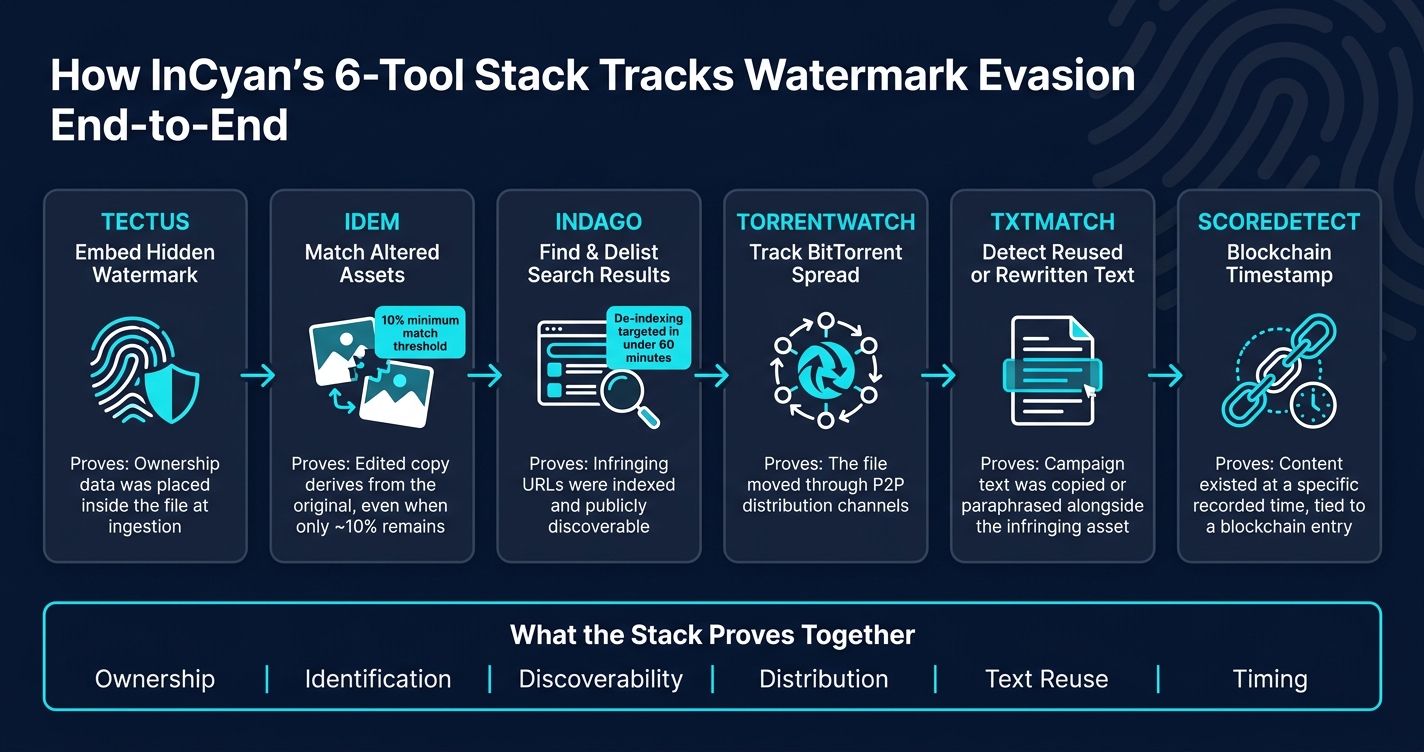
How InCyan’s 6-Tool Stack Tracks Watermark Evasion End-to-End
Quick Comparison
| Tool | Main job | What it helps show |
|---|---|---|
| Tectus | Embed hidden watermark | Ownership data was placed in the file |
| Idem | Match altered media | The edited copy came from the source |
| Indago | Find and delist search results | Infringing URLs were discoverable |
| TorrentWatch | Track BitTorrent spread | The file moved through P2P channels |
| Txtmatch | Check copied or rewritten text | Text reuse tied to the campaign |
| ScoreDetect | Timestamp file hash on blockchain | The asset existed at a recorded time |
So if you want the plain answer, it’s this: watermark evasion does not end the proof trail. I’d read this piece as a guide to how hidden marks, altered-file matching, search delisting, torrent tracking, text matching, and timestamp records fit into one enforcement workflow.
sbb-itb-738ac1e
Tectus and Idem: Detecting hidden ownership and matching altered assets
How Tectus blind watermarking holds up against common evasion attacks
Tectus hides ownership data inside the media signal. That means routine edits like resizing, compression, and re-encoding usually still leave behind a trace you can recover.
For a U.S. streaming service or media company, that matters a lot. You can watermark an entire catalog at ingestion without reworking the creative, changing the asset itself, or adding extra review steps.
In most cases, normal processing only weakens Tectus a little. More aggressive edits can reduce the signal further, but they often still leave partial traces that help support attribution.
When the watermark gets faint, Idem steps in to make the match.
How Idem matches assets when only part of the original remains
Idem matches altered images, video, and audio against the reference catalog, even when only about 10% of the original remains. [1] Put simply: even if someone trims, crops, or remakes the asset, there may still be enough left to connect it back to the source.
The table below shows how Tectus and Idem back each other up across common transformation scenarios:
| Transformation scenario | Extent of original preserved | Tectus watermark status | Idem match confidence |
|---|---|---|---|
| Simple resize and recompression | 80–100% of original structure | Intact and easily detectable | Very high; near-exact match |
| Heavy cropping for social media memes | 30–50% of original image or video area | Partial fragments remain in cropped region | High; sufficient unique feature overlap |
| Short clip extracted from a longer video | 10–30% of original duration | Generally persists within the clipped segment | High; match across frames and audio |
| Generative remake | 10–20% of original structural cues | May be weak or absent | Medium to high; depends on preserved layout and key features |
| Screen capture | 60–90% of original framing | Degraded but often detectable with forensic watermark detection tools | High; strong content similarity despite capture artifacts |
That evidence supports takedowns and licensing claims. Once Tectus and Idem establish ownership, InCyan extends enforcement to search, torrents, and reused text.
Indago, TorrentWatch, and Txtmatch: Covering search, torrents, and reused text
Using Indago to delist altered copies from search results
Once Tectus and Idem pin down the source, Indago goes after the route people use to find the altered copy in search. It scans search results for pages that surface the infringing asset, including file-hosting pages, mirror sites, rehosted landing pages, and cached references. Even when the file itself has been changed, search-facing signals often still give it away: original filenames, creator names, campaign keywords, and product titles.
Indago blocks that search route to infringing copies. It auto-generates DMCA-compliant delisting requests and sends them to major search engines, with de-indexing targeted in under 60 minutes.[3][4] The payoff is simple: the copy becomes much harder to find, even if it’s still floating around elsewhere.
Once search visibility falls, the same campaign can keep moving through torrents and reused text.
TorrentWatch and Txtmatch for P2P copies and reused text
Search delisting doesn’t stop P2P redistribution. Altered files can pop up again in BitTorrent swarms, repackaged under slightly different torrent names while still carrying the same infringing content.
TorrentWatch tracks a broad real-time index of the BitTorrent ecosystem. It scans torrent names, info hashes, tracker references, timestamps, and swarm activity to connect suspicious uploads back to the source. In many cases, those titles and notes still hold enough metadata to back the match.
Txtmatch moves the same coverage into the text layer of the campaign. Release notes, promotional blurbs, article rewrites, and captions that travel with altered assets are all text. Txtmatch checks that material against its proprietary enterprise-scale database at high speed under optimal conditions.[2]
Those matches feed the evidence layer that comes next.
ScoreDetect and the evidence layer: Proving timing and ownership
Blockchain timestamping tied to watermark and match evidence
When TorrentWatch and Txtmatch flag matches, ScoreDetect adds the timing record. The main issue here is simple: can you show you had the asset first?
ScoreDetect creates a cryptographic hash of the content and records that hash on blockchain. Only the fingerprint is written on-chain. The file itself stays off-chain. If someone changes the original file, the checksum changes too, which makes tampering much easier to spot.
Tectus logs the protected asset at creation, and ScoreDetect timestamps that same file on-chain at registration. This creates a certificate with the registration time and owner name. Later, if Idem produces a match report showing that an altered copy came from the original, legal teams can tie that finding to a ScoreDetect certificate dated before the infringing publication.
That’s where things get more useful. Detection on its own tells you something happened. This link helps show when it happened and who had the work first. In practice, it builds a chain from creation to takedown that counsel can use.
This mix often carries weight in pre-litigation talks. Outside counsel can point to the ScoreDetect certificate as a neutral, third-party-verifiable record, while Tectus and Idem reports provide the derivation proof. In the U.S., blockchain timestamps can help support timing claims. In cross-border disputes, teams still need corroboration.
What each evidence source proves in an enforcement workflow
Each InCyan tool covers a different part of the proof trail. Put together, they give legal teams and outside counsel a clearer view of which records support which argument.
| Evidence type | What it proves |
|---|---|
| Tectus logs | Hidden watermark existed at ingestion |
| Idem match reports | Altered file derives from the original |
| Indago findings | Infringing URLs were indexed and visible |
| TorrentWatch records | The file moved through P2P distribution |
| Txtmatch reports | The text was reused or copied |
| ScoreDetect certificates | Content existed at a specific time, tied to a blockchain entry |
Conclusion: A layered InCyan response to watermark evasion
Watermark evasion shows up across search, P2P, and text. And here’s the key point: removing a visible mark doesn’t erase the trail. That’s why the answer can’t rely on one check or one tool. It has to work as a stack.
InCyan’s tools line up with each part of that stack. The system covers the trail from end to end: Tectus embeds ownership, Idem matches altered assets, Indago delists infringing links, TorrentWatch tracks BitTorrent redistribution, Txtmatch catches text reuse, and ScoreDetect adds blockchain-timestamped proof of timing and ownership.
Once that trail is mapped, enforcement shifts from guesswork to a proof workflow. That’s where the stack matters most. Ownership, identification, discoverability, distribution, text reuse, and timing can all be verified in one workflow. That is the practical answer to watermark evasion: layered, channel-specific evidence.
FAQs
How does this stack prove ownership after edits?
InCyan uses a layered approach to prove ownership, even after a file has been changed.
Tectus adds invisible blind watermarks that stay in place through edits like cropping or compression. Idem then helps match altered assets across images, video, audio, and text, even if just 10% of the original is still there.
For proof, ScoreDetect creates a tamper-evident blockchain timestamp from the content checksum. Indago removes infringing search listings, and TorrentWatch tracks P2P sharing.
What happens if the watermark cannot be recovered?
If the watermark can’t be recovered, InCyan doesn’t stop there. It uses a layered approach to back enforcement.
Tectus handles invisible watermarking. Idem matches altered assets. And ScoreDetect records blockchain-based timestamps and checksums to help prove provenance.
On top of that, Indago supports fast search delisting, while TorrentWatch monitors unauthorized P2P distribution.
How fast can InCyan act on search and torrent spread?
InCyan tackles search and torrent spread with a layered workflow.
Tectus adds invisible watermarks. Idem then matches altered copies, even when just 10% of the original is still there.
On the enforcement side, Indago helps de-index search results, and TorrentWatch tracks activity across peer-to-peer networks.
ScoreDetect adds blockchain timestamps and cryptographic checksums to back up tamper-evident proof of ownership.