If a system matches text, images, audio, video, and metadata together, it can expose far more about a person than most teams expect.
I’d boil the risk down to five things: identity linkage, biometric use, user profiling, model leakage, and consent failures. The fix is simple: collect less, strip hidden data, keep checks tied to the asset, not the person, and avoid storing raw files when proof alone will do.
Here’s the short version:
- Risk 1: Identity exposure
A photo, voice clip, timestamp, and device data can point to one person. - Risk 2: Biometric misuse
Faces and voices can shift a matching tool into biometric processing. - Risk 3: Profiling through monitoring
Anti-piracy checks can drift into tracking uploader behavior. - Risk 4: Model leakage
Fine-tuned models can leak training details through prompts or attacks. - Risk 5: Consent and rule failures
Cross-image linking, hidden inference, and reuse of uploads can break privacy rules.
A few facts stand out: EXIF data can include GPS coordinates, device details, and timestamps, and faces in images may be treated as biometric data under GDPR. That means one upload can trigger more than one privacy problem at the same time.
Quick Comparison
| Risk | What goes wrong | Main harm | Basic fix |
|---|---|---|---|
| Identity exposure | Signals get fused into one profile | Re-identification | Strip metadata and redact PII |
| Biometric misuse | Faces or voices get used as identifiers | Biometric data exposure | Block or route biometric files |
| User profiling | Monitoring shifts from asset to uploader | Behavior tracking | Match the asset only |
| Model leakage | Model reveals training data | Data exposure after training | Use non-invertible embeddings and prompt checks |
| Consent failures | Data gets linked or reused beyond the core task | Rule and consent issues | Limit reuse and show likely leakage |
If I were setting up one of these systems, I’d treat every new input type as a new privacy risk, not just a new product feature.
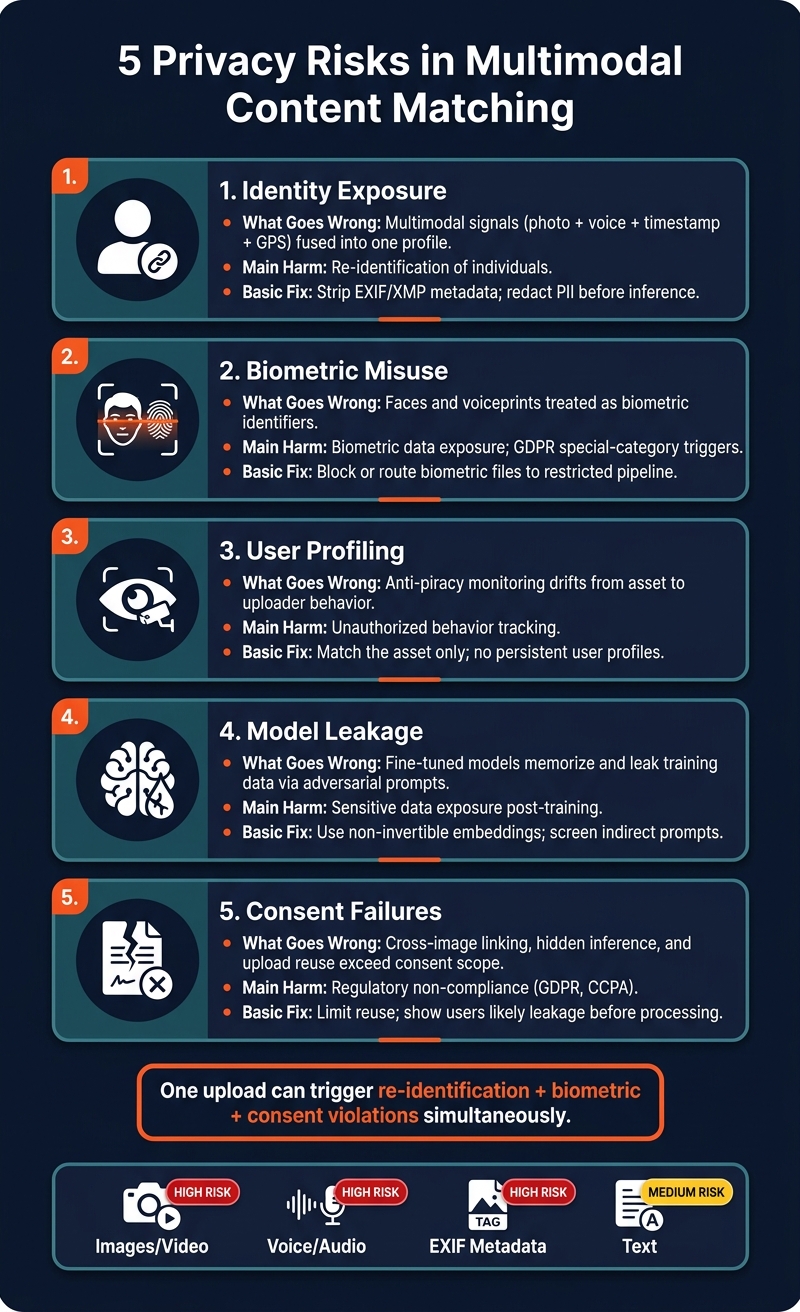
5 Privacy Risks in Multimodal Content Matching: Risks & Fixes
SwissText – Multimodal Privacy-Preserving Document Representation for Automated Document Processing

sbb-itb-738ac1e
Why Privacy Risks Are Higher in Multimodal Systems
A text-only system sees what someone wrote. A multimodal system sees what they wrote, what they look like, what they sound like, where they were, and what device they used – all at once. That changes the game. Signals that might seem harmless on their own can turn into identity-linked patterns and behavior trails when combined. The next five risks show where that shift can do the most harm.
The input modalities a system accepts shape its privacy risk.
How Combining Text, Image, Audio, Video, and Metadata Raises Re-identification Risk
Separate signals can become identifying once they’re fused. A username, a voice clip, or a photo with removed metadata may look low risk by itself. Put them together, though, and the picture changes fast. Add a timestamp, a GPS coordinate hidden in EXIF data, a device serial number, and a face someone can recognize, and you may be able to identify a specific person with high confidence.
Multimodal matching systems can infer location from visual cues even after metadata is removed [1]. Images with identifiable faces are treated as biometric data under GDPR, which brings stricter legal duties than standard text processing [1]. Here’s where hidden risk tends to show up:
| Data Type | Hidden Privacy Risk | Re-identification Potential |
|---|---|---|
| Images/Video | EXIF metadata, GPS coordinates, device IDs | High – biometric matching and geolocation |
| Voice/Audio | Biometric voiceprints, background environment noise | High – unique biometric identifier |
| Screenshots | Browser tabs, 2FA codes, Slack DMs, bookmarks | Medium – contextual profiling |
| Metadata | Timestamps, cloud-account IDs, editing software logs | Medium – routine profiling |
Once a system can infer identity, the risk moves past content matching and into surveillance.
How Anti-Piracy and Moderation Systems Often Collect More Data Than Intended
Workflows built to find unauthorized copies often end up tracking accounts, timing, and location too. That kind of scope creep can turn an content security tools into a behavior-tracking system, even if no one sat down and said, “Let’s build that.”
Part of the problem is simple: people don’t always know what they’re uploading. When they test a new multimodal feature, they often submit screenshots that include browser tabs, one-time codes, open documents, or other private material sitting in the frame. Some users also upload driver’s licenses, passports, or medical bills just to see what the system can do [1]. In plain terms, that can pull far more PII into the workflow than the original use case calls for.
That scope creep is what turns protection into monitoring.
What the Five Risks Cover
Each risk below explains how harm happens, what the impact looks like, and the simplest mitigation.
1. Identity Exposure Through Multimodal Data Fusion
Identity exposure starts the moment separate signals get merged into one profile. In multimodal matching, the main risk isn’t just comparing content. It’s identity linkage. A voice clip, a photo, and a timestamp may seem low-risk on their own. But add a device ID and GPS coordinates tucked inside EXIF data, and that mix can point to a specific person even if no name is shared [1]. That becomes a serious issue when enforcement systems handle user uploads, screenshots, and voice clips at scale.
EXIF metadata often includes meter-level GPS coordinates, device serial numbers, capture timestamps, and cloud-account identifiers [1]. And stripping GPS data doesn’t solve the whole problem. Advanced vision models can still geolocate a photo within a few kilometers by reading street layouts, signs, and building details [1]. Content matching can also drift into facial re-identification. In plain terms, it can connect the same person across different settings and tie a pseudonymous creator to their offline identity without anyone meaning to do that [3]. Under GDPR, images with identifiable faces count as biometric data and may need explicit, separate consent [1].
The safest move is simple: remove identity-bearing data before any matching starts.
- Strip EXIF/XMP metadata before any image crosses the trust boundary [1]
- Scan each upload for PII patterns and redact or reject them before inference [1]
- Keep identity, content, and behavioral stores separate so staff can’t tie identities to content profiles [3]
- Block embedding inversion so biometric source data can’t be rebuilt [3]
| Payload Type | Hidden Risk | Mitigation |
|---|---|---|
| Embedded Metadata | GPS coordinates, device IDs, timestamps | Strip EXIF/XMP before inference |
| Screen Capture PII | Browser tabs, 2FA codes, private messages | Scan and redact via OCR before processing |
| Biometric Data | Identifiable faces (GDPR special category) | Route to specialized pipeline or refuse |
| Sensitive Documents | Passports, driver’s licenses, SSNs | Classify and reject at intake |
2. Biometric Misuse in Image and Audio Matching
This risk starts the moment a system figures out who is in an asset, not just what is in it. At that point, content matching can turn into biometric identification. If the system processes an identifiable face or a voiceprint, it’s no longer dealing with plain media analysis. It’s dealing with biometric data.
That line matters. Unlike identity fusion, this risk begins when a system treats a face or voice as a biometric identifier. Under GDPR, images with identifiable faces may fall into a special category that calls for explicit, separate consent [1]. Add one more input type, and the privacy posture shifts. Add face or voice processing on top of raw uploads for moderation or anti-piracy solutions, and the risk gets much sharper.
There are two parts to this problem: disclosure during inference and retention during training [2].
If biometric data is handled poorly, the fallout can be expensive and messy. You can run into GDPR penalties, state-law claims, and failed enterprise audits. There’s also a common blind spot here: teams often apply text-log retention windows to image and audio data, even though those files carry a different level of exposure. That drives up storage risk and breach risk [1]. And text zero-retention policies often don’t extend to image or audio endpoints, which can leave holes in contracts and DPAs [1].
The practical fix is simple in theory, even if it takes discipline to do well. Treat every new input type as a privacy review event. Use automated face detectors and document classifiers at intake to block biometric content or send it into a restricted pipeline. Strip EXIF, ICC, and XMP metadata before processing. And audit raw uploads, not just model outputs, because the raw file is often where the risk sits.
Just as important, keep monitoring tied to specific assets instead of building persistent user profiles. Think asset-level matching, not person-level tracking. Once biometric data is collected, it can be reused for persistent monitoring, which leads straight into the next risk.
| Risk Type | How It Happens | Primary Harm |
|---|---|---|
| Disclosure Risk | Sensitive biometric data leaks during immediate processing | Exposure of biometric data during active inference [2] |
| Retention Risk | The model memorizes biometric or private information during fine-tuning | Long-term leakage from training data [2] |
| Contractual Gap | Text zero-retention policies do not automatically extend to image or audio endpoints | DPA violations [1] |
3. Surveillance and User Profiling via Anti-Piracy Monitoring
Anti-piracy monitoring starts from a fair goal: finding unauthorized copies of protected content. But the trouble begins when the system collects more than it needs. Instead of checking the asset and moving on, it starts pulling in uploader data too.
That’s the line between monitoring and profiling.
Anti-piracy tools can collect far more than the file itself. In many cases, they also pick up surrounding screen content and hidden upload metadata that can point back to the uploader.
When a system captures hidden data or nearby context, it stops focusing on the asset and starts building a picture of the user. That shift happens when the tool processes data the user can’t see, collects third-party information without consent, or uses identity-linking methods to profile the uploader instead of just identify the asset [1]. At that point, asset matching starts to look a lot like user tracking.
The legal and business risk here is not small. If the pipeline processes images with identifiable faces, that can trigger biometric-data duties under GDPR. Test uploads can also pull sensitive documents into the system by accident [1]. And once vision features collect data people never meant to share, a content tool turns into a privacy-classification event.
A simple rule helps here: match the asset, not the uploader.
Use three controls:
- Strip EXIF, ICC, and XMP metadata before processing.
- Run OCR-based PII detection and redaction on uploads.
- Store only image hashes and preprocessing decisions, not raw files [1].
Once matching stays at the asset level, the next issue is what the model itself may reveal.
| Data Type | Risk | Control |
|---|---|---|
| EXIF Metadata | GPS, device IDs, cloud account identifiers | Strip before data leaves the trust boundary |
| Surrounding Content | 2FA codes, chat previews, browser tabs | OCR-based PII scanning and automated redaction |
| Visual Inference | Geolocation via architectural cues | Asset-level matching; no user profiling |
| Sensitive Documents | Passports, IDs, medical bills | Classifier-based routing or blocking at intake |
4. Model-Level Privacy Leakage and Inference Attacks
The previous risk was collection. This one is memory.
Even if you limit what gets collected, the model can still give away what it learned. Multimodal matching models may memorize sensitive details during fine-tuning, and attackers can later pull that data back out with adversarial prompts. Researchers describe this as retention risks [2].
That’s what makes this problem so tricky. The weak spot often isn’t the obvious prompt. Research shows indirect tasks like captioning and rephrasing can slip past safeguards more easily than direct prompts.
This risk isn’t hypothetical. Testing found high attack success rates across models, with indirect tasks like classification and captioning standing out in particular [2].
There’s another layer to this too. Poorly protected embeddings can open the door to model inversion and membership inference attacks, which may expose original inputs [3]. If medical details appear in images, HIPAA may apply. A leak at the model level can also create CCPA and other state-law exposure.
A few controls help cut the risk:
- Use non-invertible embeddings
- Screen for indirect prompts
- Separate identity, content, and behavior data with distinct access controls
These leaks create both security exposure and compliance risk.
5. Regulatory Non-Compliance and Consent Failures
Multimodal systems often handle faces, relationships, and identity documents. That can trigger stricter consent and purpose-limit rules. And the issue isn’t only what’s in a single upload. It’s also how the system connects that upload with other data.
Consent can break down when a system links images across time or context, then turns them into summaries that reveal relationships, roles, or interactions a user never meant to share. Teams can also reuse uploads for multi-image text summarization. On top of that, model attention may surface hidden details users did not plan to reveal.
The fix is simple in principle, even if it takes discipline in practice: limit what the system can connect and what it can disclose. Keep cross-image correlation tied to the core service only. Redact sensitive pixels or features before matching. And show users likely leakage before processing. The table below sums up the main risks and controls.
| Compliance Gap | Compliance Concern | Practical Fix |
|---|---|---|
| Cross-image correlation without consent | Implicit leakage | Limit correlation to the core service |
| Processing faces, relationships, or identity documents | Sensitive-data handling | Redact sensitive pixels or features before matching |
| Hidden semantic inference from uploads | Insufficient consent | Show users likely leakage before processing |
| Repurposing uploads for multi-image summaries | Unauthorized secondary use | Enforce strict data-use boundaries at each workflow stage |
Risk and Mitigation Quick Reference Tables
These risks can stack up fast. One upload might set off re-identification, biometric, and consent problems at the same time. Use the tables below as a quick intake check for the five risks covered above.
Table 1: Highest-Risk Data Types
| Data Type | Risk Level | Primary Re-identification Drivers |
|---|---|---|
| Images | High | Faces (biometrics), background PII, visual geolocation cues |
| Metadata (EXIF) | High | GPS coordinates with meter-level precision, device serial numbers, cloud-account IDs |
| Audio | High | Voiceprints and biometric signals |
| Text | Medium | Explicit PII (names, IDs) provided directly by the user |
That overlap is why image uploads need the toughest intake controls. A photo can reveal far more than the user meant to share.
Table 2: Biometric Signals – Technical and Policy Controls
| Biometric Signal | Technical Controls | Policy Controls |
|---|---|---|
| Faces (Images/Video) | Face detection for specialized routing; EXIF stripping; re-encoding to prevent polyglot attacks; image hashing for asset matching | Explicit biometric consent; modality-specific retention limits |
| Voices (Audio) | Voice activity detection (VAD); audio fingerprinting; metadata stripping; PII redaction via speech-to-text scanning | Biometric consent; vendor-region verification |
The split here matters. Technical controls help reduce exposure in the file itself, while policy controls shape how the data can be stored, routed, and used.
Table 3: Asset-Centric vs. User-Centric Monitoring
| Monitoring Approach | Focus | Privacy Impact |
|---|---|---|
| Asset-Centric | Matches content at the asset level using hashes or invisible watermarks | Lower risk; avoids building persistent user profiles |
| User-Centric | Tracks user behavior and cross-references identities | Higher risk; triggers stricter biometric and profiling regulations |
Asset-centric matching is the safer default because it points to the file, not the person. That’s a big deal when you want moderation or abuse detection without drifting into profile building.
Even if monitoring stays asset-centered, the model can still leak training data.
Table 4: Attack Types and Corresponding Defenses
| Attack Type | What It Does | Defense |
|---|---|---|
| Membership Inference | Determines whether a specific data point was in the training set | Differential privacy; metadata stripping |
| Model Inversion | Reconstructs training data from model outputs | Gradient clipping; output normalization |
| Inference Attacks | Uses visual cues to geolocate or identify users from uploads | Preprocessing layers; OCR-based PII redaction |
In plain English: even if you lock down uploads, risk doesn’t stop at intake. It can show up later through model behavior, output patterns, or clues buried in the content itself.
How Privacy-Conscious Content Protection Works in Practice
These controls do their best work as a set. Match the asset, keep retention low, and keep monitoring tight. Each step lines up with the five risks covered above.
Match Content at the Asset Level Rather Than Building User Profiles
When a system matches a file by hash, digital fingerprint, or watermark, it connects the match to the content itself, not to the person who uploaded it. That keeps enforcement focused on the asset instead of identity.
Idem matches images, video, and audio even after cropping, compression, or mobile edits, and it does so without building user profiles.
Use Watermarking and Timestamping to Limit Raw Data Exposure
A better approach is to store checksums or watermarks instead of raw files. Blind watermarking places an invisible ownership signal inside the asset itself. InCyan’s Tectus does this for images, video, and audio without visible marks.
ScoreDetect captures a checksum of the content and records it on the blockchain instead of storing the file itself. That gives you proof of ownership you can verify while keeping sensitive content out of the verification chain. Same idea with retention: prove ownership without hanging on to raw files.
Apply Governance Controls to Monitoring and Takedown Workflows
Monitoring should stay limited to specific assets, with audit controls in place inside the organization. Role-based access, audit logs, and rights management workflows help keep asset handling under control. Mandatory approvals keep investigations narrow and auditable. Governance is what keeps these controls focused and trackable.
Conclusion
Put these five risks together, and the pattern is hard to miss: multimodal content matching starts to break down when systems collect, link, or keep too much data. In that sense, input modalities aren’t just product choices. They’re privacy choices too.
The fix stays the same from start to finish: collect less, limit access, reduce memorization, and keep enforcement centered on the asset.
A privacy-first enforcement model stores proof of ownership without storing the underlying file. ScoreDetect timestamps content on-chain instead of storing the file, giving you verifiable proof of ownership without keeping the asset itself.
Privacy by design is the only way to enforce rights at scale without adding avoidable risk.
FAQs
What counts as multimodal data?
Multimodal data brings together different content formats – like text, images, audio, and video – so they can be analyzed as one set of signals. The payoff is a richer, more accurate view of digital assets.
It can also include time-based data, such as video frame sequences, plus metadata like GPS coordinates, timestamps, and device identifiers. Put together, these signals can help identify content even after edits like cropping, re-encoding, or paraphrasing.
When does content matching become biometric processing?
Content matching can turn into biometric processing when the media contains information that can identify a person, like a face. Under rules such as the GDPR, images of identifiable people may be treated as biometric data. That can mean a company needs separate consent, not just a general agreement buried in service terms.
This is where multimodal systems can get tricky. They look at images and audio, so they may set off these stricter rules without anyone planning for it. One simple way to cut risk is to avoid storing raw user-generated content.
How can teams reduce privacy risk without storing raw files?
Teams can cut privacy risk by avoiding storage of raw media files, which may include sensitive user data. Instead, they can rely on cryptographic checksums and blockchain-based systems to create verifiable proof of ownership without keeping the actual assets.
Tools like ScoreDetect support this approach. Invisible watermarking can also embed ownership signals directly into media, making identification possible even after the file has been modified.