If you need to compare text, images, audio, and video at scale, one model is not enough. From what I see in this article, the winning setup is a layered system: shared embeddings for semantic search, ANN indexes for low-latency lookup, and fingerprint or watermark checks for proof.
Here’s the short version in plain English:
- I’d use joint embeddings when I need cross-format search, like text-to-image or audio-to-video.
- I’d use hashing or compressed retrieval when the index is huge and storage or lookup cost becomes a problem.
- I’d use HNSW, IVF, or IVF-PQ to search millions to billions of vectors without exact brute-force search.
- I would not stop at retrieval if legal action is involved. I’d add content matching algorithms for fingerprinting, watermarking, timestamps, and takedown steps.
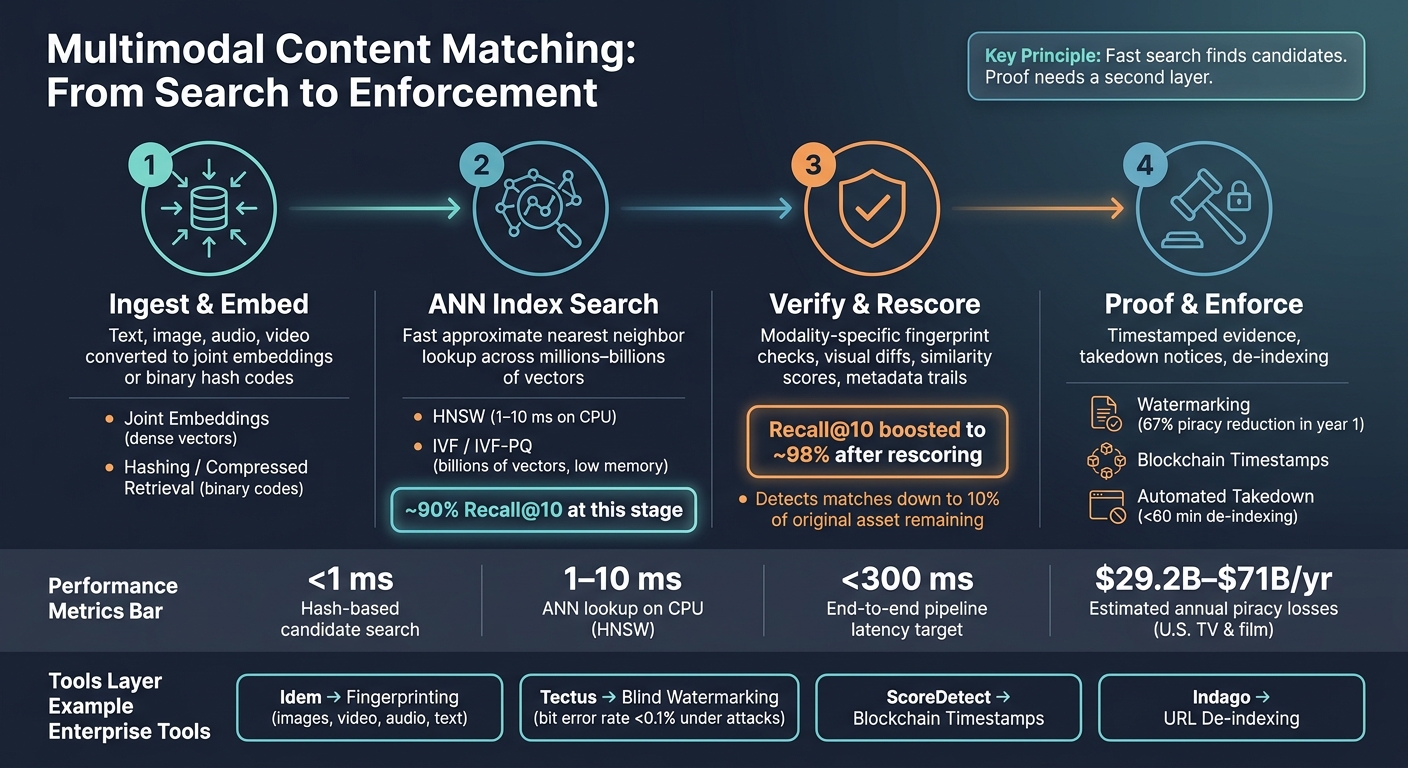
- The article points to numbers that matter: under 1 ms search in some hash-based systems, 1–10 ms ANN lookup on CPUs, ~98% Recall@10 after rescoring, under 300 ms end-to-end latency targets, and piracy losses estimated at $29.2 billion to $71 billion per year.
What this tells me is simple: fast search finds candidates, but proof needs a second layer. That distinction matters for media, e-commerce, healthcare, legal review, and brand protection.
Quick comparison
| Framework / Method | Main job | Best use | Main tradeoff |
|---|---|---|---|
| Joint embeddings | Cross-modal semantic matching | Related asset search, near-duplicate discovery | More storage and query cost |
| Hashing / compressed retrieval | Compact lookup at scale | First-pass screening on huge indexes | Loses detail on subtle matches |
| HNSW / IVF / IVF-PQ | ANN vector search | Low-latency retrieval across large catalogs | Recall depends on tuning |
| Fingerprinting | Match edited or partial copies | Rights checks, piracy detection, reuse tracing | Needs a second-stage system and index support |
| Watermarking | Link assets to source before distribution | Premium media, controlled release workflows | Must be added before release |
| Blockchain timestamps | Time-stamped proof trail | Disputes, chain-of-custody support | Not a matching system by itself |
If I had to sum up the full article in one line, it would be this: search gets you the shortlist, verification gets you the case.
Building Multimodal Search with Milvus: Combining Images and Text for Better Search Results
sbb-itb-738ac1e
Core research frameworks for multimodal similarity
Research in this area tends to group into two main framework families: joint embeddings and hashing/compressed retrieval. Once you look at production-scale systems, the split becomes even clearer. One path focuses on semantic joint embeddings. The other leans on compact hashed retrieval.
Joint embedding models for text, image, audio, and video
Joint embeddings place text, image, audio, and video in one shared space, where similarity is usually scored with cosine distance. The main training method is contrastive learning. It pulls matched pairs, like a caption and its image, closer together and pushes unmatched pairs farther apart.
A CLIP-based image-text retrieval model beat DeViSE by wide margins on R@1, R@5, and R@10.[1] More recently, joint embeddings have moved past just text and images. Frameworks like WAVE and Meta’s PE-AV encoders line up text, audio, video, and motion in a single space. That makes any-to-any retrieval possible, including audio-to-video and text-to-motion.
For enterprise deployment, joint embeddings work best for semantic retrieval. That includes finding related assets, linking captions to media, and surfacing near-duplicate content even when file-level details have changed. The catch is query-time compute. This gets heavier with cross-modal encoders that need to calculate interactions on the fly. For high-stakes workflows like rights enforcement, these models usually need a second verification step to confirm a match with forensic confidence. InCyan‘s Idem platform uses this kind of multimodal matching across images, video, and audio. In practice, this serves as the retrieval layer for candidate matching, not the final enforcement step.
Hashing and compressed retrieval methods for large indexes
As the index gets very large, dense floating-point embeddings become costly to store and slower to search. Multimodal hashing tackles that problem by turning embeddings into compact binary codes that can be compared with simple bitwise operations. The HDIdx high-dimensional indexing library showed that a million-scale high-dimensional database can be searched in under 1 millisecond with this approach.[2]
Supervised hashing methods use labels or annotations to preserve semantic relationships during compression, and they tend to beat unsupervised versions on retrieval accuracy. Techniques like Latent Semantic Sparse Hashing (LSSH) and high-dimensional sparse cross-modal hashing (HSCH) go a step further by using sparse coding to keep more expressiveness without giving up storage efficiency. The tradeoff is pretty clear: compression cuts space and speeds up search, but it also makes subtle matches harder to keep and reduces resilience to crops, re-encoding, and meme overlays. In practice, this works best as the first-pass filter for large-scale screening, not the final proof stage.
Comparison table: joint embeddings vs. hashing frameworks
| Criterion | Joint Embedding Models | Hashing / Compressed Retrieval |
|---|---|---|
| Supported modalities | Text, image, audio, video, motion | Text, image, audio, video (varies by method) |
| Indexing efficiency | Moderate – dense vectors require large storage | High – binary codes are compact and cheap to store |
| Retrieval quality | Strong semantic matching, even across modalities | Good for near-duplicate detection; weaker on subtle matches |
| Resistance to transformations | Moderate to strong, depending on training data | Weaker – compression reduces detail and resilience to edits |
| Computational cost | Higher, especially for cross-modal encoders at query time | Lower – bitwise operations are extremely fast |
| Storage footprint | Large (floating-point vectors) | Small (binary codes) |
| Fit for anti-piracy workflows | Strong for candidate retrieval; needs second-stage verification | Useful for fast first-pass filtering at scale |
No single framework comes out on top in every category. In production, the best systems usually combine both. A hashing or embedding layer cuts down the search space fast, and then a more precise verification step confirms the match. That split is what drives production systems built around fast candidate retrieval first and later verification.
How scalable architectures make multimodal comparison work in production
Multimodal Content Matching: From Search to Enforcement
Matching multimodal content is only half the job. In production, the harder part is doing it fast enough for screening and enforcement. That means searching multimodal embeddings with low latency across huge catalogs, without losing too many good matches along the way.
ANN search, vector databases, and graph-based indexes
Exact similarity search across a large embedding collection is too slow to use in practice. Approximate Nearest Neighbor (ANN) search fixes that tradeoff by giving up a little recall in exchange for a huge drop in compute time.
HNSW is the graph index most teams use for low-latency similarity search. On mid-sized indexes, modern CPUs often return results in 1–10 ms, which makes HNSW a strong fit for image and video similarity work, where a missed match can cause real problems.[3][4]
If memory is tighter, IVF-PQ is often the better option. It splits the space into centroids and searches only the most relevant partitions, which helps very large indexes stay in memory. Vector databases put ANN search into production with features like sharding, replication, metadata filters, and access control. That lets enterprise teams run similarity search while also filtering by rights holder, content type, date range, or territory.[5][6]
AWS showed this pattern in a concrete way: its creative-asset discovery workflow stores multimodal embeddings in OpenSearch Service and runs semantic similarity search across media types with millisecond-level query response times.[6]
Of course, speed by itself isn’t enough. The system also has to keep recall high enough for the verification steps that come next.
Multi-stage pipelines for speed and evidentiary accuracy
Production systems usually split the job into stages. That split matters because finding a possible match is not the same as proving one.
The first stage is coarse ANN retrieval. A query item gets embedded and searched against the full index, and the system pulls back a shortlist of candidates. The second stage runs modality-specific checks: image and video fingerprints, time-frequency fingerprint matching for audio, and semantic or token-level comparison for text. This is where the system produces the similarity scores, visual diffs, and metadata trails that compliance and legal teams need.
A rescore step on top of a PQ-compressed index can move Recall@10 from about 90% to about 98%.[7] That gap may sound small on paper, but it matters a lot when the issue is copyright enforcement or regulatory compliance.
A solid end-to-end pipeline aims for under 300 ms total latency across ANN search, reranking, and network overhead.[7] In an enterprise workflow, that lines up neatly with the core sequence: match, verify, timestamp, and de-index.
This separation between retrieval and proof becomes even more important when content has been edited, compressed, or repackaged.
Comparison table: indexing strategies for enterprise deployment
| Strategy | Latency profile | Scale range | Cross-modal support | Infrastructure complexity | Typical use cases |
|---|---|---|---|---|---|
| Graph-based ANN (HNSW) | Low to moderate | High (millions to hundreds of millions) | Yes, through shared embeddings | Moderate to high | Media search, duplicate detection, infringement monitoring |
| Partition-based ANN (IVF) | Low | High | Yes | Moderate | Large catalogs, semantic retrieval |
| Quantization-based ANN (IVF-PQ) | Very fast query, very low memory | Very high (billions) | Yes | Moderate | Large-scale search with memory constraints |
| Hashing-based retrieval | Fastest candidate generation; lowest detail | High | Limited to moderate | Lower | Candidate generation, near-duplicate screening |
In practice, teams rarely bet on one method alone. They usually use coarse ANN retrieval first, then follow it with precise verification. That production search stack is what makes later robustness work possible for edited copies, memes, and compression-heavy infringement.
Robustness, fingerprinting, and copyright protection use cases
After candidate retrieval, the hard part is staying accurate when the asset has been changed.
That matters because copied content rarely shows up in its original form. It gets resized, cropped, re-encoded, covered with text, or chopped into short clips. A matching system has to hold up through all of that.
That’s why strong systems work in perceptual feature space instead of comparing raw pixels or file bytes. In plain English, they look at how the content appears or sounds, not just whether the file is an exact copy. That makes them much less sensitive to common edits.[14][15]
Checksum-based matching falls apart fast once meme edits, platform compression, mobile reposts, or partial reuse enter the picture.
Fingerprinting and matching under edits, memes, and compression
Modern fingerprinting usually blends multi-scale visual features, time-based video aggregation, and frequency-domain audio analysis. The goal is simple: even if you only have a short clip or a heavily cropped frame, the system can still trace it back to the source.
At scale, exact fingerprint lookup can outperform ANN for near-duplicate matching.[10] InCyan’s Idem uses this method across images, video, and audio in a multimodal database. It’s built to detect ownership even when only 10% of the original asset remains. For text, InCyan’s Txtmatch uses forensic matching against a secure, enterprise-scale database, which helps catch paraphrased or partly reused material that plain string matching would miss.
This is where multimodal retrieval stops being a lab demo and starts doing anti-piracy work. The U.S. TV and film industry is estimated to lose between $29.2 billion and $71 billion per year to digital piracy.[8][9][12][13] If a fingerprinting system breaks under compression or cropping, that doesn’t just mean weaker model output. It means missed detections and lost money.
Watermarking, blockchain proof, and end-to-end enforcement workflows
Fingerprinting helps find unauthorized copies that are already out in the wild. Watermarking does a different job. It embeds an invisible signal into the asset when it’s created or distributed, which helps tie the content to its owner even before infringement is found.
Platforms that adopted forensic watermarking have reported up to a 67% reduction in content piracy within the first year.[11] Modern robust watermarking schemes can keep bit error rates below 0.1% under JPEG compression, Gaussian blur, and cropping attacks. They can also survive up to 50% cropping combined with scaling between 60–150%.[16][17]
InCyan’s Tectus offers blind watermarking for images, video, and audio. ScoreDetect stores a checksum on-chain for timestamped proof of creation. Used together, they give legal teams layered, dated evidence of authorship that supports DMCA workflows and U.S. copyright disputes.
A mature workflow brings these parts together:
- Idem handles fingerprinting
- Tectus adds watermarks
- ScoreDetect provides blockchain timestamps
- Indago de-indexes infringing URLs in under 60 minutes
- Automated notices finish the takedown flow
Comparison table: watermarking vs. fingerprinting in anti-piracy programs
| Aspect | Watermarking (e.g., Tectus) | Fingerprinting (e.g., Idem, Txtmatch) |
|---|---|---|
| Media coverage | Images, video, audio; text watermarking is less mature | Images, video, audio, and text – no prior embedding required |
| Robustness to transformations | Survives compression, resizing, re-encoding; vulnerable to very aggressive cropping if not carefully engineered | Engineered for high robustness, including memes, heavy compression, and partial reuse down to ~10% of the original |
| Prevention vs. detection role | Proactive and deterrent – marks content before distribution, enables traceability | Reactive and discovery-oriented – finds unauthorized copies already circulating |
| Evidentiary value | Strong direct link between marked copy and rights holder; compelling in disputes when combined with embedding logs | Strong correlation evidence via similarity scores; strengthened further with blockchain timestamps (ScoreDetect) and manual review |
| Operational constraints | Requires access to assets before distribution; retrofitting large legacy catalogs is time-intensive | No pre-embedded signal required; works on historical and third-party content; requires robust index infrastructure |
| Best-fit use cases | Controlled distribution, premium releases, pre-release material, high-value catalogs | Web-wide monitoring, UGC platforms, legacy catalog protection, large-scale compliance with search enforcement via Indago |
These layered controls are already showing up in media monitoring, e-commerce enforcement, and legal evidence workflows.
Industry applications and conclusion
Where the research is already being applied
These architectures aren’t sitting in research papers anymore. They’re part of day-to-day workflows across media, commerce, healthcare, legal, and marketing teams.
Media and entertainment uses multimodal retrieval to track licensed assets, spot unauthorized reuse, and handle takedowns at scale. The job is simple to describe but hard to do: keep control of rights across huge content libraries that keep changing.
E-commerce relies on the same setup for visual search, duplicate listings, and catalog deduplication. If a system can match products even when titles and metadata shift, it can cut fraud, reduce manual review, and clean up search results.[19][20]
Healthcare uses multimodal retrieval to link medical images with records for diagnosis, triage, and documentation.[18][20] Legal and government teams use it for contract review, due diligence, filing review, and archive search across scanned documents.[21] In these cases, recall and provenance matter more than raw speed.
Marketing and advertising teams use multimodal comparison for brand monitoring, unauthorized asset reuse, and content provenance checks.
Key takeaways for enterprise teams
The big lesson across these sectors is clear: no single framework fixes every problem. The best enterprise systems layer semantic matching, fast retrieval, and forensic verification instead of betting on one method.
What separates strong lab results from systems that hold up in practice? Robustness. A model can look great on clean benchmarks and still fail once files get compressed, cropped, or paraphrased. And if that happens, it’s not ready for rights enforcement or fraud detection.
When a team needs both detection and enforcement, retrieval is only one part of the chain. For teams that need matching, digital watermarking, blockchain timestamps, and takedown workflows in one path, InCyan’s Idem, Tectus, ScoreDetect, and Indago cover the full enforcement path.
FAQs
When should I use embeddings vs. fingerprinting?
Use embeddings when you need scalable multimodal matching across images, video, audio, and text, especially when content may be edited or partly removed. They match underlying meaning and patterns instead of exact file data.
Use fingerprinting for exact or near-exact matches. In practice, these frameworks can also pair multimodal matching with InCyan tools like Idem, Tectus, Indago, and ScoreDetect for stronger protection and proof of ownership.
Which ANN index fits my scale and latency needs?
Scalable multimodal comparison frameworks use AI embeddings to place images, video, audio, and text in a shared vector space. That lets teams compare different media types on the same map instead of treating each one like a separate island.
With ANN search, these systems can find related content in sub-second time, even when the asset has been altered through cropping, compression, or paraphrasing. In plain terms, the system isn’t just looking for exact matches. It’s looking for close neighbors in the vector space, which is why it can still spot connections after small edits.
At enterprise scale, these frameworks may connect with InCyan tools such as Idem for matching, Tectus for invisible watermarking, and ScoreDetect for blockchain-based proof of ownership.
How do I prove ownership after a match is found?
After a match is found, ownership is usually backed up in two ways: multimodal matching and proof of origin.
InCyan’s Idem helps spot matching content. ScoreDetect then records a cryptographic checksum on the blockchain.
That gives you a tamper-evident ownership timestamp and an audit trail, without putting the original file on-chain.