Most piracy copies are edited on purpose, so exact-match checks often miss them. I’d treat search enforcement as a simple loop: find altered copies with AI matching, link each result to proof of prior ownership, file URL-by-URL delisting requests, and keep checking for reposts.
Here’s the short version:
- I use AI matching for media and text when pirates crop, compress, clip, screen-record, or rewrite the source.
- I pair those match reports with ownership proof, such as blockchain-certified ownership timestamps and, when available, invisible watermark extraction.
- I verify each indexed URL in Google and Bing, then file search delisting requests with records, dates, and match data.
- I track time to first detection, time to filing, de-index rate, and reappearance rate.
- This matters because search delisting cuts discovery in search, and research cited here says combining it with ISP blocking can reduce piracy traffic by about 1.5x more than ISP blocking alone.
Search delisting does not remove a page from the web. It only removes that page from search results. So if I want fewer people finding copied content, I use delisting as one layer, then add host complaints and other steps as needed.
A few points stand out:
- Idem can match image, video, and audio even when only about 10% of the original remains.
- Txtmatch checks meaning and structure, which helps with paraphrased or AI-rewritten text.
- ScoreDetect records a file hash and timestamp on a public blockchain, with only the hash stored.
- Indago helps move from detection to indexed-URL review and filing.
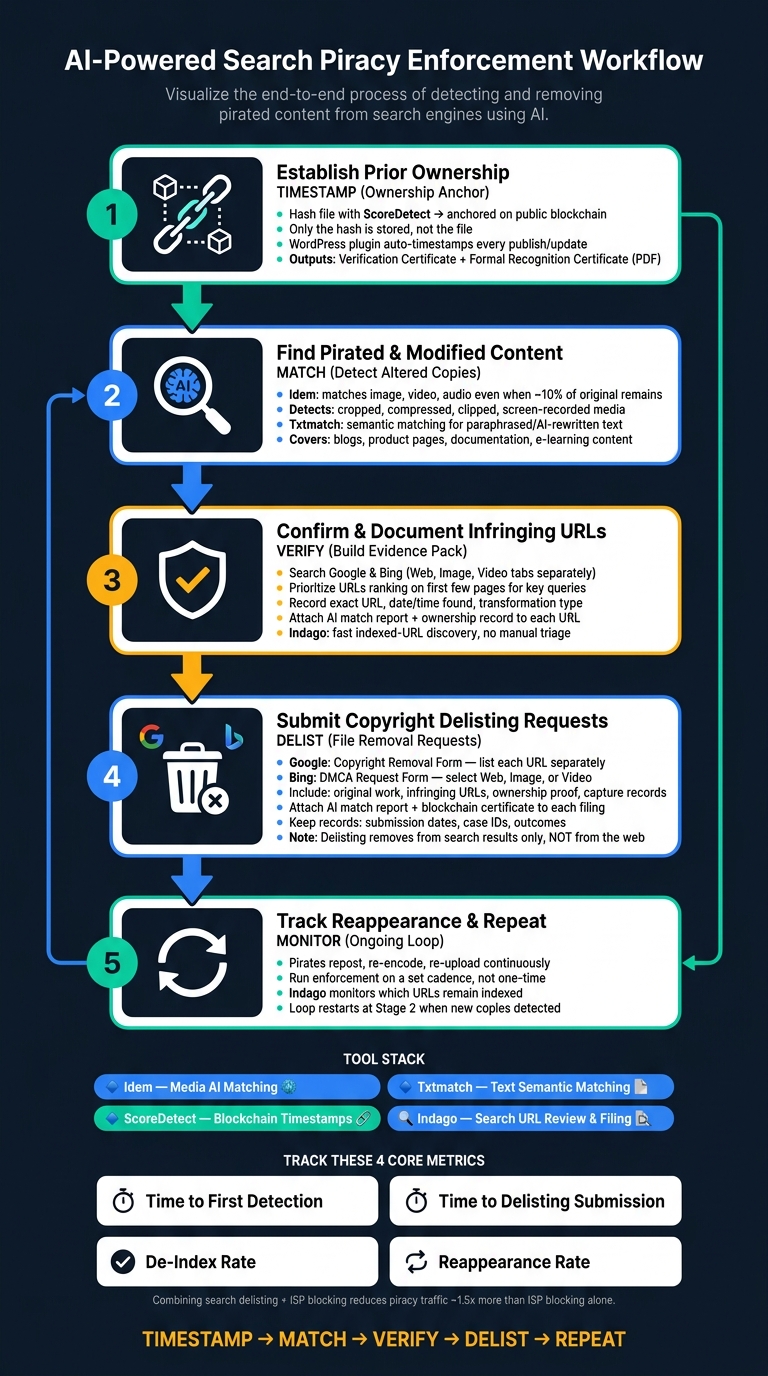
AI-Powered Search Piracy Enforcement Workflow
Quick comparison
| Part | What I use it for | What it shows |
|---|---|---|
| Idem | Edited image, video, and audio copies | Similarity scores, match maps, linked reports |
| Txtmatch | Rewritten or paraphrased text | Passage-level matches and semantic scores |
| ScoreDetect | Prior ownership and publish timing | Hash, timestamp, blockchain record, certificate |
| Watermark extraction | Media ownership check inside the file | Embedded ownership signal after common edits |
| Indago | Search review and delisting workflow | Indexed URLs and filing support |
If I had to sum up the full process in one line, it would be this: timestamp, match, verify, delist, and check again.
sbb-itb-738ac1e
Use AI Matching to Find Altered Copies
When hashes and keyword checks stop working, AI matching helps you find altered copies that slip past those standard checks.
That matters because pirates rarely post a clean copy. They crop files, compress them, rewrite text, or record content off a screen to make detection harder. The job isn’t just finding those copies. It’s turning those findings into proof that can back a delisting request.
Detect Cropped, Compressed, Clipped, and Screen-Recorded Media with Idem

Idem looks at image, motion, and audio patterns instead of relying on exact file matches.
That means the match can still hold up after cropping, re-encoding, compression, or screen recording. So a cropped meme, a compressed clip, or a screen-recorded version may still link back to the source asset.
Even better, Idem is built to match when as little as 10% of the original asset remains visible or audible. That’s a big deal when someone is trying to wreck the file quality on purpose so it’s harder to trace.
Detect Rewritten Articles and Paraphrased Text with Txtmatch
Text piracy has changed in the same way.
Content farms and AI rewriting tools now produce paraphrased versions that swap synonyms, rearrange sentences, and condense sections while keeping the same facts, arguments, and structure.
Txtmatch handles this with semantic matching. Instead of looking only at surface wording, it compares meaning across sentences and paragraphs to see whether an infringing page keeps the same structure and arguments as the protected original.
That applies across:
- Blogs
- Product pages
- Documentation
- E-learning content
Turn Match Results into Usable Proof
Finding a match is only part of the job. The output also needs to support an actual enforcement action.
Idem returns similarity scores, match maps, and URL-linked reports. Txtmatch returns paragraph-level matches and semantic scores that show how much of the page lines up with protected text.
Put together, those outputs give enforcement teams a verifiable record of how the original appears on the infringing page and how much of it is there. That record can support delisting requests and broader copyright action using established legal tools for combating digital piracy, especially when paired with ownership records and timestamps.
Build a Defensible Evidence Pack Before Filing
A match report from Idem or Txtmatch is strong evidence. But on its own, it usually isn’t enough.
Search engines and legal teams often want proof that you owned the content before the copied version showed up. So the job here is simple: pair the AI match report with records that show prior existence and clear ownership.
Use ScoreDetect for Blockchain Timestamps and Ownership Records

ScoreDetect, an InCyan product, hashes the file and anchors that checksum on a public blockchain. Only the hash is stored, not the underlying file.
Here’s how it works in practice: publish the content once, let ScoreDetect record the hash and timestamp, and keep that record on hand. If someone copies the work later, you can re-hash the original file, verify the match, and pull the certificate.
ScoreDetect generates two certificate types:
- Verification Certificates, which include the hash, blockchain URL, registration date, and copyright owner name
- Formal Recognition Certificates, which package the record into a letter for authorities
Both are downloadable as PDFs. And the WordPress plugin timestamps each article automatically, which gives you a chronological publication record without extra manual steps.
Use that certificate as the ownership layer alongside the AI match report.
Add Invisible Watermark Evidence When Available
For images, video, and audio, invisible watermarking adds a second ownership signal directly inside the file.
InCyan’s Tectus solution embeds an invisible watermark that remains detectable by extraction tools after cropping, compression, or conversion. That matters because copied media often gets altered a little before it’s reposted.
Watermark extraction confirms who owns the original. The smart move is to watermark the file at creation, so every distributed copy carries that embedded signal. Paired with Idem, you get both similarity evidence and ownership evidence in the same file.
Compare the Main Evidence Types
| Evidence Type | Edit Resilience | Ownership Support | Usefulness for Legal Escalation |
|---|---|---|---|
| AI Match Reports (Idem, Txtmatch) | Very high; works when as little as ~10% of the asset remains | Strong; shows infringing content is derived from the original | High; forensic similarity evidence, strongest with expert testimony |
| Blockchain Timestamps (ScoreDetect) | N/A; tied to the original checksum, proving prior existence rather than similarity | Very strong; tamper-resistant, timestamped proof of anteriority | Very high; cryptographic records are compelling for establishing anteriority |
| Invisible Watermark Extraction (InCyan / Tectus) | High; survives common reposting, cropping, compression, and minor edits | Very strong for media; direct invisible ownership proof embedded in the file | High; a powerful complement to AI matching for image, video, and audio claims |
| Traditional Copyright Records | N/A; registration and contracts remain valid regardless of edits | Strong; legally recognized proof of authorship, ownership, or licensing rights | Very high; often required or strongly favored in formal legal proceedings |
Once the evidence pack is complete, move to URL verification and delisting filing.
Follow the Search Delisting Workflow Step by Step
Once Idem or Txtmatch flags likely matches, the next move is URL-level review and filing. The workflow is simple: discover, verify, file, and monitor.
Discover and Verify Infringing URLs
Search Google and Bing for your brand name, title, and distinctive phrases. Check Web, Image, and Video results separately.
Focus first on URLs that:
- rank on the first few pages for key queries
- host full copies
- clearly divert traffic or revenue
After you flag a candidate URL, verify it carefully. Record the exact URL, the date and time you found it, and what appears on that page compared to the original. Note the transformation type and how it differs from the source. Then match each URL against the Idem or Txtmatch results before moving ahead.
Indago identifies infringing indexed links fast, so you can go from discovery to filing without manual triage.
Once a URL is verified, attach it to the match report and ownership record before filing.
Prepare and File Copyright Delisting Requests
A defensible complaint should include the original work, exact infringing URLs, establishing ownership, capture records, and the required good-faith and accuracy declarations.
For Google, use the copyright removal form and list each infringing URL separately. For Bing, use the DMCA Request form and choose the right content type: Web, Image, or Video.
Only submit URLs that you verified during discovery and matched against the original. Overbroad claims can slow review and hurt credibility. Attach the AI match report, ownership record, and capture evidence to each URL. Keep records of submission dates, case IDs, and outcomes so follow-up enforcement stays organized.
Manual vs. AI-Assisted Enforcement: A Direct Comparison
Manual review can work fine for simple, one-off cases. But the picture changes when the portfolio gets larger, infringement keeps happening, or the infringer crops, compresses, or rewrites the content to dodge detection. That’s where AI-assisted enforcement helps.
| Dimension | Manual Filing | AI-Assisted Workflow |
|---|---|---|
| Speed | Slow; each URL requires individual review and documentation | Fast; matching and evidence generation run at scale |
| Coverage | Limited; struggles with altered, partial, or transformed copies | Broad; detects cropped, compressed, clipped, rewritten, and paraphrased variants |
| Evidence Quality | Inconsistent; depends on the reviewer’s judgment and thoroughness | Consistent; produces structured match reports and reusable evidence records |
| Repeatability | Low; each enforcement cycle requires the same manual effort | High; templates and match records carry over to new complaints |
| Suitability | Best for small portfolios with obvious, unaltered copies | Best for medium to large portfolios with frequent reposts or intentionally modified content |
Use the AI-assisted path for altered or repeated infringements, then monitor for reindexed copies.
Run Search Enforcement as an Ongoing Process
Piracy enforcement needs to run all the time, not as a one-and-done cleanup. Pirates repost, re-encode, and re-upload nonstop, so a single campaign won’t stick.
Once you have evidence, keep enforcement moving on a set cadence.
Connect Idem, Txtmatch, Indago, and ScoreDetect into One Workflow
Use a closed-loop process. Start with ownership records. Then move into match detection and delisting.
ScoreDetect handles ownership timestamps. Idem and Txtmatch handle match detection. Indago shows which URLs are indexed and visible to users, then helps speed up delisting notice generation and submission. That cuts the gap between detection and delisting.
Use the ScoreDetect WordPress plugin to timestamp every publish or update. If you’re working with a larger team, use the API or Zapier to trigger timestamps from your DAM or CDN.
When Idem or Txtmatch flags a match, Indago helps confirm where that copy appears in search. From there, your team can move straight into delisting.
Track four core metrics:
- time to first detection
- time to delisting submission
- de-index rate
- reappearance rate
Fewer indexed pirate URLs on the first page of search results correlates with lower revenue leakage and stronger conversion to authorized offerings.
If you manage large libraries, route reference assets and rights data into Idem and Txtmatch through your existing workflow.
The loop is simple and repeatable: timestamp, match, verify, delist. Use ScoreDetect to establish ownership with timestamps, Idem and Txtmatch to prove altered copying, and Indago to remove indexed copies from search.
FAQs
How accurate is AI matching on edited copies?
AI matching deals with the messy stuff. It uses similarity checks, embeddings, and multimodal fingerprinting to spot copied content even after cropping, compression, clipping, or paraphrasing. That matters because exact match tools and hash matching often miss those altered versions.
InCyan’s Idem supports image, video, and audio matching, even when only about 10% of the original remains. Txtmatch helps verify rewritten text. ScoreDetect adds a SHA-256 checksum and a blockchain timestamp to help with search delisting and broader copyright action.
What proof should I include with a delisting request?
Include proof that links the copied material back to your original, even when the copy was cropped, compressed, clipped, re-encoded, or paraphrased. Idem and Txtmatch supply that matching proof and group related uses so they’re easier to review.
You can also add ownership proof, such as ScoreDetect’s cryptographic checksum and tamper-evident blockchain timestamp. InCyan may pair this with Indago for fast search de-indexing.
Does search delisting stop piracy by itself?
No. Search delisting can cut down visibility, but it doesn’t stop piracy by itself.
That’s where matching and proof come in.
AI matching can help show infringement even when content has been cropped, compressed, clipped, or rewritten. InCyan’s Idem and Txtmatch offer forensic matching that supports delisting and broader copyright action. ScoreDetect adds timestamped proof of ownership with blockchain-recorded checksums.