I’d choose multimodal matching tools for mixed-media libraries, platform-side recognition for upload checks, and managed monitoring for discovery and takedowns – not treat all three as the same service.
My shortlist is InCyan, Pex, and Audible Magic, with Vobile as the baseline. As of October 26, 2026, Pex is Vobile-owned, so I wouldn’t count it as an independent alternative. I compare content matching algorithms, channel coverage, enforcement, integrations, and total cost – not match counts alone.
Quick Comparison
| Option | Main use | Enforcement model | Pricing check |
|---|---|---|---|
| InCyan | Image, video, audio, and text tools; watermarking; search and peer-to-peer monitoring | Module-specific; confirm who handles notices | Request an itemized USD quote |
| Pex | Audio/video recognition on participating platforms | Platforms apply rights-holder policies | Free rights-holder registration; Discovery advertised at $1 per file/month |
| Audible Magic | Platform-side audio/video identification | Platforms apply Block or Allow policies | Qualifying owner registration is free; enterprise pricing requires a quote |
| Vobile | Audiovisual monitoring, rights management, and enforcement | Managed services and platform claims vary by product | Quote-based; confirm asset and platform-request fees |
My first check: <u>who acts after a match?</u> A detection is not an infringement ruling, and no supplied source establishes a verified cross-vendor accuracy benchmark.
I’d use the comparison below to narrow the list, then test the same files with each provider and price the workflow from review through dispute handling.
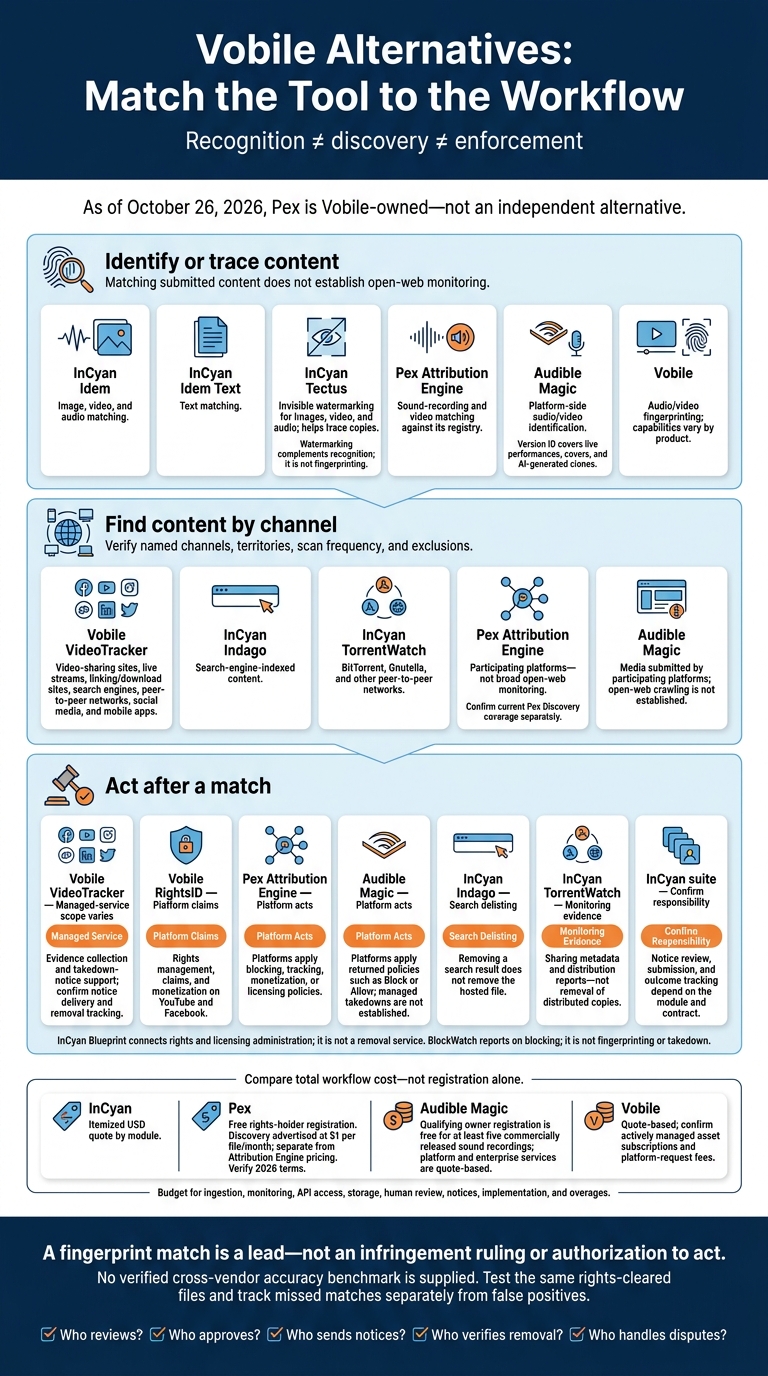
Vobile Alternatives: Match the Tool to the Workflow
1. InCyan Content Protection Suite
Media Types and Match Performance
Idem matches images, video, and audio. It claims to recognize transformed copies with as little as 10% of the original asset intact. That’s a vendor claim – not an independent benchmark.
Test it with cropped, compressed, re-encoded, shortened, and other partial files from your own library. Track both missed matches and false positives. Idem Text handles text, but public details about supported formats, matching methods, and performance are limited.
Monitoring and Platform Coverage
TorrentWatch monitors BitTorrent, Gnutella, and other peer-to-peer networks over IPv4 and IPv6. It collects sharing metadata and distribution reports.[7]
Indago finds search-engine-indexed infringements and supports delisting. InCyan’s under-60-minute delisting claim isn’t a guaranteed turnaround. Confirm which search engines it covers, and distinguish removing a search result from removing content on the host site.
Finding a copy is one step. Documenting it and taking action require separate checks.
Evidence and Enforcement
Tectus embeds invisible watermarks before distribution to help trace copies. It works alongside recognition rather than replacing it.
Detection doesn’t prove a notice was delivered. Confirm who reviews the evidence, sends notices, and tracks outcomes.
BlockWatch checks DNS, IP, HTTP/S, and transport-layer blocking and produces timestamped blocking reports. It isn’t a digital fingerprinting or takedown service.[8]
Integrations and Cost
Blueprint connects licensing records with Tectus and Idem so rights and sales teams can act on reports within one workflow.[6] Use InCyan Business Intelligence and Insights only if you need reporting and prioritization. Check its dashboards, exports, permissions, and API access.
Request an itemized quote in U.S. dollars covering each module, library size, scan frequency, channels, notice volume, evidence retention, implementation, and minimum term.
Before committing, ask for an end-to-end demonstration that shows match review, evidence preservation, notice status, and removal verification – not just a successful detection.
2. Pex
Pex’s platform-side model fits rights holders working with participating platforms. It’s not designed for broad open-web piracy monitoring.
Media Types and Match Performance
Pex’s Attribution Engine matches sound recordings and videos against its asset registry. When metadata is available, matches include recording and composition ownership. Public materials don’t provide a verified accuracy rate, so test excerpts, live versions, and transformed uploads separately.[9][17]
Monitoring and Platform Coverage
According to Pex, participating platforms use its platform-side SDK to send fingerprints and receive ownership and policy data in 5 seconds or less. That’s a latency claim – not an accuracy measure. Attribution Engine serves participating platforms rather than monitoring the open web. For Discovery, check current platform coverage and scan frequency.[9][12][16]
Evidence and Enforcement
Rights holders register reference files, add ownership and licensing metadata, and set policies by asset, platform, or territory. A match can trigger monetization, tracking, royalty-free use, custom licensing terms, or blocking. The platform applies the policy.
A match isn’t an infringement ruling or an automatic DMCA notice. Confirm who handles disputes and takedown notices.[9][10][13]
Integrations and Cost
Pex supports registration through DDEX, CSV, a web interface, and an SDK. Check current availability, required identifiers such as ISRCs, metadata-update methods, and supported SDK versions.
Rights-holder registration is free, while platform pricing requires a quote. Discovery has been advertised at $1 per file per month, separate from Attribution Engine pricing. Verify the 2026 terms, including revenue share and enforcement fees.[11][12][14][15]
Next, compare this platform-side model with Audible Magic’s enterprise recognition offering.
3. Audible Magic
Media Types and Match Performance
Audible Magic identifies audio and video in user-generated content through perceptual fingerprinting. Unlike open-web monitoring tools, it works with participating platforms and registered reference files. Version ID covers live performances, covers, and AI-generated clones.
The company says it can recognize short clips and audio with changes to speed, pitch, or tempo, but it publishes no verified accuracy rate. Confirm supported file formats and delivery methods during setup: public product pages don’t include a complete technical format matrix.[19][21][25][26]
Monitoring and Platform Coverage
Documented integrations include Facebook, Instagram, Twitch, SoundCloud, Dailymotion, and Vimeo. The company also claims feeds from 140,000 labels and 1,000 studios across 150 territories. Those numbers don’t prove that your catalog is covered.
Check coverage, not just registry size. These integrations show which channels participate – not how broadly the system scans. Verify current support for your channels and territories. Public materials describe media submitted by platforms, not open-web crawling.[19][20][22]
Evidence and Enforcement
Enforcement is platform-driven, not takedown-led. The host platform applies returned policies such as Block or Allow. Before onboarding, confirm that match events include the matched asset, timestamp, territory, platform or service, returned policy, and any URL or uploader data needed for notices.
Rights holders can use Rights360 to manage policies by asset, by platform, or globally. The available documentation does not establish that Audible Magic offers a managed-takedown service.[18][22][23]
Integrations and Cost
With enforcement handled by platforms, the next checks are integration and price. Audible Magic supports DDEX catalog delivery for identification and compliance submissions. Prepare authoritative reference files, ownership and territory data, and policy rules. During setup, confirm API limits, reporting, dispute handling, and DDEX validation.
No public rate card or standard per-track, per-match, API, or platform price was identified. The company says copyright owners can register at least five commercially released sound recordings for free, with subsequent identification/compliance services included under that program. Platform and enterprise services remain quote-based. Platform, licensing, administration, and specialized services have separate commercial terms.[23][24]
4. Vobile (Baseline)
Use Vobile as the baseline for full-stack detection and enforcement.
Media Types and Match Performance
Vobile is modular, not a single uniform product. VideoTracker uses VDNA for video matching.[2] Separate documentation covers audio fingerprints for sound recordings and melody/phonetic matching for compositions or lyrics, including covers and live versions. Media-file processing, including video, returns match timecodes in five seconds or less.[4]
That timing is a documented claim, not a universal SLA. Vobile does not publish a universal accuracy rate.
Monitoring and Platform Coverage
Matching is only part of the picture. Where can Vobile search – and where can it act?
VideoTracker searches video-sharing sites, live streams, linking and download sites, search engines, peer-to-peer networks, social media, and mobile apps for suspected copies shared without permission.[27] RightsID handles rights management, claims, and monetization on YouTube and Facebook.[3]
Ask for named channels, scan frequency, territories, and exclusions. Broad monitoring coverage does not mean equal access or enforcement across every platform.
Evidence and Enforcement
Finding a copy is the first step. Enforcement also depends on the evidence package and notice workflow. VideoTracker finds and documents suspected copies shared without permission and supports takedown notices. Notice delivery and remediation tracking are separate steps.[5][27]
Confirm the approval process and whether the service tracks removals, reuploads, and counter-notices. Require exportable evidence that links the reference asset, detected URL, match timecodes, capture timestamp, and ownership record.
A match alone does not establish infringement. Authorized uses and disputed rights still need review.
Integrations and Cost
Check how Vobile connects to your existing asset and rights systems. The local SDK supports on-device fingerprinting. Live-stream matching sends short segments and returns results for each segment.[4] Verify that the proposed product includes these capabilities, API access, and dashboards.
Pricing is quote-based, with subscriptions tied to actively managed assets, custom SLAs, and platform-request fees.[5] Ask what triggers those fees, including whether platforms request service coverage or action. Request separate costs for onboarding, SDK/API usage, monitoring, evidence retention, and managed enforcement.
Compare Matching, Coverage, Enforcement, and Cost
Compare products across four areas: matching, discovery, enforcement, and total cost.
Table 1: Media Types and Match Performance
| Product | Recognition capability |
|---|---|
| Vobile | Audio/video fingerprinting; capabilities vary by product.[2][4] |
| Pex Attribution Engine | Sound-recording and video matching against its registry.[9][17] |
| Audible Magic | Audio/video fingerprinting; Version ID covers live performances, covers, and AI-generated clones.[19][25][26] |
| InCyan Idem | Image, video, and audio matching. |
| InCyan Idem Text | Text matching. |
| InCyan Tectus | Invisible watermarking for images, video, and audio. Watermark detection is not a measure of fingerprint accuracy. |
No supplied source provides a verified cross-vendor benchmark. Test every vendor with the same rights-cleared files, and score missed matches separately from false positives.
Table 2: Monitoring and Platform Coverage
| Product | Discovery channel |
|---|---|
| Vobile VideoTracker | Video-sharing sites, live streams, linking/download sites, search engines, peer-to-peer networks, social media, and mobile apps.[27] |
| Pex | Attribution Engine serves participating platforms; confirm current Discovery coverage.[9][12][16] |
| Audible Magic | Media submitted by participating platforms; open-web crawling is not established.[19][22] |
| InCyan Indago | Search-engine-indexed content. |
| InCyan TorrentWatch | BitTorrent, Gnutella, and other peer-to-peer networks.[7] |
| InCyan Idem / Idem Text | Submitted content; independent web crawling is not established. |
Check territories, scan frequency, platform exclusions, and whether you need to supply URLs. Finding content does not mean taking enforcement action.
Table 3: Evidence and Enforcement
| Product | Supported action |
|---|---|
| Vobile | VideoTracker supports evidence collection and takedown notices; RightsID supports platform claims and monetization.[3][27] |
| Pex Attribution Engine | Participating platforms apply blocking, tracking, monetization, or licensing policies.[9][10][13] |
| Audible Magic | Platforms apply returned policies such as Block or Allow; managed takedowns are not established.[18][22][23] |
| InCyan Indago | Search delisting; the hosted file may remain available. |
| InCyan TorrentWatch | Sharing metadata and distribution reports, not removal of distributed copies.[7] |
| InCyan Blueprint | Rights and licensing administration, not removal.[6] |
Track notice submission, source removal, and delisting separately. Each is a different outcome. Implementing comprehensive copyright infringement solutions for online media requires coordinating these distinct actions.
Table 4: Integrations and Total Cost
| Product | Implementation and pricing checks |
|---|---|
| Vobile | Confirm SDK/API access, evidence exports, managed-service scope, asset-based subscriptions, and platform-request fees.[4][5] |
| Pex | Confirm DDEX/CSV ingestion, SDK access, usage limits, revenue share, and separate Discovery charges.[11][12][14][15] |
| Audible Magic | Confirm DDEX delivery, platform integration, reporting, and separate enterprise or specialized-service terms.[23][24] |
| InCyan products | Confirm identifiers, API access, evidence exports, and contracts for each product. |
No complete public U.S. rate card was identified, so request a quote for each product. Pex Discovery has been advertised at $1 per file per month – not an all-inclusive enforcement price.[11][12] Pex rights-holder registration and Audible Magic’s qualifying copyright-owner registration program are free; platform and enterprise charges are separate.[14][23][24]
Ask for itemized onboarding, reference-asset, API, discovery, evidence-storage, and enforcement charges. Price and integrate each InCyan module separately.
Product-Level Decision Matrix
Use this matrix to match each product to your buying needs.
| Product | Buyer fit |
|---|---|
| Vobile | Managed audiovisual monitoring and enforcement. |
| Pex | Recognition and policy application on participating platforms. |
| Audible Magic | Platform-side upload identification and compliance. |
| InCyan Idem | Multimodal matching. |
| InCyan Idem Text | Text matching. |
| InCyan Tectus | Watermarked-copy tracing. |
| InCyan Indago | Search-index discovery and delisting. |
| InCyan TorrentWatch | Peer-to-peer distribution monitoring. |
| InCyan Blueprint | Rights and licensing administration. |
Pros, Cons, and Buyer Fit
The comparison above explains what each platform does. Here’s how that translates into a buying decision: choose for the workflow you need – not recognition alone.
| Option | Advantage | Limitation | Best fit if… | Buyer responsibility |
|---|---|---|---|---|
| InCyan suite | Broad modular coverage. | Confirm how modules work together and which services are included.[28][29] | You can coordinate separate tools into one enforcement process. | Assign responsibility for each module’s workflow. |
| Pex | Best for edited-audio matching on participating platforms.[17] | Recognition access alone doesn’t include complete monitoring or managed enforcement. | Your main need is edited-music reuse or platform-side audiovisual matching. | Confirm who acts on match results. |
| Audible Magic | Best for pre-publication and platform-side checks.[21][30] | Platform policy controls aren’t a takedown service.[31] | You run a platform or distributor that needs checks before publication or delivery. | Set up review and appeal handling. |
| Vobile | Best for end-to-end monitoring plus enforcement.[5] | Coverage and service levels depend on what you purchase. | Your priority is broad monitoring with managed enforcement. | Define enforcement authority and escalation procedures. |
For InCyan, request a written module-to-workflow map. It should separate software, managed services, custom development, and steps your team must handle.[28][29]
Use the matrix below to choose the narrowest product that covers the job.
| Main need | Selection rule |
|---|---|
| Multimodal libraries | Choose InCyan Idem, with Idem Text for text, when one workflow must cover images, video, audio, and text. Confirm how the results connect. |
| Text protection | Choose InCyan Idem Text only if the contract covers discovery and enforcement – not just matching. |
| Search enforcement | Choose Vobile VideoTracker or InCyan Indago when source removal and delisting are separate goals. Confirm which action each service supports. |
| Torrent monitoring | Choose InCyan TorrentWatch or Vobile VideoTracker when peer-to-peer evidence is a priority. Confirm who handles follow-up. |
| Invisible watermarking | Choose InCyan Tectus when traceability matters more than live monitoring. |
Budget for internal review, even with managed services. Keep ownership records, exceptions, territories, and expiration dates current. A match may still be authorized use or fair use, so verify ownership and permissions before enforcement.[30][31]
Request a sample case record and assign responsibility for detection, review, notice approval, response tracking, and dispute handling. Require separate reporting for confirmed infringements, successful removals, repeat uploads, and unresolved claims – not just match counts.
Conclusion: Match Protection to Your Rights and Channels
Choose recognition when identification is the missing step. Choose channel-specific monitoring and enforcement when you need discovery, notices, and follow-up on priority channels. For InCyan, pick modules based on your library and rights needs – not the suite label.[28][32]
Before signing, turn your shortlist into a written checklist. Confirm accepted file types; asset, file-size, and duration limits; minimum reference and excerpt lengths; performance on transformed content; and coverage by channel, country, and scan frequency. Also confirm reviewer staffing, notice approval, who submits notices, dispute handling, and required integrations.
Compare the total annual cost, including ingestion, monitoring, API access, storage, human review, notices, implementation, and overages. Get contract minimums, renewal terms, and exit provisions in writing. Public sources don’t show a standardized rate card, so request itemized quotes.[28][32]
Next, test your shortlist in a time-limited live pilot using four sets: licensed uses, known infringements, transformed copies, and unrelated nonmatches. Where relevant, test cropping, compression, pitch changes, and short excerpts. Track missed matches, false positives, response time, analyst hours, and evidence completeness. Require an exportable case record that covers detection through dispute resolution.
Enforcement still depends on rights and process, even when matches are strong. A fingerprint match is a lead, not authorization to act. U.S. notices still need rights evidence, context review, authority to act, identification of the material, required statements and signature, and counter-notice support.[33][34][35]
FAQs
How can I switch providers without losing enforcement history?
Before you sign, make sure the contract preserves your rights to all fingerprints, watermark keys, evidence records, and derived analytics [1]. Require structured exports that show any signs of tampering and include your complete case history: evidence, decisions, notices, correspondence, and status logs [2].
Check that those exports are ready for litigation. Another analyst should be able to independently reproduce every finding and confirm the chain of custody, so your data stays portable and verifiable across platforms [3][1].
How do I prevent claims against licensed users?
Keep asset records that include original files, license terms, and a history of authorized derivatives. Before sending automated notices, run a two-step human review. Check each match against internal records, publication timing, jurisdiction, and active licensing agreements.
Document the chain of custody using blockchain-backed timestamps and watermark logs. Use these records to identify and exclude authorized uses, helping prevent mistaken claims against partners and licensed users.
When should I combine fingerprinting with watermarking?
Use fingerprinting and watermarking together to identify pirated content and trace where it came from. Fingerprinting detects copies shared without permission by matching an asset’s identifying traits. Watermarking embeds a distinct identifier in specific files to trace a leak to a user, device, or distribution session.
Fingerprinting identifies what’s being shared. Watermarking provides forensic evidence that links the copy to a leak source or an authorized recipient.