I compare enterprise video piracy vendors in 2026 by live and on-demand coverage, source tracing, verified removals, response times, territory support, integrations, and total cost – not notice counts alone.
My shortlist covers InCyan, Corsearch, and Irdeto, using public materials available as of October 25, 2026. The key distinction: finding a pirated stream, tracing its source, and removing it are separate tasks. I would ask each vendor to prove those steps in a four- to six-week pilot before signing.
Quick Comparison
| Vendor | Documented focus | What I would verify |
|---|---|---|
| InCyan | Content matching algorithms, monitoring, watermarking, and DMCA workflows | Live-stream coverage, notice submission, integrations, and removal results |
| Corsearch | Automated detection, 24/7 monitoring, link review, and managed takedowns | Video detection methods, live-response times, and confirmed removals |
| Irdeto | Monitoring, fingerprinting, forensic watermarking, and enforcement | Session attribution, source-removal times, deployment needs, and total cost |
I would also request <u>a 12-month quote in USD</u>, with support hours, territory coverage, usage limits, and renewal terms in writing. Public sources do not establish comparable removal rates or takedown times across all three vendors, so I use the comparison below to separate documented features from claims that still need testing.
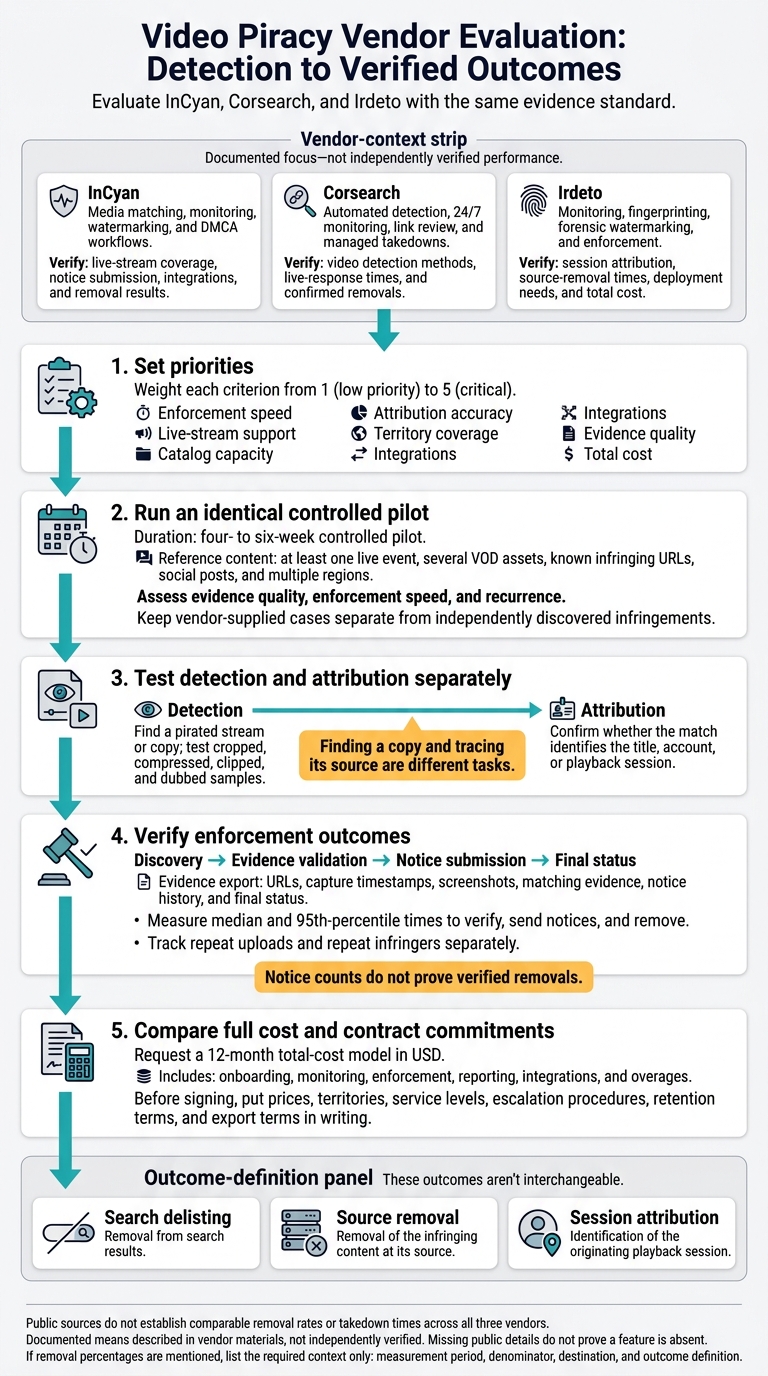
Video Piracy Vendor Evaluation: Detection to Verified Outcomes
Enterprise Video Protection Comparison
Compare vendors across four categories: coverage and identification, enforcement results, enterprise operations, and pricing and contract terms. The matrix separates documented features from items that need written proof. Focus on evidence of coverage, removal, and support – not marketing claims. Documented means described in vendor materials, not independently verified.
| Criterion | InCyan | Corsearch | Irdeto |
|---|---|---|---|
| Coverage and identification | Crawling, scraping, monitoring, and image, video, and audio matching documented[6] | Automated detection and 24/7 monitoring and enforcement for websites, streams, torrents, and illegal distribution documented[9] | Monitoring of websites, social media, apps, search engines, and peer-to-peer networks documented[1]; fingerprinting and TraceMark documented[2] |
| Enforcement results | DMCA notice system documented; automated generation and vendor submission require written proof[6] | Infringing-link verification and expert-managed takedowns documented[9] | Takedowns, DMCA notices, search delisting, and social-platform enforcement documented[1][2] |
| Enterprise operations | Modular platform and reporting documented[6] | Client portal for managed enforcement documented[9] | Facebook, Instagram, and YouTube account connections and batch notices documented[2] |
| Pricing and contract terms | Module-based licensing documented; full terms not publicly documented[11] | Enterprise terms not publicly documented[10] | Enterprise terms not publicly documented[1][8] |
Verification note: “Not publicly documented” means the reviewed materials do not establish the capability or terms – not that they are unavailable. “Written proof required” means buyers should obtain written evidence before treating an item as included.
Start with detection scope. Then check whether each vendor can trace a match to a title, account, or playback session.
Monitoring Coverage and Content Identification
Finding a copy and tracing its source are different tasks. InCyan’s matching identifies assets, but its watermarking does not prove subscriber or session identity.[6] Irdeto combines detection with fingerprinting and TraceMark forensic watermarking.[2]
Test cropped, compressed, clipped, and dubbed samples. For each match, confirm whether the result identifies the title, account, or playback session.
| Coverage or method | InCyan | Corsearch | Irdeto |
|---|---|---|---|
| Live and on-demand scope | Web crawling and matching documented; live-stream scope requires written proof[6] | Streams and website/torrent monitoring documented; live and catalog scope require written proof[9] | Live sports, events, films, and television documented[1] |
| Monitoring destinations | Web crawling documented; platform coverage requires written proof[6] | Websites, streams, and torrents documented; confirm coverage for each destination, including IPTV and forums[9] | Websites, social media, apps, search engines, and peer-to-peer networks documented[1] |
| Identification and review | Image, video, and audio matching documented; session tracing requires written proof[6] | Verification documented; fingerprinting specifications require written proof[9] | Fingerprinting and TraceMark documented; deployment-specific attribution requires written proof[2] |
Enforcement Methods and Removal Results
Request a sample evidence export with URLs, capture timestamps, screenshots, matching evidence, notice history, and final status. Ask for separate records for repeat uploads and repeat infringers.
A removal percentage needs context: its measurement period, denominator, destination, and outcome definition. Do not publish one without those details. The supplied evidence does not establish comparable removal rates across these vendors.
| Enforcement detail | InCyan | Corsearch | Irdeto |
|---|---|---|---|
| Notice and platform action | DMCA notice system documented; automated generation and vendor submission require written proof[6] | Infringing-link verification and expert-managed takedowns documented[9] | DMCA notices, search delisting, and social-platform enforcement documented[1][2] |
| Escalation beyond notices | Written proof required | Written proof required | Host and ISP escalation, including disruption, documented[1][2] |
| Evidence and outcomes | Evidence capture not publicly documented; removal-time benchmarks require written proof[6] | Evidence capture not publicly documented; removal-time benchmarks require written proof[9] | Evidence capture documented; retention and removal-time benchmarks require written proof[1] |
Next, check how each vendor connects to your stack and handles demand during live events.
Integrations, Capacity, and Support
Ask for API documentation and label every connection native, partner-provided, or custom. InCyan’s modular platform alone does not confirm compatibility with a particular DRM, OTT, CDN, or rights database.[6]
Test capacity against concurrent live events and catalog ingestion – not asset count alone. Get territory coverage, supported languages, escalation ownership, and after-hours response commitments in writing. Any operations or support item not documented below requires written proof.
| Operational requirement | InCyan | Corsearch | Irdeto |
|---|---|---|---|
| Documented connections | Specific API, DRM, OTT, and CDN connections not publicly documented[6] | Native, partner-provided, or custom integrations not publicly documented[9] | Facebook, Instagram, and YouTube account connections documented[2] |
| Reporting and automation | Monitoring, alerts, and reporting documented; export formats not publicly documented[6] | Client portal documented; export formats not publicly documented[9] | Batch notices aligned to platform policy documented; export formats not publicly documented[2] |
| Capacity and support | Event limits, languages, and support commitments not publicly documented | 24/7 service advertised; contractual response and capacity not publicly documented[9] | Global hosting-site and ISP relationships documented; country, language, and capacity commitments not publicly documented[2][8] |
Pricing and Contract Terms
Public pricing is not disclosed. Request a written quote in USD that states the billing period, included volumes, and overage rules.[11][10][1][8]
Have the vendor itemize onboarding, live-event hours, catalog monitoring, analyst review, notices, watermarking, API access, and evidence storage. Specify whether overages count URLs, cases, notices, or confirmed removals.
1. InCyan
Use the comparison matrix as your baseline. This section covers what InCyan still needs to prove in practice.
Monitoring and Identification
InCyan combines matching, watermarking, delisting, and torrent monitoring. Buyers should test each module against actual piracy samples.[14]
Test Idem with cropped clips, screen recordings, re-encoded files, speed-shifted video, short excerpts, and mobile-format edits. Treat Tectus as a leak-tracing layer – not a replacement for detection. Confirm whether Idem detects live streams and which module can trace a leak to a subscriber, account, device, or distribution partner.
Enforcement and Removal Results
Detection needs to lead to enforcement you can track. For Indago, check whether InCyan submits delisting notices, connects to your notice workflow, or simply flags URLs for your team. For TorrentWatch, request a walkthrough showing how a detection becomes an enforcement case. BlockWatch checks ISP blocking; it does not remove content.
Ask for redacted cases that connect discovery, notice recipient, jurisdiction, and final outcome. Do not publish removal rates or turnaround guarantees without case-level evidence.
Integrations and Capacity
Public software listings mention API access, but they do not confirm endpoints, authentication, webhook support, or rate limits.[12][13] Ask InCyan to show the full detection-to-closure workflow, including failed submissions and reporting exports.
Base acceptance on documented limits for concurrent investigations, scan schedules, territory coverage, audit-log retention, and emergency escalation – not API access alone.
Pricing and Contract Terms
InCyan does not publish pricing, so request an itemized enterprise proposal in USD. It should separate Idem matching, Tectus watermarking, Indago enforcement, and TorrentWatch monitoring. Check whether analyst review and removal verification are included or billed separately.
Put detection, notice-submission, and escalation commitments in the contract, along with support hours, dedicated account management, exclusions, and remedies. Product copy is not a service commitment.
2. Corsearch
Use the matrix above to check Corsearch’s claims against proof of live detection, removal, and support.
Monitoring and Identification
Corsearch’s published materials cover leaks, piracy, torrents, and illegal streaming.[18] Its workflow includes verifying infringing links and filtering out decoys.[9] But public materials don’t establish live-stream detection or removal speed.
Request separate evidence for live-stream restreams, on-demand copies, fingerprinting, social-platform coverage, IPTV monitoring, and territory-specific rights checks. Then check whether those detections lead to removals.
Enforcement and Removal Results
Corsearch says its anti-piracy system takes enforcement action against thousands of distinct domains each month. That claim does not prove verified removals.[7] Its workflow covers discovery, verification, reporting, and removal attempts across torrents, illegal streaming sites, and peer-to-peer networks.[9][7]
Confirm covered destinations in the order form. Require reports that distinguish notice submission, search delisting, and source removal – they’re different outcomes. For live events, measure both review time and removal time.
Integrations and Capacity
Public materials don’t list full API or integration coverage. Ask for a demonstration of reporting exports, catalog ingestion, and rights-window controls by title and territory. Confirm limits for titles, territories, and concurrent events, along with analyst staffing across languages, weekends, and event hours.
Published terms allow onboarding to take up to six weeks, so account for implementation time in release planning.[17]
Pricing and Contract Terms
Request a USD quote that separates monitoring, analyst services, live-event coverage, integrations, and evidence retention.
Published terms indicate annual advance billing, 30 days’ notice for fee increases, a one-year initial term, and automatic renewals requiring 90 days’ notice of non-renewal unless the contract says otherwise.[15][16] Check those deadlines alongside any negotiated service-level commitments.
3. Irdeto
Apply the same test criteria: live and on-demand coverage, attribution quality, enforcement speed, integrations, and commercial terms.
Monitoring and Identification
Detection finds a leak. Attribution traces its source. TraceMark for OTT uses forensic watermarks to trace leaks to distribution partners or viewing sessions across live and VOD content.[19][20][21] Confirm whether it can link a piracy event to the session, partner, or account you need to identify. Also ask which detections need human review before enforcement.
Enforcement and Removal Results
During the 2023 Rugby World Cup, Irdeto and MultiChoice identified more than 80 watermarked streams being restreamed through DStv Now accounts.[22] The accounts were blocked, and rogue IP addresses were blocked during live matches.[22]
Ask whether Irdeto can repeat that process across titles, territories, and live events. Leak identification in seconds does not establish end-to-end removal speed.[20][21] Request a walkthrough from detection and evidence validation through session attribution and the approved response, with a separate timestamp for each step.
Integrations and Capacity
Check how the service fits your DRM, CDN, reporting exports, and concurrent-event needs. TraceMark documents encoder, CDN, and Irdeto Control Multi-DRM integrations, plus HLS and MPEG-DASH support. Some deployments require no client-side changes.[19][21]
Public materials do not clearly confirm current, direct integrations with YouTube Content ID or Facebook Rights Manager, so verify those workflows during diligence.[1] Test subscriber-ID mapping and staffing coverage in your target territories, too.
Pricing and Contract Terms
Request separate USD charges for OPD, TraceMark licensing, watermark extraction, integration work, analyst review, and enforcement. Clarify CDN costs, event surcharges, evidence retention, and renewal increases. Check whether live-response commitments cover identification, notice submission, or disruption.
Vendor Strengths, Gaps, and Buying Trade-Offs
Compare documented capability, not feature count. Missing public details leave a question to verify; they don’t prove a feature is absent. Hold all three vendors to the same evidence standard. Use the matrix above to separate feature claims from proof of enforcement.
| Vendor | Best fit and confirmation gaps | Buying question |
|---|---|---|
| InCyan | Best fit for teams seeking detection plus a DMCA workflow; verify live coverage, integrations, and enforcement depth.[6] | Which modules, API access, analyst services, and usage limits does the USD quote include? |
| Corsearch | Best fit for buyers seeking managed enforcement; verify video-specific detection, integrations, and removal evidence.[9][18] | How are video removals and recurrence measured, and what triggers outcome-based fees?[23] |
| Irdeto | Strong in detection, fingerprinting, and forensic attribution; verify source-removal rates, exports, integrations, and total cost.[1][4][8] | Which monitoring, attribution, and enforcement services does the quote include? |
Test these strengths against live incidents and contract terms. Require separate statuses for search delisting, source removal, and session attribution. These outcomes aren’t interchangeable.
Validate your shortlist with a four- to six-week controlled pilot. Give each vendor identical reference content: at least one live event, several VOD assets, known infringing URLs, social posts, and multiple regions. Assess evidence quality, enforcement speed, and recurrence. Keep vendor-supplied cases separate from independently discovered infringements.
None of the supplied sources establishes a comparable cross-vendor metric for takedown time, source-removal rate, false positives, or live-stream shutdowns. Treat vendor-reported removal rates as directional until vendors disclose outcome definitions, denominators, measurement periods, duplicate handling, and recurrence windows.
For the cost comparison, request a 12-month total-cost model in USD, not just a single quote. Include onboarding, monitoring, enforcement, reporting, integrations, and overages.
Conclusion: Choose Vendors by Enforcement Needs
Use the trade-offs above to rank finalists by how well they meet your enforcement needs – not by feature count. Set priorities first, then score each vendor against them. Weight each criterion from 1 (low priority) to 5 (critical). Record evidence from pilots to compare enforcement speed, scale, geography, and proof of removals.
| Criterion | Evidence to review |
|---|---|
| Enforcement speed | Median and 95th-percentile times to verify, send notices, and remove |
| Live-stream support | Live-event intervention and after-hours escalation |
| Catalog capacity | Queue handling and detection completeness at expected volume |
| Attribution accuracy | Source accuracy and false-positive handling |
| Territory coverage | Results in required countries and destinations |
| Integrations | Case routing, status sync, and API access |
| Evidence quality | Reproducible records tied to assets and rights |
| Total cost | Written pricing, usage limits, and event surcharges |
Test finalists against your highest-weighted criteria through a live-stream and VOD pilot across the agreed destinations.
Before signing, put prices, territories, service levels, escalation procedures, retention terms, and export terms in writing.
FAQs
What proof of ownership do I need for takedowns?
Connect each detected match to ownership using a ScoreDetect verification certificate that includes the asset’s SHA-256 hash, copyright owner’s name, registration date, and blockchain transaction ID. Add Tectus watermark logs, Idem match reports, and documentation for the original asset.
Check that the audio, video, and metadata align, and confirm that the use isn’t licensed or covered by fair use. Keep a litigation-ready export with the match rationale, detection timestamps, source locations, and account identity so an independent reviewer can verify the findings.
How can I prevent wrongful piracy takedowns?
Verify the evidence and context before taking automated action. Check that video, audio, and metadata signals line up. Then use a two-step human review to check the original asset, the reason for the match, timestamps, and context.
Keep ownership records, watermark logs, and match reports. Takedown packages should include clear proof of rights and any license exceptions. Vendor contracts should spell out how to correct false positives and handle counter-notices.
What can I do when a piracy site ignores notices?
Go beyond standard notices. Track confirmed removals – not just the number of notices sent [1][2]. If hosts don’t respond, consider search engine de-indexing, payment processor disruption, or contacting upstream CDNs or ISPs [3][4][1].
Make sure your vendor contract spells out escalation procedures and response times for unresolved cases [5][1]. Keep litigation-ready evidence exports for every finding so another analyst can independently reproduce the case if legal action becomes necessary [5][4][1].