I’d choose invisible watermarking to trace images distributed with embedded IDs, image fingerprinting to find copies without those IDs, and both when copyright enforcement needs discovery and tracing.
My starting rule: a detection is a lead, not proof of infringement. Before sending a takedown, I’d preserve the file and URL, check ownership and license records, and review fair use.
Quick Comparison
| Criterion | Invisible watermarking | Image fingerprinting |
|---|---|---|
| Main purpose | Trace a copy to an asset or delivery record | Find visually matching copies using digital fingerprints |
| Setup | Embed an ID before distribution | Index reference images and obtain images to compare |
| Unmarked images | Cannot recover an ID never embedded | Can match without an embedded ID |
| Edits | Test whether the signal survives | Test whether visual features still match |
| Costs | Embedding, ID storage, and decoding | Indexing, monitoring, matching, and review |
| Claim support | Check recovered IDs against rights records | Check matches against rights records |
I’d test crops retaining 10%, 25%, and 50% of the image, plus compression, screenshots, and AI edits – not assume either method survives them. For results, I’d track confirmed violations and review costs, not alert counts; a blockchain timestamp can support the file record but <u>does not prove ownership</u>.
Here’s how I’d choose and test each method before using its results in an enforcement request.
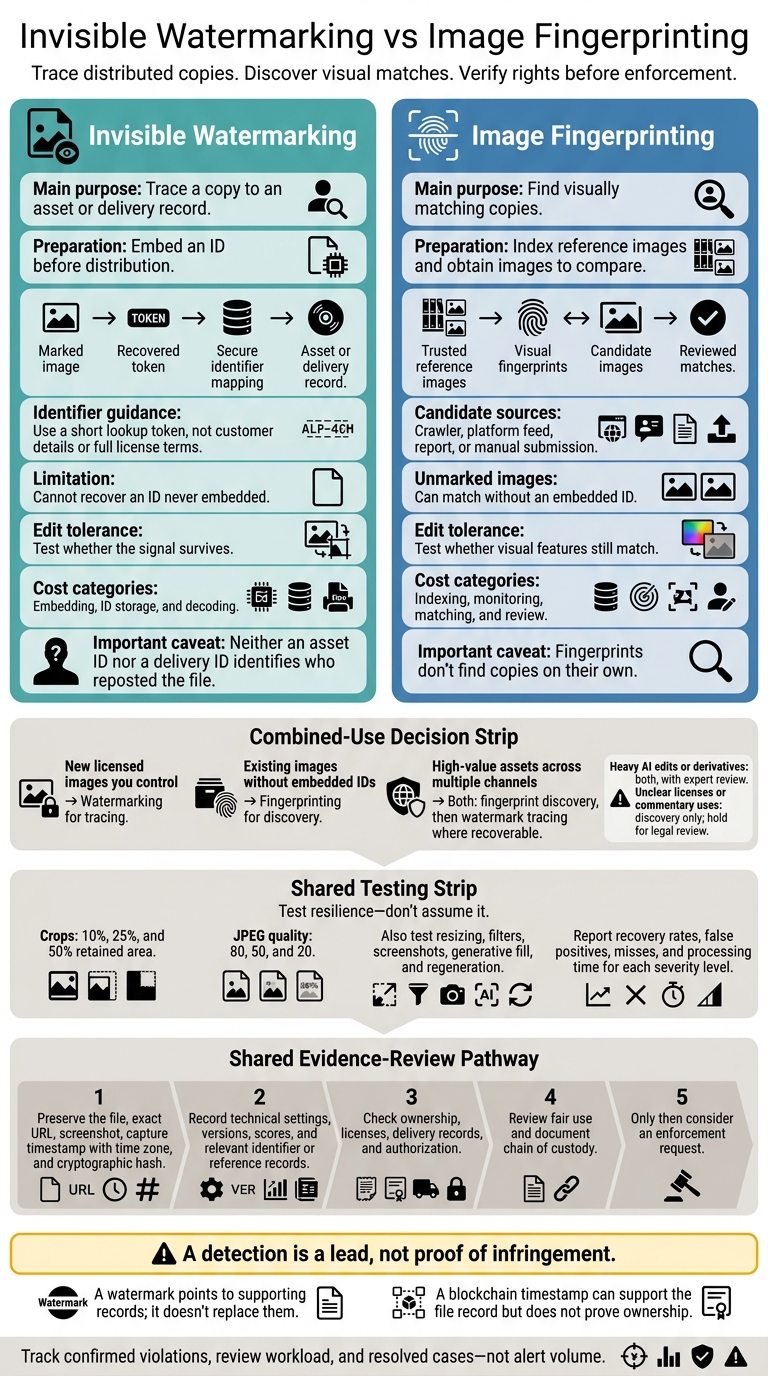
Invisible Watermarking vs Image Fingerprinting: Choose Your Workflow
Tree-Ring Watermarks: Fingerprints for Diffusion Images that are Invisible and Robust (Explained)
Invisible Watermarking: Tracing Distributed Images
Invisible watermarking embeds machine-readable data in an image before it’s distributed. Use a short lookup token, not customer details or full license terms, and keep the mapping in a secure database.[6] The token is useful only if the decoder can match it to a maintained record.
How Embedded Identifiers Are Recovered
A decoder looks for the embedded signal and reconstructs the token. It may first need to resize or align the image. Match the recovered token to trusted records rather than relying on the alert alone. Log the decoder version, settings, confidence score, and the tested file’s cryptographic hash.[6]
C2PA treats an invisible watermark as a fallback link to provenance records when metadata has been stripped. The watermark points to supporting records; it doesn’t replace them.[7][8]
Example: Tracing a Licensed Image
For a licensed-image investigation, compare the recovered identifier with the delivery record and the contract’s allowed publication, territory, and term. An asset ID points to the image; a delivery ID points to one release. Neither identifies who reposted the file. Check whether the later publication had separate permission before concluding that the use exceeded the license.[6] That link holds only while the watermark survives the edits applied to the file.
Watermark Setup and Recovery Limits
Keep the master file, marked file, keys, delivery logs, and detection results. Secure both the identifier database and the watermark keys.
Before release, test whether the watermark can be recovered after JPEG compression, cropping, and screenshots. Test AI edits separately: surviving compression doesn’t mean a watermark will survive generative edits.
Failed recovery limits traceability. It doesn’t prove that the suspect image is unrelated to the original, nor does it settle authorship or ownership.[3][4][6] If recovery fails, use fingerprinting to look for unwatermarked copies.
Image Fingerprinting: Finding Unwatermarked Copies
When watermark recovery fails, image fingerprinting can help find unwatermarked copies.
Fingerprinting creates a visual signature, such as a perceptual hash or learned embedding, then compares it with signatures from reference images. SHA-256 identifies identical file bytes. Visual fingerprints, by contrast, can stay similar after resizing or JPEG recompression[9][11]. Fingerprinting doesn’t change the file, so it also works for indexing older, unwatermarked archives.
To use it, you’ll need a reference library and tested match thresholds.
Reference Libraries and Match Thresholds
Generate and index fingerprints from trusted originals and authorized variants. Connect each entry to its creator, acquisition records, license terms, and known crops or adaptations. Fingerprints don’t find copies on their own. A crawler, platform feed, report, or manual submission must provide candidate images.
Set match thresholds using genuine copies and unrelated images from your own collection. Include crops, screenshots, and AI-edited versions in your tests. Some systems report similarity; others report distance, where a lower value means a closer match. Send borderline results to reviewers, and track precision, recall, and false-positive rates rather than relying on a single cutoff.
Example: Matching an Unwatermarked Repost
For a resized, recompressed repost of an archived original, compare its fingerprint with the archived reference. A visual match may identify the likely source even when the file checksum differs[9][11]. Preserve the retrieved copy, page URL, screenshot, discovery timestamp, match score, and algorithm version. Use the match as a lead, not proof.
False Matches and Deliberate Evasion
Stock variants, authorized derivatives, collages, and common layouts can make matches hard to judge. Learned embeddings may also return images with similar subjects rather than the same underlying photograph. Check identifying details and matched regions before classifying a result.
Some perceptual-hashing systems are vulnerable to evasion, false collisions, or inversion attacks. Tolerance for compression doesn’t mean resistance to deliberate edits[9][12][13]. Test rotations, borders, crops, and AI-assisted changes. Use complementary fingerprints where practical, and require human review before enforcement.
Invisible Watermarking vs. Image Fingerprinting: Key Differences
Use watermarking for attribution and fingerprinting for discovery; neither proves authorization. Once you’ve tested recovery limits, the choice depends on how you find copies and which records you can link them to.
The table separates attribution, discovery, and evidence used in enforcement.
| Dimension | Invisible watermarking | Image fingerprinting |
|---|---|---|
| Best use | Trace distributed copies to internal records. | Find copies used without permission or without watermarks. |
| Preparation | Embed identifiers before distribution; maintain identifier mappings and decoder access. | Build and maintain a reference index; obtain candidate images. |
| Attribution | Link to internal records, such as an asset ID or delivery record. | Identify the source asset. |
| Unwatermarked copies | Cannot recover an identifier if no signal was embedded or the signal was destroyed. | Can match copies without an embedded signal. |
| Edit tolerance | Depends on signal strength, retained image area, and decoder. | Depends on retained visual features and matching threshold. |
| Search scale | Best when you control distribution. | Best for large-scale monitoring. |
| Costs | Embedding, integration, identifier management, and decoding. | Indexing, storage, monitoring, matching, and review. |
| False results | Damaged signals can cause missed detections; incorrect detections are possible. | Similar images can produce false matches; major edits can prevent matching. |
| Supporting records | Source file, license, delivery log, chain of custody, decoder report. | Reference file, fingerprint version, match score, capture URL, date evidence, ownership record. |
Resistance to edits matters because enforcement usually starts with altered files, not untouched originals.
Testing Cropping, Compression, and AI Edits
Test representative photographs, illustrations, text-heavy graphics, and low-resolution exports.
| Transformation | Effect on watermark recovery | Effect on fingerprint matching | Test settings to record |
|---|---|---|---|
| Partial crops | Removing marked areas can prevent decoding. | Removing identifying features can prevent matching. | Crop location; 10%, 25%, and 50% retained area. |
| Resizing | Recovery may fall outside the decoder’s usable range. | Lost detail can weaken similarity. | Original and final pixel dimensions; scale ratio. |
| JPEG compression | Heavy compression may destroy the signal. | Compression artifacts can lower similarity. | JPEG quality 80, 50, and 20; file size. |
| Filters | Blur, sharpening, or color changes may alter the signal. | Changed colors or edges may affect matching. | Filter type, strength, and processing order. |
| Screenshots | Recovery depends on resolution and capture conditions. | Borders, scaling, and display artifacts can interfere. | Screenshot dimensions; display capture versus photographed screen. |
| Generative fill | Replaced pixels may remove embedded information. | Preserved regions may remain matchable. | Region replaced; percentage of original content retained. |
| Regeneration | Extensive pixel replacement can prevent recovery. | Changed geometry, objects, or texture can prevent matching. | Editing settings, severity, and retained structure. |
Report recovery rates, false positives, misses, and processing time for each severity level. Don’t combine them into one accuracy figure.
Generative edits can prevent watermark recovery while leaving the image visually convincing.[14][15]
Day-to-day usefulness depends on measured costs, review time, and confirmed outcomes.
Deployment Costs and Quarterly Performance
Compare actual quarterly costs in U.S. dollars, including staff time. State sample sizes and review criteria. Recovered identifiers and visual matches are not confirmed violations.
| Quarterly measure | Watermarking | Fingerprinting |
|---|---|---|
| Preparation and maintenance | Assets marked, embedding costs, identifier-management hours, decoder access and updates. | References indexed, indexing costs, storage, and version maintenance. |
| Monitoring and processing | Decoder runs, failure rate, and cost per processed asset. | Monitored sources, candidate matches, and match-review hours. |
| Cost per reviewed result | Attributable operating and review costs ÷ reviewed detections. | Attributable operating and review costs ÷ reviewed matches. |
| Confirmed license violations | Cases verified against delivery records and license scope. | Cases verified against reference assets and license records. |
| Review time | Minutes spent checking each detection and its rights record. | Minutes spent checking each match and its rights record. |
| Resolution time | Days from discovery to documented resolution. | Days from discovery to documented resolution. |
| Quality checks | Incorrect identifier recoveries and missed detections in audit samples. | False matches and missed copies in audit samples. |
| Financial results | Documented recovered revenue; estimated avoided losses reported separately. | Documented recovered revenue; estimated avoided losses reported separately. |
Report paid retroactive licenses and settlements separately from projected losses avoided through removal. Show the calculation behind each estimate.
For performance reviews, track confirmed violations, review workload, and resolved cases – not alert volume. Match the tools to the work: watermarking for traceability, fingerprinting for discovery, or both when enforcement requires both tasks.
Conclusion: Choose Your Method and Enforcement Workflow
Preserve Records Before Sending a Takedown
Before you act on a match, preserve the evidence before contacting the platform or service provider. Document how you found the material and keep the records needed to review your claim.
- Rights records: Source files, creation history, publication dates, assignments, licenses, and registration details.
- Technical records: For watermark tracing, keep identifiers, recipient mappings, and recovery reports. For fingerprint discovery, keep reference files, algorithm versions, thresholds, and scores.
- Discovery records: Exact URL, page context, screenshot, downloaded file, cryptographic hash, and capture timestamp with time zone.
- Custody records: Chain of custody, fair-use review, and analyst notes.
A match supports a rights review. It is not proof on its own. A U.S. DMCA notice generally needs a signature, work identification, infringing-material identification, location, contact details, a good-faith belief statement, and an accuracy-and-authority statement.[5][10] Check authorization and consider fair use before sending a notice. Registration is not required.
Send source-removal requests to the service’s designated agent. If search visibility matters, submit a separate delisting request. Delisting reduces search visibility; it does not remove the file from the source site.[16]
For a timestamped audit trail, pair the technical result with the preserved rights record.
ScoreDetect Timestamping and InCyan Protection Tools
ScoreDetect, InCyan’s blockchain timestamping product, records a file checksum on-chain at a specific time. It can form part of your evidence package for infringement counterclaims, but it does not prove ownership or replace U.S. Copyright Office registration. Keep both the original file and the timestamp certificate.
The distinction matters: SHA-256 identifies identical files, while perceptual fingerprints match similar images.
InCyan also offers watermarking, asset matching, and monitoring tools. Before deployment, confirm supported formats, monitoring coverage, recovery requirements, and report exports.
Use the table below to match your enforcement workflow to the evidence you already control.
Decision Matrix: Watermarking, Fingerprinting, or Both
| Your situation | Choose | Evidence or review still needed |
|---|---|---|
| New licensed images you control | Watermarking for tracing | Suspected copies, recoverable signals, and recipient/license mappings |
| Existing images without embedded IDs | Fingerprinting for discovery | Reference files, validated matches, and rights records |
| High-value assets across multiple channels | Both | Fingerprint discovery, then watermark tracing where recoverable |
| Common post-processing edits | Fingerprinting; watermark recovery if available | Validated matches and tested watermark resilience |
| Heavy AI edits or derivatives | Both, with expert review | Source relationships, derivative rights, and fair use |
| Unclear licenses or commentary uses | Discovery only; hold for legal review | No automated accusations or notices |
Prioritize the evidence package, not the detection score. To support an enforcement request, pair technical results with preserved evidence, rights records, and legal review.
FAQs
How can I test these tools before committing?
Run a controlled pilot using the same representative set of images you own or have licensed. Test whether watermarks can be recovered after cropping, resizing, compression/re-encoding, color changes, overlays, and format conversion. Record any detection failures [1].
For fingerprinting, ingest the originals, then test partial or modified copies – including copies with only small areas remaining. Track false positives, missed matches, and detection latency. Preserve chain-of-custody evidence and check matches against the license terms before taking enforcement action [2].
Can a match distinguish copying from coincidence?
A match alone doesn’t prove copying. Image fingerprinting can detect altered images, but it may flag different files as matches when they share similar structural features. Invisible watermarking can link an image to its source. But if heavy editing removes that watermark, its absence doesn’t prove the images are unrelated.
Technical matches don’t establish legal infringement. Before taking enforcement action or submitting takedown requests, a person still needs to review license terms, fair use, and context.
What if a detected use has a disputed license?
Put human review ahead of automated matches or watermarks. Check the official license record for permitted dates, territories, media, exclusivity, and placements. Assess fair use before escalating, and consult legal counsel if questions remain.
Keep licensing, approval, and distribution records in one place. If the dispute continues, combine timestamps, fingerprint match scores, and recovered watermark identifiers to support the chain of custody. These signals help with legal review; they do not prove copyright ownership.