Multimodal AI systems – those combining text, images, audio, and video – are reshaping how digital content is created, shared, and verified. But with this evolution come privacy and security challenges. Here’s what you need to know:
- Privacy Risks: From data collection to output generation, multimodal systems can unintentionally expose sensitive information. Metadata, often stripped during processing, complicates tracking content origins.
- Security Threats: Vulnerabilities like cross-modal attacks, metadata manipulation, and detection evasion threaten content integrity. For example, altering text captions while leaving images unchanged can mislead users.
- Key Solutions:
- Blockchain Timestamping: Stores cryptographic fingerprints of content for tamper-proof verification.
- Invisible Watermarking: Embeds origin details directly into media, surviving edits like cropping or compression.
- C2PA Standards: Cryptographically signed manifests ensure provenance across platforms.
- Real-Time Monitoring: Tracks anomalies in provenance chains to flag tampering.
With regulations like the EU AI Act (compliance deadline: August 2, 2026) imposing strict transparency rules, organizations must act now to safeguard content and avoid fines of up to 3% of global annual revenue. The future of multimodal AI depends on building trust through secure, verifiable systems.
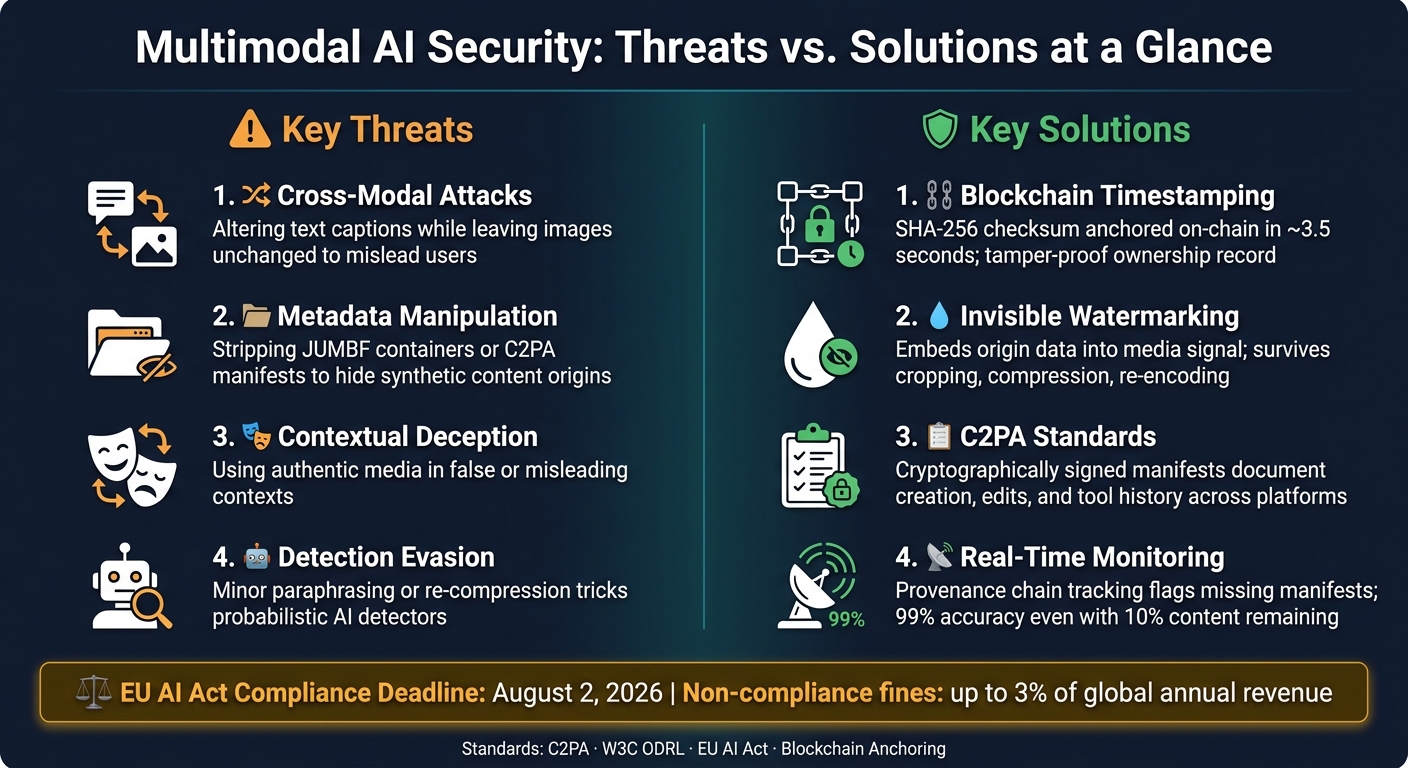
Multimodal AI Security: Threats vs. Solutions at a Glance
Securing AI Part 4: The Rising Threat of Hidden Attacks in Multimodal AI
sbb-itb-738ac1e
Privacy Risks Across the Multimodal Data Lifecycle
Privacy concerns in multimodal AI systems arise at every phase of the data lifecycle, from the moment data is collected to the point where models generate outputs. Identifying these risks is the first step toward addressing them effectively.
Data Collection and Fusion Risks
Combining different types of data – like text, images, audio, and video – into a single verifiable unit (a process known as composite signing) can unintentionally link various data points back to an individual [2]. Techniques like invisible watermarks and resilient text embeddings [1][2] can persist through transformations, potentially undermining anonymization efforts. Similarly, tracking the provenance of re-uploaded assets can expose editing histories, which might inadvertently reveal the identities of contributors [4]. Without precise opt-in controls, creators risk sharing more information than they intend, as digital manifests might include unnecessary details [6].
But the risks don’t stop at collection – they extend into how the data is stored and handled.
Storage and Metadata Exposure
Metadata, such as EXIF, IPTC, or XMP, often gets stripped during re-uploads or transcoding [7]. However, storing raw files or detailed metadata on public blockchains can expose sensitive information.
"Traditional approaches to provenance rely on private databases, internal registries, and file level metadata. These tools are important, yet they share structural weaknesses. They are mutable, so records can be edited or removed." – Nikhil John, InCyan [7]
A safer alternative is the hash-to-chain model, which stores only a cryptographic fingerprint of the content on the blockchain. For instance, ScoreDetect uses a checksum to anchor content to the blockchain without storing the actual digital file, ensuring privacy while maintaining a verifiable record [5]. Additionally, Merkle trees can batch millions of hashes into a single blockchain transaction, cutting costs while preserving verification [7].
These storage-related vulnerabilities are compounded by risks that arise during AI inference and output generation.
Inference and Model Outputs
AI-generated outputs, like voice clones or face swaps, bring unique privacy challenges. Traditional tools that rely on confidence scores [3][7] can fail, producing false positives or overlooking the lack of consent. A more reliable solution is deterministic verification using digital watermarking, which provides a clear binary result: either the content is verified as authentic, or it has been altered. Merkle tree-based methods also help track text reuse [3].
With the EU AI Act imposing fines of up to 3% of an organization’s global annual revenue for non-compliance with transparency requirements [3], implementing robust verification measures is not just a technical necessity – it’s a financial one too.
Security Threats Specific to Multimodal Systems
Multimodal systems, which integrate text, images, audio, and video, open up new possibilities but also introduce unique security risks. By combining multiple data types, these systems expand their functionality, but they also create more opportunities for attackers. Every new modality added to the system becomes a potential weak point, and the connections between these modalities are often the most vulnerable. Let’s dive into some of the specific threats that target these systems.
Cross-Modal Attacks
In multimodal systems, different types of data share the same processing pipeline. This creates a risk where tampering with one type of data can corrupt others. For instance, imagine a scenario where a text caption is altered while the accompanying image remains untouched. Without a cryptographic link between the two, the system might fail to detect the mismatch. This is referred to as cross-modal context manipulation – exploiting the disconnect between what the media displays and what the accompanying text describes [6].
The C2PA specification highlights this issue, focusing on validating the association and integrity of data rather than assessing its truthfulness.
"C2PA specifications SHOULD NOT provide value judgments about whether a given set of provenance data is ‘good’ or ‘bad,’ merely whether the assertions included within can be validated as associated with the underlying asset, correctly formed, and free from tampering." – C2PA Technical Specification [6]
This means that while file integrity might be checked, the relationship between different modalities often goes unverified, leaving the system exposed to this type of attack.
Input and Metadata Manipulation
Metadata vulnerabilities become even more concerning when attackers deliberately manipulate them. For example, removing a JUMBF (JPEG Universal Metadata Box Format) container or a C2PA manifest can obscure the origins of synthetic content or bypass licensing requirements [3]. Interestingly, the absence of previously present metadata can itself serve as evidence of tampering:
"Removal is itself evidence. If a C2PA manifest was present when the content was signed but is absent when the content appears elsewhere, that absence documents tampering." – Encypher [8]
Composite assets, such as an AI-generated voice layered over real video footage, are particularly at risk. If the system doesn’t keep track of the origins of each component, the security chain can break during assembly [4][6].
Misinformation and Model Steering
AI detectors that rely on statistical patterns can be tricked with relatively minor adjustments, such as paraphrasing text, re-compressing media, or making small audio tweaks. This technique, known as model steering, takes advantage of the gap between probabilistic detection methods and cryptographic watermarking. When synthetic media evades detection, it’s often treated as legitimate, potentially corrupting downstream processes. Cryptographic watermarking offers a solution by providing a tamper-proof, binary result that directly addresses this vulnerability [3].
To summarize these threats, here’s a breakdown of key vulnerabilities across modalities:
| Threat Type | Description | Vulnerability Origin |
|---|---|---|
| Cross-Modal Splicing | Overlaying synthetic audio (voice clones) on real video | Integration of authentic and synthetic modalities [4] |
| Metadata Stripping | Removing JUMBF containers or C2PA manifests | Fragility of file-container metadata during re-compression [3] |
| Contextual Deception | Using authentic media in a false or misleading context | Lack of secure binding between media and its descriptive text [6] |
| Detection Evasion | Altering content to fool probabilistic detectors | Reliance on statistical patterns rather than cryptographic proof [3] |
Privacy and Security Measures for Distributed Multimodal Systems
Building systems that can withstand threats in distributed pipelines is a challenging but crucial task. Let’s break down how to approach this effectively.
Data Encryption and Federated Learning
One key strategy is avoiding centralized storage for sensitive multimodal data. Instead, on-device hashing generates local content checksums, which are then recorded on a blockchain. As ScoreDetect explains:
"ScoreDetect does not store any digital assets or content. It only stores the checksum of the content on the blockchain. This means that your digital assets are safe and secure with you." [5]
This approach prioritizes data minimization, ensuring that assets like medical scans, legal recordings, or proprietary videos remain secure and local, while still allowing their authenticity to be verified independently. Platforms like InCyan’s Blueprint demonstrate how this principle can be applied, managing rights centrally without compromising the security of raw assets.
Input Validation and Guardrails
To prevent synthetic or tampered content from infiltrating processing pipelines, "decide at upload" policies are essential [4]. Detection SDKs evaluate all modalities simultaneously, delivering authenticity results in under 300 milliseconds [4]. These systems combine AI-based detection with content authenticity verification tools like C2PA manifest validation:
"AI detection looks at the content itself for generation artifacts. C2PA validation reads the cryptographic manifest attached to the content. Both run in parallel." – deepidv [4]
Adding configurable enforcement policies provides even more flexibility. Instead of a simple allow-or-block approach, organizations can implement nuanced responses – like labeling, restricting, demoting, or blocking content – based on confidence scores for each modality. This adaptability is particularly useful for composite assets where authenticity may vary across different elements. Once secure upload measures are in place, continuous monitoring ensures that any breach in the verification chain is quickly identified.
Monitoring and Telemetry for Anomaly Detection
Real-time monitoring is essential for maintaining security in distributed pipelines. Provenance chain tracking detects disruptions in C2PA manifests or metadata, flagging any missing manifest as a potential sign of tampering [4].
For organizations managing extensive multimodal libraries, InCyan’s Idem platform offers a compelling example. Its AI-powered system can identify assets even after mobile edits, cropping, or compression, maintaining 99% accuracy across image, video, and audio formats – even when only 10% of the original content remains [9]. By combining this detection capability with structured telemetry – such as logging provenance events, detection scores, and chain-of-custody transitions – organizations can act quickly and compile defensible evidence for compliance or legal needs [7].
| Mechanism | Function | Resilience Against Tampering |
|---|---|---|
| On-Device Hashing | Stores only checksums on-chain; raw assets stay local | High – no centralized data to breach |
| C2PA Manifest Validation | Verifies tool origin and edit history cryptographically | Medium – stripping signals a chain break |
| AI Detection at Upload | Scores synthetic artifacts across modalities in <300ms | Variable |
| Provenance Chain Tracking | Flags missing or broken metadata as tamper evidence | High – absence itself is an actionable signal |
Trust, Governance, and Verification Controls
Ensuring content integrity isn’t just about detection and monitoring – it also requires a solid governance framework. This framework validates content for regulators, courts, and licensing partners, using tools such as blockchain timestamping, invisible watermarking, and standardized protocols.
Blockchain-Based Timestamping
When disputes arise over content ownership, relying on probabilistic AI scores won’t cut it in a legal setting. What you need is a clear, binary record: proof that content existed at a specific time. Blockchain timestamping delivers exactly that.
Instead of storing sensitive files on a public ledger, solutions like ScoreDetect store a cryptographic checksum (a SHA-256 hash) of the content on the blockchain. Transactions are quick, averaging 3.516 seconds [5], and the records are both permanent and tamper-proof. As Nikhil John from InCyan puts it:
"Blockchain technology offers a complementary capability… a blockchain can act as an independent, cryptographic timestamping and attestation layer." [7]
To keep costs manageable, Merkle trees batch asset hashes efficiently, ensuring individual verification remains intact [7][3]. ScoreDetect operates on the SKALE blockchain, which boasts a zero-gas-fee, carbon-neutral system [5]. This setup makes large-scale timestamping feasible and sets the stage for additional security measures like invisible watermarking.
Invisible Watermarking for Content Protection
While blockchain timestamps anchor content in time, invisible watermarking embeds origin details directly into the media itself, safeguarding both its timeline and provenance – even after modifications.
Unlike file-level hashes that fail when a file is altered (e.g., re-encoding a video or cropping an image), AI-driven invisible watermarks integrate directly into the media’s signal. These watermarks withstand transformations like compression, format changes, screenshots, and transcoding, all while remaining invisible to the human eye. InCyan’s Tectus platform exemplifies this approach, offering watermarking for images, videos, and audio. This ensures ownership can be proven without degrading the media’s appearance or quality.
The real power lies in combining both systems. Invisible watermarking provides a durable, embedded link at the signal level, while blockchain timestamping offers an immutable, time-stamped record. Together, they create what InCyan’s ProofChain describes as cryptographic certainty of origin [1][7]. Even if an asset loses its metadata, the watermark can still trace back to the blockchain record.
Standardized Security Frameworks
No single tool can solve every issue. Without a universal standard, provenance data from one system may not be compatible with another. That’s where the C2PA (Coalition for Content Provenance and Authenticity) standard steps in, offering a shared framework for multimodal content governance [6][7].
C2PA’s "Content Credentials" are cryptographically signed manifests that document how an asset was created, what edits it underwent, and which tools were used. Importantly, the C2PA Guiding Principles emphasize:
"C2PA specifications SHOULD NOT provide value judgments about whether a given set of provenance data is ‘good’ or ‘bad,’ merely whether the assertions included within can be validated." [6]
This neutrality ensures C2PA can function as a verification layer across different platforms and vendors. Organizations should also note the EU AI Act compliance deadline of August 2, 2026 [3][4]. This regulation mandates machine-readable labeling for AI-generated content, with non-compliance fines reaching up to 3% of global annual turnover [3]. Adopting C2PA, along with blockchain and watermarking solutions, can help organizations prepare well in advance.
| Framework | Primary Function | Key Governance Benefit |
|---|---|---|
| C2PA 2.1+ | Cryptographic provenance manifests | Tamper-evident media history across vendors [6] |
| EU AI Act CoP | Regulatory compliance | Standardized labeling for AI-generated content [2][7] |
| W3C ODRL | Rights expression | Machine-readable licensing and usage policies [2] |
| Blockchain Anchoring | Immutable timestamping | Independent, time-stamped proof of ownership [7] |
Conclusion: Key Takeaways on Privacy and Security in Multimodal Systems
We’ve explored the risks and protective measures essential for safeguarding multimodal systems. These systems, which combine text, images, audio, and video, face challenges far beyond those of single-format pipelines. Vulnerabilities can arise at any point – whether during data collection, cross-modal integration, inference, or distribution. Because of this interconnected nature, a single flaw can jeopardize the entire system.
The main takeaway? There’s no one-size-fits-all solution. Comprehensive protection demands a multi-layered approach. This includes encryption to minimize exposure, input validation to prevent tampering, real-time anomaly detection, and governance tools like blockchain timestamping, invisible watermarking, and standards such as C2PA to safeguard content throughout its lifecycle.
At the heart of this effort is provenance – the cornerstone of trust. With metadata easily removed and deepfakes becoming increasingly convincing, cryptographic proof of origin is critical. Tools like ScoreDetect directly address this by storing a SHA-256 checksum on the SKALE blockchain, ensuring ownership verification without revealing sensitive content [5]. As Kyrylo Silin, SaaS Founder and CEO, explains:
"With ScoreDetect, I can take pictures for my travel blog and be confident that nobody will claim them as theirs. I can always prove that I am the author." [5]
This approach supports a broader ecosystem of enterprise-level tools designed to protect digital assets effectively.
InCyan offers additional solutions tailored for multimodal content security. Their Idem platform excels in content matching, while Tectus provides invisible watermarking for images, video, and audio. Together, these tools offer robust, evidence-backed protection for digital assets across distribution channels. With increasing regulatory demands for content authenticity, adopting these measures now can help prevent future security breaches.
FAQs
How do you verify multimodal content if metadata gets stripped?
If metadata is missing, verification remains possible through durable, invisible watermarking embedded directly into the media. These watermarks are designed to withstand changes such as cropping, compression, and re-encoding. Tools like ScoreDetect can retrieve these watermarks and match them against records anchored in a blockchain.
Additionally, even when metadata is unavailable, multimodal matching – which analyzes elements like images, videos, audio, or text – can trace altered versions back to their original source. This process provides confidence scores and immutable timestamps, ensuring the content’s origin and integrity are preserved.
What’s the difference between AI detection and cryptographic verification?
AI detection works by estimating the probability that content aligns with certain patterns or characteristics. Because of this, it’s inherently uncertain and can sometimes misclassify content.
In contrast, cryptographic verification offers a clear, tamper-proof method to confirm a file’s authenticity and origin. By utilizing tools like digital signatures and blockchain records – such as those provided by platforms like ScoreDetect – it ensures ownership and integrity. This method delivers immutable proof that can even hold up in legal scenarios.
How can you comply with the EU AI Act transparency rules by August 2, 2026?
To meet the EU AI Act’s transparency requirements by August 2, 2026, providers will need to label AI-generated audio, video, and image content in a machine-readable format. One way to achieve this is by using C2PA specifications, which allow for the creation of tamper-evident manifests. These manifests document the content’s provenance, edit history, and authorship, ensuring traceability. Tools like InCyan’s ScoreDetect make this process easier, offering integration for content identification and blockchain-backed proof to verify authenticity and aid in compliance.