In today’s digital age, managing online content is more challenging than ever. AI-powered tools are transforming content moderation by automating repetitive tasks, detecting violations faster, and improving accuracy. Here’s a quick breakdown of how AI enhances moderation systems:
- Scale: AI processes millions of images, videos, and text daily, far beyond human capacity.
- Detection: Advanced multimodal analysis identifies altered or partial content, even if only 10% of the original remains.
- Efficiency: AI handles straightforward cases, while human reviewers focus on complex ones.
- Tools: Solutions like InCyan’s Idem (content detection) and Tectus (watermarking) ensure precise tracking and enforcement. These invisible watermarks resist removal attacks to maintain security.
- Verification: Blockchain-based tools like ScoreDetect provide tamper-proof evidence of ownership.
Using AI to Automate Moderation of User-Generated and Third-Party Media Content
sbb-itb-738ac1e
Mapping Your Existing Content Moderation Workflow
Before integrating AI into your moderation process, you need a solid understanding of how your current system operates. This means documenting every step – from the moment content enters your system to how violations are managed. This approach makes it easier to pinpoint inefficiencies or roadblocks.
Defining Moderation Goals and Challenges
Start by clearly outlining your moderation goals. Are you focused on stopping piracy? Removing hate speech? Blocking spam? Each objective will influence the type of AI tools you’ll need. Once goals are set, identify the challenges tied to them. Common hurdles include:
- Signal overload: Too many raw alerts, with few being actionable.
- Slow enforcement cycles: Delays between detecting violations and taking action.
- Siloed teams: Lack of coordination between legal, trust and safety, and business units, leading to gaps in coverage.
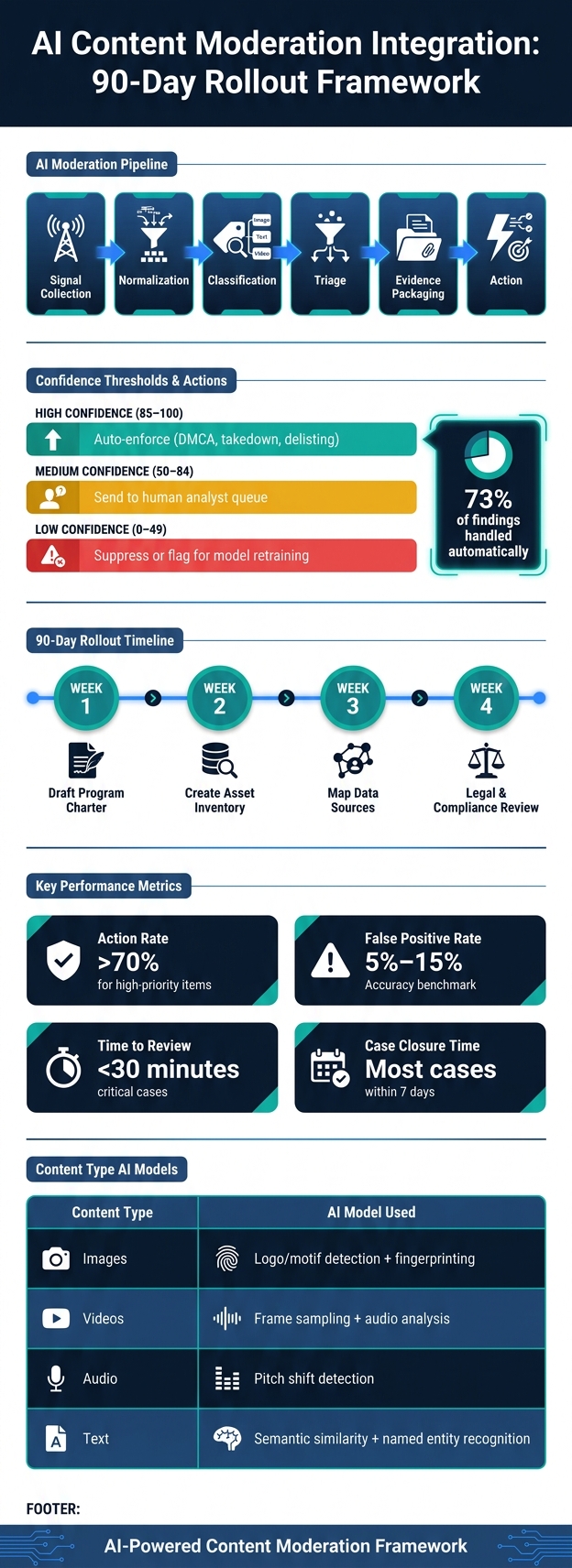
To prepare for AI integration, consider a 90-day rollout audit. This structured timeline includes:
- Week 1: Drafting a program charter.
- Week 2: Creating an asset inventory.
- Week 3: Mapping data sources.
- Week 4: Conducting a legal and compliance review.
By addressing these foundational steps, you’ll be ready for technical integration [2].
Cataloging Content Types and Data Sources
Content moderation isn’t one-size-fits-all. Different formats require different AI models. Make a list of all the types of content your system handles – such as images, videos, audio, and text. For instance:
- Videos: Require temporal segment alignment models.
- Text: Use semantic similarity models.
- Images: Benefit from content matching and fingerprinting techniques.
Next, document your data sources. These might include social media platforms, peer-to-peer networks, open web crawlers, or official APIs. Be sure to note the regions and languages each source covers. This detailed source map will guide decisions on where AI monitoring should expand.
"Rather than treating discovery as a black box that emits alerts, it organises data, algorithms, and workflows around a clear unit of evidence." – Nikhil John, InCyan [2]
Identifying Bottlenecks for AI Integration
With your goals and content catalog in hand, it’s time to identify where the process slows down. Key metrics to track include:
- "Time to Review": The time from detecting an issue to human review.
- "Time to Action": The time from making a decision to enforcement.
For example, if your target is to review critical live content within 30 minutes, measuring these metrics will reveal where manual steps are causing delays [2].
Another bottleneck is reviewer fatigue, which happens when reviewers treat every alert as a separate case. Grouping related sightings into clusters – like the same pirated video appearing on multiple platforms – can significantly reduce the workload. Effective systems typically aim for a false positive rate of 5% to 15%, ensuring reviewers focus on the most important cases [2].
| Bottleneck | Root Cause | AI Solution |
|---|---|---|
| Signal overload | Too many raw alerts, few actionable | Automated crawling + incident clustering |
| Reviewer fatigue | Treating isolated cases individually | Grouping related sightings into clusters |
| Content evasion | Manipulations like cropping or mirroring | Multimodal fingerprinting |
| Slow enforcement | Manual takedown processes | Automated API-based enforcement |
| Weak evidence chain | Lack of tamper-proof records | Cryptographic hashing and audit logs |
Designing a Multimodal AI-Powered Moderation Framework
After pinpointing where your workflow falters, the next step is creating a structure that addresses these gaps. A multimodal AI framework isn’t a one-size-fits-all solution – it’s a layered system where every component has a specific role. This setup ensures that tools like InCyan’s advanced systems can be integrated smoothly.
Core AI Components for Content Moderation
The framework operates in distinct stages: signal collection, normalization, classification, triage, evidence packaging, and action. Each step builds on the previous one, so setting a solid foundation is critical.
At the classification stage, the type of content determines which AI model steps in:
- Images undergo logo and motif detection that works even with cropping or filtering.
- Videos are analyzed through frame sampling and audio analysis to catch partial copies or remixes.
- Audio models handle pitch shifts and background noise to flag short clips.
- Text is processed using semantic similarity and named entity recognition to prevent paraphrased or translated content from slipping through.
Once classified, a decision engine assigns two key scores: a confidence score, which reflects how certain the match is, and a risk score, which factors in elements like asset value and audience size. These scores decide whether the case is handled automatically or sent for human review. For instance, a moderately confident match on a pre-release asset would take priority over a high-confidence match on older content due to its greater business impact. InCyan’s tools, such as Idem and Tectus, align seamlessly with these stages, ensuring accuracy from detection to enforcement.
Every detection also requires an evidence bundle that includes an HTML snapshot, access logs, hash values, and a timestamped chain of custody. Without this, it becomes difficult to take legal action.
Using InCyan‘s Tools to Strengthen Moderation

Once the core framework is in place, specialized tools can be integrated to enhance its effectiveness. Two key tools from InCyan play vital roles in this system:
- Idem, InCyan’s multimodal matching engine, handles the identification process. It achieves forensic-grade accuracy of 99% and remains reliable even after significant transformations, like compression, speed changes, or mirroring. Unlike traditional hash-based tools, which fail when files are re-encoded or cropped, Idem excels under these conditions [5].
- Tectus, their blind watermarking solution, operates at the prevention layer. It embeds invisible, permanent marks directly into the media signal – not the metadata – so they survive format changes and editing. When infringing copies appear, Tectus can trace them back to their original distribution point without needing to compare them against the original file. Together, Idem and Tectus form a closed loop: Tectus marks the content at its source, and Idem identifies it wherever it resurfaces.
"Gaining visibility into how content is utilised across the internet has truly been invaluable. We now have the automated intelligence needed to make smarter decisions, increase revenue through improved monetisation and enforcement, and maintain strict control over our assets." – Director, Shutterstock [5]
| Tool | Layer | What It Does |
|---|---|---|
| Idem | Identification | Multimodal fingerprinting; 99% accuracy; survives 90% content loss |
| Tectus | Prevention | Invisible watermarking embedded in the media signal |
| Indago | Enforcement | Search delisting in under 60 minutes |
Where ScoreDetect Fits in the Framework

ScoreDetect plays a crucial role at the verification layer, helping to prove content ownership. It generates an SHA-256 checksum of your asset and records it on the SKALE blockchain, with an average transaction time of just 2.754 seconds [1]. Importantly, only the hash is stored – not the actual file – ensuring your content remains private while the timestamp is publicly verifiable.
This feature becomes especially valuable when enforcement escalates. If a takedown is contested or a case moves to litigation, a blockchain-anchored timestamp provides an immutable, independent record of ownership that predates the infringement. ScoreDetect’s blockchain-enabled proofs complement the overall framework by offering legally reliable evidence of ownership, meeting compliance and governance needs. It also supports Google’s E-E-A-T framework by providing verifiable proof of original authorship, which can improve search engine authority. With integrations for over 6,000 apps via Zapier, ScoreDetect easily fits into existing moderation workflows without the need for custom coding.
"ScoreDetect is exactly what you need to protect your intellectual property in this age of hyper-digitization." – Imri, Startup SaaS CEO [1]
Implementing AI into Existing Moderation Workflows
AI Content Moderation Integration: 90-Day Rollout Framework
Integrating AI into your moderation process isn’t about replacing your current workflow – it’s about making it faster and more precise. AI bridges the gap between detecting issues and taking decisive action, reinforcing the multimodal framework you’ve already built.
Building a Multimodal Reference Library
A strong reference library is the backbone of your AI-driven moderation system. Think of it as a well-organized database containing everything you own, content you’ve licensed, and material that’s explicitly prohibited. Without this, AI has nothing to compare against.
Start by cataloging every type of content your organization handles – images, videos, audio, and text. Assign each item precise metadata, including ownership, licensing details, and territorial rights. Standardized fields like Asset ID, owner name, media type, and applicable rights ensure consistency, enabling AI to operate effectively at scale. For example, advanced systems process over 272 million images daily [3], which is only achievable with clean, structured reference data.
If you already have a content library, run a bulk backfill scan to tag older assets. This ensures legacy content is protected once the system is live. Pay special attention to video assets by using fingerprinting technology, which generates a unique digital signature for each file. As WebKyte explains:
"Video fingerprinting is the technology that extracts distinctive elements of a video into a unique line of code, a digital fingerprint. The tech enables video matching at large scale, high speed, and with extraordinary accuracy." [4]
For text content, tools like ScoreDetect create verifiable timestamps for each asset. By generating an SHA-256 checksum and recording it on the blockchain in just 2.754 seconds [1], you can establish an immutable record without storing the actual file. This is especially useful for backfilling historical content, creating a timestamped chain of custody for assets that previously lacked one.
Once your library is set up, identifying where AI should intervene becomes much easier.
Adding AI Checkpoints to Moderation Pipelines
Pinpoint key integration points for AI in your moderation workflow: pre-upload, post-upload, and during reporting.
- Pre-upload checks: Quickly identify obvious violations before content goes live.
- Post-upload scans: Conduct deeper analyses using techniques like temporal, semantic, and audio fingerprinting to catch altered or overlooked content.
- Reporting workflows: When users flag content, AI can cross-reference it against your library and generate a preliminary confidence score before human review.
Roll out these checkpoints gradually to minimize disruption to your team. Once they’re in place, establish clear policy rules to ensure AI outputs lead to appropriate actions.
Setting Policy Rules and Enforcement Actions
AI-generated results should trigger immediate and appropriate responses. A three-band threshold system based on confidence scores works well:
| Confidence Band | Score Range | Action |
|---|---|---|
| High Confidence | 85–100 | Auto-enforce (DMCA, takedown, delisting) |
| Medium Confidence | 50–84 | Send to human analyst queue |
| Low Confidence | 0–49 | Suppress or flag for model retraining |
In an optimized system, about 73% of findings are handled automatically, while the remaining 27% go to human reviewers for ambiguous cases [6]. This balance ensures your team focuses only on edge cases that require judgment.
For human review, provide side-by-side comparisons with detailed transformation insights, such as whether the content was cropped, mirrored, or re-encoded. Include plain-language explanations for why matches were flagged. As Nikhil John of InCyan emphasizes:
"Automated classification should not attempt to replace human judgment for high impact decisions. Instead, it should provide calibrated scores and explanations that help reviewers focus on the right work." [2]
Every enforcement action should generate a complete evidence record – such as screenshots, HTML snapshots, SHA-256 hashes, and timestamped logs. Store these with object locking to preserve the integrity of the evidence, even if the original content is removed [6]. This ensures your actions remain defensible at every stage.
Monitoring, Auditing, and Continuous Improvement
Tracking and Analyzing AI Performance
Once your AI checkpoints are live, it’s crucial to measure their effectiveness consistently. Four key metrics help you gauge performance: action rate, false positive rate, time to review, and case closure time.
| KPI | What It Measures | Target |
|---|---|---|
| Action Rate | Percentage of validated incidents leading to action | >70% for high-priority items |
| False Positive Rate | Percentage of flagged incidents that are incorrect | 5%–15% |
| Time to Review | Time from incident creation to first human review | <30 minutes for critical cases |
| Case Closure Time | Time from incident creation to resolution | Most cases within 7 days |
For example, maintaining a false positive rate between 5% and 15% ensures a manageable review workload while preserving detection accuracy. To simplify reporting for executives, combine these metrics into a single Program Score using a weighted formula – such as 40% for Evidence Quality, 35% for Freshness, and 25% for Throughput. This provides leadership with a quick overview of system performance [2]. These metrics not only track efficiency but also help ensure legal defensibility and support continuous improvement.
Maintaining Legal Compliance and Governance
Every AI-driven enforcement action must hold up under legal scrutiny to ensure reliable content moderation. To achieve this, evidence must clearly answer four key questions: what was observed, where it was observed, when it was observed, and how it was captured [2].
Tools like ScoreDetect are designed to help. ScoreDetect uses blockchain-based timestamps by recording a content checksum, creating an unalterable proof of existence. This is especially helpful during audits or disputes, as it allows you to confirm that specific content existed at a particular time – without needing to store the actual file.
In addition to timestamping, set up a cross-functional governance forum that includes representatives from legal, trust and safety, and business teams. This group should meet regularly to review model threshold adjustments, address ethical concerns, and ensure compliance with regulations like the EU’s Digital Services Act (DSA) and Article 17 of the EU Copyright Directive [4].
Iterative Improvements and Feedback Loops
AI models need constant refinement to keep up with shifting content patterns and evolving tactics from bad actors. Left unchecked, models can degrade over time as edge cases pile up and new trends emerge. To counter this, structured human feedback is essential.
Train reviewers to use specific feedback codes, such as "false positive due to fair use" or "policy exception", to ensure clean and actionable data for retraining [2]. Incorporate risk-tier sampling to evaluate model performance across all confidence levels consistently.
Nikhil John of InCyan highlights the importance of this approach:
"AI powered discovery works best when human reviewers play an active role in calibration." [2]
Conclusion: Next Steps for AI in Content Moderation
Bringing AI-driven multimodal analysis into your moderation workflow is a process that demands consistent refinement and careful planning. Here’s a clear path forward: start by mapping out your current workflow, pinpoint any bottlenecks, create a multimodal reference library, introduce AI checkpoints, and establish governance practices to ensure legal defensibility and ongoing improvement. This method builds on earlier strategies and sets the foundation for proactive and effective content enforcement.
A phased 90-day rollout can serve as a practical framework. Begin with a program charter and asset inventory, then move through technical integration, model configuration, a pilot launch, and governance setup. This step-by-step approach minimizes risks and allows your team to adjust and fine-tune before fully implementing the system.
InCyan’s suite of tools supports each stage of this roadmap. Tools like Idem, Indago, and Tectus work seamlessly together to cover the entire enforcement process – from detection to takedown. This collaboration provides a robust, end-to-end solution for your content moderation needs.
Meanwhile, ScoreDetect plays a vital role in the compliance layer of this framework. By using blockchain technology to record a SHA-256 checksum of your content, it ensures a timestamped and tamper-proof record of ownership – without storing the actual file. With an average transaction speed of approximately 2.754 seconds [1], it offers a fast and reliable way to protect intellectual property. As one user, Imri, a Startup SaaS CEO, shared:
"ScoreDetect is exactly what you need to protect your intellectual property in this age of hyper-digitization. Truly an innovative product, I highly recommend it!" – Imri, Startup SaaS CEO [1]
FAQs
What should I audit before adding AI to moderation?
Before bringing AI into your moderation process, it’s crucial to assess your system’s capabilities. Start by checking if it can manage large-scale operations and recognize different content formats. This includes identifying altered material, such as cropped images, compressed files, or paraphrased text. Make sure it can group near-duplicates effectively to cut down on manual reviews.
Think about whether you need tamper-proof evidence. Tools like ScoreDetect, which use blockchain technology, can provide secure audit trails to maintain transparency. Lastly, ensure your system is equipped for multimodal analysis, meaning it can handle a mix of images, videos, audio, and text seamlessly.
How do multimodal models detect edited or partial copies?
Multimodal models excel at spotting edited or partial copies by converting various media formats into a unified numerical space known as embedding space. In this space, these models generate compact digital signatures that encapsulate critical features – such as semantic meaning, visual patterns, or temporal elements. This approach enables detection even after significant transformations like cropping, compression, or altering playback speed. A great example is InCyan’s Idem, which can identify content even if only 10% of the original material is intact.
How does ScoreDetect strengthen ownership proof in disputes?
ScoreDetect leverages blockchain technology to establish a secure, unalterable record of your digital assets. When you upload content, it creates a unique cryptographic checksum along with a verification certificate that includes a timestamp. This unchangeable record can act as solid evidence in legal disputes. By pairing these blockchain-secured logs with advanced multimodal AI analysis, creators can trace unauthorized content back to the original, strengthening copyright protection efforts.