Ethical AI is reshaping how digital assets are protected, offering solutions that safeguard ownership while respecting privacy and transparency. Here’s a quick breakdown:
- Challenges in Digital Asset Protection:
- Traditional methods like visible watermarks and metadata fall short as social media platforms strip these protections.
- Deepfakes, voice cloning, and AI-generated content contribute to an "authenticity crisis", with 80% of shared content considered fake and 70% of people encountering misinformation.
- Ethical AI Solutions:
- Tools like ScoreDetect use cryptographic checksums to verify ownership without storing actual files, ensuring privacy.
- Invisible watermarks embedded in content survive alterations like cropping or compression, providing reliable ownership proof.
- Blockchain timestamping creates tamper-proof records of creation and ownership.
- Core Ethical Principles:
- Respect for Copyright: Establish ownership without compromising user experience.
- Privacy: Collect only essential data, like checksums, to maintain user control over content.
- Transparency: Ensure clear documentation and accountability for AI decisions, avoiding "black box" enforcement.
- Implementation Practices:
- Human oversight for complex cases ensures fairness and reduces errors.
- Compliance with regulations like the EU AI Act (effective August 2, 2026) is crucial to avoid penalties.
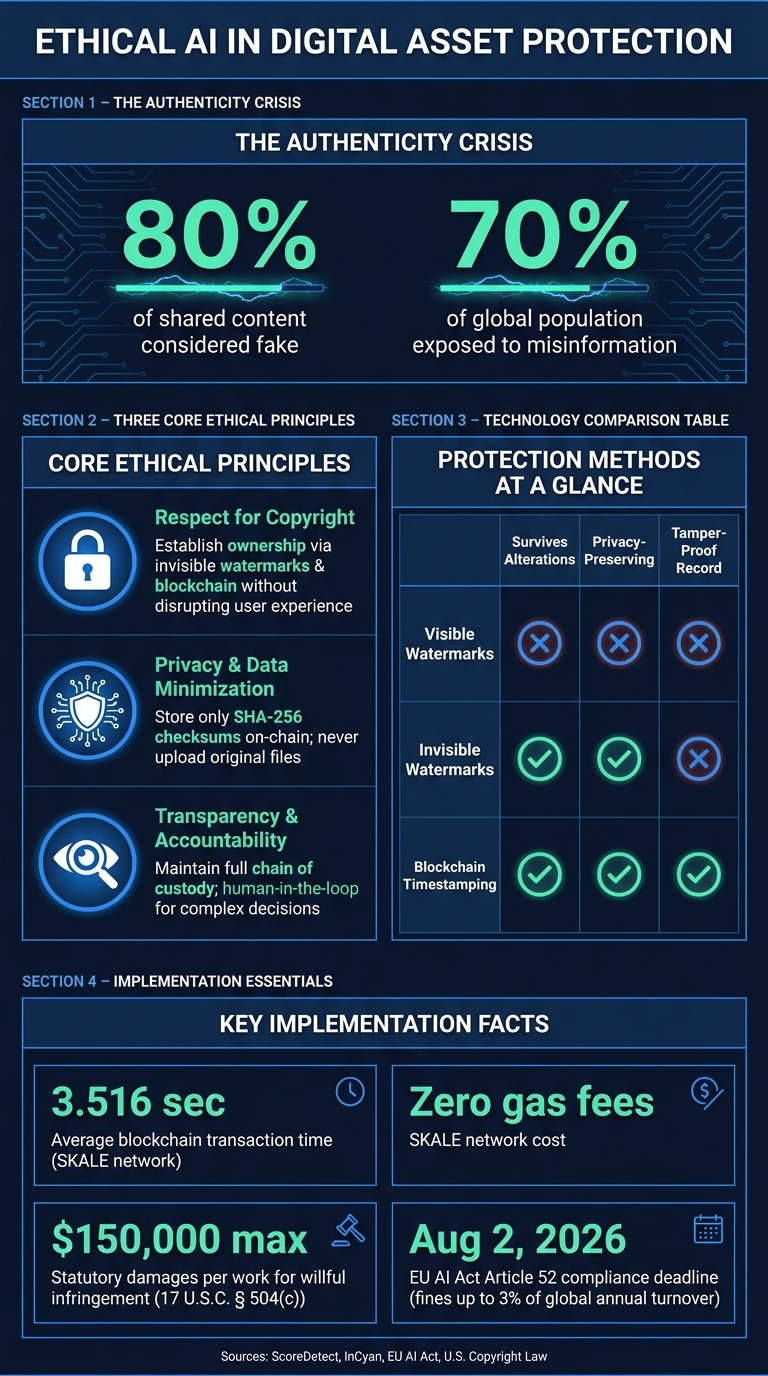
Ethical AI Digital Asset Protection: Key Methods, Stats & Principles
Core Ethical Principles for AI-Driven Digital Asset Protection
Respect for Copyright and Ownership
When it comes to ethical digital asset protection, respecting creators’ rights is a top priority. Ethical AI systems ensure that ownership is clearly established, even when content is modified. One way this is achieved is through invisible watermarks – embedded directly within the content. Unlike visible watermarks, which can be easily cropped or removed, these hidden markers survive format changes and re-uploads, making them far more reliable.
Take InCyan’s Tectus solution, for example. It provides an invisible proof of ownership that doesn’t interfere with the user experience while streamlining copyright enforcement. When paired with blockchain technology, this approach creates an unchangeable record of who created an asset and when it was created – all without requiring the original file to be stored elsewhere.
Beyond proving ownership, ethical AI also emphasizes protecting user data through strict data minimization practices.
Privacy and Data Minimization
Ethical AI doesn’t just protect creators; it safeguards the privacy of individuals whose data interacts with these systems. The guiding principle? Only collect what’s absolutely necessary.
A great example of this is ScoreDetect, which uses a local SHA-256 checksum to anchor content to the blockchain. This method completely avoids uploading the actual files.
"ScoreDetect does not store any digital assets or content. It only stores the checksum of the content on the blockchain. This means that your digital assets are safe and secure with you, and only you have access to them." – ScoreDetect [3]
By generating hashes locally, raw content stays in the user’s control, while the blockchain only receives the minimum information needed to verify ownership. Transactions on the SKALE network using this method are fast, averaging just 3.516 seconds [3]. This approach strikes a balance between robust copyright protection and respect for individual privacy.
Transparency and Accountability
While ownership and privacy are crucial, ethical AI must also ensure that enforcement actions are clear and accountable. Transparency is key – when an AI system flags potential copyright violations, it’s essential to provide a clear, traceable explanation.
Systems that operate as "black boxes", issuing takedowns without evidence, pose legal and reputational risks. Ethical AI avoids this by maintaining a structured chain of custody. This means documenting what was detected, where, when, and how the match was made. Such transparency allows analysts – or even courts – to retrace the steps and verify the conclusions [5].
"Classification choices have ethical consequences. Fairness and privacy practices should include excluding protected characteristics such as race, religion, or gender identity from model features." – Nikhil John, InCyan [5]
Accountability also requires acknowledging the limits of AI. Decisions with significant legal or ethical impact should always involve human oversight. While AI can efficiently identify and route potential issues, humans play a critical role in reviewing and mitigating errors or biases. This human-in-the-loop approach isn’t a flaw – it’s what ensures enforcement remains fair, defensible, and aligned with ethical standards. Together with ownership verification and privacy measures, it completes the foundation for ethical AI-driven digital asset protection.
sbb-itb-738ac1e
Invisible Watermarking and Blockchain Timestamping: Ethical Applications
Benefits of Invisible Watermarking
Invisible watermarking offers a way to safeguard content without compromising its quality. Unlike visible watermarks that can disrupt the viewing experience and are relatively easy to remove, invisible watermarks are embedded within the file’s data. This ensures they remain undetectable while enduring changes like compression, re-encoding, cropping, and format conversions across images, videos, and audio files.
InCyan’s Tectus takes this concept further by embedding a highly durable blind watermark. This watermark is designed to withstand significant alterations, such as edits made using mobile tools or re-uploads at lower resolutions, ensuring ownership proof remains intact.
"Invisible digital watermarking combined with blockchain verification to protect and authenticate your digital assets with cryptographic certainty." – InCyan [1]
Because the watermark is invisible and non-intrusive, it preserves the original quality and appearance of the content. When combined with blockchain timestamping, it provides creators with a reliable way to secure both their identity and the time of creation.
Blockchain Timestamping for Proof of Ownership
While invisible watermarking establishes ownership, blockchain-based authorship verification verifies the time of creation. Together, they form a tamper-proof record of both ownership and creation time. ScoreDetect uses a local SHA-256 checksum to record only the hash on the SKALE blockchain, leaving the original file in the user’s possession. With an average transaction time of 3.516 seconds [3] and zero gas fees on the SKALE network, this process is both efficient and budget-friendly.
The resulting Verification Certificate includes key elements such as the SHA-256 hash, public blockchain URL, public ledger URL, and registration date. This creates a transparent and verifiable chain of custody. These timestamps integrate seamlessly with ethical AI protocols, complementing tools like Tectus to establish an unalterable record of ownership.
This approach also strengthens legal claims. Under U.S. copyright law (17 U.S.C. § 504(c)), proving willful infringement can increase statutory damages from $30,000 to $150,000 per work [9]. A blockchain-based record provides definitive proof – either the hash matches or it doesn’t – making it a powerful tool in infringement cases.
Ethical Considerations for Implementation
Using these technologies responsibly means prioritizing consent, transparency, and sustainability.
- Consent: Ethical use requires an opt-in model for provenance tracking. Creators should have control over what ownership data is embedded or recorded. The Coalition for Content Provenance and Authenticity (C2PA) stresses that provenance tools should validate claims without making judgments on the data itself [8].
- Transparency: A clear chain of custody is essential for every detection or enforcement action. Detailed documentation of what was detected, where, when, and how ensures that AI-driven enforcement can hold up in legal contexts.
- Sustainability: Traditional blockchain networks can consume significant energy. Choosing eco-conscious infrastructure, like the SKALE network with zero gas fees and a reduced carbon footprint, demonstrates a commitment to sustainable practices [3].
| Consideration | Strategy | Goal |
|---|---|---|
| Data Minimization | Store only checksums/hashes on-chain | Protect user privacy and asset security |
| Transparency | Maintain audit trails and reviewer hints | Build trust in AI-driven decisions |
| Consent | Opt-in provenance disclosure | Empower creators with data control |
| Sustainability | Use zero-gas, eco-friendly blockchains | Reduce environmental impact |
Ethical Multimodal Analysis in Practice
How Multimodal AI Works
Multimodal AI uses multiple signals simultaneously to identify unauthorized content. For example, platforms like InCyan’s Idem analyze visual, audio, text, and metadata signals together. This allows them to identify content even when only fragments remain. Why is this important? Infringers rarely repost content as-is – they crop images, re-encode videos, adjust audio pitch, or strip metadata to dodge detection.
To counter this, systems use two types of bindings:
- Hard bindings: These verify exact file matches.
- Soft bindings: These include invisible watermarks or perceptual fingerprints, making it possible to detect modified content.
For multimedia publishers, composite signing takes this a step further. It bundles an article’s text, hero image, and even podcast clips into one verifiable unit. This ensures the entire content package shares a single chain of custody [7]. InCyan’s Idem applies these techniques to strengthen digital asset protection while adhering to ethical AI principles. This multimodal approach also helps reduce bias and improve enforcement accuracy.
Reducing Bias and Ensuring Accuracy
Once diverse signals are combined, the system must carefully determine whether content has been infringed – without creating a flood of false positives. Keeping false positives low is critical to maintaining trust. A well-designed system assigns two key scores to each detection:
- Confidence score: Measures how certain the system is about the match.
- Risk score: Assesses the potential impact of the detection.
High-confidence matches can be handled automatically, while medium-confidence cases are routed to human analysts for review. This tiered approach ensures that near-matches aren’t automatically flagged as violations.
A realistic goal for AI-powered discovery systems is a false positive rate of 5% to 15% for reviewed incidents [5]. To achieve this, systems group near-duplicate detections into single "Incidents" instead of overwhelming reviewers with repetitive alerts. Additionally, excluding irrelevant personal attributes from the analysis helps prevent model bias when detecting sub-content [5].
Human Oversight and Governance
Even with advanced algorithms, human oversight is essential for maintaining contextual integrity, especially in complex cases. For example, determining whether content falls under fair use often requires escalation to human reviewers. These cases typically follow a structured process: operational review, consultation with legal experts, and, if necessary, engagement with external regulatory bodies [5].
To assist human reviewers, AI systems should provide clear visual or audio cues – like highlighting overlapping image regions or specific audio segments. This speeds up decision-making and ensures accuracy [5]. Every reviewed item should also maintain a complete chain of custody, documenting what was detected, when and where it was captured, and who handled the evidence. This meticulous record-keeping isn’t just good practice – it’s vital for ensuring that AI-driven enforcement holds up in legal contexts [5].
Putting Ethical AI Into Practice for Digital Asset Protection
Building Ethical AI Policies
To effectively implement ethical AI, organizations need to move beyond abstract principles like respecting copyright, privacy, and transparency. These ideals must be turned into actionable, written policies.
One key principle is data minimization. A great example of this is ScoreDetect’s checksum method, which captures essential data without transmitting full files. This approach ensures proof of ownership while maintaining privacy[3]. Policies should also clearly define thresholds for action. For instance, high-confidence matches could trigger automated takedown notices, while medium-confidence cases might require human review first. This prevents automated systems from acting on unclear or ambiguous detections.
For organizations operating in or selling to the European Union, aligning with EU AI Act Article 52 is essential. This regulation mandates machine-readable marking for AI-generated images, audio, and video, with compliance required by August 2, 2026. Non-compliance could result in fines of up to 3% of global annual turnover[10].
These policies form the foundation for the ongoing oversight and improvement processes discussed next.
Monitoring and Continuous Improvement
Deploying ethical AI is not a "set it and forget it" process. The landscape evolves rapidly, with new AI models and evasion tactics constantly emerging. This makes continuous monitoring a necessity.
Reporting dashboards are invaluable tools for trust and safety teams. They track metrics like the rate of AI-generated content and the types of generator models detected. When new AI models produce content that differs from what the system was trained on, these dashboards can signal the need for updates – whether that means adjusting detection thresholds or retraining models[6]. Additionally, retroactively scanning older content, not just new uploads, ensures consistency across all assets[6][3].
"In a world rampant with AI and deepfakes, ScoreDetect helps you stand out as an authority with authenticity." – ScoreDetect[3]
Regular audits of published content are equally critical. These audits can help verify that metadata remains intact, even after content passes through third-party platforms. This is particularly important because metadata stripping is a common tactic used to evade detection.
Integrating Tools Like ScoreDetect
Ethical AI practices should always prioritize minimal data exposure, and tools like ScoreDetect make this achievable. Its Zapier integration, which connects with over 6,000 web apps, allows organizations to automate timestamping at the moment of content creation. For WordPress users, the dedicated plugin automatically timestamps every article published or updated, creating blockchain timestamping solution. This not only strengthens Google E-E-A-T signals for SEO but also provides robust legal proof of ownership[3].
ScoreDetect also offers Verification Certificates for high-value assets. These certificates include a SHA-256 hash, blockchain URL, and formal recognition, transforming copyright claims into solid documentary evidence. Under US copyright law, willful infringement can lead to damages of up to $150,000 per work[9]. Having immutable, timestamped records of ownership simplifies the process of enforcing rights.
For those interested, ScoreDetect provides a 7-day free trial on its Pro plan, starting at $11.31/month with annual billing. Enterprise plans are available for larger organizations needing features like invisible watermarking, 24/7 monitoring, and automated takedown workflows[3].
Conclusion: The Path Forward for Ethical AI in Digital Asset Protection
Ensuring ethical AI in digital asset protection requires a multi-layered approach. Combining techniques like invisible watermarking with blockchain-anchored timestamps creates a robust provenance trail, capable of withstanding file alterations such as cropping or compression. Meanwhile, relying on cryptographic checksums allows creators to maintain complete control over their original files [2][3].
The industry is moving away from reactive enforcement and focusing on proactive stewardship. As Nikhil John from InCyan explains:
"Blockchain anchored content provenance should be understood as infrastructure rather than as a stand alone product. Its real value emerges when it is woven into the everyday systems that create, transform, and distribute media." [2]
This shift is essential. With approximately 70% of the global population exposed to misinformation [4], authenticity has become a baseline expectation rather than a competitive edge. By aligning with standards like C2PA and adhering to regulations such as the EU AI Act, organizations can stay ahead of compliance demands instead of scrambling to meet them.
To maintain this integrity, the best practice is to register assets at the moment of creation – whether through a CMS, editing platform, or ingest pipeline – ensuring the chain of custody remains intact [2]. Solutions like ScoreDetect and InCyan’s enterprise tools provide a comprehensive framework for this. Their offerings include Tectus for invisible watermarking, Idem for multimodal asset matching, and Indago for search enforcement, collectively addressing the complexities of content protection.
At its core, ethical AI in digital asset protection revolves around a single guiding principle: proactively building trust.
FAQs
When should I timestamp content on the blockchain?
Timestamping your content on the blockchain – whether at creation or publication – helps establish verifiable proof of ownership and integrity. Tools like ScoreDetect make this process seamless by automating timestamps for new uploads, ensuring a trustworthy record of your content’s original state. Even older materials, like archived photos or blog posts, can be timestamped to create a tamper-proof audit trail. This approach works well alongside enterprise solutions like InCyan, offering added protection for your digital assets.
How do invisible watermarks work after edits?
Invisible watermarks work by embedding information directly into the media’s core elements – like the textures of an image or specific frequencies in audio – rather than relying on metadata that can be easily stripped away. This approach makes them resilient to edits. Even after transformations like cropping, rotation, scaling, compression, or format changes, advanced AI can still detect these embedded signals. For example, InCyan’s Tectus employs blind watermarking technology, ensuring proof of ownership remains intact even after substantial modifications.
What tasks should humans handle instead of AI?
AI is fantastic at handling massive datasets and grouping alerts efficiently, but it’s no substitute for human judgment in certain areas. People play a key role in setting monitoring priorities – whether it’s deciding which platforms, languages, or asset types to focus on. They’re also essential for validating tricky edge cases and determining how to route incidents based on risk levels or specific policies. Beyond that, human expertise is critical for legal evaluations and choosing the right enforcement strategies for confirmed incidents. This combination ensures the system runs smoothly while maintaining ethical standards.