AI invisible watermarking embeds hidden signals into digital content like images, videos, text, or audio. These signals are undetectable to humans but can be identified by specialized algorithms. Unlike visible watermarks, these markers are integrated directly into the content, making them resilient to transformations like cropping, compression, or re-encoding.
Key Points:
- Purpose: Protects digital content from misuse, verifies authenticity, and tracks ownership.
- Techniques: Includes frequency-domain methods for images/videos, statistical patterns for text, and cryptographic keys for detection.
- Applications: Used in industries like media, healthcare, e-commerce, and government to secure assets and combat fraud.
- Advanced Tools: Platforms like SynthID and ScoreDetect combine watermarking with blockchain for added security.
This technology is increasingly important in addressing challenges like piracy, misinformation, and intellectual property protection.
Invisible Watermarking: Content Provenance for Videos at Scale | Wes Castro, Meta

sbb-itb-738ac1e
How AI Invisible Watermarking Works
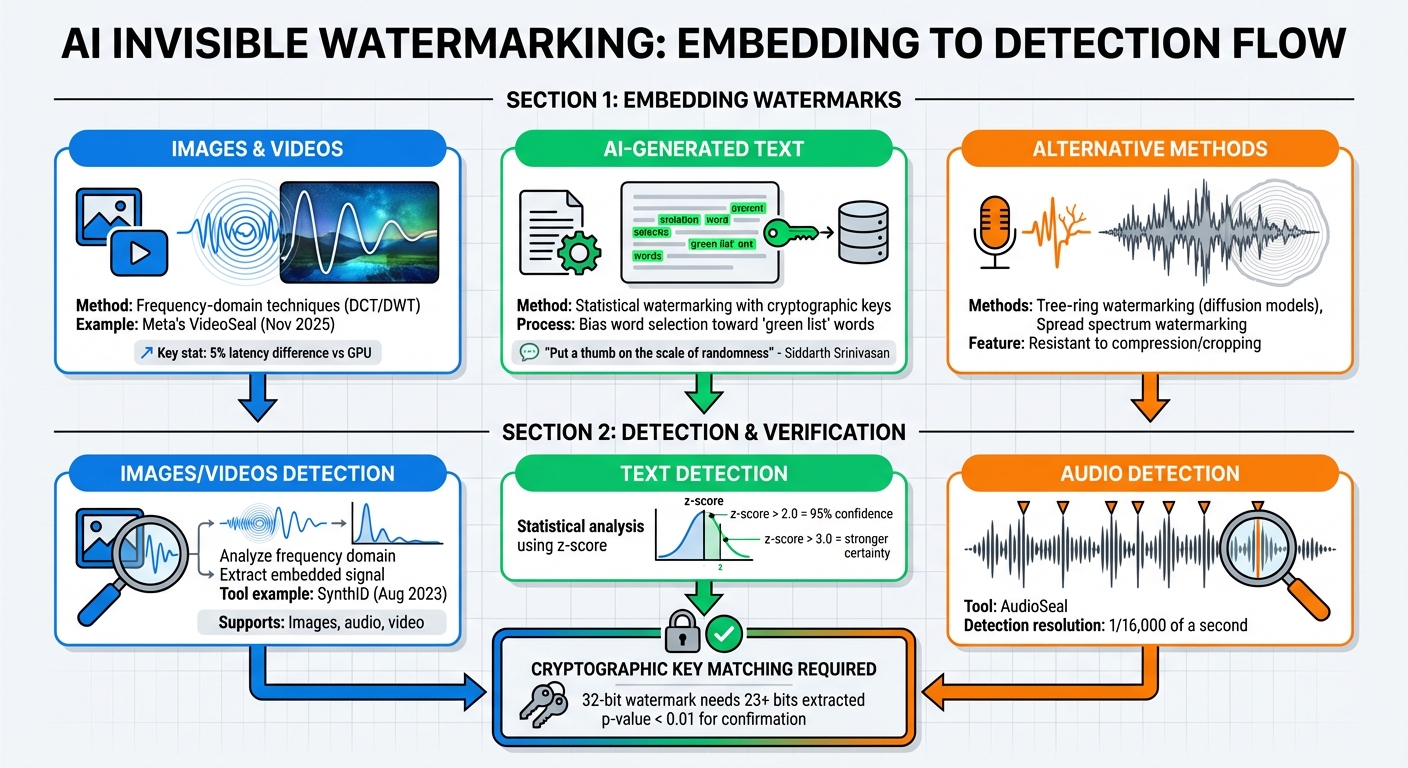
How AI Invisible Watermarking Works: Embedding and Detection Process
Embedding Watermarks with AI
AI-based invisible watermarking works by embedding subtle markers into digital content that specialized algorithms can later detect. The exact method depends on the type of media being watermarked.
For images and videos, AI uses frequency-domain techniques like the Discrete Cosine Transform (DCT) or Discrete Wavelet Transform (DWT). These methods tweak the spectral properties of the content, hiding information in frequencies that the human eye typically can’t notice. A notable example is Meta Engineering’s VideoSeal, launched in November 2025. This technology optimized watermarking for CPU-only systems, achieving end-to-end latency within 5% of GPU performance. It used a frame-selection method to reduce a 20% BD-Rate regression, ensuring watermarks survived social media compression without significantly inflating file size [1].
For AI-generated text, the process is entirely different. Siddarth Srinivasan, a Postdoctoral Fellow at Harvard University, explains:
The idea behind statistical watermarking is to put a thumb on the scale of randomness during generation so it leaves a fingerprint that can be detected later [2].
In this case, a cryptographic key biases the model’s word selection by favoring specific "green list" words. This creates a hidden statistical pattern that feels natural to readers but can be identified later.
Other models, like diffusion-based systems, employ "tree-ring watermarking." This technique embeds patterns in the initial latent noise, ensuring no visible artifacts. Another approach, spread spectrum watermarking, distributes the watermark across a broad range of frequencies. This makes it highly resistant to compression or cropping, while still remaining invisible [2][3]. Each of these embedding methods requires a tailored detection strategy to verify authenticity.
Watermark Detection and Verification
After embedding, detecting these watermarks involves reversing the process to uncover the hidden markers. For images and videos, detection algorithms analyze the frequency domain to extract the embedded signal. For text, detection uses statistical analysis – computing a z-score based on the frequency of "green list" words. A z-score above 2.0 provides 95% confidence that the text contains a watermark, while scores above 3.0 indicate even stronger certainty [4].
In August 2023, Google DeepMind introduced SynthID, which integrates two deep learning models: one to embed watermarks invisibly into image pixels and another to detect them. By 2024, SynthID expanded to support audio and video, working with Google Cloud’s Vertex AI to verify the origins of synthetic media [2][3]. For audio, tools like AudioSeal can detect watermarked fragments at a resolution as fine as 1/16,000 of a second [6].
Detection often involves cryptographic key matching, ensuring that only authorized parties with the correct private key can verify the watermark. For instance, in a 32-bit watermark, at least 23 bits must be accurately extracted to confirm its presence with a p-value below 0.01 [5]. This combination of advanced embedding and rigorous detection provides a strong layer of security for digital content.
Applications of AI Invisible Watermarking
AI invisible watermarking has become an essential tool for safeguarding digital content and streamlining workflows, offering solutions to various challenges in content security and management.
Content Protection and Anti-Piracy
Invisible watermarking plays a crucial role in tracing the origins of leaked or pirated content. When digital assets end up on unauthorized platforms, the embedded watermark serves as a hidden identifier, pinpointing the source of the breach. This is a game-changer for businesses that suffer substantial financial losses – data breaches and content leaks cost an average of $10 million per incident due to lost revenue and recovery expenses [7].
Using non-reversible watermarking techniques ensures that identifiers remain intact and resistant to tampering or removal [8]. This feature is especially important for safeguarding high-value media assets, where maintaining revenue streams is critical.
Additionally, watermarking helps verify content authenticity, providing a defense against deepfakes and alterations made by generative AI. The growing demand for such solutions is reflected in the global AI watermarking market, which is expected to grow from $427.2 million in 2024 to $3,072.8 million by 2033, with invisible watermarking accounting for 61.2% of global revenue in 2024 [8].
Integration in Content Workflows
Modern AI watermarking systems are designed to integrate seamlessly into existing digital workflows. By leveraging REST APIs, web applications, and on-edge solutions, these systems can be embedded into Digital Asset Management (DAM) platforms and creative software tools [7]. This integration can occur during either content creation or post-production, depending on the level of access to the source model [6][10].
For example, Google updated its Google Photos "Magic Editor" in February 2025 to include SynthID technology. This feature embeds invisible metadata and watermarks into AI-generated images, helping users and platforms identify manipulated visuals without compromising image quality [8]. Similarly, in April 2024, Digimarc Corporation partnered with DataTrails Inc. to introduce a multi-layered content protection system that combines digital watermarking with cryptographic fingerprints and provenance metadata, securing assets against tampering and misinformation [8].
The shift toward cloud-based solutions has further simplified integration, enabling organizations to scale their content protection efforts without requiring major infrastructure changes. This scalability makes invisible watermarking a practical option for businesses of all sizes [8].
Use Cases Across Industries
The durability and adaptability of AI-embedded watermarks make them suitable for a wide range of applications across industries. Here are some key examples:
- Media and entertainment companies use watermarking to combat piracy on OTT and streaming platforms [8].
- Healthcare organizations secure Electronic Health Records (EHR) to ensure compliance with regulations like HIPAA and GDPR [8].
- E-commerce businesses protect brand equity and verify product authenticity [8][9].
- Finance and banking institutions safeguard digital transactions and prevent document tampering [8].
- Government agencies use watermarking to secure sensitive information and identify deepfakes, helping combat misinformation [8].
- Marketing and advertising agencies track the use of brand assets online, measuring campaign reach and calculating earned media value [9].
These examples highlight the versatility of invisible watermarking in addressing both security and operational challenges across different sectors.
ScoreDetect‘s Advanced Watermarking Technology

ScoreDetect builds on traditional watermarking methods by combining invisible watermarking with blockchain verification. This dual approach ensures comprehensive protection for digital content throughout its entire lifecycle.
Prevent Unauthorized Content Use
ScoreDetect’s invisible watermarking embeds hidden markers into digital files like images, videos, audio, and documents. These markers are undetectable to the naked eye and difficult to remove, safeguarding content without altering the user experience. The platform connects effortlessly with over 6,000 web apps via Zapier, and its WordPress plugin helps secure articles by automatically recording them, providing verifiable ownership proof, and boosting SEO. Impressively, blockchain verification is completed in just 3.189 seconds, offering quick and seamless protection without slowing down workflows [11].
This technology also lays the groundwork for automated detection of unauthorized content use.
Discover and Take Down Infringements
ScoreDetect uses an AI-powered discovery system to identify unauthorized content with 95% accuracy. By employing targeted web scraping, it locates infringements and compares them against your protected assets, delivering solid evidence of misuse. The platform’s automated system generates takedown notices, achieving an impressive 96% success rate in removing unauthorized content. As Imri, CEO of a SaaS startup, noted:
ScoreDetect is exactly what you need to protect your intellectual property in this age of hyper-digitization. Truly an innovative product, I highly recommend it! [11]
Copyright Protection with Blockchain
To secure ownership, ScoreDetect creates a cryptographic hash of your content and stores it on the SKALE blockchain. This process ensures tamper-proof records without storing the actual files, keeping your content private. Since the hashing happens locally on your device, your data remains secure. Recognized as the #1 Blockchain Trailblazer Award winner in December 2024, ScoreDetect also promotes eco-friendly blockchain transactions with zero gas fees. With a projected ROI of 8,233.33%, the platform offers a 7-day free trial – no strings attached [11].
Conclusion
AI invisible watermarking has transitioned from an idea into a key tool for safeguarding digital content. It addresses challenges like misinformation, ownership verification, and legal disputes by securely tracking how content is shared and used.
One standout feature is its ability to withstand common alterations while staying undetectable to users. Platforms like ScoreDetect showcase how these technologies work in practice. By combining invisible watermarking with blockchain verification, they offer robust content security without interrupting workflows. With a 95% success rate in detecting unauthorized use and a 96% success rate in takedown efforts, this approach is proving its effectiveness across industries such as education, finance, healthcare, and entertainment.
Siddarth Srinivasan, Postdoctoral Fellow at Harvard University, highlights this point:
A realistic objective is to raise the barrier to evading watermarks so the majority of AI-generated content can be identified [2].
This perspective underscores the importance of adopting such tools to ensure strong content protection. While no system is flawless, advanced watermarking significantly increases the difficulty of misusing content, acting as a deterrent against unauthorized distribution. For organizations aiming to safeguard their digital assets – whether it’s proprietary research, media content, or proof of authenticity – AI invisible watermarking provides a critical layer of defense.
FAQs
Can invisible watermarks survive cropping and compression?
Invisible watermarks are designed to endure challenges like cropping and compression. Using advanced methods such as frequency domain embedding, these watermarks are integrated into the content in a way that ensures their resilience against such alterations, all while maintaining the watermark’s integrity.
How is AI-generated text watermarking detected reliably?
Reliable detection of AI-generated text watermarking involves sophisticated methods to spot subtle, embedded markers in digital content. These invisible watermarks, often hidden in media files like images, videos, or audio, are designed to remain unnoticed by the human eye. Advanced AI tools examine these files for tiny changes, such as frequency shifts or pixel modifications. Even after processes like compression or resizing, these tools can verify the watermark, ensuring the integrity and authenticity of the content.
Does ScoreDetect store my actual files on the blockchain?
ScoreDetect doesn’t store your actual files on the blockchain. Instead, it creates a checksum of your content. This approach enhances copyright protection without needing to save your digital assets directly.