Multimodal frameworks integrate data types like text, images, video, and audio into unified AI systems. However, off-the-shelf solutions often fail to meet the unique demands of specific industries. Customization ensures these systems address technical, legal, and operational requirements effectively.
Key Takeaways:
- Why Customize? Different industries (e.g., media, e-commerce, research) have unique goals like live piracy detection or brand misuse prevention. Tailoring frameworks improves precision, compliance, and efficiency.
- Core Features: Domain-specific pipelines handle transformations (e.g., re-encoded videos, pitch-shifted audio) and respect regulations like the EU AI Act.
- Tools: Blockchain timestamping (e.g., ScoreDetect) and invisible watermarking (e.g., Tectus) reinforce ownership and evidence credibility.
- Performance Benchmarks: Aim for <300 ms detection latency, 99% accuracy, and low false positives (5%-15%).
- Iterative Improvements: Use human feedback and structured reviews to refine models and scale frameworks for evolving threats.
Customizing multimodal frameworks ensures they meet the distinct needs of industries, balancing precision, compliance, and scalability.
Building Multimodal AI Models A Hands-On Guide
sbb-itb-738ac1e
Mapping Domain Requirements to Multimodal Frameworks
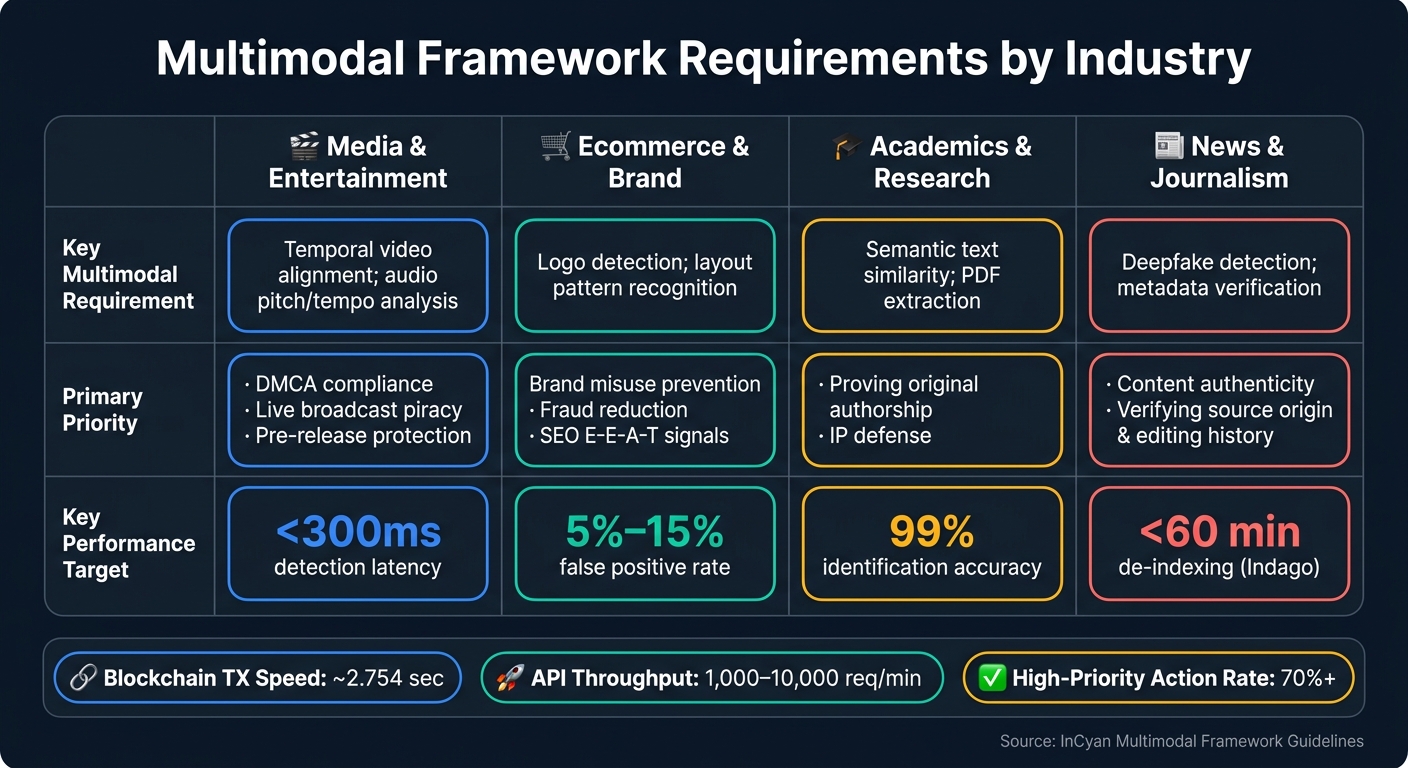
Multimodal Framework Requirements by Industry: Key Metrics & Priorities
Key Domain-Specific Factors to Consider
Before diving into framework development, you need to clearly define your domain’s specific needs. Some of the most critical factors include content type, latency requirements, and regulatory constraints.
The type of content you’re working with will guide your choice of AI models. For instance:
- Images: Require tools for logo and layout detection.
- Videos: Need temporal segment alignment to identify speed or aspect ratio changes.
- Audio: Demands pitch and tempo analysis.
- Text: Must handle paraphrasing or translation without losing meaning [3].
Missteps in addressing these can leave your framework open to manipulation, undermining its effectiveness.
Latency is another big deal and depends heavily on the use case. A live broadcast team might need to review incidents within 30 minutes at the 95th percentile, while teams managing older content can afford a next-business-day timeline [3]. Trying to serve both scenarios with a single pipeline – without proper triage logic – can waste valuable reviewer time.
On the regulatory side, frameworks must respect data minimization rules. Instead of keeping full raw content, privacy-compliant systems may store hashes, cropped regions, or redacted versions [3][4]. These requirements directly shape how you design your data storage from the start. Such domain-specific needs form the backbone of the legal and business-focused design choices discussed next.
How Business and Legal Priorities Shape Framework Design
Business goals and legal requirements don’t just influence your framework – they determine its structure. Legal compliance often requires that detections come with detailed evidence, including a complete chain of custody. This means tracking who viewed, annotated, or exported any artifact. Meanwhile, risk scores help prioritize incidents based on factors like asset value, audience size, and jurisdiction [3].
From a business perspective, triage logic revolves around these risk scores. For example, a pre-release film in a major market might demand immediate legal action, while a legacy asset with less commercial value could follow a slower response path. A well-structured framework should aim to ensure 70% of validated high-priority incidents lead to concrete actions like takedowns, direct outreach, or even policy updates [3].
Industry-Specific Examples
Different industries face unique challenges, making it clear that a one-size-fits-all framework won’t cut it. Below is a breakdown of how key industries align their multimodal requirements with their primary priorities:
| Industry | Key Multimodal Requirement | Primary Priority |
|---|---|---|
| Media & Entertainment | Temporal video alignment; audio pitch/tempo analysis | DMCA compliance; live broadcast piracy; pre-release protection [3][4] |
| Ecommerce & Brand | Logo detection; layout pattern recognition | Brand misuse prevention; fraud reduction; SEO (E-E-A-T signals) [3][1] |
| Academics & Research | Semantic text similarity; PDF extraction | Proving original authorship; IP defense [3][1] |
| News & Journalism | Deepfake detection; metadata verification | Content authenticity; verifying source origin and editing history [4] |
Take the media and entertainment sector, for example. InCyan’s collaboration with BPI Limited highlights the impact of a tailored approach:
"Working with InCyan has completely transformed how we handle our media operations. The ability to centralize, secure and protect our content has turned a previously chaotic workflow into a streamlined process." – Director, BPI Limited [2]
In ecommerce and brand protection, the focus lies in scaling logo and layout detection to combat unauthorized use of branding across thousands of product listings or social media posts. For academics and researchers, the emphasis shifts to semantic text similarity and safeguarding educational content and datasets. Blockchain-anchored timestamps often serve as legally defensible evidence of creation [1][3].
Each industry has unique demands, and there’s no shortcut to success – you need to map out these specific requirements before building your framework.
Designing and Building Domain-Specific Multimodal Pipelines
This section outlines how to create an effective multimodal pipeline tailored to specific domain needs, starting from data collection to implementing advanced verification techniques.
Data Collection and Preparation
Once you’ve identified the requirements for your domain, the next step is gathering the right data. Start by determining the platforms, regions, languages, and asset types your pipeline needs to handle. Then, align these sources with official APIs and compliant crawling methods, ensuring that data minimization policies are clearly defined from the beginning [3].
Raw data – like URLs, screenshots, text, or media – needs to be converted into a standardized schema. This includes normalizing timestamps, encodings, and metadata such as language tags and platform identifiers. Standardization is essential for reliable cross-platform comparisons. Without it, encoded data becomes inconsistent, making model evaluations unreliable. Additionally, your training data should include transformed content samples (e.g., cropped images, pitch-shifted audio, paraphrased text, or re-encoded video). These variations help models adapt to real-world scenarios.
"An evidence-centred operating model… organises data, algorithms, and workflows around a clear unit of evidence. That unit has a defined schema, quality gates, and a traceable chain from first crawl through to enforcement." – Nikhil John, InCyan [3]
With well-structured data in place, the focus shifts to fine-tuning encoders for each content type.
Customizing Encoders and Fusion Mechanisms
Different content types require specialized encoding approaches. For example:
- Image encoders should handle transformations like cropping, filters, and low resolutions while still detecting logos and visual patterns.
- Video encoders need to combine frame sampling with audio analysis to identify remixes or speed alterations.
- Audio models must recognize pitch shifts, tempo changes, and background noise to detect even brief clips or hooks.
- Text encoders should use semantic similarity and Named Entity Recognition (NER) to account for paraphrasing and translations [3].
A great example of this in action is InCyan’s Idem platform. Its AI-powered matching engine can identify content ownership even when only 10% of the original asset remains, effectively handling transformations like mobile edits, memes, and compression [2]. Once the encoders are optimized, use multimodal fingerprinting and clustering to group related content, such as near-duplicates or derivatives, into unified "incidents." This approach minimizes isolated alerts and keeps false positives manageable – ideally between 5% and 15% – to avoid overwhelming reviewers [3].
After achieving robust encoding and clustering, the final step is to ensure content verification and traceability.
Integrating Watermarking and Blockchain Technology
To verify content ownership, the pipeline incorporates invisible watermarking and blockchain timestamping as key tools.
For watermarking, InCyan’s Tectus embeds an invisible, forensic-grade mark into assets. This mark is undetectable to users, ensuring it doesn’t disrupt the experience, while still surviving common evasion attempts. It provides legally defensible proof of ownership when enforcement is required. On the blockchain side, ScoreDetect records a SHA-256 checksum of your content on the SKALE blockchain – without storing the actual asset. This creates a permanent, third-party verifiable record [1]. The process is fast, with an average transaction time of 2.754 seconds, and integrates seamlessly into workflows via a developer API or through 6,000+ app connections via Zapier [1].
"ScoreDetect does not store any digital assets or content. It only stores the checksum of the content on the blockchain." – ScoreDetect [1]
These two solutions work together: Tectus verifies what the content is, while ScoreDetect confirms when it was created. Together, they establish a complete chain of custody and establish ownership with timestamps, from content creation to enforcement.
Testing and Refining Multimodal Frameworks
Benchmarking Framework Performance
Once your pipeline is up and running, it’s time to measure how it stacks up against the challenges of your domain. Start by evaluating detection latency – if you’re dealing with real-time content verification, aim for decision times under 300 milliseconds per upload. For example, blockchain-based timestamping tools like ScoreDetect average a transaction speed of about 2.754 seconds per operation[1].
Next, test the framework’s resilience to transformations. This includes running your watermarks and provenance signals through standard processes like transcoding, compression, cropping, and file format changes. If your system can’t handle basic re-encoding, it’s not ready for production use. Additionally, assess throughput by simulating enterprise-level traffic. High-performance pipelines should support 1,000 to 10,000 API requests per minute, depending on the volume of content your system manages[6].
Here’s a quick summary of key performance benchmarks:
| Metric | Target Benchmark |
|---|---|
| Detection Latency | <300ms per upload |
| Blockchain Transaction Speed | ~2.754 seconds |
| API Rate Limit (Enterprise) | Up to 10,000 requests/min |
| False Positive Rate | 5%–15% |
| Identification Accuracy | 99% |
Use these metrics as a baseline for refining your system over time.
Iterative Improvement and Cross-Domain Adaptation
Once benchmarks are established, focus on refining your framework through structured feedback and continuous improvement. No system performs perfectly right out of the gate. The most effective frameworks treat refinement as an ongoing effort. Incorporating Human-in-the-Loop (HITL) feedback is particularly valuable – have reviewers analyze incidents across all risk levels to uncover patterns or biases your model might miss[3].
Rather than relying on free-form reviewer notes, implement structured feedback codes to provide clear, actionable data for tuning thresholds. For instance, labels like "false positive due to fair use" or "true positive but low impact" help your data science team make targeted adjustments[3]. As Nikhil John from InCyan explains:
"AI powered discovery works best when human reviewers play an active role in calibration." – Nikhil John, InCyan[3]
Another key metric to monitor is the action rate – the percentage of high-priority incidents that result in measurable outcomes, such as content removal or licensing outreach. A well-optimized system should convert at least 70% of high-priority incidents into actionable results[3].
Scaling Frameworks and Planning for Future Changes
Once your framework’s performance is fine-tuned, shift focus to scalability and adapting to new challenges. Scalability isn’t just about handling more data – it’s about maintaining accuracy as piracy tactics evolve and new content formats emerge. For instance, InCyan’s Idem platform is designed to handle significant content transformations without compromising detection accuracy[2].
For domains that rely heavily on text – such as legal, academic, or media sectors – the Txtmatch solution offers advanced protection. It compares text against large-scale databases with forensic precision, detecting paraphrased or plagiarized material that image-based tools may overlook. When expanding into new areas, use bulk backfill tools to scan and tag existing content libraries retroactively. This prevents older assets from becoming weak points in your system[5].
To stay ahead, schedule regular governance reviews involving legal, data science, and operations teams. These reviews should formally evaluate model performance and adjust policies to address emerging threats[3].
"Our algorithms are continuously refined as the threat landscape evolves, keeping your protection ahead of new forms of infringement." – InCyan[2]
Conclusion and Key Takeaways
Summary of Key Steps
Customizing a multimodal framework involves a structured approach that evolves over time. It begins with clearly defining protection parameters, followed by the technical integration of modality-aware models. These models process text, images, audio, and video differently but operate through a unified interface. The final stage is execution – this includes launching a pilot program, adjusting thresholds based on actual results, and scaling up from there. A short-term pilot, such as a 13-week rollout, is suggested to keep the process manageable and focused on data-driven insights.
These steps align seamlessly with the tools offered by InCyan, ensuring compliance and enforcement tailored to specific industries. This process is supported by various content authenticity verification tools that bridge the gap between creation and protection.
How ScoreDetect and InCyan Tools Support Domain Customization

ScoreDetect plays a key role in managing the provenance layer. It timestamps content checksums on the SKALE blockchain with zero gas fees, creating an immutable and verifiable record of ownership that is legally recognized across jurisdictions [1]. For organizations with frequent publishing needs, the WordPress plugin automates this process for each article. This not only saves time but also enhances Google E-E-A-T signals without requiring manual intervention [1].
On a broader scale, InCyan’s suite of tools completes the pipeline:
- Idem: Matches assets across different formats – image, video, audio, and text – even when only 10% of the original content is detectable [2].
- Indago: Handles search enforcement by de-indexing infringing links in under 60 minutes [2].
- Tectus: Embeds invisible watermarks that remain intact even after cropping, compression, or re-encoding.
Together, these tools create a comprehensive and legally sound framework that adapts to the unique needs of various industries.
"Gaining visibility into how content is utilised across the internet has truly been invaluable. We now have the automated intelligence needed to make smarter decisions, increase revenue through improved monetisation and enforcement, and maintain strict control over our assets." – Director, Shutterstock [2]
Building Frameworks That Work Across Domains
Leveraging these tools, organizations can develop frameworks that adapt to diverse industries. The key is designing frameworks with flexibility in mind – using API-first architecture, modular model designs, and governance processes that can incorporate new content types and address emerging threats without requiring a complete overhaul. Whether it’s safeguarding stock photography for Shutterstock, managing music rights for BPI Limited, or protecting live event content for The BRIT Awards, the foundational principles remain constant. Only the configuration changes to meet specific needs [2].
The ultimate goal is a framework that not only meets today’s demands but also evolves alongside your domain. Achieving this requires a combination of blockchain-based proof, AI-driven matching, and structured human oversight, ensuring long-term adaptability and resilience.
FAQs
What should I define first before customizing a multimodal framework?
Before tailoring a multimodal framework, it’s crucial to understand how your content is typically altered and the unique requirements of your industry. The process hinges on balancing the Watermarking Triangle – a framework that considers imperceptibility, robustness, and capacity. This balance ensures your content remains protected, even through edits or compression.
Once you’ve identified these factors, tools like Tectus (for invisible watermarking) or ScoreDetect (for blockchain-based timestamping) can provide scalable solutions. These tools are designed to establish verifiable ownership proofs, customized to meet the demands of your specific field.
How can I preserve evidence and chain of custody without storing raw content?
You can maintain a secure chain of custody and establish legal proof without holding onto raw files by using blockchain timestamping and invisible watermarking.
Here’s how it works: ScoreDetect generates a cryptographic hash of your asset, which is then recorded on the blockchain. This provides an unchangeable record of ownership. Meanwhile, invisible watermarking embeds a forensic signature directly into your media. This allows you to detect unauthorized use and compile evidence for legal action – all without requiring the original file.
When should I add watermarking and blockchain timestamping to the pipeline?
To protect your content and establish ownership, integrate invisible watermarking right from the start of your content production process. This approach embeds a tamper-resistant signature into your work before it’s distributed. Additionally, consider using blockchain timestamping to secure your assets when they are published or updated. Tools like the ScoreDetect WordPress plugin make this process seamless by automatically recording proof of ownership on the blockchain the moment an article is created. This not only safeguards your intellectual property but also enhances your SEO by verifying your content’s authenticity.