Images can now be protected from tampering with a two-layer security system combining fragile watermarking and blockchain.
This approach ensures image integrity by embedding invisible, sensitive watermarks into images and securing their verification through blockchain’s permanent, decentralized ledger. Fragile watermarks break if even a single pixel changes, while blockchain stores tamper-proof hashes, enabling robust detection of modifications.
Key Highlights:
- Fragile Watermarking: Detects the smallest image alterations by embedding delicate, invisible markers.
- Blockchain Integration: Stores cryptographic hashes of watermarked images on a decentralized ledger for verification without a central authority.
- Smart Contracts: Automate verification processes, linking watermark data with blockchain records.
- IPFS Storage: Efficiently stores large image files off-chain while maintaining their integrity via blockchain metadata.
- Performance Metrics: Achieves high image quality with PSNR up to 65.607 dB and SSIM of 0.999.
This method is being applied across industries like healthcare, law enforcement, and digital media to authenticating digital images and ownership while reducing reliance on third-party intermediaries. Future advancements in blockchain and watermarking could expand these protections to videos, 3D imaging, and more.
Restoring Trust in Digital Media: A Blockchain-Based Framework for Content Authentication
How Fragile Watermarking Works with Blockchain Systems
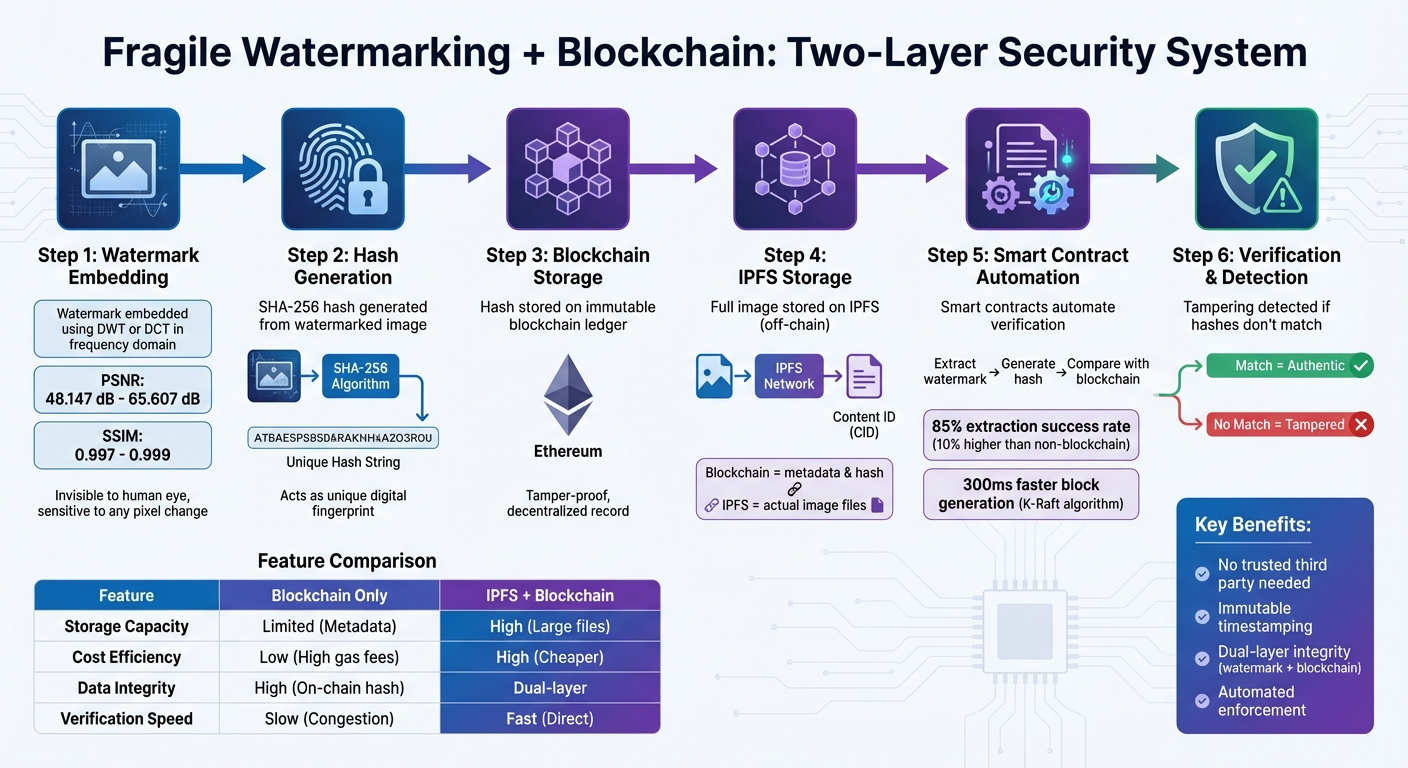
How Fragile Watermarking Works with Blockchain: Two-Layer Security System
The combination of fragile watermarking and blockchain creates a two-layer security system. The watermark flags any tampering within the image, acting as one of several digital piracy solutions, while the blockchain offers unchangeable records of an image’s original state. Together, they shift image authentication from a centralized process to a decentralized, tamper-resistant method. Here’s a closer look at how this system works.
Embedding Watermarks and Storing Hashes on Blockchain
Fragile watermarks are inserted into the image’s frequency domain using techniques like DWT (Discrete Wavelet Transform) or DCT (Discrete Cosine Transform). Instead of altering the visible pixels, these methods adjust the image’s mathematical structure, ensuring the watermark stays invisible while remaining sensitive to any changes. Research using DWT-based watermarking with the Ethereum blockchain reported a PSNR of 48.147 dB and an SSIM of 0.997, while advanced models achieved 65.607 dB, indicating minimal impact on image quality [2][3].
After embedding the watermark, a SHA-256 cryptographic hash is generated from either the watermark or the entire image. This hash acts as a unique fingerprint and is stored on the blockchain. Since cryptographic hashes are highly sensitive to even the smallest changes, comparing the extracted watermark with the blockchain record quickly reveals any tampering [4].
"The use of the blockchain to accomplish authentication without the involvement of a trusted third party for the secrecy of the watermark so is not be exposed to anyone except the involved parties." – Alsehli Abrar, Department of Computer Engineering, King Saud University [3]
Smart Contracts in Verification Processes
Smart contracts streamline verification by automating the process. They extract the watermark, create its hash, and compare it to the blockchain record, ensuring the image’s authenticity without manual intervention [3][4].
In September 2024, Professor Jian Yun and his team introduced DRPChain, a blockchain-based Digital Rights Management system designed for image protection. Using a specialized K-Raft consensus algorithm and smart contracts, DRPChain handles copyright registration and verification. It achieved an 85% success rate in watermark extraction – 10% higher than older non-blockchain methods – and reduced block generation time by 300ms compared to standard Raft algorithms [4].
Smart contracts also safeguard the verification rules from tampering. They automatically track copyright transfers and image modifications, linking metadata to the rightful owner’s blockchain address. This integration ensures a seamless connection between watermark extraction and blockchain-based verification [4][5].
IPFS for Decentralized Storage

Storing full images directly on a blockchain is both expensive and inefficient. Instead, systems rely on the InterPlanetary File System (IPFS) for decentralized storage. IPFS holds the actual image files off-chain, while the blockchain records the IPFS content identifier (CID) and relevant metadata [2][4].
IPFS assigns addresses based on the content itself. If the image data is altered, the CID changes, and it no longer matches the blockchain record. This setup ensures ownership is verified via the blockchain, while the watermark and IPFS hash confirm pixel-level integrity. Together, they strengthen the overall system [2].
In February 2024, Xiaosheng Huang and Yi Wu from East China Jiaotong University demonstrated this approach in their research. Their method, which combined digital watermarking, blockchain, and IPFS, achieved a mean PSNR of 65.607 dB and an SSIM of 0.999, proving that decentralized storage doesn’t compromise watermark quality [2]. DRPChain uses a similar system, uploading watermarked images to IPFS only after the corresponding block is validated, ensuring synchronized registration [4]. By linking off-chain storage with on-chain identifiers, IPFS enhances the verification process managed by smart contracts.
| Feature | Blockchain Only | IPFS + Blockchain |
|---|---|---|
| Storage Capacity | Limited (Metadata only) | High (Large image files) |
| Cost Efficiency | Low (High gas fees) | High (Cheaper off-chain storage) |
| Data Integrity | High (On-chain hash) | Dual-layer (On-chain hash + IPFS CID) |
| Verification Speed | Slow (Network congestion) | Fast (Direct content addressing) |
Research and Case Studies on Fragile Watermarking with Blockchain
Key Research Studies
Researchers have been exploring how fragile watermarking combined with blockchain can secure digital images. For instance, in February 2021, a team from King Saud University tested an authentication model using 200 images from USC SIPI and MedPix datasets. They embedded AES-encrypted watermarks into the third-level DWT middle-frequency regions and recorded SHA-256 hashes on Ethereum. Their results were impressive, achieving a PSNR of 48.147 dB and an SSIM of 0.997 for general images, with medical X-rays reaching 60.339 dB [3].
"The proposed medical image watermarking approach is the first method that demonstrates an effective solution to the medical image authentication problem using the blockchain, thus removing the need for trusted third parties." – Alsehli Abrar, Researcher, King Saud University [3]
In March 2024, researchers led by Tiroshan Madushanka at the University of Kelaniya introduced SecureRights, a DRM framework. This system generates 16-bit hexadecimal image IDs using Different Hash (DHA), embeds QR codes containing block hashes via DCT, and uses IPFS for file distribution. It also incorporates layered tamper detection through SSIM and Oriented Fast and Robust Brief (ORB) [5].
Later, in August 2024, Tong Liu, Si-Nga Lai, and Xiaochen Yuan from Macao Polytechnic University developed the Blockchain-Watermarking Mechanism (BWM). Their approach utilized the Fast Walsh Hadamard Transform (FWHT) alongside Ethereum and IPFS. The system encrypted and uploaded images while storing addresses in smart contracts, enabling secure, decentralized trading and ownership validation [6].
These studies collectively highlight the potential of combining fragile watermarking with blockchain, offering both technical validation and practical pathways for real-world use.
Real-World Applications for Image Integrity
The research models have already demonstrated practical value across various industries. For example, the King Saud University project addresses legal disputes in healthcare by providing decentralized blockchain timestamping for diagnostic images. This approach eliminates the risks associated with centralized databases, which are prone to tampering [3].
In the media sector, intellectual property protection benefits from the SecureRights framework. It enables creators to embed blockchain-verified watermarks in their content and distribute files securely via IPFS. The use of perceptual hashing ensures that blockchain records can identify unauthorized use, even if the files undergo compression [5].
Meanwhile, the BWM system from Macao Polytechnic University is tailored for digital art trading platforms. It allows encrypted, watermarked images to be securely exchanged between buyers and sellers. Smart contracts manage access control and ownership transfer, ensuring a trustworthy and decentralized transaction process [6].
sbb-itb-738ac1e
Benefits and Challenges of Fragile Watermarking with Blockchain
Benefits of Integration
Combining fragile watermarking with blockchain offers a layered security system that tackles many persistent issues in safeguarding digital content. One standout advantage is the elimination of trusted third parties. By using decentralized verification, there’s no single authority managing authentication, which not only lowers security vulnerabilities but also cuts administrative costs [3][4].
Performance metrics back up the effectiveness of this approach. Studies report a PSNR of up to 65.607 dB, an SSIM of 0.999, and an 85% watermark extraction success rate under attack – marking a 10% improvement over earlier non-blockchain methods [2][3][4]. Additionally, blockchain’s immutable timestamping creates a permanent, tamper-proof record of when content is registered. This feature is crucial for proving ownership in legal disputes [3][5].
| Feature | Traditional Watermarking | Blockchain-Integrated Watermarking |
|---|---|---|
| Verification | Relies on a Trusted Third Party | Decentralized; no TTP needed [3][4] |
| Data Integrity | Prone to tampering | Immutable; secured by consensus [4][5] |
| Storage | Centralized servers | Distributed (e.g., IPFS + Blockchain) [2][5] |
| Traceability | Limited to internal logs | Transparent global transaction history [4] |
While these benefits are compelling, integrating fragile watermarking with blockchain also introduces certain challenges.
Challenges and Limitations
Despite its advantages, this integration isn’t without obstacles. One major issue is the balance between watermark strength and image quality. Increasing the embedding strength can degrade image quality, with PSNR dropping from 48.147 dB to 42.347 dB [3]. Fragile watermarks are particularly sensitive; even minor compression, like JPEG at 90% quality, can lower PSNR to 38.469 dB and increase the Bit Error Rate to 0.245 [3].
Another significant challenge is computational overhead. Traditional blockchain consensus mechanisms, such as Proof of Work, are energy-intensive and introduce delays, making them unsuitable for real-time applications [4]. Although optimized protocols like K-Raft have improved efficiency – reducing latency by 300ms and block error rates by 2% [4] – these require custom implementations, adding complexity.
Lastly, storage scalability poses a problem. Storing high-resolution images directly on the blockchain is both inefficient and expensive. To address this, most systems now use off-chain solutions like IPFS to store the actual content, while limiting the blockchain to metadata and hashes [2][4].
ScoreDetect‘s Role in Content Protection

ScoreDetect combines fragile watermarking with blockchain technology to deliver practical tools for safeguarding digital content.
Blockchain Timestamping for Copyright Protection
ScoreDetect uses blockchain timestamping to confirm ownership without storing actual digital assets on the blockchain. Instead, the system calculates a SHA-256 checksum and records it on the blockchain, creating an unchangeable timestamp that verifies when your work was registered [3]. This eliminates the need for a middleman while keeping your files secure and private.
The platform offers two types of certificates:
- Verification Certificates: These include details like the registration date, copyright owner name, SHA-256 hash, and public blockchain URLs.
- Formal Recognition Certificates: These provide official documentation for legal and organizational purposes.
Both certificates are signed by ScoreDetect Limited (registered in England and Wales), creating a strong copyright record.
For WordPress users, the platform’s plugin automatically captures every published or updated article. It generates blockchain-based proof of ownership while also boosting SEO by improving E-E-A-T (Experience, Expertise, Authoritativeness, Trustworthiness) signals. This automation frees creators to focus on producing content instead of worrying about ownership verification.
Invisible Watermarking and Detection Features
ScoreDetect goes beyond blockchain timestamping by offering invisible watermarking for added protection.
While the Pro plan focuses on timestamping, the Enterprise plan includes invisible watermarking technology developed by InCyan. This method embeds undetectable markers into digital assets using DWT (Discrete Wavelet Transform), achieving PSNR values above 65 dB to ensure the watermark remains invisible [2].
In addition to watermarking, ScoreDetect uses advanced web scraping tools with a 95% success rate in bypassing protections. When unauthorized content is found, perceptual hashing algorithms create unique "fingerprints" of your assets. These fingerprints enable similarity searches, making it possible to identify infringements even if images have been cropped, compressed, or otherwise altered [4].
Enterprise Tools for Monitoring and Enforcement
ScoreDetect’s enterprise tools build on its blockchain and watermarking features, offering robust monitoring and enforcement solutions.
The Enterprise plan provides a four-step protection workflow. It monitors your content around the clock and generates similarity reports using metrics like the Hamming distance to compare suspected infringing content with your originals [4]. This data serves as quantitative evidence for enforcement actions.
The platform also automates takedown requests, achieving a 96% removal rate. By generating delisting notices automatically, it simplifies a process that would otherwise be tedious and time-consuming. Integration with over 6,000 web apps via Zapier allows for tailored workflows to meet specific business needs.
For large-scale operations, InCyan offers additional tools like Indago and Idem. Indago can de-index unauthorized content within 60 minutes, while Idem identifies ownership even when only 10% of the original asset is visible. Together with ScoreDetect’s blockchain timestamping, these tools form a complete digital content protection system, supported by dedicated success managers and 24/7 premium support.
Conclusion and Future Outlook
Key Takeaways
Combining fragile watermarking with blockchain has created a robust, decentralized security framework. As Alsehli Abrar et al. explained, "The use of the blockchain is to accomplish authentication without the involvement of a trusted third party for the secrecy of the watermark so is not be exposed to anyone except the involved parties" [3]. This method offers three standout benefits: verifying content authenticity using immutable ledgers, immediate detection of unauthorized changes, and automated enforcement through smart contracts.
Advancements in consensus algorithms, such as K-Raft, have demonstrated significant efficiency gains – reducing processing time by 300 milliseconds and lowering block error rates by 2% compared to traditional protocols [4]. These improvements are especially crucial in fields like medical imaging, law enforcement, and forensics. N. R. Neena Raj, a researcher, highlighted this by stating, "Fragile watermarking is an effective solution for ensuring image content authentication… used as supporting evidence in critical applications such as law enforcement, medical diagnosis, news reporting, and forensic investigation" [1]. With such proven applications, the path forward looks promising for even greater integration and functionality.
Future Developments
As technology continues to evolve, new innovations in watermarking are emerging. The global blockchain market, valued at $17.57 billion in 2023, is expected to grow at an impressive 87.7% compound annual growth rate (CAGR) through 2030 [7]. This rapid growth is likely to fuel several advancements, including modular architectures that separate consensus processes from execution to boost scalability, privacy-enhancing techniques like zero-knowledge proofs, and AI-driven tools to audit smart contracts and detect fraud in real-time [7][9].
Future systems aim to extend protection beyond grayscale images to cover 3D medical imaging, color images, and even video content [3][4]. Integrating with Directed Acyclic Graph (DAG)-based ledgers like Hedera, which consumes as little as 0.0001 kWh per transaction, will address scalability concerns while keeping costs minimal [8]. As traditional finance analyst Roomy Khan noted, "Traditional finance isn’t just adopting crypto – it’s being rebuilt around it" [7]. This shift signals broader adoption across sectors like healthcare, legal services, and enterprise content management, where blockchain-based watermarking could soon become the go-to solution for verifying ownership and detecting tampering.
FAQs
What’s the difference between a fragile watermark and a hash?
A fragile watermark is integrated directly into an image or digital asset and reacts strongly to any alterations. Even the smallest edits can compromise it, making it useful for identifying and pinpointing tampering. In contrast, a hash functions as an external cryptographic summary, creating a unique fingerprint of the content. While it confirms the integrity of the asset, it doesn’t reveal details about where or how modifications occurred. Both methods play a role in verifying authenticity, but they operate in fundamentally different ways.
How can an image be verified if it’s stored on IPFS instead of on-chain?
To ensure the authenticity of an image stored on IPFS, combining digital watermarking with blockchain technology offers a reliable solution. Here’s how it works: a tamper-evident watermark is embedded directly into the image, and the image’s checksum is securely recorded on the blockchain. When verification is needed, the watermark is extracted, and its checksum is compared to the one stored on the blockchain. If both checksums align, the image is confirmed as original. If they differ, it indicates tampering. Additionally, cryptographic hashes can be used to further strengthen the verification process.
How do smart contracts automate watermark verification?
Smart contracts streamline watermark verification by automatically checking the embedded watermarks in digital assets against a stored cryptographic hash or signature. If any changes are detected, the smart contract identifies discrepancies, flagging possible tampering or unauthorized use.
This approach leverages blockchain’s decentralized and unchangeable nature to keep verification records secure. The smart contract performs these checks automatically whenever the content is accessed or transferred, boosting both security and efficiency in managing digital rights.