Invisible watermarks embed hidden identifiers into digital files, like images or videos, without altering their visual or audio quality. They’re crucial for tracing ownership, especially when metadata is stripped during uploads. However, adversarial attacks are making these watermarks vulnerable, though many invisible watermarks resist removal attacks by using noise injection, geometric transformations, and AI tools to erase them without damaging the file.
Key Points:
- Techniques Used in Watermarking: Pixel-domain (e.g., LSB insertion) and frequency-domain methods (e.g., DWT, DCT).
- Challenges: JPEG compression, cropping, and AI-powered attacks can render watermarks undetectable.
- Industries at Risk: Media, e-commerce, and content creators face rising threats, with fraud losses from synthetic media projected to exceed $25 billion annually.
- Attack Methods: Gaussian noise, cropping, rotation, and AI inpainting are common tactics to disrupt watermarks.
Solutions:
- Multi-Domain Embedding: Distribute watermark signals across spatial and frequency domains.
- Error Correction: Use BCH-based coding to recover watermarks after distortions.
- Cryptographic Binding: Link watermarks to content using SHA-256 hashes.
- Adversarial Training: Train detection models on worst-case distortions for better resilience.
Combining these methods with enterprise tools like InCyan and ScoreDetect can provide layered protection, ensuring ownership proof even under attack. With regulatory compliance deadlines approaching (e.g., EU AI Act by August 2026), these defenses are becoming increasingly important.
How Adversarial Attacks Target Invisible Watermarks
What Are Adversarial Attacks?
Adversarial attacks are calculated efforts to manipulate digital files in ways that prevent watermark detection systems from identifying embedded markers [1][2]. The objective isn’t to destroy the content itself but to make the hidden watermark unreadable while keeping the file functional. These attacks are particularly concerning because of their precision. Attackers craft adversarial examples – files that look unchanged to the naked eye but are stripped of any detectable watermark [1]. Let’s explore how these attacks undermine watermarking systems.
"Invisible watermarks do not have explicit visual cues that reveal their presence or location. Developing removal techniques for imperceptible embedded watermarks presents unique challenges." – Xuandong Zhao et al., Researchers [6]
How Attackers Exploit Watermarking Systems
Invisible watermarks typically rely on subtle pixel-level adjustments measured by a small ℓ₂-distance. While this constraint is critical for keeping the watermark imperceptible, it also creates a major weakness. Attackers take advantage of this by injecting noise to disrupt the watermark and then using generative AI models to reconstruct the file without the embedded marker [6].
This approach, called a regeneration attack, is alarmingly effective. Studies show it can eliminate up to 98% of invisible watermarks from systems like RivaGAN while maintaining high image quality (PSNR above 30) [6]. Ironically, the same generative AI tools originally designed to create content are now being used to strip away its protective layers.
Industries Most Affected by Adversarial Attacks
Industries dealing with high-value content that’s widely distributed are particularly vulnerable. Take media and entertainment companies, for instance. They often embed unique watermarks into distributed content to trace leaks. If attackers remove these watermarks before redistribution, the forensic trail disappears entirely. Similarly, e-commerce platforms that use watermarked images to prove ownership or combat counterfeiting may find that a single regeneration attack can render their efforts useless.
Content creators are arguably hit the hardest. By 2026, an estimated 64% of all web traffic will come from non-human sources like bots and AI agents [2]. Meanwhile, annual fraud losses tied to synthetic media and deepfakes are projected to surpass $25 billion [2]. When adversarial attacks erase the only machine-readable proof of authorship, creators lose their ability to defend their rights against AI copyright infringement – both financially and legally. On a larger scale, this erodes trust in digital media, making it harder to distinguish between authentic and manipulated content.
sbb-itb-738ac1e
I Built An AI That Destroys Watermarks
Methods Adversarial Attacks Use to Break Watermarks
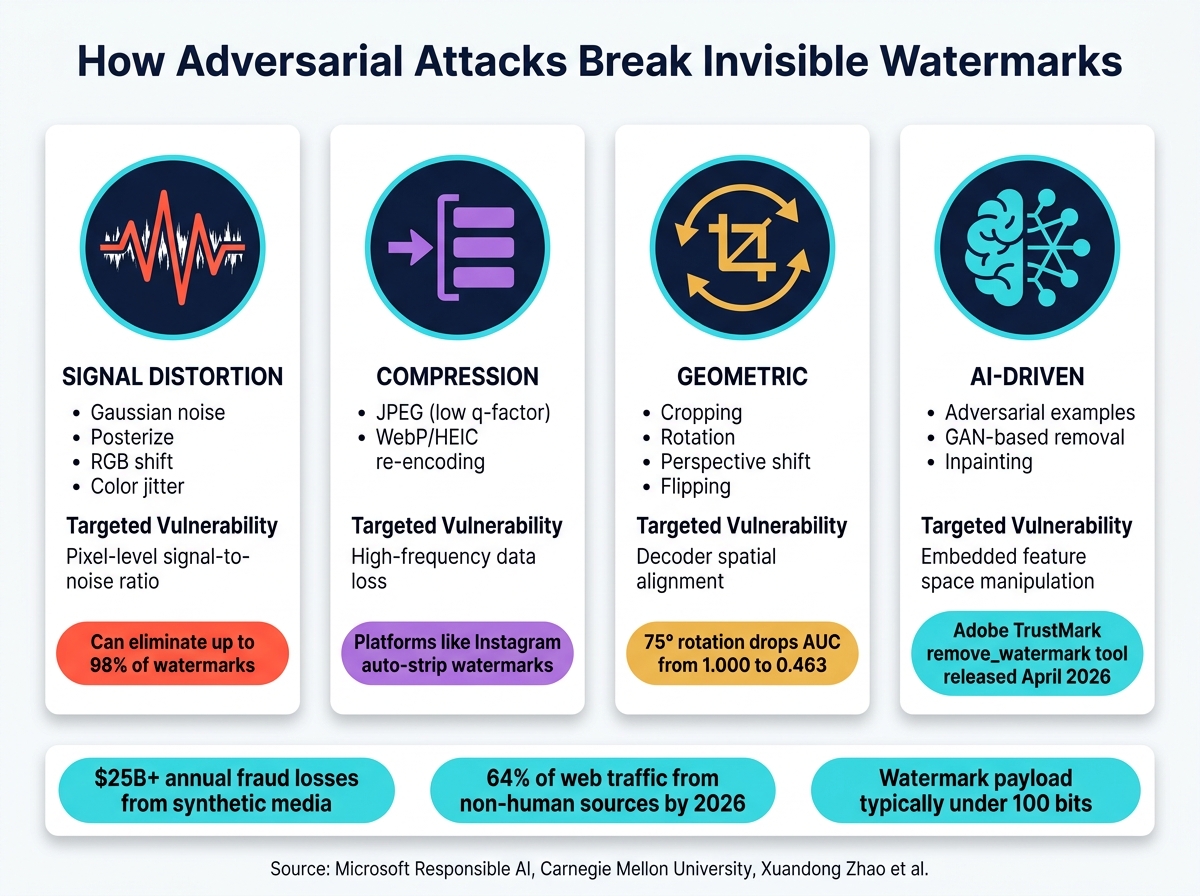
Adversarial Attack Methods vs. Watermark Vulnerabilities
Signal Distortions and Compression Tactics
One common method attackers use is injecting Gaussian noise or tweaking visual elements like RGB color values, brightness, and contrast. They might even apply posterization, which reduces the number of distinct tones in an image. These small changes weaken the watermark’s signal-to-noise ratio, making it hard to detect. Since many invisible watermarks depend on fixed pixel-level patterns, these subtle adjustments can render them ineffective [1].
Another tactic involves low-quality JPEG compression. This process discards high-frequency data – where many watermarks are embedded – effectively erasing the watermark signal [1][5]. Platforms like Instagram and Twitter make things even easier for attackers. Their automatic re-encoding processes can strip watermarks without requiring any deliberate effort [1].
"The inherent tradeoff between capacity, imperceptibility, and robustness restricts watermark payload capacity, typically to under 100 bits." – Rui Xu et al., Microsoft Responsible AI [1]
But noise isn’t the only tool attackers use. They also rely on geometric transformations and AI-driven methods to undermine watermark integrity.
Geometric and Temporal Transformations
Geometric attacks take a different approach. Instead of degrading the watermark signal, they disrupt the spatial alignment needed for the decoder to function. For instance, a small crop removing 25% of the image, a 10-degree rotation, or even a horizontal flip can throw off watermark detection entirely [1]. This exploits the fixed spatial patterns that many invisible watermarks rely on.
"Certain image transformations, such as random cropping and rotation, pose significantly greater challenges for watermark recovery compared to others." – Rui Xu et al., Microsoft Responsible AI [1]
For video and audio, temporal changes – like altering the resolution or frame rate – can be just as destructive. Traditional frequency-domain methods, such as DWT or DCT, are particularly vulnerable here. Even something as simple as converting a JPEG file to PNG can break these systems [2]. However, newer systems like InvisMark are more resilient, achieving over 97% bit accuracy even under random crops and rotations by training with resolution scaling [1]. Older methods lack this robustness.
AI-Driven Watermark Removal
AI-based attacks represent a more advanced and concerning challenge. Deep learning models can detect residual watermark patterns and reconstruct clean, watermark-free images while maintaining high quality [1]. These methods target the embedded feature space of watermarking models, making them especially hard to defend against.
In April 2026, Adobe Research updated its open-source TrustMark repository with a Python remove_watermark function. This tool demonstrates how AI inpainting technology now allows anyone – even those with little technical expertise – to erase watermarks in seconds [2][7]. Additionally, adversarial examples can be crafted to create images that look identical to the original but carry no detectable watermark [1]. These attacks exploit the frequency-domain and spatial dependencies that traditional watermarking systems depend on.
| Attack Category | Specific Techniques | Targeted Vulnerability |
|---|---|---|
| Signal Distortion | Gaussian noise, posterize, RGB shift, color jitter | Pixel-level signal-to-noise ratio |
| Compression | JPEG (low q-factor), WebP/HEIC re-encoding | High-frequency data loss |
| Geometric | Cropping, rotation, perspective shift, flipping | Decoder spatial alignment |
| AI-Driven | Adversarial examples, GAN-based removal, inpainting | Embedded feature space manipulation |
| Content Handling | Screenshots, social media re-encoding | Signal degradation through re-capture |
Watermarking Design Flaws That Attackers Exploit
Watermarks often fail because of fundamental weaknesses in their design. These vulnerabilities are not rare exceptions – they’re recurring flaws that attackers consistently take advantage of.
Over-Reliance on Fixed Spatial Features
A common issue with many watermarking systems is their dependence on embedding signals in fixed locations within an image. While this approach might work under ideal conditions, it struggles when spatial alignment is disrupted.
For instance, a 75° rotation caused the Tree-Ring watermarking method’s detection performance (measured by AUC) to plummet from a perfect 1.000 to just 0.463, according to research from Carnegie Mellon University [8]. The problem? Rotations in pixel space don’t align with similar transformations in latent space, making the decoder’s reference key unrecognizable [8].
"Rotation in the pixels space does not necessarily correspond to a rotation in the latent space, which leads to the Fourier space latents not looking like the original key." – Carnegie Mellon University Project Group 3 [8]
Although some systems use Spatial Transformer Networks to correct for geometric shifts, these methods have their limits. Extreme rotations or carefully crafted adversarial manipulations can still bypass these corrections [8].
Beyond spatial alignment, watermarks also falter when exposed to even small distortions.
Limited Resistance to Distortions
Watermarking systems that rely on frequency-domain techniques are particularly vulnerable to minor image modifications, which can significantly weaken their reliability in practical scenarios [1].
"Frequency domain methods still suffer from vulnerability to relatively minor alterations to the image, limiting their robustness in real-world scenarios." – Microsoft Responsible AI [1]
Attackers often use tools like GradCAM to pinpoint and target specific pixels. By selectively blurring these regions, they can erase watermarks while causing minimal visual damage to the image [8].
"A uniform attack across the whole image is unnecessary and can degrade perceptual quality… LBA degrades the image significantly less compared to uniform blurring of the entire image." – Carnegie Mellon University Project Group 3 [8]
This targeted approach means attackers don’t need to distort the entire image. They only need to tamper with a few critical pixels, exploiting weaknesses in spatial and frequency-domain dependencies. These flaws make watermarking systems vulnerable not just to traditional attacks but also to sophisticated, AI-driven manipulations.
Another significant issue arises from their inability to handle content fragmentation effectively.
Weak Collusion Resistance and Fragment Detection
Most post-generation watermarking techniques are limited to a payload of fewer than 100 bits [1]. This small capacity leads to two major problems: increased risk of ID collisions and the inability to handle cropped or fragmented content. These weaknesses allow attackers to perform collusion attacks, where multiple watermarked copies are averaged to neutralize the watermark signal.
"This limited capacity elevates the risk of ID collisions in the presence of bit errors, compromising the reliability of watermark extraction." – Rui Xu et al., Microsoft Responsible AI [1]
Without cryptographic binding between the watermark and the content, there’s no mathematical link to ensure the watermark’s integrity or detect tampering [2]. Attackers can combine fragments of watermarked files, effectively erasing the signal and exposing the system to even more advanced adversarial attacks. These gaps in design make it easier for attackers to bypass watermarking protections entirely.
How to Build Watermarking Systems That Resist Attacks
The design issues highlighted earlier aren’t unavoidable. By making thoughtful engineering decisions, watermarking systems can be designed to withstand many types of attacks.
Designing Watermarks That Resist Evasion
Resilient watermarks distribute their signals across spatial and frequency domains, making it harder for attackers to remove or alter them without affecting multiple independent signals.
To enhance this, combining multi-domain embedding with BCH-based Error Correction Coding (ECC) is key. ECC enables the decoder to recover the original watermark payload even when parts of it are corrupted by compression, resizing, or adversarial noise [3]. For example, Adobe’s open-source TrustMark system, updated in April 2026, uses this strategy. It encodes a 100-bit payload across various image resolutions while achieving a PSNR of 50.35, ensuring reliability across formats like JPEG, PNG, and WebP [3].
To address vulnerabilities ECC can’t handle, cryptographic binding is essential. This involves creating a SHA-256 hash of the content and signing it with ECDSA keys stored in Secure Enclaves. If the file is tampered with, the hash no longer matches, making alterations immediately detectable [2]. This shifts the challenge from preserving signals to proving the integrity of the content through mathematical verification.
These advancements form the groundwork for more advanced decoder training, as explored next.
Using Adversarially Trained Detection Models
A watermarking system’s strength heavily depends on its decoder. Training a decoder only on clean or lightly modified images leaves it vulnerable to sophisticated manipulations.
To counter this, robustness is treated as a worst-case scenario by exposing the model to the most damaging distortions during training – specifically, transformations that cause the highest watermark recovery loss [1]. Microsoft’s Responsible AI team employed this method when creating InvisMark in November 2024. Trained on 100,000 DALL-E 3 images, InvisMark achieved over 97% bit accuracy across a range of image manipulations, while maintaining a PSNR of around 51 – ensuring that watermarked images remain visually identical to the originals [1].
"We approach watermark resilience as a robust optimization problem, focusing on worst-case scenarios." – Microsoft Responsible AI Team [1]
Switching from ResNet to ConvNeXT-base models further enhances the decoder, enabling it to identify subtle watermark patterns and improving resistance to AI-based removal attempts [1]. Introducing complex adversarial distortions like rotation and cropping only after the model has mastered clean extractions prevents it from developing ineffective shortcuts [1].
Enterprise Protection with InCyan and ScoreDetect

For organizations, combining technical improvements with enterprise solutions adds another layer of security. Building robust watermarking systems is a challenging and resource-intensive task, but layered solutions offer a practical way to ensure content protection.
InCyan offers a range of content protection tools tailored to this need. Their Tectus blind watermarking solution embeds invisible ownership proof into images, videos, and audio files. For cases where content undergoes significant modifications, Idem, InCyan’s multimodal matching platform, can verify ownership even when only 10% of the original asset remains. This makes it effective against edits like cropping, compression, and memes that typically defeat standard matching systems.
ScoreDetect complements these tools by introducing a blockchain-based timestamping layer. It records a SHA-256 checksum of the content on the blockchain, creating a permanent, third-party-verifiable record of when the content existed in a specific form – without storing the actual file. This timestamp can serve as legally relevant evidence in ownership disputes. As one user shared:
"ScoreDetect is exactly what you need to protect your intellectual property in this age of hyper-digitization. Truly an innovative product, I highly recommend it!" – Imri, CEO, Startup SaaS [4]
The combination of Tectus’s invisible watermarking, Idem’s advanced matching, and ScoreDetect’s blockchain timestamping creates a multi-layered defense. Even if one layer is bypassed, the remaining layers maintain the system’s integrity and protection.
Conclusion: Protecting Digital Content Against Adversarial Attacks
Adversarial attacks on invisible watermarks aren’t just theoretical – they’re happening now and evolving quickly. Techniques like signal distortions, geometric transformations, and AI-powered removal tools are actively being used to erase ownership signals from digital content. With generative AI capable of creating photorealistic images in just a few seconds [2], the time between content creation and misuse is shrinking fast.
The takeaway here is simple: relying on a single layer of protection isn’t enough. Watermarks can be attacked. Metadata can be stripped. But by combining multiple defenses – like adversarially trained watermarking models, cryptographic binding, and blockchain-based timestamping – you create a system where attackers must overcome every layer at once. That’s no small feat.
"InvisMark provides a robust foundation for ensuring media provenance in an era of increasingly sophisticated AI-generated content." – Rui Xu et al., Microsoft Responsible AI [1]
This is where InCyan steps in with a practical solution. Their tools are designed to tackle these challenges head-on. Tectus applies invisible watermarking at the asset level. Idem can confirm ownership even after significant alterations. And ScoreDetect offers blockchain-backed timestamps, proving content existed in a specific form at a specific time – without storing the actual file. This timestamp acts as a safety net, particularly when pixel-level signals are damaged or removed.
With deepfake-related fraud costing over $25 billion annually [2] and the EU AI Act’s machine-readable marking requirements set to take effect in August 2026 [5], industries can no longer afford to delay adopting robust content protection. The tools to build these defenses – like adversarially trained decoders and enterprise-grade blockchain timestamping – are already available.
FAQs
Which attacks can remove invisible watermarks without lowering quality?
Adversarial attacks – like cropping, rotation, scaling, and format conversion – are designed to tamper with or erase invisible watermarks. Older techniques, such as Discrete Wavelet Transform (DWT) or Discrete Cosine Transform (DCT), tend to be more susceptible to these disruptions. On the other hand, modern neural watermarking methods, such as those developed by InCyan, leverage adversarial training to counter these distortions. This approach ensures that ownership markers stay intact, even after compression or edits, all while maintaining the quality of the original asset.
Why do cropping and rotation disrupt watermark detection?
Cropping and rotation interfere with watermark detection by altering the high-frequency components where invisible watermarks are typically embedded. These modifications distort the watermark’s features, making it much more challenging to detect or extract them effectively.
What’s the best defense when watermarks get stripped or corrupted?
The most effective way to protect against stripped or corrupted watermarks is by using advanced invisible watermarking techniques. These methods are specifically designed to endure manipulations such as compression, cropping, or re-encoding. Tools like AI-powered forensic watermarking and cryptographic signatures embed resilient identifiers directly into the content, making them harder to tamper with. Combining these techniques with blockchain-based timestamping solutions, such as ScoreDetect, adds another layer of security, ensuring ownership and authenticity remain verifiable even if the watermark is altered.