A detector alone will not stop attack-driven input changes. I’d treat adversarial-noise detection as an intake filter: useful for flagging risky files, but weak if used as the only gate.
Here’s the short version:
- I see three main detector groups: statistical checks, input transforms, and separate detector models.
- I see a clear pattern in the research: no single method works best across all datasets and attack types.
- I also see a hard limit: many systems that score well in lab tests drop under attack-aware evasion.
- For content protection, the pain points are direct: missed piracy, watermark removal attacks that break reads, false flags, and review backlog.
- The safer setup is a layered stack: detection at intake, then matching, proof of ownership, timestamped records, and enforcement actions after that.
A few numbers make the point fast:
- Some studies found false-positive rates above 20%
- Automated adaptive testing found 3%–50% more attack success than standard test suites suggested
- In perceptual-hash settings, over 99.9% of images were pushed past detection in a black-box attack
- For a 64-bit pHash, near-collision success reached 99.4% at a 0.10 match threshold
Five examples of adversarial machine learning attacks
sbb-itb-738ac1e
Quick comparison
| Method | What I’d watch | Cost at inference | Main weakness |
|---|---|---|---|
| Statistical checks | Score, logit, or feature drift | Low to medium | Can weaken when the attacker tunes for the detector |
| Input transforms | Prediction change after filtering, compression, or rescaling | Medium to high | Often bypassed with low-distortion attacks |
| Separate detector models | Clean vs. attack classification | High | Often drops when both model and detector are targeted |
| Multi-signal setups | Combined signals from several checks | Medium | Better than single checks, but still not enough by itself |
If I were putting this into a digital content protection workflow, I’d keep the role narrow: flag suspect inputs early, send risky cases to review, and avoid relying on the detector as final proof.
Main Research Approaches to Adversarial Noise Detection
Research usually groups adversarial detectors into three families: statistical tests, input transformations, and auxiliary detector networks. That split works well for content protection because each one can sit on top of an existing pipeline instead of forcing a full rebuild. The main difference is where each method looks for trouble: output signals, transformed inputs, or a separate detector.
Statistical Tests and Score-Based Detectors
These detectors watch model outputs or internal signals without changing the classifier itself. The basic idea is simple: adversarial inputs often push scores, activations, or feature representations away from the patterns seen in clean data. Methods such as MMD and energy distance use two-sample tests to compare current features against a clean reference set. If the shift is large enough, the system flags possible manipulation.[12][14]
Another line of work looks at log-odds. These detectors make a small input perturbation and then check whether the change in top-class log-odds lines up with normal clean-sample behavior. Roth et al. tuned thresholds to keep false detections near 1%.[13][15]
Because these methods operate on logits, embeddings, or layer activations from an existing model, teams can add them as external modules without retraining the base classifier.[6][7]
When output signals don’t tell the whole story, input transformations look at the same sample from a different angle.
Feature Squeezing and Input-Transformation Detectors
Feature squeezing starts from a practical assumption: many adversarial perturbations are small, high-frequency changes. So techniques like bit-depth reduction or median filtering can remove part of that noise while leaving normal content mostly intact. The detector then compares the model’s prediction before and after the transformation. A big gap between the two is a warning sign.[1][2][5][8]
The reported results are strong. Xu et al. found 100% detection of FGSM and 97.9% of BIM on MNIST with 1-bit reduction, at about a 5% false-positive rate.[2][3] An entropy-based version detected over 98% of FGSM, BIM, DeepFool, and CW attacks on CIFAR-10 and ImageNet with a 2.5% false-positive rate.[2][3]
Related methods use:
- Compression
- Denoising
- Re-encoding
- Rescaling
That makes them low-cost to deploy in existing image and video pipelines.[6][7]
If those checks still miss an attack, a separate detector network can add one more screen.
Auxiliary Detector Networks and Multimodal Defense Layers
Auxiliary detector networks are separate binary classifiers trained to mark inputs as clean or adversarial. They can rely on input signals, hidden layers, or both.[6][7] Some are supervised and train on labeled adversarial examples. Others are unsupervised and learn the pattern of clean data, then flag deviations.
Nearest-neighbor influence function (NNIF) detectors have reported AUC scores near 100% for FGSM and JSMA attacks, and above 96% for DeepFool and PGD on CIFAR-10 and SVHN.[9]
For enterprise content protection, teams can tune these detectors by asset type and combine their outputs into a single risk score.
What Comparative Studies Show About Performance and Limits
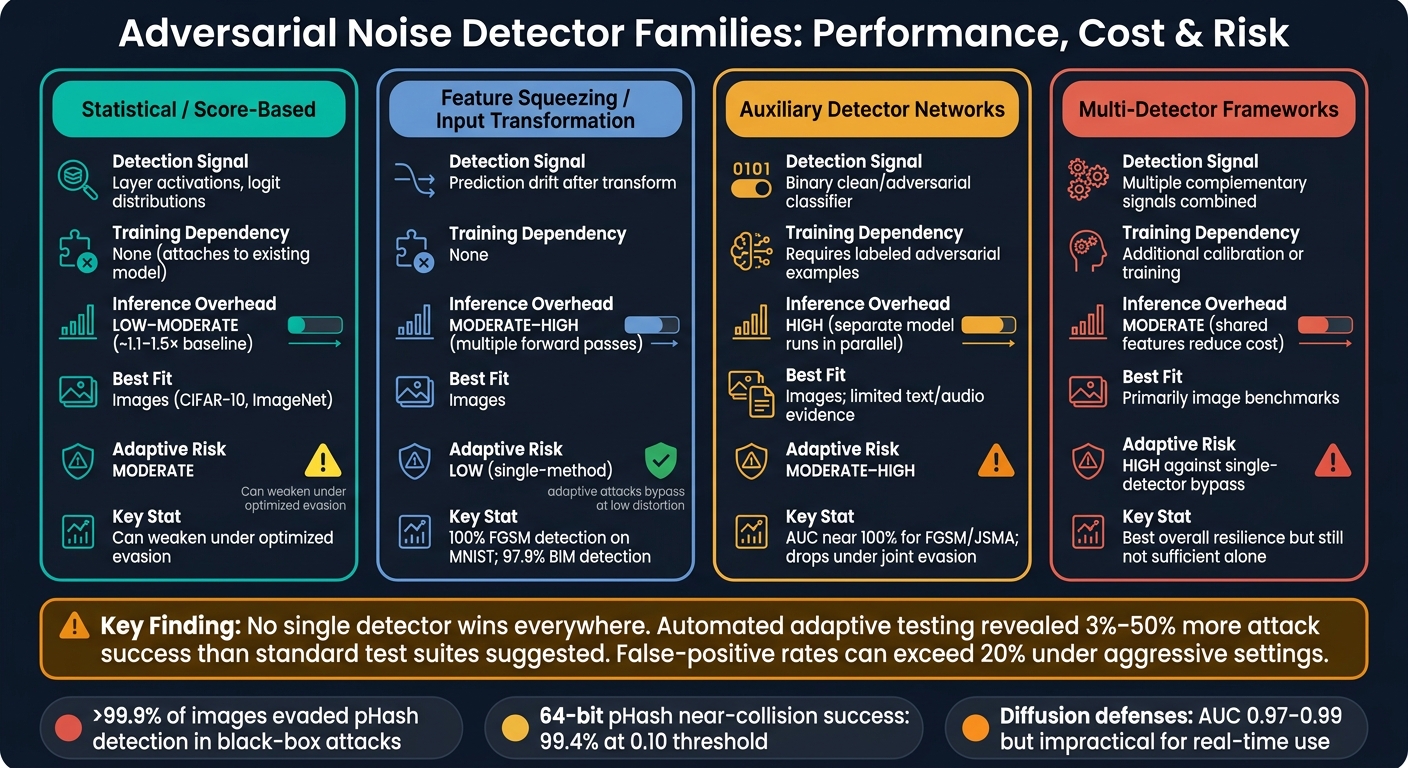
Adversarial Noise Detector Families: Performance, Cost & Risk Compared
Comparative studies show how these detector families behave under real attack pressure.
Detection Accuracy, Overhead, and Adaptive Attack Risk
Comparative studies show a simple pattern: no detector wins everywhere. Results change by dataset, attack type, and deployment setup. A systematic comparison across MNIST, CIFAR-10, SVHN, and Tiny ImageNet found that no single detection method consistently beat all others across five attack types and four datasets[23][24].
That’s the part that matters. A method can look strong in a lab and still fall apart once someone tries to get around it on purpose.
Here’s how the main detector families stack up on the factors that matter most in deployment:
| Detector Family | Detection Signal | Training Dependency | Inference Overhead | Best Fit | Adaptive Risk |
|---|---|---|---|---|---|
| Statistical / Score-Based | Layer activations, logit distributions | None (attaches to existing model) | Low–moderate (about 1.1–1.5× baseline)[18][10] | Images (CIFAR-10, ImageNet) | Moderate – can weaken under optimized evasion |
| Feature Squeezing / Input Transformation | Prediction drift after transform | None | Moderate–high (multiple forward passes) | Images | Low – adaptive attacks can bypass it at low distortion[1][4][21] |
| Auxiliary Detector Networks | Binary clean/adversarial classifier | Requires labeled adversarial examples | High (separate model runs in parallel) | Images; limited text/audio evidence | Moderate–high for single attacks; drops under adaptive joint evasion[20] |
| Multi-Detector Frameworks | Multiple complementary signals combined | Additional calibration or training | Moderate (shared features reduce cost) | Primarily image benchmarks | High against single-detector bypass attempts[20] |
The biggest problem is adaptive attack pressure. One review of 13 defenses found that all of them could be bypassed by stronger, targeted attacks[16]. Automated systems built to find adaptive attacks showed that some detectors faced 3–50% more successful adversarial examples than standard attack suites suggested[11]. So even strong benchmark numbers don’t guarantee safety once an attacker targets both the classifier and the detector at the same time[20].
Limits of Standalone Detection in Production
Strong detection scores don’t settle the production question. What hurts in practice is often the stuff around the model: false alarms, weak transfer across datasets, and compute cost.
False positives are a major failure mode. Studies report that aggressive detector settings can push false positive rates above 20% – about one in five legitimate inputs flagged[17][6][10]. At that point, the review queue starts to snowball. If a system handles content at scale, that kind of flag rate creates real operational drag.
Generalization is another pain point. Detectors tuned for MNIST or other low-resolution datasets often do much worse on ImageNet or richer content[19][24][25]. Some patterns show up again and again:
- NSS and Feature Squeezing can do well on simpler datasets, then lose ground as data gets more complex.
- LID struggles on high-dimensional inputs.
- MagNet works better against high-distortion adversarial examples, but does less well on low-distortion ones[19][25].
So there’s no clean handoff from one dataset, or even one modality, to another.
Compute cost can be just as limiting as detection quality. Diffusion-based defenses can hit detection AUC scores of 0.97–0.99 and remain usable under adaptive attacks, but they need multiple sampling steps per image, which makes them hard to use in real-time pipelines[22]. Adversarial training brings its own trade-off: on tasks like ImageNet, it often cuts clean accuracy by 10–20%[22]. In production, that trade means balancing latency, accuracy, and the actual threat model – not just chasing a high score on a benchmark.
These limits matter most when detectors are used inside watermarking and matching workflows.
Research Implications for Watermarking, Content Matching, and InCyan Workflows

Why This Matters for Watermarking and Asset Matching
These limits hit hardest at the intake layer, before matching or ownership checks even start. That’s the weak spot attackers go after.
A large-scale evaluation of perceptual hashing-based detection found that more than 99.9% of images could be attacked in a black-box setting and still evade detection, without visible changes to human viewers[27]. For a 64-bit pHash, near-collision success at a matching threshold of 0.10 reached 99.4%[26]. Put simply, if an attacker tunes the input for the system, threshold-based matching can fail with alarming ease.
That’s where InCyan’s setup makes sense. Tectus handles ownership proof, while Idem keeps matching working even after major transformations. If you pair Idem with intake logic that looks for adversarial noise, suspicious files can be sent to manual review before a match decision is locked in. In that setup, detection works as a front-end filter, not as a defense on its own.
Where ScoreDetect Fits in the Evidence Chain

Once content is flagged as suspicious, the issue shifts from detection to proof. ScoreDetect is InCyan’s blockchain timestamping product. It captures a cryptographic checksum and records it on a blockchain, creating a record of when a work existed in a given form.
Its role becomes clear after detection and matching confirm ownership. At that point, the timestamped proof helps show that the original existed before the infringing copy appeared. That gives teams a verifiable record they can use in enforcement actions and dispute resolution.
A Layered Protection Stack for Enterprise Enforcement
The strongest setup is a layered workflow, not one control doing all the heavy lifting. In an InCyan workflow, that stack works in four stages:
- Tectus embeds invisible ownership proof at the moment of creation.
- Idem matches changed copies back to the original, even after cropping, compression, and mobile edits.
- ScoreDetect timestamps the original asset to build a defensible provenance record on the blockchain.
- Indago de-indexes unauthorized listings in under 60 minutes, while TorrentWatch monitors the BitTorrent ecosystem for illicit distribution in real time.
Adversarial-noise detection sits at the intake layer across this stack. Its job is simple: flag manipulated inputs before they move into matching or review. That way, enforcement teams spend time where it counts, while ownership evidence stays usable.
Conclusion: Key Research Takeaways for Decision-Makers
The main point is simple: adversarial noise is a real threat to AI-driven content protection. Tiny changes can slip past classifiers, weaken watermark checks, and throw off content matching.
That’s why one detector can’t be your final gate. Published defenses can fail under adaptive attacks, and strong benchmark scores can fall apart once attackers start tuning against the detector. On paper, a detector may look solid. In practice, it can miss attacks without making much noise about it.
The safer move is a layered defense. Think of detection as one part of a broader protection stack, not the whole stack. Pair it with resilient matching, invisible watermarking, and blockchain proof of ownership.
For the next 12–24 months, the priority is clear:
- Build layered defenses
- Run red-team testing
- Tie detection, matching, and enforcement together tightly
That’s the practical role of adversarial noise detection in content protection.
FAQs
Why isn’t one detector enough?
Adversarial noise detection is hard because digital media can be changed in many ways. That includes intentional noise, cropping, and compression. And here’s the catch: one detector can miss part of the picture.
Modern AI-based methods deal with this by checking media from more than one angle. Instead of relying on a single signal, they analyze patterns across the file to spot edits that might slip past simpler systems.
ScoreDetect by InCyan pairs AI-driven detection with blockchain-based timestamping. The goal is straightforward: help flag unauthorized content and give owners verifiable proof of ownership.
Which detection method is most practical?
No single method is the best fit on its own. Research points to a multi-layered approach instead: combine invisible, neural-based watermarking, forensic analysis, and blockchain verification. Why? Because rule-based systems are often easy to get around with adversarial attacks.
ScoreDetect, by InCyan, supports this setup by recording SHA-256 content checksums on the blockchain as immutable proof of ownership, without storing the files themselves.
How does this fit into content protection?
Research on adversarial noise detection shows how AI can spot and resist watermark tampering, including evasion and spoofing. Methods like diffusion inversion and auditory masking can help check whether a watermark is still intact after cropping, compression, or editing.
ScoreDetect by InCyan puts those ideas to work through invisible watermarking, blockchain-based timestamping, and AI-driven content matching to help protect digital assets.