Audio piracy is a growing problem, and traditional watermarking methods are struggling to keep up. Blockchain offers a tamper-proof solution by storing ownership details and audio fingerprints on a decentralized ledger. This ensures proof of ownership, even if watermarks are removed. When combined with AI-powered watermarking, this approach achieves over 97% accuracy in detecting and tracing misuse. Key benefits include:
- Immutable Ownership Records: Blockchain stores timestamps and hashes, making ownership verifiable and permanent.
- Resilience Against Attacks: Perceptual hashing identifies altered audio, even after compression or edits.
- Automated Licensing: Smart contracts streamline licensing and royalty distribution without intermediaries.
- Enhanced Piracy Detection: AI scans platforms for misuse and sends takedown notices with high success rates.
While blockchain improves security and traceability, challenges like high costs, scalability issues, and technical complexity remain. Advances like sharding and Layer-2 solutions aim to address these hurdles, making blockchain-backed audio protection more accessible for creators.
Audio Watermarking and Its Limitations
### Psychoacoustic Audio Watermarking: How It Works
Audio watermarking is a technique used to embed data into sound files, primarily for tracking ownership and preventing misuse. This embedded information often includes tamper-resistant IDs and copyright details, helping creators assert their rights over the content.
The process relies on complex methods like time-domain and frequency-domain processing, Fourier transforms, wavelet analysis, and diffusion models. These techniques hide the watermark within the audio signal in a way that is meant to be inaudible to listeners while also being resistant to tampering.
Platforms and creators use this technology to trace leaks and verify the origins of content. Neural networks are increasingly employed to detect these watermarks by analyzing frequency patterns, making it easier for rights holders to monitor their content online.
Despite its potential, traditional audio watermarking comes with several limitations that hinder its reliability.
Problems with Traditional Audio Watermarking
Although audio watermarking provides a layer of protection, it has vulnerabilities that attackers can exploit. For instance, overwriting attacks can nullify certain neural watermarking systems almost every time. Additionally, modern neural codecs used for audio compression and decompression often erase watermarks completely, eliminating any trace of the original protection[1].
Another significant issue is timing-based attacks. Simple changes, like speeding up the audio or altering its pitch, can disrupt the synchronization needed for watermark detection. Machine learning tools can also remove or imitate watermarks, compromising their ability to prove ownership.
Beyond these, traditional watermarks struggle against common signal manipulations. Techniques such as aggressive compression, cropping, adding noise, or geometric distortions often destroy the embedded data. This is especially problematic in low-bitrate environments, where limited data space makes watermarks more vulnerable.
These challenges highlight the need for more robust solutions, like blockchain, to maintain the integrity of watermarks and provide a tamper-proof record.
sbb-itb-738ac1e
AI Music Copyright: The Watermarking Solution Explained
How Blockchain Improves Audio Watermarking
Blockchain technology tackles the vulnerabilities of traditional audio watermarking by offering a secure and decentralized system for managing ownership records. Unlike centralized databases, which can be tampered with or manipulated, blockchain uses a distributed ledger where no single entity has control over the data. This eliminates weak points in the system and ensures records remain intact.
Here’s how it works: audio fingerprints – essentially unique digital signatures of sound files – are anchored to the blockchain using smart contracts. When an audio file is uploaded, the system generates a hash (a unique identifier) and permanently records it on the ledger. Any unauthorized modification of the audio or its metadata results in a mismatch, instantly flagging the file as altered.
"Blockchain’s potential in video copyright protection and management applications has motivated researchers… Copyright owners and consumers may now communicate directly via copyright protection apps built on the blockchain, eliminating the need for distributers and the associated fees." – PLOS One [8]
For efficiency, large audio files are stored off-chain (e.g., using IPFS), while essential metadata remains on the blockchain. This two-layer approach ensures the system stays fast without compromising security.
The outcome? A transparent and tamper-proof system where anyone can verify the ownership and authenticity of an audio file without relying on a central authority. Every interaction with the content – whether it’s registration, licensing, or access requests – is logged, creating a clear, auditable trail. This setup enables automated copyright management through smart contracts.
Permanent Storage of Audio Metadata
Blockchain ensures permanent and unalterable records of audio file metadata. When an audio file is registered, details like the creation timestamp, ownership, and a unique hash are written into a block on the chain. Once stored, these records become part of an immutable history that cannot be erased or changed.
The HashWave framework, introduced in 2025 and updated in 2026, demonstrates how efficient this process can be. Published in Nature Scientific Reports, the system recorded average hash upload times of 0.017 seconds and smart contract execution times of 0.044 seconds [7]. These speeds make blockchain practical for managing even large-scale audio content.
This permanence is made possible by blockchain’s consensus mechanism. Each block is cryptographically linked to the one before it, forming a chain where altering a single record would require rewriting every subsequent block – a nearly impossible task on established networks like Ethereum. This ensures that ownership claims remain verifiable, no matter how many times the audio changes hands.
Smart Contracts for Copyright Management
Smart contracts take the hassle out of licensing by automating the entire process. These self-executing programs are pre-programmed with rules for different license types – such as exclusive, sole, or ordinary – and execute actions automatically when conditions are met. For instance, when someone purchases a license, the smart contract verifies the payment, grants access to the audio, and distributes royalties to collaborators based on pre-set shares [5].
This automation removes the need for intermediaries, such as agencies or third parties, who could introduce errors or biases. Instead, agreements are enforced through immutable code. Research published in Frontiers in Blockchain by Qilong Shi and Yan Zhou highlights that blockchain-based copyright registration adds only 1.9 seconds to the registration time per music piece – a small tradeoff for the added security [5].
"Smart contracts consist of code that is automatically run when preset conditions and requirements are fulfilled without the need for a central authority." – Franco Frattolillo, Department of Engineering, University of Sannio [9]
Smart contracts can also manage time-limited licenses, automatically revoking access when the license expires. Every transaction – whether it’s a license purchase, ownership claim, or access request – is logged on the blockchain, creating a transparent audit trail that reduces disputes and simplifies copyright enforcement.
Perceptual Hashing with Blockchain
Blockchain also strengthens technical fingerprinting through perceptual hashing. Unlike traditional cryptographic hashes, which completely change with even minor edits, perceptual hashes are based on what the audio sounds like. They remain consistent even if the audio is compressed, pitch-shifted, or time-stretched, making them ideal for identifying pirated content.
The HashWave system, for example, combines multiple audio features – such as Mel-Frequency Cepstral Coefficients (MFCC), chroma, and Constant-Q Transforms (CQT) – to create highly resilient fingerprints. Tests showed an Area Under the Curve (AUC) of 0.957 and a True Positive Rate of 0.952 at a 1% false positive rate, even after over 20 different signal-processing attacks [7].
When these perceptual hashes are anchored on the blockchain, they form a tamper-proof verification system. If someone alters your audio and tries to claim it as their own, the perceptual hash of their version will still match the original hash stored on the ledger. The system uses Dynamic Time Warping (DTW) to align the altered audio with the registered fingerprint, ensuring accuracy even when attackers manipulate the audio’s timeline [7].
| Feature | Traditional Watermarking | Blockchain-Enhanced Perceptual Hashing |
|---|---|---|
| Tamper Resistance | Low (easily removed by edits) | High (anchored on immutable ledger) |
| Edit Resilience | Fails under pitch/time shifts | Robust via multi-feature fusion & DTW |
| Verification | Centralized/Proprietary | Decentralized & Publicly Verifiable |
| Storage | Centralized Database | Blockchain & IPFS |
| Accuracy | Variable under attack | 95% – 97%+ [1][7] |
Benefits of Blockchain-Enhanced Audio Watermarking
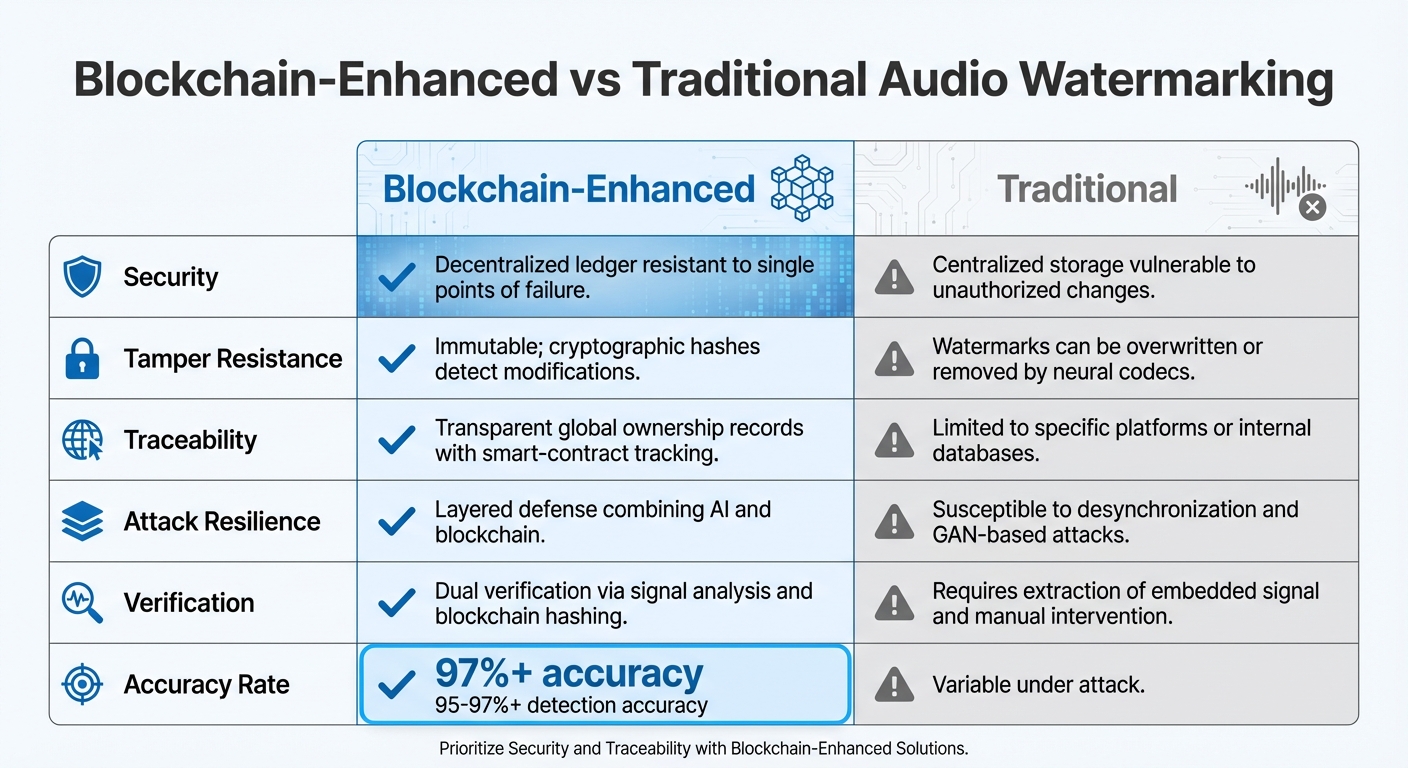
Blockchain-Enhanced vs Traditional Audio Watermarking Comparison
When blockchain technology meets audio watermarking, it creates a powerful two-layered defense system. Watermarks embed ownership details directly into the audio, while blockchain stores a permanent SHA-256 hash to verify the file’s integrity – even if the watermark is removed. This combination forms the backbone of the enhanced security features discussed below.
Better Security and Tamper Resistance
Blockchain’s decentralized structure eliminates the risks of centralized databases, like single points of failure. By storing watermark metadata – such as perceptual hashes or ownership details – on the blockchain, no single party can alter the data without the agreement of the entire network. Each block is cryptographically linked to the next, making unauthorized changes virtually impossible.
Traditional neural audio watermarking systems, on the other hand, are prone to overwriting attacks, which can succeed almost 100% of the time when no extra defenses are in place. With blockchain, even if the audio is altered, any mismatch in the hash immediately reveals tampering. This combination of forensic audio watermarking and cryptographic verification creates a strong shield against both minor edits and advanced machine learning-based attacks.
Beyond security, blockchain also offers unmatched traceability for audio content.
Better Tracking and Transparency
Blockchain’s tamper-proof nature significantly boosts content tracking and ownership verification. It enables segment-level tracking, which allows copyright holders to prove ownership of specific parts of an audio file, rather than just the entire recording. This precision is especially useful when snippets are sampled, remixed, or shared without proper authorization across various platforms.
Every interaction with the audio – be it a license purchase, access request, or distribution – is logged on the blockchain. This creates a transparent and publicly accessible audit trail, reducing disputes and fostering trust. Additionally, smart contracts can automate licensing processes, ensuring that usage rights are clear and self-executing across streaming services, social media, and other platforms. This level of cross-platform traceability far surpasses what traditional centralized systems can achieve.
Blockchain vs. Traditional Watermarking Methods
| Feature | Blockchain-Enhanced Watermarking | Traditional Watermarking |
|---|---|---|
| Security | Decentralized ledger resistant to single points of failure | Centralized storage vulnerable to unauthorized changes |
| Tamper Resistance | Immutable; cryptographic hashes detect modifications | Watermarks can be overwritten or removed by neural codecs |
| Traceability | Transparent global ownership records with smart-contract tracking | Limited to specific platforms or internal databases |
| Attack Resilience | Layered defense combining AI and blockchain | Susceptible to desynchronization and GAN-based attacks |
| Verification | Dual verification via signal analysis and blockchain hashing | Requires extraction of embedded signal and manual intervention |
How ScoreDetect Uses Blockchain for Audio Protection
ScoreDetect combines blockchain timestamping and AI-powered watermarking to tackle the challenges of traditional audio protection. This two-layer approach ensures audio content is safeguarded from creation through distribution, making it a standout solution in the field.
Blockchain Timestamping for Audio Files
By leveraging blockchain’s unchangeable nature, ScoreDetect uses timestamping to secure audio ownership. Each audio file is assigned a SHA-256 hash, which is stored on the blockchain. This cryptographic timestamp acts as proof of ownership and integrity without storing the actual audio file – only the checksum is recorded. This ensures privacy while maintaining control over original files.
The system creates encrypted timestamps in seconds, allowing you to verify ownership of specific audio segments. Even if a portion of the file is sampled or altered, the protection remains intact. ScoreDetect uses the SKALE blockchain, which eliminates gas fees and operates on an energy-efficient model, avoiding the high energy demands of older blockchain systems.
AI-Powered Piracy Detection
ScoreDetect’s AI scans the internet and streaming platforms for unauthorized use of protected audio. By combining invisible watermarking with blockchain-based hashes, the platform achieves over 97% accuracy in identifying piracy[1]. The AI detects infringements, while the blockchain provides unalterable evidence for enforcement.
Its intelligent web-scraping technology has a 95% success rate in bypassing anti-scraping measures, enabling it to uncover unauthorized content across various platforms. When piracy is detected, the system matches the content to proof of unauthorized use and sends automated takedown notices. These notices achieve a 96% success rate in removing infringing material[1], streamlining the process from detection to resolution.
Automated Workflows and SEO Benefits
ScoreDetect integrates with more than 6,000 web apps, including a WordPress plugin, to automate audio timestamping and enhance SEO. The blockchain timestamps created by the platform signal authenticity, improving Google’s E-E-A-T (Experience, Expertise, Authoritativeness, and Trustworthiness) metrics. This boosts visibility and credibility in search engine rankings.
As Imri, the CEO of a SaaS startup, put it: "ScoreDetect is exactly what you need to protect your intellectual property in this age of hyper-digitization. Truly an innovative product, I highly recommend it!" The platform offers a 7-day free trial with no commitment. Verification certificates remain publicly accessible as long as your subscription is active, providing third-party validation of your ownership claims.
Challenges and Future Developments
Technical and Cost Barriers
Blockchain undoubtedly enhances audio watermarking, but it comes with its own set of hurdles that make widespread adoption tricky. One of the biggest issues is scalability. For example, platforms like Ethereum can only handle about 15 transactions per second, which creates bottlenecks when processing large volumes of audio files. This becomes especially problematic during peak times, where delays in transaction confirmations can disrupt real-time piracy detection efforts[2][5].
Another major challenge is the cost. Blockchain operations, including consensus mechanisms and smart contract execution, can be 10 to 100 times more expensive than using centralized databases for handling large-scale audio distribution. On top of that, technologies like AI-powered perceptual hashing and blockchain timestamping demand significant GPU and CPU resources, making it difficult for smaller creators or independent artists to afford implementation without access to optimized platforms[2][10].
The complexity of implementation is another obstacle. Successfully deploying these systems requires expertise across several fields, such as cryptography, smart contract programming (e.g., Solidity), audio signal processing to embed imperceptible watermarks, and integrating blockchain with decentralized storage solutions like IPFS. The steep learning curve, combined with blockchain’s immutability, makes updates challenging and requires constant vigilance against removal attacks. This complexity can deter adoption, especially for those without specialized technical skills[2][3][4][6].
New Developments in Blockchain and Watermarking
Despite these challenges, advancements in blockchain and watermarking technologies are offering promising solutions. For instance, sharding networks – which split blockchains into parallel chains – have significantly improved throughput, scaling from 15 transactions per second to thousands. A 2023 study even showed that sharding could speed up multimedia file registration by up to 10 times[2]. Additionally, Layer-2 rollups are helping to cut costs and reduce latency for smart contracts used in watermark enforcement[2][10].
AI is also making strides in watermark detection. Neural networks are now capable of analyzing frequency features to detect invisible watermarks, even after files have been compressed or distorted by noise. Looking ahead, new techniques like content-adaptive watermarking aim to resist removal attempts by Generative Adversarial Networks (GANs). Other innovations include real-time anti-piracy systems that use session-specific watermarks to track live-stream piracy within seconds and energy-efficient wavelet methods with blind extraction techniques. These developments not only improve protection but also aim to reduce power consumption, making the technology more accessible and sustainable.
Conclusion
Blockchain is reshaping how audio copyright protection works by tackling the weaknesses of traditional watermarking methods. While older systems often falter when faced with tampering or unreliable ownership verification, blockchain offers a robust solution: immutable metadata storage and perceptual hashes backed by legally sound timestamps. Its decentralized nature eliminates the need for intermediaries, enabling transparent usage tracking through smart contracts that can automate licensing and detect infringement.
By integrating AI-powered invisible watermarking with blockchain verification, this approach addresses the shortcomings of traditional systems. Research highlights an impressive detection and traceability accuracy of over 97% [1], making it far more resilient against sophisticated removal attacks. Businesses can store SHA-256 hashes on-chain while keeping audio files off-chain, ensuring proof of ownership without the storage costs or privacy risks associated with centralized databases.
For industries like media, entertainment, and content creation, tools like ScoreDetect showcase the practical application of this technology. By combining blockchain timestamping, invisible watermarking, AI-driven piracy detection, and automated takedown notices, ScoreDetect achieves a 96% success rate. Features such as Zapier workflows – connecting with over 6,000 web apps – and a WordPress plugin for automatic timestamping allow businesses to secure their audio assets seamlessly. This is especially useful for organizations managing large volumes of audio files, where manual verification would be both time-consuming and expensive.
As blockchain technology continues to evolve with advancements like sharding networks and Layer-2 solutions, it becomes more accessible for businesses of all sizes. The combination of immutable ownership proof, automated smart contracts, and segment-level verification marks a shift from reactive dispute resolution to proactive, scalable protection – tailored to the challenges of today’s digital landscape.
FAQs
How does blockchain prove I own an audio file?
Blockchain secures ownership of an audio file by generating a permanent, unchangeable record with precise timestamps. Rather than holding the actual file itself, the system stores small hash values on the blockchain. These hashes safeguard the file’s integrity while offering a reliable way to verify ownership.
Will blockchain still work if the watermark is removed?
Blockchain adds a new layer of security to watermarking by creating tamper-proof records of ownership and timestamps. This means that even if a watermark is removed or altered, blockchain can still verify the content’s integrity using a unique digital fingerprint, also known as a checksum. By combining these methods, copyright protection is reinforced through unchangeable records, ensuring ownership proof doesn’t rely solely on the watermark itself.
What does it cost to use blockchain for audio protection?
The expense of implementing blockchain for audio protection can vary widely, largely influenced by the scope and intricacy of the project. Development costs generally fall between $8,000 and $300,000 or more, depending on the features and scale of the system. On top of that, annual maintenance typically costs about 15–20% of the original development investment, ensuring the system remains functional and secure. These figures can fluctuate based on the specific needs and technical details of the project.