Neural networks are transforming how digital watermarks are identified, making it easier to protect intellectual property in a world where both human and AI-generated content are rapidly increasing. These systems analyze subtle patterns in digital files to detect invisible watermarks, even after edits like cropping or compression. Here’s how they work:
- What are watermarks? Invisible markers embedded in digital files (images, videos, audio) to indicate ownership or origin.
- Types of watermarks: Post-processing watermarks (added after creation) and generative watermarks (embedded during AI content generation).
- How neural networks detect them: By analyzing file components, spotting patterns, and learning to differentiate natural features from watermark signals.
- Applications: Protecting copyrights, ensuring dataset quality, and combating misuse like deepfakes or piracy.
Neural networks offer high accuracy and efficiency, making them indispensable tools for industries like media, education, and e-commerce. Platforms like ScoreDetect leverage these systems to safeguard digital assets and automate detection workflows.
SynthID – Watermarking and identifying AI-generated text

sbb-itb-738ac1e
How Neural Networks Detect Watermarks
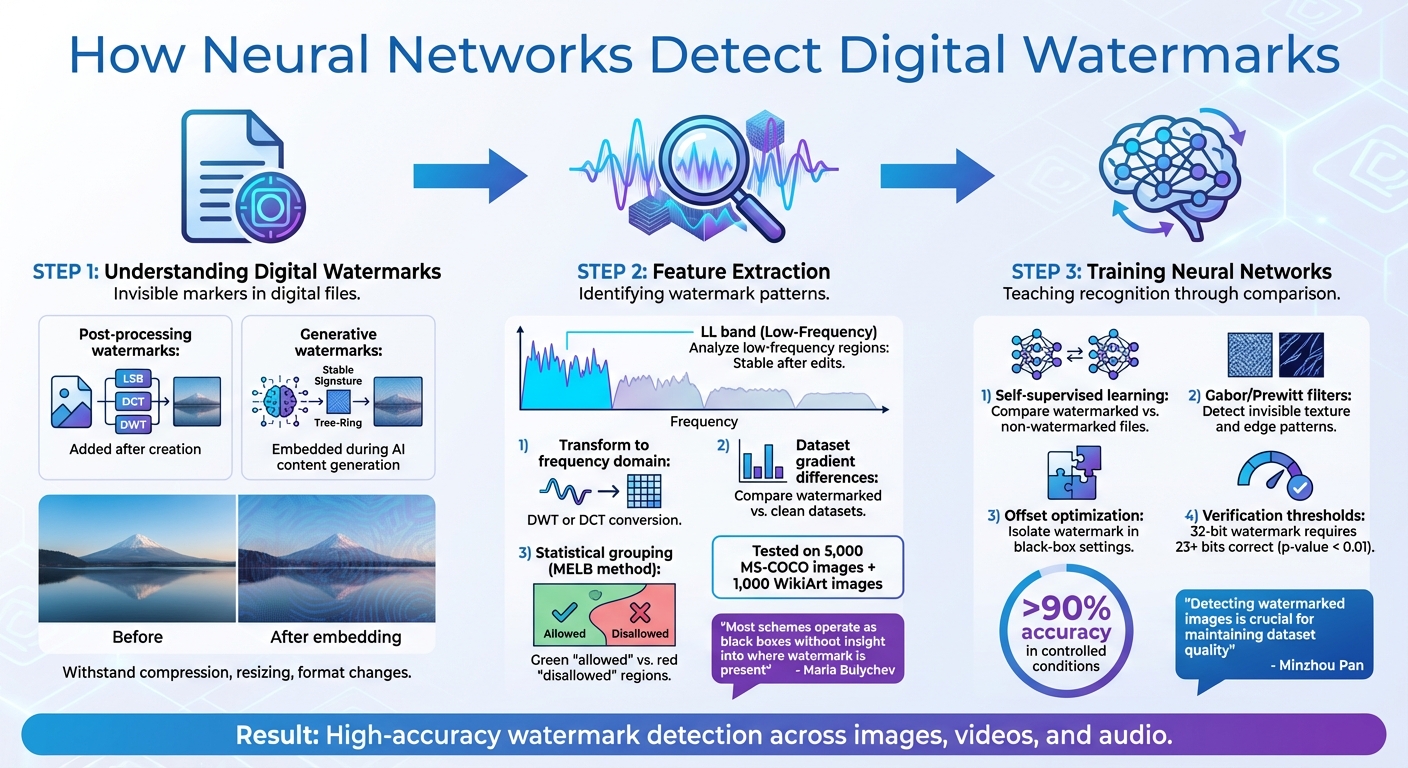
How Neural Networks Detect Digital Watermarks: 3-Step Process
Neural networks can uncover hidden digital watermarks by analyzing content at an incredibly detailed level. This process involves breaking files down into their core components, spotting unique patterns, and learning to distinguish between natural features and embedded watermark signals. The process unfolds in three main steps: understanding digital watermarks, extracting key features, and training the network to recognize these signals effectively. Let’s explore each step.
What Are Digital Watermarks?
Digital watermarks are invisible markers embedded into digital files – such as images, videos, and audio – that carry information about ownership, authenticity, or origin. These markers are designed to be undetectable to the human eye while preserving the quality of the content. They allow for verification without altering the user experience.
There are two primary types of watermarks:
- Post-processing watermarks: These are added to content after it has been created. Techniques include methods like LSB (Least Significant Bit), which slightly tweaks pixel values, and frequency-domain techniques such as DCT (Discrete Cosine Transform) and DWT (Discrete Wavelet Transform), which modify the mathematical structure of an image [1].
- Generative watermarks: These are embedded directly during the creation of AI-generated content. Examples include Stable Signature and Tree-Ring, which encode watermarks into the hidden layers of AI-generated outputs [1][3].
These watermarks are designed to withstand common edits like compression, resizing, or format changes – especially when embedded in the frequency domain rather than directly in pixel data [7].
Feature Extraction in Neural Networks
To detect watermarks, neural networks must first identify the features that define them. This involves transforming digital content into mathematical representations, often shifting from pixel-based data to frequency-based data using methods like DWT or DCT [7][3]. In these transformed spaces, watermarks emerge as recurring patterns, particularly in the low-frequency (LL band) regions, which remain stable even after edits like compression or blurring [7].
One effective method for isolating watermarks is by analyzing dataset gradient differences. By comparing a watermarked dataset with a clean reference dataset, researchers can pinpoint the unique patterns that represent the watermark [1].
Another innovative technique is statistical grouping. In December 2025, researchers at the University of Melbourne introduced MELB (Multidimensional Embedding via Localized Blocking). This method divides DWT coefficients into "allowed" (green) and "disallowed" (red) regions. Watermarked content tends to cluster in the "allowed" regions, while natural content shows a balanced distribution. Tested on datasets like MS-COCO (5,000 images) and WikiArt (1,000 images), MELB successfully detected watermarks even after significant alterations, such as 50% cropping [7].
"Most existing image watermarking schemes operate as black boxes, producing global detection scores without offering any insight into how or where the watermark is present." – Maria Bulychev, University of Melbourne [7]
Training Neural Networks for Watermark Detection
After extracting features, the next step is teaching the network to recognize watermarks. This involves comparing watermarked files with non-watermarked references. Since watermarks are often too subtle for standard anomaly detection, self-supervised learning techniques are used. Traditional methods, by contrast, may only achieve AUC scores between 0.508 and 0.522 – barely above random guessing [1].
To enhance detection, networks utilize filters like Gabor or Prewitt filters. These tools help identify texture and edge patterns that are invisible to the human eye, enabling the detection of even complex watermark forgeries [6].
In cases where the watermarking method is unknown (black-box settings), the network applies offset optimization. By subtracting dataset gradients, it isolates the watermark’s influence without needing prior knowledge of the embedding technique [1].
"Detecting and filtering out watermarked images is crucial for maintaining dataset quality and ensuring accurate model development." – Minzhou Pan, Northeastern University [1]
The training process also includes setting verification thresholds to ensure reliability. For example, a 32-bit watermark might require at least 23 bits to be correctly extracted to confirm its presence with statistical confidence (p-value < 0.01) [5][8].
Through this rigorous training, neural networks achieve high accuracy – consistently exceeding 90% in controlled conditions – when detecting watermarks across various types of content, from photographs to AI-generated images [1]. This capability plays a critical role in protecting digital content and supporting modern anti-piracy measures.
Applications of Neural Network Watermark Detection
Neural network watermark detection has found its way into various industries, addressing challenges like content verification, intellectual property protection, and dataset integrity. With over 18 billion AI-generated images produced annually – and about 5% of all images estimated to be AI-generated – this technology is becoming increasingly critical in ensuring content security and combating misuse[1]. By identifying and verifying watermarks, it not only safeguards ownership but also strengthens efforts against piracy.
Copyright Protection and Content Ownership
One of the standout uses of watermark detection is in safeguarding digital assets. Neural networks can retrieve embedded ownership data from images, even if they’ve been cropped, rotated, or compressed. This makes it possible to trace unauthorized use or plagiarism without affecting the quality of the visuals[1]. The stakes are high, especially when training cutting-edge AI models like GPT-4 can cost as much as $40 million. Protecting these investments is essential[8].
E-commerce and marketing industries also benefit significantly, as watermark detection helps protect brand assets by identifying unauthorized use of product images and promotional materials[1]. Beyond individual asset protection, watermarking can filter out AI-generated content from training datasets, maintaining the quality of AI models and preventing potential degradation.
Fighting Digital Piracy
Watermark detection is an essential tool in the fight against digital piracy. Neural networks excel at identifying invisible watermarks that remain intact even after significant distortions. Advanced systems can recover watermarks with over 97% bit accuracy, even when content has been heavily altered[4]. This capability is vital for enforcing anti-piracy measures.
Another critical application is identifying deepfakes and AI-generated misinformation. By detecting invisible provenance watermarks, neural networks can verify the origins of news photos and videos. Given that over 30% of social media images now contain AI-generated elements – and with 71% of people expressing concerns about scams involving such content – these tools are more important than ever[3]. In academia, watermark detection helps safeguard educational content by differentiating between authentic student work and AI-generated submissions. This is especially relevant when platforms like DALL-E 2 generate an average of 34 million images daily[3].
ScoreDetect‘s Watermark Detection Capabilities

ScoreDetect, a flagship solution from InCyan, showcases how advanced neural network algorithms can be applied effectively. This platform combines automated watermark detection with intelligent web scraping to identify unauthorized content usage online, achieving a 95% detection rate and a 96% takedown rate.
ScoreDetect also incorporates blockchain technology by capturing digital fingerprints for content verification, enhancing copyright protection without storing the actual assets. For large-scale needs, it offers invisible watermarking for images, videos, audio, and documents, providing both proactive prevention and reactive detection. Its versatility makes it suitable for industries like media, education, healthcare, and finance.
What sets ScoreDetect apart is its integration capabilities. Through Zapier, the platform connects with over 6,000 web apps, enabling automated workflows that respond instantly when unauthorized, watermarked content is flagged. Additionally, its WordPress plugin allows content creators to automatically generate verifiable proof of ownership for published or updated articles. This not only strengthens copyright claims but also boosts SEO by enhancing Google E-E-A-T signals.
Benefits of Neural Network-Based Watermark Detection
High Accuracy and Speed
Neural networks bring exceptional precision to detecting invisible or complex watermarks. They remain effective against common content manipulations like JPEG compression, noise addition, cropping, and rotation [9][3]. By leveraging deep latent representations and perceptual hashes, they can identify subtle watermark patterns that are imperceptible to the human eye but easily recognized by algorithms [9][5].
These systems also deliver unmatched speed. For instance, the MaskWM framework, introduced in October 2025, achieves 15× greater computational efficiency, while the Neural Honeytrace framework reduces query requirements to just 2% of what earlier methods needed [10][2]. This combination of speed and precision ensures accurate detection and allows for efficient scaling when dealing with large content libraries.
Scalability for Large Content Libraries
Neural networks are particularly well-suited for processing large-scale digital content, making them indispensable for enterprises managing extensive datasets. Manual screening for invisible watermarks is impractical due to the subtle nature of these marks, but neural networks fully automate this task, enabling platforms to scan millions of files without human input [1].
Advanced architectures like InvisMark, developed by Microsoft Responsible AI researchers in November 2024, take scalability further. InvisMark uses resolution scaling during training, allowing it to handle high-resolution images – common in modern generative AI – without needing to process every pixel in full detail [4]. This system successfully embedded 256-bit watermarks into high-resolution images, maintaining over 97% bit accuracy even after distortions such as 25% random cropping or 10-degree rotations [4]. Its high payload capacity also minimizes the risk of ID collisions in massive databases, a critical feature for managing extensive digital asset collections.
Integration with Platforms Like ScoreDetect
Neural network-based watermarking also supports plug-and-play integration, meaning it can be deployed without retraining models. This flexibility makes it easier for content protection platforms to adapt to changing needs [2]. Advanced detectors can identify invisible watermarks in datasets without requiring prior knowledge of the specific watermarking methods used, making them ideal for handling diverse third-party content [1].
Platforms like ScoreDetect capitalize on these strengths through their collaboration with InCyan’s enterprise-grade solutions. This setup ensures fast and reliable content verification. ScoreDetect’s invisible watermarking capabilities span images, videos, audio, and documents, seamlessly integrating with automated detection workflows. By connecting with over 6,000 web apps via Zapier, the platform can trigger instant responses whenever unauthorized watermarked content is flagged. This powerful combination of neural network detection and automated actions helps organizations across industries – such as media, healthcare, finance, and entertainment – secure their digital assets efficiently and at scale, all without manual intervention.
Conclusion
Neural networks have reshaped watermark detection by offering a level of accuracy, speed, and scalability that older methods simply can’t achieve. These systems excel at uncovering invisible watermarks in images, videos, audio, and documents – even after challenges like compression, cropping, rotation, or noise injection. By leveraging CNNs to model texture and edge features, they achieve over 90% AUC while using just 2% of the queries required by traditional approaches [1][2].
With large-scale AI models costing upwards of $40 million [8], protecting ownership is more critical than ever. Minzhou Pan from Northeastern University highlights this urgency:
"As invisible watermarks become increasingly prevalent, while specific decoding techniques remain undisclosed, our approach provides a versatile solution and establishes a path toward increasing accountability, transparency, and trust in our digital visual content" [1].
This advanced performance meets the rigorous demands of enterprises seeking to protect their valuable assets. ScoreDetect takes this further by combining blockchain timestamping with cutting-edge invisible watermarking and automated detection workflows. This streamlined approach helps organizations in industries like healthcare, finance, media, and entertainment safeguard their assets without the need for manual oversight.
For businesses needing full-spectrum content protection – from preventing unauthorized use to detecting piracy infringements and automating takedown actions – ScoreDetect’s Enterprise plan offers everything they need. It allows organizations to verify ownership, track content usage, and address violations at scale, all while ensuring watermarks remain invisible to end users.
FAQs
Can watermarks still be detected after heavy cropping or compression?
Watermarks can sometimes still be detected even after an image has been heavily cropped or compressed. This largely depends on the watermarking method used. Some advanced techniques embed signals deep within the image, making them resilient to changes like cropping or compression. Additionally, neural networks designed for robustness can pick up on these subtle watermark signals, even after significant alterations. However, their success often hinges on how much the image has been modified and the specific watermarking approach applied.
Why do detectors use frequency-domain features instead of pixels?
Detectors use frequency-domain features because they excel at identifying patterns and textures associated with watermarks. This method proves to be more dependable when facing attacks or manipulations, as pixel-based techniques often miss the faint signals of a watermark. By focusing on frequency features, detection becomes more precise and dependable, even in tough conditions.
How can detection work if the watermark method is unknown?
Detecting watermarks without prior knowledge of the specific method involves leveraging advanced techniques. Neural networks play a key role by scanning content for patterns, irregularities, or statistical markers that hint at the presence of a watermark. Techniques such as offset learning or detection maps can pinpoint areas likely to contain a watermark without needing to decode it directly. These methods are particularly useful for verifying content authenticity and safeguarding copyrights, even when the watermarking process is proprietary or undisclosed.