Scalable multimodal systems process text, images, audio, and video simultaneously, making them powerful but expensive to operate at scale. Managing costs requires addressing three main areas: compute, storage and data transfer, and orchestration. Key strategies include:
- Compute Efficiency: Use task-specific models, batching, and dynamic routing to reduce GPU and CPU usage.
- Storage Optimization: Store only essential data (e.g., cryptographic hashing) and use cheaper storage tiers for raw files.
- Cloud Cost Control: Implement autoscaling, workload isolation, and "hash-to-chain" methods to reduce infrastructure costs. Utilizing blockchain timestamping can further verify data integrity without storing massive files.
- Orchestration Improvements: Eliminate redundant processing and automate tasks like enforcement to save time and resources.
New Foundations for AI data: Multimodal Lakehouse
sbb-itb-738ac1e
Main Cost Drivers in Multimodal Systems
To manage costs effectively, you first need to pinpoint where the money is being spent. In multimodal systems, the main expenses typically fall into three categories: compute, storage and data transfer, and orchestration. Each of these areas comes with its own challenges, and costs can escalate quickly. Let’s break down how these factors contribute to overall expenses.
Compute Resource Usage
Handling diverse data types simultaneously requires heavy GPU usage. Each image, video, audio file, or text document needs its own processing pipeline, and at an enterprise level, these pipelines often operate continuously. For example, InCyan‘s Idem engine processes multimodal content – images, videos, audio, and text – with 99% accuracy, even when only 10% of the original asset remains intact [1]. Achieving this level of precision demands high-performance, dedicated infrastructure running around the clock.
Ongoing monitoring further increases compute demands. Automated scans of social platforms, peer-to-peer networks, and the broader web operate 24/7, ensuring GPU and CPU usage never fully drops [1][6]. Additionally, generating forensic-grade fingerprints – designed to withstand changes like cropping, re-encoding, or speed adjustments – adds a significant layer of compute overhead compared to simpler hash-based methods [1][3].
But compute isn’t the only area where costs add up – storage and data transfer also play a major role.
Storage and Data Transfer Costs
Multimodal files like high-resolution images, videos, and audio recordings are large, making them costly to store at scale. To reduce these expenses, it’s essential to store only the data required for verification. For instance, ScoreDetect eliminates the need to store full assets by capturing just the checksum (a cryptographic hash) of the content on the blockchain [2].
"ScoreDetect does not store any digital assets or content. It only stores the checksum of the content on the blockchain. This means that your digital assets are safe and secure with you." – ScoreDetect [2]
However, blockchain anchoring introduces additional costs. On high-traffic public chains, transaction fees – or "gas" – can vary with network demand, making it unsustainable to anchor millions of assets individually.
"Anchoring every asset individually on a high traffic public chain would quickly become cost prohibitive. Transaction fees, sometimes described as gas, are paid for each operation and fluctuate based on demand." – Nikhil John, InCyan [7]
Beyond blockchain costs, discovery systems also generate capture artifacts like screenshots, HTML snapshots, and media samples. These artifacts, used as evidence, require structured and auditable storage, further increasing storage overhead [8].
Orchestration Overhead
Orchestration costs may not be as visible as compute or storage, but they can quickly become one of the largest expenses. Poorly coordinated multimodal pipelines and inefficient content matching algorithms can lead to duplicate processing, which not only increases costs but also creates inefficiencies [8]. For example, the same piece of infringing content might be processed and stored multiple times before being flagged as a duplicate.
Without automated triage, inefficient routing can amplify redundant processing and increase the workload for analysts. Clustering similar detections into unified incidents helps reduce both compute usage and reviewer effort. This ensures resources are focused on high-priority cases rather than being wasted on repetitive tasks [8]. Fine-tuning these processes is essential to keep overall costs in check.
Architecture Choices That Reduce Cost
When it comes to managing compute, storage, and orchestration expenses, making smart architectural decisions is crucial. The way a system is designed can directly impact operating costs, helping to reduce unnecessary resource use, lower latency, and maintain predictable expenses – all while ensuring accuracy remains intact.
Modality Fusion Approaches
One of the most important choices in building a multimodal system is deciding how to combine data signals from various sources. Late fusion stands out as one of the more cost-efficient methods, especially at scale. In this approach, each modality – whether it’s images, video, audio, or text – is processed individually by a dedicated model. The outputs are then merged to make a final decision. This parallel processing approach helps cut down on redundant compute cycles. As InCyan explains, "Tailoring the technology to the problem means higher accuracy and faster results." [1]
Dynamic Routing and Parallel Processing
Once modality pipelines are separated, the next step is to implement intelligent routing. Dynamic routing uses confidence scores and risk indicators to determine the level of processing needed for each asset. For example, high-confidence detections can go straight to automated enforcement, while more uncertain cases are flagged for manual review. This reduces labor costs by minimizing the need for human intervention [8].
Running detection processes and provenance validation in parallel, rather than sequentially, can also significantly reduce latency without increasing compute demands. For instance, combining AI-driven content detection with cryptographic manifest validation (such as C2PA standards) allows decision times to stay under 300ms per upload – even when dealing with multiple data types simultaneously [4]. Deepidv emphasizes the importance of this approach:
"Keep platform trust decisions close to the upload boundary, before synthetic content spreads." [4]
By making these trust decisions early, you can limit the spread of problematic content and avoid costly downstream issues. These routing strategies not only improve efficiency but also set the stage for better caching and resource management.
Caching and Resource Allocation
Building on earlier cost-saving measures, this layer ensures that every processing cycle is used effectively. For large-scale platforms handling over 100 million uploads daily, dedicated tenant isolation can prevent performance bottlenecks that might otherwise require over-provisioning [4]. Additionally, structuring blockchain metadata anchoring around a fixed-cost model helps stabilize expenses, turning unpredictable transaction costs into a manageable constant [2].
These optimizations can lead to impressive results, such as increasing verification speeds by up to 170% [2]. At an enterprise scale, such gains are crucial for maintaining efficiency while processing massive volumes of data.
Making AI Models More Efficient
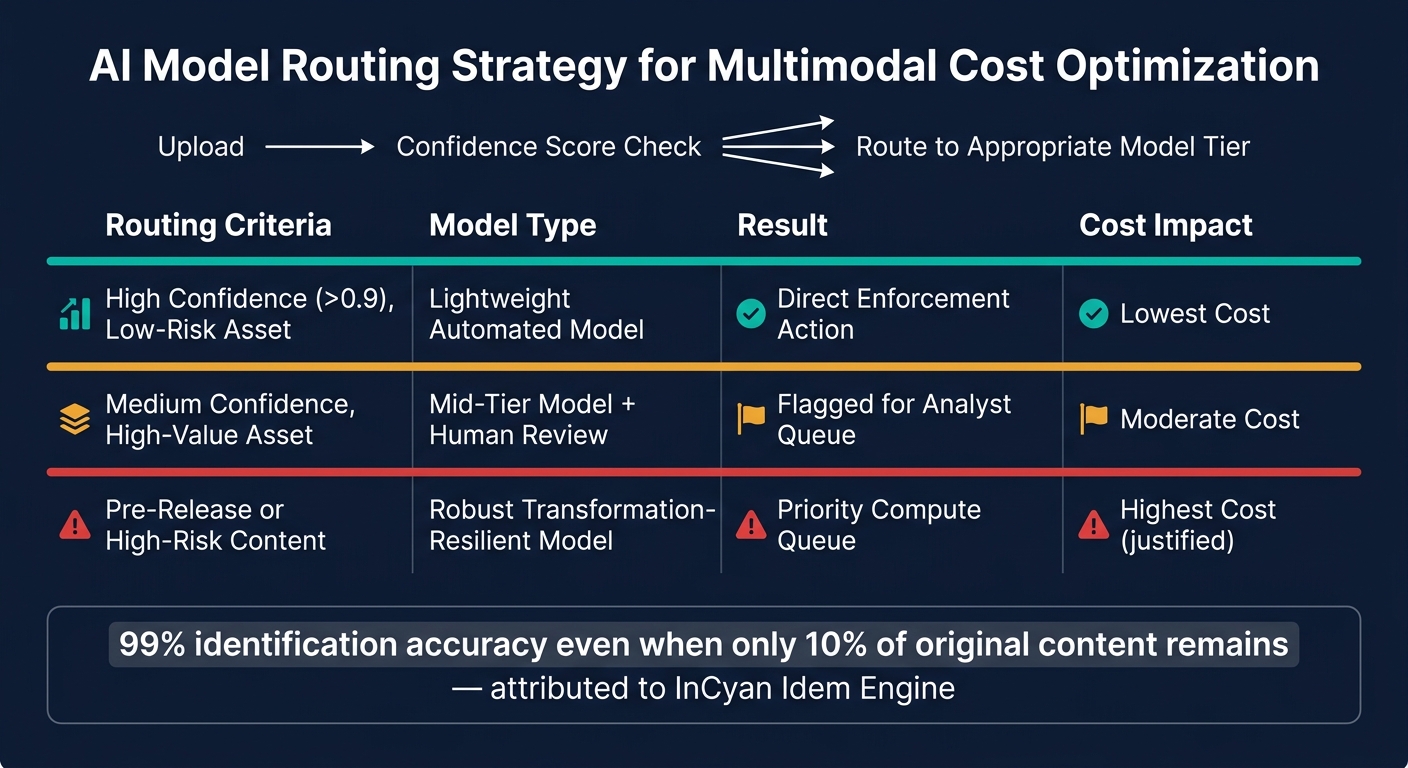
Multimodal System Cost Optimization: Routing Strategy by Confidence & Risk
After optimizing architecture, the next step in improving AI efficiency involves refining model design, selection, and execution. This approach ensures that models are tailored to fit specific tasks, which helps cut costs while maintaining performance.
Model Selection and Optimization Techniques
One effective way to reduce computational demand is by avoiding the use of a single, oversized multimodal model for all tasks. These "one-size-fits-all" models, capable of processing images, video, audio, and text, consume far more resources than necessary. Instead, using task-specific models designed for particular data types can achieve impressive accuracy with much lower computational costs. For instance, models tailored for content fingerprinting can deliver up to 99% identification accuracy [1]. This targeted approach not only enhances efficiency but also lays the groundwork for additional improvements through batching and adaptive sampling.
Batching and Adaptive Sampling
Processing individual requests one at a time can be expensive. Batching, which involves grouping multiple inputs and processing them together, significantly reduces per-unit compute costs. When combined with incident clustering – where near-duplicate detections are grouped into a single case instead of being treated as separate events – the efficiency gains multiply.
"Near duplicates and derivatives are clustered into incidents so that humans review cases rather than isolated sightings." – Nikhil John, InCyan [8]
In video processing, frame sampling is another practical efficiency booster. Instead of analyzing every frame, the system samples frames at specific intervals and matches them with audio fingerprints to detect partial copies or remixes [8]. Confidence-based thresholding further streamlines this process: high-confidence detections can trigger automated responses, while lower-confidence signals are either suppressed or used for retraining the model [8]. These strategies, combined with choosing the right model size for the complexity of the task, help manage costs effectively.
Using Lighter Models for Simpler Tasks
For simpler tasks, deploying lighter models can drastically cut costs without compromising on quality. Routing decisions can be guided by a mix of confidence scores and risk levels, as shown below:
| Routing Criteria | Model Type | Result |
|---|---|---|
| High confidence (>0.9), low-risk asset | Lightweight automated model | Direct enforcement action |
| Medium confidence, high-value asset | Mid-tier model with human review | Flagged for analyst queue |
| Pre-release or high-risk content | Robust, transformation-resilient model | Priority compute queue |
When dealing with heavily altered content – such as cropped, compressed, or remixed material – a more robust model is essential. For example, InCyan’s Idem platform can identify assets even when only 10% of the original content remains [3][1]. However, for straightforward matches involving lower-value assets, routing these to lighter models ensures consistent coverage while keeping costs manageable.
Cloud Infrastructure Cost Reduction
Managing cloud infrastructure costs is just as important as optimizing architecture and modeling. For multimodal systems that handle images, video, audio, and text at scale, expenses can quickly spiral out of control without proper measures in place. Let’s explore some key strategies to keep costs in check.
Right-Sizing and Autoscaling
One of the most common ways teams waste money on the cloud is by overprovisioning resources. It’s tempting to allocate large compute instances to handle peak loads, but leaving them running during quieter periods leads to unnecessary expenses. The solution? Align resource allocation with actual demand through autoscaling. This approach expands capacity during traffic spikes and reduces it when demand drops.
For multimodal workloads, this becomes even more critical. Different data types require vastly different compute resources. For instance, video fingerprinting demands far more power than text hashing. Treating these workloads the same can lead to either wasted resources or performance bottlenecks. By separating workloads, setting up independent autoscaling policies, and using asynchronous processing for tasks like anchoring and fingerprinting, you can ensure costs stay proportional to actual usage while keeping spending predictable [7].
These compute adjustments naturally lead us into strategies for efficient storage and workload management.
Storage Tiering and Workload Isolation
Handling raw multimodal files can be expensive due to their size. A smarter approach is to store only what’s necessary at each tier. For example, store compact cryptographic hashes on-chain for verification while keeping raw files in cheaper, access-controlled off-chain systems [7]. This aligns storage costs with data importance and complements earlier architectural optimizations.
"The chain stores commitments, while access controlled systems handle raw files and rich metadata." – Nikhil John, InCyan [7]
This "hash to chain" strategy significantly reduces on-chain storage costs. Leveraging Merkle trees to batch thousands of asset fingerprints into a single root hash takes this even further. Instead of paying for individual blockchain transactions for each asset, you can commit large volumes of data in one go [7].
"Anchoring every asset individually on a high traffic public chain would quickly become cost prohibitive." – Nikhil John, InCyan [7]
Workload isolation also plays a big role in cost savings. By organizing tasks into specialized queues – such as separating broadcast piracy detection from brand misuse monitoring – you avoid resource overlap. This ensures that high-priority tasks are handled by infrastructure fine-tuned for the job [8].
Once storage and workloads are optimized, the next step is managing specialized compute resources effectively.
GPU Cluster Management
For multimodal pipelines, GPU time is often one of the most significant costs. The key is to avoid using general-purpose models for simple tasks. Instead, rely on modality-specific AI models – dedicated models for images, video, audio, and text. This ensures every GPU cycle is used efficiently [1].
For large-scale operations, cloud-hosted GPU solutions can eliminate the hassle and expense of maintaining on-premises clusters. Fully managed infrastructure scales to meet enterprise demands without requiring internal teams to handle provisioning, updates, or capacity planning [1]. Pairing this with zero-gas-fee blockchain platforms like SKALE helps keep transaction costs predictable, even when dealing with high volumes [2].
Monitoring and Cost Governance
After reducing costs in cloud infrastructure and modeling, the next big task is keeping expenses under control as your system scales. Without proper oversight and tools in place, even the most well-designed multimodal pipelines can become a financial burden.
Key Metrics to Track
Focusing on the right metrics can reveal inefficiencies and help tackle performance issues before they escalate.
| Metric | What It Tells You |
|---|---|
| p99 Latency | Highlights expensive processing delays [5] |
| Daily Processing Volume | Monitors workload across various content types like images, videos, audio, and text [6] |
| Automation Rate | Assesses the extent of manual labor replaced by automation [6] |
| Gas/Transaction Fees | Tracks blockchain anchoring costs per asset [7] |
| Identification Accuracy | Ensures fewer false positives, reducing manual re-reviews and associated costs [1] |
These metrics help validate your architecture and modeling strategies while pointing out areas for further refinement.
Among these, identification accuracy is especially critical. For instance, InCyan’s multimodal fingerprinting engine achieves an impressive 99% accuracy, even when only 10% of the original content is available [1]. A small drop in accuracy can lead to higher manual review costs, making this metric a priority for cost governance.
Setting Up Cost Controls
Automating cost controls can prevent unnecessary spending. For example, scheduling blockchain-based timestamps during off-peak times and using Merkle tree batching can help stabilize gas fees per asset [7]. Free tiers, like processing up to 1,000 documents per month, can also provide benchmarks for estimating actual expenses [5].
Regulatory compliance is another key consideration. The EU AI Act Article 52, which becomes fully enforceable on August 2, 2026, mandates machine-readable markings on AI-generated media. Non-compliance could result in fines as high as 3% of global annual turnover [5]. Incorporating these requirements into your governance framework now can save you from costly adjustments down the road.
Once cost controls are in place, the next step is to address inefficiencies that quietly inflate your budget.
Finding and Fixing Inefficiencies
Disconnected workflows often lead to unnecessary expenses. Consolidating operations can eliminate redundant tools and streamline processes. When tasks like content discovery, verification, and enforcement using specialized content authenticity verification tools are handled by separate teams using different tools, costs can spiral out of control.
"Working with InCyan has completely transformed how we handle our media operations. The ability to centralize, secure and protect our content has turned a previously chaotic workflow into a streamlined process." – Director, BPI Limited [1]
Automating enforcement is another game-changer. Cutting infringement resolution times from 24–48 hours to under 60 minutes can significantly reduce operational costs and minimize revenue losses [1]. Additionally, role-based access control (RBAC) with granular permissions – offering over 50 specific controls – ensures that sensitive data and expensive computing resources are only accessible to the right people [9]. This level of control adds another layer of efficiency to your operations.
Conclusion: Key Takeaways and Next Steps
Reducing costs in multimodal systems isn’t about one sweeping change – it’s about layering small, strategic improvements across your entire stack. The strategies outlined here work hand-in-hand: optimizing architecture trims compute waste, using lighter models lowers inference costs, right-sizing your cloud setup avoids overspending, and strong cost governance ensures your spending stays controlled as you scale.
One of the quickest wins comes from identifying problems early. By integrating AI detection at the upload stage, you can block synthetic or infringing content before it even touches your storage or processing systems. With decision times under 300ms, this step alone can dramatically cut downstream computing and storage demands [4]. These early savings pave the way for more extensive system consolidation, reducing operational overhead and simplifying workflows.
Consolidation is another key lever for cost savings. Managing separate tools for images, video, audio, and text often hides costs in maintenance, licensing, and coordination. A unified multimodal engine with high identification accuracy eliminates these inefficiencies entirely [1]. Combine this with a zero-gas-fee blockchain like SKALE for content timestamping , which helps enhance transparency for content security, and your verification costs become both predictable and manageable [2].
Here’s a quick summary of the most impactful strategies and their first steps:
| Strategy | Impact Area | First Action |
|---|---|---|
| Upload Boundary Detection | Processing Efficiency | Add detection SDK to your upload flow [4] |
| Unified Multimodal Engine | Tooling Consolidation | Transition to a unified platform [1] |
| Zero-Gas Blockchain | Infrastructure Costs | Use zero-gas blockchain for predictable verification [2] |
| Automated Enforcement | Revenue Protection | Automate delisting to resolve infringements within 60 minutes [1] |
| Volume-Based Pricing | Operational Scaling | Negotiate enterprise rates for 100M+ assets [4] |
Start by addressing the most expensive bottleneck in your pipeline. For example, you can use ScoreDetect’s 7-day free trial to test blockchain timestamping and compare its ROI against traditional timestamping methods before committing to a larger plan [2]. This low-risk step gives you real-world benchmarks to guide bigger infrastructure decisions.
"Gaining visibility into how content is utilised across the internet has truly been invaluable. We now have the automated intelligence needed to make smarter decisions, increase revenue through improved monetisation and enforcement, and maintain strict control over our assets." – Director, Shutterstock [3]
The path forward is clear: tackle your most pressing cost areas first, set up the right metrics to track progress, and refine your approach as you go. The frameworks in this guide offer a structured way to boost efficiency while keeping spending under control.
FAQs
What’s the fastest way to cut GPU costs in multimodal pipelines?
To cut down on GPU expenses in scalable multimodal pipelines, consider using advanced indexing for asset fingerprints. This approach reduces computational strain by eliminating the need for file-by-file comparisons. InCyan’s Idem platform delivers multimodal matching with an impressive 99% accuracy, even for assets that have undergone significant modifications.
Another cost-saving strategy involves anchoring cryptographic checksums on a sustainable blockchain. By doing this without storing entire media files, you can significantly decrease storage costs. For comprehensive content protection, take a closer look at InCyan’s enterprise solutions.
How do I decide what to store on-chain vs off-chain?
To keep costs low and scalability high, it’s best to store only cryptographic checksums, fingerprints, or ownership metadata directly on-chain, rather than the actual media files. Think of the blockchain as a secure, unchangeable layer for verification. By hashing your content’s fingerprint and saving the timestamped checksum on-chain, you create a tamper-proof record of ownership while keeping storage demands minimal. Tools like ScoreDetect from InCyan make this process straightforward by offering simple ways to generate blockchain certificates.
What metrics help predict cost overruns as systems scale?
Monitoring infrastructure resource allocation and AI model performance is crucial to keep costs under control as you scale. Automated pipelines can streamline this process by handling high-confidence results automatically while flagging medium-confidence outputs for manual review, balancing efficiency with accuracy. Advanced indexing techniques make rapid asset fingerprinting possible, avoiding the need for tedious file-by-file comparisons. Solutions like InCyan’s blockchain-based checksums offer a smart way to verify ownership. They also help reduce storage expenses since full media files don’t need to be stored on-chain.