If you want to prove a video is yours after it gets reposted, trimmed, resized, or compressed, you need more than one layer. The article’s main point is simple: hidden watermarking marks the video, feature extraction helps find that mark after edits, and blockchain timestamping adds dated proof of ownership that links the video back to your original file.
Here’s the short version:
- Invisible watermarking puts a hidden code inside the video without changing how it looks.
- Feature extraction looks at stable parts of frames, motion, and timing so the system can still find the mark after edits.
- Blind detection means the mark can be checked without comparing it to the original file.
- Blockchain timestamping stores a SHA-256 checksum, date, and ownership record without putting the video on-chain.
- Proof works best as a package: watermark match + feature match + timestamped registration.
- Enforcement depends on reports: match confidence, source URL, timestamps, and edit notes help support takedowns.
- The article also points to hard numbers, including 96.82% bit accuracy under H.264/AVC compression, 1.0000 MNC in crop tests removing 5% to 25% of frame area, and 96%+ takedown rates for automated delisting notices.
In other words: a watermark can show a hidden mark is there, but it does not prove the full ownership story by itself. I’d treat the article as a guide to building a simple chain of proof: mark the file, register the master, monitor copies, and act when matches appear.
That’s the core idea the rest of the article explains.
Invisible Watermarking: Content Provenance for Videos at Scale | Wes Castro, Meta
sbb-itb-738ac1e
What invisible video watermarking does in content protection
Invisible watermarking hides a coded signal inside compressed video data so specialized tools can detect it, but viewers can’t see it. The video looks the same on screen – no logo, no overlay, no visual clue that anything was added. And the hidden mark can survive common platform processing like transcoding, resizing, and light edits. In plain English, it carries machine-readable proof of origin inside the file itself. Later on, feature extraction helps place that signal and recover it.
The main business payoff is traceability and faster enforcement. Each copy you send out can carry an identifier inside the watermark payload. If an unauthorized copy shows up, automated tools can check the watermark, match it to internal records, and kick off enforcement steps.
InCyan’s Tectus is a blind watermarking solution. That means it can detect ownership marks without needing the original file for comparison. That’s a big deal because rights holders can validate marks on their own, without storing a separate reference copy just for later checks. Tectus embeds a strong, invisible signal that can be extracted and validated by itself. From there, feature extraction helps detect the mark even after compression, clipping, or reposting.
Why invisible marks work better than visible overlays
Visible overlays – corner logos, lower-thirds, and text bugs – are easy targets. A crop, blur, or slight reframe can wipe them out fast.
Invisible marks are harder to strip away because they are spread across the image field and across many frames. So removing them often takes heavy manipulation that leaves visible damage in the video. That’s the tradeoff: the more someone tries to scrub the mark, the more likely they are to hurt the content.
There’s also a governance upside. Invisible marks can carry metadata like:
- campaign IDs
- license territories
- distributor codes
That means teams can track assets without putting sensitive business details on screen. It also helps with audit trails and compliance workflows, especially in regulated US sectors like Finance & Banking, Healthcare, and Government, where documented control over video assets matters for compliance and auditability.
What a watermark can prove and what it cannot prove alone
An invisible watermark can show that a persistent signal exists inside a video and that the signal matches the pattern registered by the rights holder’s watermarking method. If the payload is structured, it can also point to which release or version was redistributed without authorization. That’s useful for contract enforcement and internal compliance.
What it can’t do by itself is prove the full legal chain of title. A watermark shows that a mark was embedded. It does not prove legal ownership on its own. Someone could also argue that the mark was added after the fact.
That’s why invisible watermarking is stronger when it’s paired with an independent, time-stamped ownership record. That’s where [blockchain timestamping through ScoreDetect adds timestamped proof](https://www.scoredetect.com/blog/posts/advantages-of-blockchain-based-timestamps-for-content-security). Feature extraction then helps place the mark in stable regions and recover it after edits.
Next, feature extraction shows how the mark is embedded in stable frame features.
How feature extraction supports watermark embedding and detection
Feature extraction helps watermark bits stay in place when a video gets compressed, resized, transcoded, or lightly edited. The job starts with picking the frames and regions most likely to make it through that later processing.
Frame selection, key frames, and stable regions
Frame stability comes first. Systems score frames for stability, then place marks in key frames and stable regions that change the least from one frame to the next. Inside those frames, stable-region detection finds areas like textured backgrounds, product surfaces, or other scene elements that keep their structure over time.
From there, the watermark is embedded in DCT or wavelet coefficients instead of raw pixels. That choice helps the mark better survive cropping and re-encoding.
Feature points, temporal signals, and multimodal matching
When visual cues get weaker, temporal patterns and multimodal matching help keep the asset identifiable. Temporal signals like camera motion, object paths, and scene cuts add resilience by spreading watermark bits across consecutive frames in step with predictable motion. So if a clip gets trimmed, a subtitle overlay is added, or some frames are dropped, enough watermark data may still remain in nearby frames for extraction to work.
An end-to-end trainable robust video watermarking framework reported bit accuracy reaching 96.82% under H.264/AVC compression after incorporating stability-based coefficient selection [2], which shows how temporal-aware embedding can hold up under common platform processing.
Feature points push this a step further. These are salient locations, such as corners or other distinctive regions, that can often be found again after cropping, reframing for vertical formats, or color filtering. During detection, the system extracts feature points from the suspect video and matches them to the original pattern, then realigns the watermark before extraction. That realignment step can be the difference between a hit and a miss.
InCyan’s Idem adds multimodal matching across visual, audio, and metadata signals when watermark data is degraded. Even if only fragments remain, the system can still confirm asset identity. That keeps the watermark matchable after reposting and supports later proof and enforcement paths.
How watermark extraction works after a video is altered or reposted
Once the system knows which parts of the video stayed stable at embed time, it has a map to work from later. When a suspect video shows up, the system first normalizes it. Then it scans frames and checks the same embedded transform features for the original watermark signal. Instead of treating each frame like a yes-or-no test, it combines partial matches into a single confidence score.
That matters because reposted videos are often messy. Some frames may be blurred, cropped, or crushed by heavy compression. Those frames are given less weight or skipped. Frames that still hold a clean signal carry more weight in the final result. So the next step is a confidence-based recovery check, not a frame-by-frame verdict.
What happens after compression, clipping, or resizing
After normalization, the system checks how much of the signal survives common edits. In tests, cropping attacks that removed between 5% and 25% of the frame area still produced an MNC of 1.0000 in every case, which means complete watermark extraction despite the crop [1].
That said, not every edit leaves the signal untouched. If cropping removes marked regions, or if the video goes through heavy blur, repeated transcoding at very low bitrates, or full frame replacement, the signal can weaken enough that fewer frames still offer usable evidence. When that happens, the aggregation step returns a lower confidence score instead of forcing a match.
How verification results become usable evidence
A usable extraction report records:
- matched timestamps
- confidence score
- processing method
- source URL
- visible edits
This gives an enforcement team a clear record they can review later without rerunning the full analysis. Paired with ScoreDetect’s blockchain record, the extraction report gives reviewers both the original registration proof and the reposted-video match.
From there, that evidence moves into the discovery and automated takedown systems workflow.
How blockchain timestamping, discovery, and takedowns fit the workflow
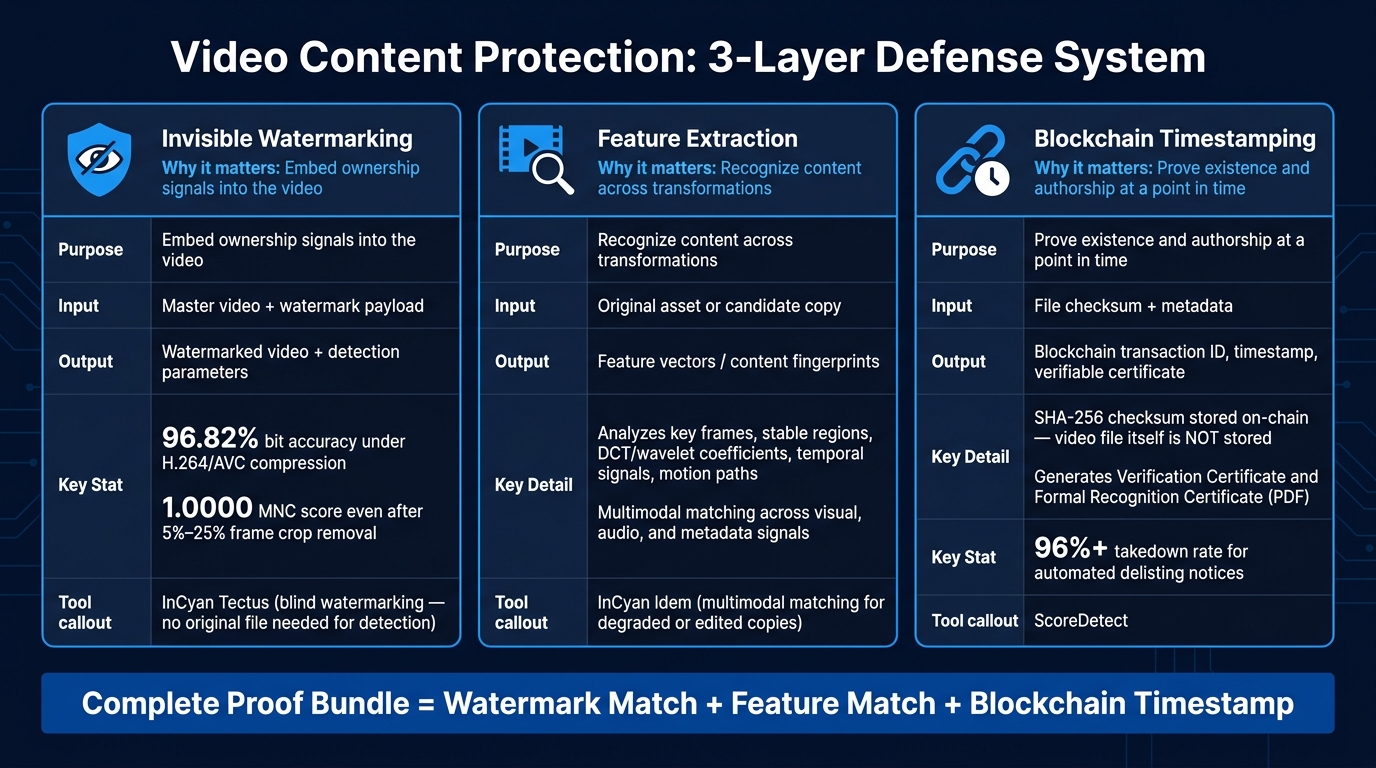
Video Content Protection: 3-Layer Defense System Explained
Once extraction flags a suspect copy, two records matter right away: the content match and the ownership timestamp. Those two pieces then move the case into discovery and takedown.
ScoreDetect records a SHA-256 checksum and timestamp for the master file without storing the video itself.
The table below shows what each layer does, and why one can’t stand in for another:
| Layer | Purpose | Input | Output |
|---|---|---|---|
| Invisible watermarking | Embed ownership signals into the video | Master video + watermark payload | Watermarked video + detection parameters |
| Feature extraction | Recognize content across transformations | Original asset or candidate copy | Feature vectors / content fingerprints |
| Blockchain timestamping | Prove existence and authorship at a point in time | File checksum + metadata | Blockchain transaction ID, timestamp, verifiable certificate |
How ScoreDetect strengthens ownership proof

For enforcement, the blockchain record backs up the watermark and fingerprint match. When a business registers a video through ScoreDetect, the platform generates a Verification Certificate with the SHA-256 hash, a public blockchain URL, a registration date, and the copyright owner’s name. A Formal Recognition Certificate adds an official letter that explains the blockchain mechanism and states ownership. Both documents can be downloaded as PDFs and used as part of an evidentiary bundle.
If a dispute comes up, the rights holder can recreate the hash from the original master and show that it matches the on-chain record. Paired with a watermark extraction report and feature-based matching results, this creates a chronological anchor. The blockchain shows prior ownership, while the watermark and fingerprint evidence ties the disputed copy back to the registered master.
How discovery and takedown move from detection to action
Once ownership is anchored, the system can search, verify, and remove copies. ScoreDetect discovery surfaces candidate infringing URLs through targeted web scraping. For video, InCyan’s Idem adds multimodal matching for edited or partial copies.
Then each candidate match gets checked against a few plain questions:
- Does the detected watermark payload match an authorized distribution channel?
- Does the usage fit the licensed territory and time period?
The system produces structured reports with match confidence scores, the percentage of original content detected, frame-level evidence, and source URLs. That gives enforcement teams and platforms hard proof they can review.
For search engine de-indexing, InCyan’s Indago submits removal requests at high velocity, cutting off search traffic to infringing copies at the source. ScoreDetect’s automated delisting notices consistently achieve a 96%+ takedown rate, and high-confidence matches can trigger auto-submission, while cases above a review threshold are sent to a human team.
Conclusion: the practical model for protecting business video
Video piracy makes a layered defense hard to ignore. The U.S. loses billions of dollars each year, and piracy traffic is still massive.
The model in this article works because each layer solves a different part of the problem. Invisible watermarking – such as InCyan’s Tectus-based blind watermarking – adds a hidden, persistent identifier that can survive transcoding, cropping, and reposting without hurting viewing quality. Feature extraction helps keep detection steady after those edits by tying the search to stable structural signals like key frames, motion patterns, and object boundaries.
Once the watermark survives the edit, the next step is proof. That proof has to be recorded and ready to stand up under scrutiny. ScoreDetect turns detection into time-stamped proof: it records a checksum of the registered master on blockchain without storing the video itself, giving teams time-stamped proof of ownership that the watermark alone cannot provide. When you pair that with watermark extraction and feature-matching results, legal and compliance teams get a combined evidence record they can actually use.
After ownership is anchored, the workflow moves from verification to removal. Discovery, match analysis, and takedown tools then turn that evidence into action at scale.
The practical model is simple: watermark on export, register on publish, monitor continuously, and enforce automatically.