An AI content fingerprinting platform in 2026 is a system that registers original image, video, audio, and text files, then finds edited or partial copies by using perceptual matching, text matching, timestamps, and watermark checks.
If I had to sum up the article in plain English, it comes down to four steps: register, find, review, act. The main point is simple: a normal file hash only catches an exact copy, while modern fingerprinting can still spot a file after cropping, trimming, compression, translation, or paraphrasing.
A few numbers make the case clear. The article notes that nearly one-third of Americans consumed pirated content online in 2023, and basic hash checks can miss common edits at high rates, including 52% false negatives after 20% image removal, 47% after color overlays, 44% after mirroring, 35% for audio time-stretching, and 41% for small pitch shifts. That is why byte-for-byte matching is not enough.
Here’s the short version of what matters:
- Registration links each asset to an ownership record, timestamp, and file checksum.
- Fingerprinting checks visual, audio, and text patterns instead of exact file bytes.
- Watermarking adds another proof layer when distributed copies need source tracing.
- Match evidence should show where the reuse happened, how much matched, and what changed.
- Human review still decides whether a match is an AI copyright infringement issue, a licensed use, a fair use case, or something else.
- Enforcement works better when evidence, review rules, and case records are in one workflow.
What I like about the article is that it does not treat detection as the finish line. It frames fingerprinting as part of a larger proof and enforcement process, which is the part most teams care about once money, licensing, or brand misuse is on the line.
The rest of the article walks through how that process works across each media type and how to test a platform before rollout.
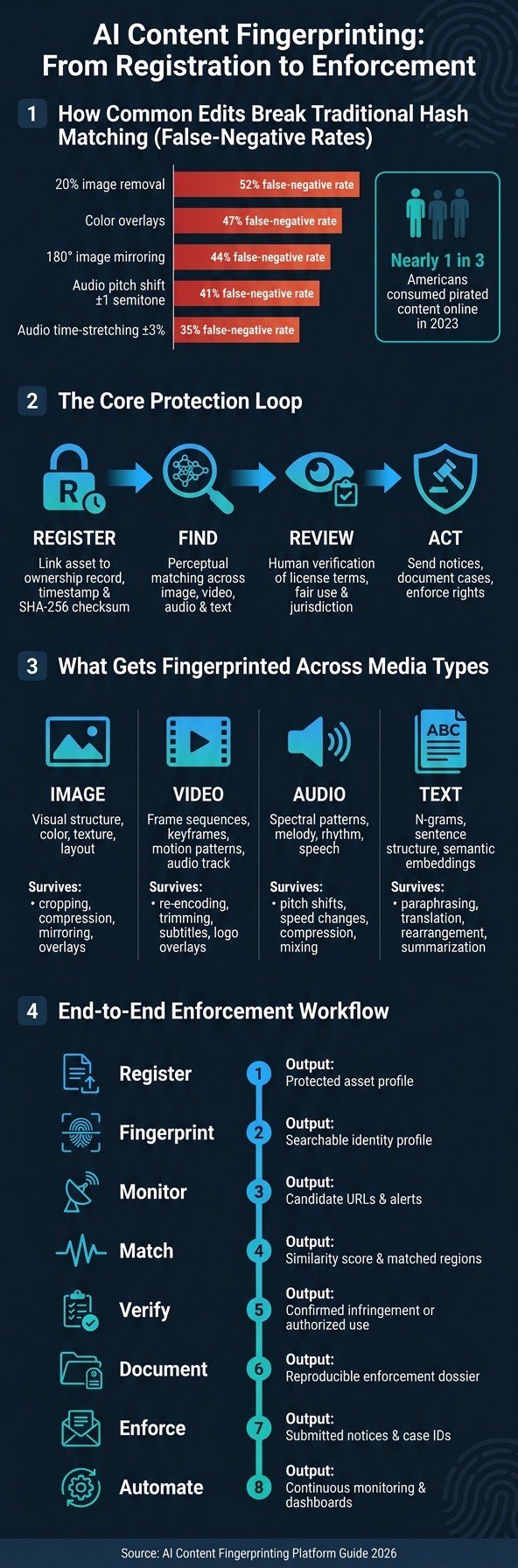
AI Content Fingerprinting: From Registration to Enforcement (2026)
SynthID: A tool for watermarking and identifying AI-generated content
sbb-itb-738ac1e
Core capabilities across images, video, audio, and text
Single-modality platforms miss too much. An image may be licensed, then cropped and reposted somewhere else. An ad video may get clipped, dubbed, and uploaded again. A podcast episode can show up inside a compilation. An article can be paraphrased and republished.
Strong protection connects every content type to one asset record: the original file, the owner, revision history, license terms, and discovered uses. That record becomes the reference point for ownership proof and watermark checks.
How fingerprinting works for each asset type
Each asset type needs its own matching approach because each one changes in different ways. A visual fingerprint looks at shapes, colors, textures, and spatial layout. An audio fingerprint looks at spectrogram patterns, rhythm, melody, and speech. A text fingerprint compares passages, lexical overlap, sentence structure, and language-aware embeddings.
One method can’t handle everything.
| Asset type | What is fingerprinted | Transformations to test | Match evidence | Common use case |
|---|---|---|---|---|
| Image | Visual structure, color, texture, layout, local regions, optional embedded watermark | Resizing, compression, cropping, mirroring, color changes, overlays, screenshots, added text | Similarity score, matched regions, crop boundaries, detected edits, source identifier, preview comparison | Product photos, artwork, advertising creative, thumbnails |
| Video | Frame sequences, keyframes, scene order, motion patterns, audio track, optional watermark | Re-encoding, resizing, trimming, mirroring, subtitles, logos, overlays, frame-rate changes, audio replacement | Matched time ranges, matching keyframes, total matched duration, transformations detected, source URL or platform location | Stolen ads, films, training videos, livestream clips, social reposts |
| Audio | Spectral patterns, melody, rhythm, speech characteristics, distinctive time segments | Compression, noise, equalization, pitch shifts, speed changes, clipping, mixing, partial use | Matched waveform intervals, matched duration, audio confidence, transformation indicators, source record | Podcasts, music, audiobooks, voice-overs, recorded events |
| Text | Exact passages, n-grams, sentence structure, semantic embeddings, language-aware embeddings | Copying, paraphrasing, rearrangement, summarization, translation, formatting changes, inserted text | Matching passages, overlap percentage, semantic similarity, language pair, altered wording, source identifier | Article scraping, unauthorized syndication, rewritten marketing copy, AI-assisted reuse |
| Mixed-media | Relationships among visual, audio, textual, and timing components | Re-editing, replacing one modality, removing captions, dubbing, cropping, combining sources | Modality-by-modality matches, synchronized timestamps, matched regions or passages, consolidated asset relationship | Social posts, advertisements, presentations, product pages, repackaged campaigns |
A unified asset record pulls all of this into one place. Say a product campaign includes a product photo, a 30-second ad, its voice-over, the campaign article, and a set of social cutdowns. All of those can sit under one ownership record.
That matters because a discovered use can then be checked against the right license and derivative history, instead of being treated like some random file with no context.
The next problem is harder: finding copies after the usual edits.
How altered and partial copies are still matched
Detection starts with durable fingerprints, not exact-file hashes. Each modality needs its own search unit to catch cropped, trimmed, paraphrased, or recombined copies.
Research on social-media content shows how fast hash-based detection breaks down under routine edits. Removing just 20% of an image pushed the false-negative rate to 52%. Color overlays pushed it to 47%, and 180-degree mirroring pushed it to 44%. For audio, time-stretching by ±3% produced a 35% false-negative rate, while pitch shifts of ±1 semitone produced a 41% false-negative rate.[2] These are not rare edge cases. They’re everyday changes that happen when content gets reposted across platforms.
The fix is to break each asset into searchable units:
- image regions
- video frames and scenes
- audio time windows
- text passages
The system first pulls candidate matches with compact fingerprints. Then it expands nearby hits into larger regions or time intervals. For text, passage-level fingerprinting finds candidate reuse pairs first, then measures detailed similarity across matching chunks before merging adjacent results into likely reuse passages.[1]
That’s how a clipped ad, a trimmed podcast excerpt, or a reordered article can still be matched.
What match evidence should include
A raw score doesn’t tell you much. The evidence needs to show where the match happened, what changed, and how much was reused.
| Field | What it should show |
|---|---|
| Original asset identifier | Stable ID linked to the registered source and ownership record |
| Suspected copy URL or platform location | Exact page, post, account, channel, marketplace listing, or file location |
| Modality | Image, video, audio, text, or mixed-media match |
| Matched percentage or duration | Matched visual area, text proportion, or audio/video time range |
| Matching segments or regions | Coordinates, timestamps, frames, scenes, waveform intervals, or text passages |
| Transformations detected | Crop, compression, trim, subtitle, pitch shift, paraphrase, translation, or other changes |
| Confidence score | Model’s estimated match strength and the threshold used |
| Timestamp | When the content was found, captured, and reviewed |
| Evidence status | New, pending review, confirmed, authorized, disputed, escalated, removed, or closed |
You should also store the original file, the suspected copy, and the extraction settings for later review. A 42% match by itself is vague. A result showing 42% of an image’s visual area, 13 of 30 video seconds, or four matching passages totaling 38% of an article is much more useful.
Specific evidence is what makes a match actionable.
Fingerprint matches get stronger when they’re tied to ownership records and invisible watermarking.
Ownership proof, watermarking, and the ScoreDetect workflow
Fingerprinting finds copies. Timestamping shows that a file existed at a given moment. Watermarking links a copy back to a source. Each one does a different job, and together they create the proof layer that makes discovery and enforcement usable in practice. That’s why registration sits at the base of any later claim.
How to register assets and create verifiable ownership records
ScoreDetect registers a file by storing its SHA-256 checksum on-chain, not the file itself. Your content stays private, while the record makes the file’s existence at that point in time tamper-evident.
A full record should include the original file, creator, owner, format, title, UTC timestamp, version, revision history, license terms, and internal asset ID. For a campaign, the master video and its related files – social edits, subtitles, thumbnail, audio stem, and creator agreement – should sit under one record instead of being handled as separate files. That evidence trail shows what was held, who held it, and how each version connects back to the original.
ScoreDetect provides a Verification Certificate and a Formal Recognition Certificate. Each one includes a public validation path and official signature. For example, a campaign master and its derivatives should be linked under one record so any discovered use can be checked against the right license and derivative history. Download and keep every certificate, transaction identifier, and validation URL in an internal evidence repository. That chain of custody is often the difference between a supported claim and one that falls apart when a dispute shows up months or years later.
Registration proves the file existed. Watermarking helps point to the exact copy that was sent out.
When invisible watermarking adds stronger verification
A blockchain timestamp proves a file existed. When content is licensed and distributed, watermarking can help trace leaked copies back to the original release path. InCyan’s Tectus provides invisible watermarking for images, video, and audio. NIST guidance says watermarks should survive common edits like compression, cropping, and format conversion, but no watermark survives every attack.[3][4]
The day-to-day workflow is simple: register the master in ScoreDetect before distribution, apply an invisible watermark through InCyan’s protection suite before the file leaves your control, and log the watermark settings and recipient. If that file later shows up somewhere it shouldn’t, the watermark result – paired with the timestamp, fingerprint match, and license records – gives you a much stronger evidence package than any one method on its own.
Used together, these methods make the evidence stack stronger, but they still need human review.
Limits that legal and compliance teams need to know
A checksum is exact by design. Even small changes – recompression, metadata edits, or cropping – produce a different hash. Fingerprinting is for finding copies. The checksum is for verifying the registered file. They do not do the same thing.
Watermarks can weaken too. Heavy compression, editing, noise, cropping, re-recording, or deliberate removal can make a watermark impossible to detect. If the watermark signal is missing, that does not prove the content is unrelated. It only means that this layer of evidence is gone, so the case has to lean on the timestamp, fingerprint match, and licensing records.
These signals only become useful when they are read together. A timestamp shows possession at a recorded time. It is not a government copyright registration, and it does not prove authorship in a legal sense. A fingerprint match shows similarity, not unauthorized use. Human review still has to check license terms, publication timing, jurisdiction, fair use, public-domain status, and any contract-based permissions before a match turns into enforcement. In the United States, the Copyright Office notes that unauthorized uploading or downloading may implicate exclusive reproduction or distribution rights, but the legal outcome depends on the facts of the particular use.[5] Technical evidence helps legal review; it does not replace it.
Once ownership is recorded and a watermark is embedded, monitoring can start across channels and platforms.
Discovery, verification, and enforcement at scale
Detection without a clear path to action is just noise. The payoff starts when a match turns into a documented enforcement case.
Once assets are registered and fingerprinted, monitoring can move a team from detection to action.
The step-by-step sequence from registration to enforcement
This workflow has eight stages, and each stage supports the next. Skip one, and enforcement gets weaker.
| Workflow Stage | Required Platform Capability | Output | Responsible Team |
|---|---|---|---|
| Register | Asset intake, ownership, and license records | Protected asset profile and approved master reference | Asset management, rights management, marketing |
| Fingerprint | Multimodal perceptual fingerprints, text fingerprints, optional watermarking | Searchable identity profile for image, video, audio, or text | Security, asset management, engineering |
| Monitor | Web, platform, search, social, file-sharing, and torrent monitoring | Candidate URLs, captured source URLs, alerts, and discovery timestamps | Copyright operations, security, brand protection |
| Match | Exact, transformed, partial, cropped, re-encoded, translated, and text-reuse matching | Similarity score, matched regions or passages, and match classification | Copyright operations, content teams |
| Verify | Rights checks, watermark validation, license comparison, and human review | Confirmed infringement, authorized use, or unresolved case | Legal, licensing, copyright operations |
| Document | Evidence capture, chain of custody, screenshots, hashes, timestamps, and case notes | Reproducible enforcement dossier | Legal, compliance, copyright operations |
| Enforce | Notice generation, host and platform submission, search de-indexing, and escalation | Submitted notices, case IDs, deadlines, and response status | Legal, copyright operations |
| Automate | APIs, queues, rules, integrations, and reporting dashboards | Continuous monitoring, routing, reminders, and performance metrics | Security operations, IT, legal operations |
Automation should grow only after policies are clearly defined and accuracy has been checked. Legal or rights teams should set escalation rules, approve thresholds, and review any disputed or low-confidence match before a notice is sent. Notice quality matters. A large pile of matches doesn’t automatically lead to a large pile of removals.
Prioritization matters as much as coverage. A high-confidence, full-length match of an unreleased film should go straight into an immediate enforcement queue. A low-confidence text overlap on a small personal blog can wait for a scheduled review.
Useful signals for ranking alerts include:
- Confidence score
- Percentage or duration matched
- Audience reach
- Monetization indicators
- Repeat-offender history
- Proximity to a release window
How ScoreDetect and InCyan fit into enterprise protection
ScoreDetect structures its enterprise workflow around four stages: Prevent, Discover, Analyse, and Take Down. Those four stages line up with the eight steps above. Prevent and fingerprint happen before distribution. Discover and match run continuously. Analyse covers verification and documentation. Take Down handles enforcement and follow-up.
InCyan’s product suite supports specific workflow stages across the same register → monitor → verify → enforce path. Idem handles multimodal matching across images, video, and audio, and it can still detect content after mobile edits, memes, cropping, and compression. Idem Text focuses on text reuse detection. Tectus adds invisible watermarking for provenance and post-distribution verification. Indago supports search discovery and reporting to surface unauthorized pages for documentation and de-indexing. TorrentWatch monitors the BitTorrent ecosystem and captures info hashes, tracker references, and seed or peer data as evidence. Blueprint handles rights and permissions management for license checks. BlockWatch monitors blocked or inaccessible sites to spot enforcement gaps.
Specific capabilities, integrations, retention periods, geographic coverage, and service-level commitments should be confirmed directly with InCyan before deployment. Use these criteria to choose the right deployment mix in the next section.
How to evaluate and deploy a platform in 2026
Evaluation criteria you can actually verify
A checklist by itself won’t tell you much. You need to test the platform with your own assets and with confirmed unauthorized copies. That includes authorized lookalikes and legitimate transformations too. The point is simple: the platform should tell the difference between an exact duplicate and a partial or transformed match. And it should show why it returned that result, not just hand you a confidence score.
Use these checks to confirm the platform can protect the same asset record across discovery, review, and enforcement.
| Capability | Validation Question |
|---|---|
| Multimodal fingerprinting | Can the platform match your image, video, audio, and text samples reliably across one workflow? |
| Altered-copy matching | Which transformations are supported, and what are precision and recall for each? |
| Excerpt matching | What is the minimum detectable duration, area, token count, or signal length? |
| Invisible watermark tracing | Adds a trace signal for specific distribution paths. What attacks and transformations has the watermark survived, and how is it linked to an authoritative record? |
| Reproducible evidence | Does each case show matched regions or time ranges, threshold settings, model version, and comparison assets? A score is only a screening signal. |
| Source monitoring | Which sources, platforms, and access-restricted areas are actually monitored? |
| Record controls | Can registrations be versioned, access-controlled, and tied to license records? |
| Enforcement workflow | Can the system route cases for human approval before a notice is sent? |
| Security controls | Are encryption, retention, separate customer environments, audit logs, and deletion controls documented? |
| Exports and APIs | Can you export raw evidence, case history, decisions, and metrics through documented APIs? |
Ask for per-modality reporting: false-positive rate, false-negative rate, precision, recall, latency, and reviewer override rate. One blended accuracy number can look fine on paper while hiding weak results on short clips, partial text reuse, or heavily transformed media.
Deployment steps for protecting high-value assets
After validation, start with your highest-value assets and top-priority channels. Register originals, including derivatives and licensed variants, before distribution. Not after. Keep the file, hash, fingerprint, ownership documents, timestamp, territories, and permitted uses in a single record.
Set thresholds by modality. A low-confidence discovery might create an analyst task. A high-confidence match backed by strong ownership evidence might qualify for automated notice drafting. Those thresholds should not be the same for a cropped image, a short audio excerpt, a text quotation, and a full video copy.
Before launch, build a known-transformation test set. Include resized images, screenshots, recompressed video, short clips, audio pitch changes, paraphrased passages, and translated text. Add negative examples too, such as licensed partner uses, public-domain material, and authorized excerpts. Then measure two operating intervals:
- Discovery to verification
- Verification to notice
Track both during the pilot and review them monthly.
Conclusion: what creates real protection value
Once the pilot shows strong match quality and review speed, extend the same controls across the catalog. Real protection comes from tested matching, verified ownership, continuous monitoring, and gated enforcement, applied the same way to every original, derivative, and licensed variant a business owns. The platform has to prove it can find altered copies, preserve ownership evidence, and speed up documented action.
FAQs
How is fingerprinting different from a file hash?
A file hash, like a SHA-256 checksum, creates a one-of-a-kind ID from a file’s exact bit-level structure. Change even a single bit, and the hash changes too. So a hash can only confirm that you have the exact same file, untouched and unmodified.
Fingerprinting works differently. Instead of matching the file bit for bit, it builds a signature from the content’s features, like visual layout, audio patterns, or text meaning. That means it can spot the same asset even after cropping, compression, re-encoding, or partial reuse.
What proof do I need before sending a takedown?
Before sending a takedown, turn raw detection signals into a defensible evidence package. A similarity match alone isn’t enough. You need a clear chain of custody that proves ownership and backs up the infringement claim.
Include ownership proof with a blockchain-based timestamp certificate from ScoreDetect and a SHA-256 hash. Add in-file signals like invisible watermarks from Tectus, along with match records and an audit trail.
That audit trail should include:
- similarity scores
- versioned results
- protocol logs
Put simply, you’re not just showing that two files look alike. You’re showing who owned the work, what was found, when it was found, and how the record was preserved.
How should I test a platform before rollout?
Run the full workflow against the kinds of edits you actually see in production: cropping, re-encoding, filters, compression, and added noise. The goal is simple: make sure the system still finds matches after those changes, keeps recall high, and stays within an acceptable false-positive rate.
You should also test how the system handles partial matches, including low-match cases like ~10%. That matters because many flagged assets won’t be perfect copies. Some will be clipped, altered, or reused in small fragments.
It’s also worth pressure-testing the system under load. If performance drops when volume spikes, good detection on paper won’t mean much in practice. At the same time, verify your tiered decision logic – which cases trigger auto-block and which ones go to human review.
And don’t stop at detection alone. Check whether the evidence package still stands up after modifications. If an asset has been edited, compressed, or partially reused, the review trail still needs to be clear enough for investigators, moderators, or legal teams to act on.