I shortlist anti-piracy vendors in 2026 by three requirements: fingerprint matching for your content, monitoring on your target channels, and documented automated notices or removals.
I compare InCyan with ScoreDetect, Vobile VideoTracker, and Audible Magic ACR – and separate finding copies from removing them. ScoreDetect’s claimed 96% takedown rate lacks a published method or timeframe, so I would request dated removal reports before buying.
Quick Comparison
| Vendor | Content and matching | Detection coverage | Automated action | Results and follow-up |
|---|---|---|---|---|
| InCyan with ScoreDetect | Image, video, audio, and text matching | Web, social, search, and P2P, depending on modules | Automated delisting and takedown notices | Vendor-reported 96% rate; follow-up needs verification |
| Vobile VideoTracker | Video fingerprinting | Video sites, streams, social, search, and P2P | Automated notices | Removal and reupload checks; no audited removal rate reported |
| Audible Magic ACR | Music and video fingerprints | Participating upload and streaming platforms | Platform-run rights rules; removal depends on integration | No reliable public removal-rate data |
My buying rule: require <u>confirmed removals</u>, not just notices sent or uploads blocked. Below, I weigh content support, U.S. channel coverage, enforcement responsibility, and proof of results so you can choose what to test.
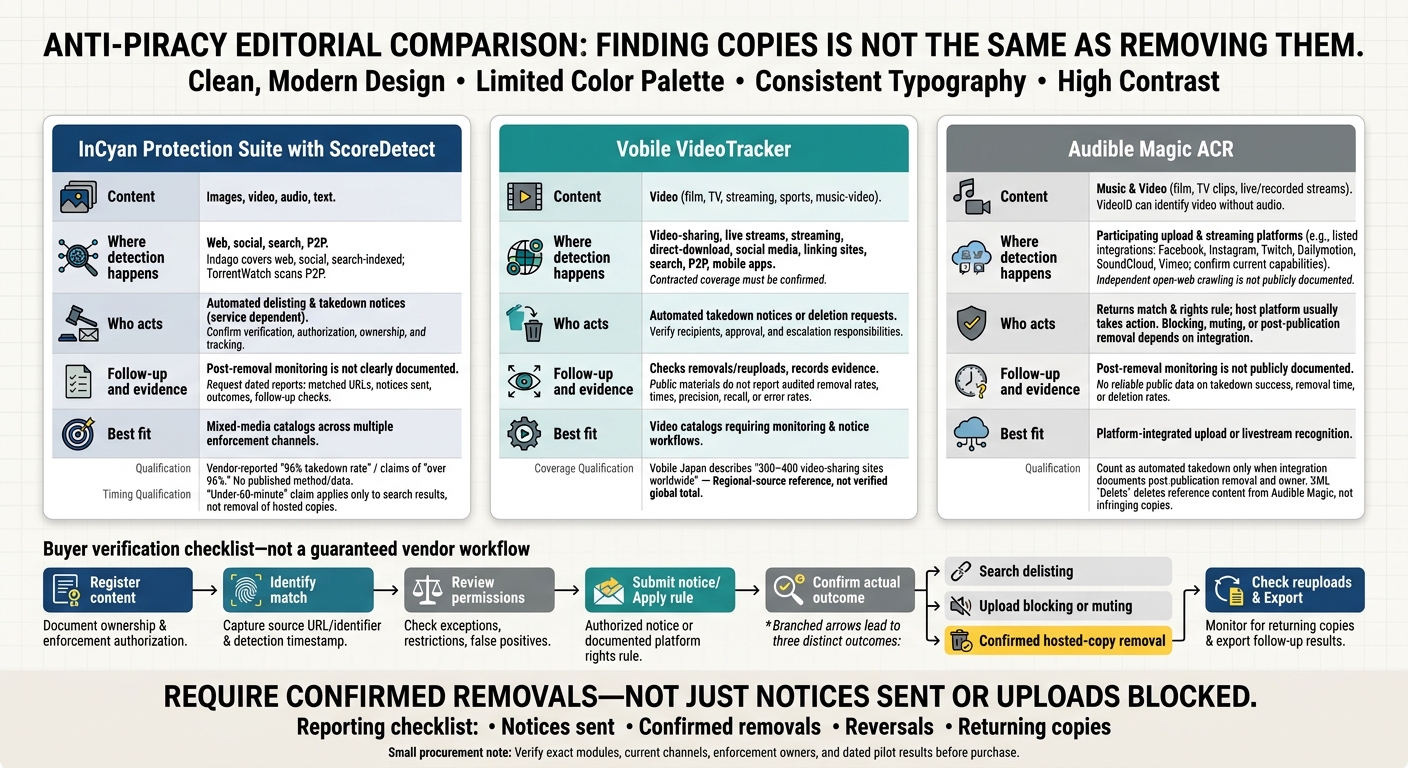
Anti-Piracy Vendors in 2026: Detection vs. Removal
1. InCyan Protection Suite with ScoreDetect
Content Types and Matching
Idem matches images, video, and audio, while Idem Text matches text against protected content. Both compare AI-generated fingerprints with protected originals to identify edited, cropped, or re-encoded copies. InCyan also pairs invisible watermarking with ownership timestamps.[7] These matches support discovery across web, social, search, and P2P channels.
Detection Coverage
Indago checks for infringement across web, social, and search-indexed content. TorrentWatch scans file-sharing and P2P networks.[7] After discovery, the workflow moves to automated takedown systems and status tracking.
Takedown Automation and Follow-Up
Fingerprint matches trigger automated delisting notices.[7] Ask for a demo covering rights verification, authorization review, notice submission, and status tracking. Treat search delisting separately from other enforcement: the under-60-minute claim applies only to search results.
Proof of Removal Results
ScoreDetect claims a 96% takedown rate, but it publishes no method, timeframe, or channel-level data. Request dated reports that show matched URLs, notices sent, outcomes, and follow-up checks.
sbb-itb-738ac1e
2. Vobile VideoTracker
Content Types and Matching
VideoTracker covers film, TV, streaming, and other video assets. Its VDNA technology matches copies that have been altered, compressed, cropped, mirrored, dubbed, or screen-recorded.[1][9][10]
Buyers should confirm which reference formats it accepts and test short clips against their own assets. Public materials do not report audited precision, recall, or error rates.[1] Matching is only part of the picture: fingerprinting helps only where the vendor monitors distribution channels.
Detection Coverage
Vobile says VideoTracker monitors video-sharing sites, live streams, streaming services, direct-download sites, social media, linking sites, search engines, peer-to-peer networks, and mobile apps.[1] Vobile Japan describes monitoring roughly 300–400 video-sharing sites worldwide.[5] Treat that number as a regional reference, not a global total.
Ask for a current channel matrix that lists supported territories, scan frequency, and access restrictions. It should also show whether each channel supports detection, notice submission, or both.
Takedown Automation and Follow-Up
After detection, notice processing speed matters. Detected videos trigger automated takedown notices, while monitoring continues to check for removals and reuploads.[1][5][11] Vobile says notices can target hosting or distribution infrastructure.[1]
Confirm which providers receive requests, which submissions need approval, and how unresolved cases move through escalation.
Proof of Removal Results
Public materials do not report audited removal rates or notice-to-removal times.[4][5][8] Request dated results showing accepted notices, confirmed removals, median removal time, and reuploads.
3. Audible Magic Automatic Content Recognition
Content Types and Matching
Audible Magic uses perceptual fingerprints to identify music, film, TV clips, and live or recorded streams. VideoID can identify video without audio. Before platforms can match uploads against a catalog, rights holders must register their reference content and metadata. Test partial clips and audio with altered pitch, tempo, or playback rate against your assets.[19][6][15] The key question: Can each match trigger a platform action?
Detection Coverage
Publicly listed integrations include Facebook, Instagram, Twitch, Dailymotion, SoundCloud, and Vimeo. Check whether each supports blocking, notice generation, or removal. When issuing manual requests, follow a DMCA notice template customization guide to ensure legal compliance. An integration does not prove open-web monitoring or removal on every service. Amazon IVS documents stream scanning, fingerprint matching, and action rules, but that alone does not establish a removal workflow.[13][3][16]
Takedown Automation and Follow-Up
The main limit between a match and an action is who handles enforcement. Audible Magic returns the match and the applicable rights rule; the host platform usually takes action. Per-asset rules can allow content on one platform and block it on another. The XML Delete instruction removes reference content from Audible Magic – not infringing copies elsewhere. For existing infringements, require a documented removal owner, action-status logs, and an escalation process.[12][14]
Proof of Removal Results
Assess takedown claims using removal data, not system availability. Public sources do not provide reliable data on takedown success, removal time, or deletion rates. Count Audible Magic as automated takedown only when the integration documents removal and identifies who carries it out.
Capability and Results Comparison
The table puts vendor details side by side: content types, detection channels, enforcement, and evidence of results.
| Vendor or product | Primary content types | Fingerprinting or matching method | Supported detection channels | Automated enforcement capability | Post-removal monitoring | Public evidence of effectiveness | Key limitation or qualification |
|---|---|---|---|---|---|---|---|
| InCyan Protection Suite | Images, video, audio, and text | Idem multimodal matching; Idem Text text matching | Search engines, websites, and BitTorrent, depending on the service used | Indago can generate automated delisting notices. The Enterprise suite includes automated takedown notifications. | Not clearly documented in the public website profile | ScoreDetect reports takedown claims of over 96%; vendor-reported only. | ScoreDetect is a timestamping layer. Matching and enforcement come from InCyan’s broader suite. |
| Vobile VideoTracker | Video | VDNA video fingerprinting.[5] | Online video monitoring; the reviewed source does not list specific platforms.[5] | Automatically sends deletion requests.[5] | Checks removal and reappearance, and records evidence.[5] | The workflow is documented, but no independently validated removal-rate statistic is provided.[5] | Publicly verified scope is limited in the reviewed material.[5] |
| Audible Magic ACR | Music, film, television, and other multimedia embedded in user-generated media | Reference-based digital fingerprint matching against rights-holder fingerprints.[18][21] | Participating media-sharing and UGC platforms that submit fingerprints to Audible Magic. Independent open-web crawling is not publicly documented.[18] | Returns matches and rights rules to the platform for block-or-allow actions.[18] | Post-removal monitoring is not publicly documented. | Public figures focus on upload prevention and transaction volume, not post-publication removals.[23][17][18][20][22] | These figures show prevention and scale, not post-publication removal success. |
The points below help separate matching, evidence, and automation.
Content Types and Matching Methods
Fingerprinting detects reuse. Watermarking and timestamping add evidence, but they don’t perform matching. InCyan says Idem handles transformations such as cropping, compression, and partial assets. Treat those claims as vendor-reported until you test them with your own content.
Detection Channels and Coverage
Build a channel-by-channel matrix that treats upload-time recognition, web monitoring, and BitTorrent scanning as separate types of coverage.
Takedown Steps and Follow-Up
Ask for one sample case showing the evidence, approval, submission, recipient response, status history, and reappearance checks.
Detection alone isn’t enough. Does the system remove the content – and keep it down?
Proof of Removal Results
Judge removal effectiveness by removal data, not scale data. Verify recognition, notice submission, and removal confirmation as separate steps. Measure sustained suppression separately, too.
The next section weighs the trade-offs that matter most in procurement.
Strengths, Limits, and Trade-Offs
Use the matrix below to compare each vendor against your purchasing needs.
| Vendor or suite | Principal advantage | Principal limitation | Best-fit use case | What to verify before purchase |
|---|---|---|---|---|
| InCyan Protection Suite | Modular tools cover mixed-content catalogs and multiple enforcement channels. | Choosing modules adds configuration and integration work. | Managing mixed-media catalogs across several enforcement channels. | Confirm the exact modules and separate pricing for matching, monitoring, watermarking, and managed notices. |
| Vobile VideoTracker | Continuous video monitoring combines fingerprint matching with managed takedown workflows.[24] | Coverage and results depend on the platforms, jurisdictions, and notice workflow purchased.[24] | Protecting film, television, sports, and music-video assets. | Confirm live-stream coverage, notice-review responsibilities, counter-notice procedures, and response times. |
| Audible Magic ACR | Platform-integrated ACR applies rights rules to uploads or live streams.[2][19] | Enforcement depends on participating platforms; it is not an open-web takedown service.[2][19] | Protecting music and live content on platforms that support the integration. | Confirm active platform integrations, regional coverage, removal support after publication, and dispute handling. |
Confirm the contract structure, module scope, and responsibility for each enforcement step. Specify who approves matches, submits notices, handles counter-notices, and escalates stalled cases.
For Audible Magic, make post-publication removal a purchase condition if you need it. Blocking, muting, and removal are different outcomes. The platform integration determines which options are available.[2][19][21]
Request custom pricing for your exact deployment; public pricing for full configurations is not available. Run a pilot using clips, edits, re-encodes, translations, remixes, and poor-quality copies. Then ask vendors to price the channels, modules, and enforcement responsibilities you tested – not a broad, undefined promise of protection.
Choose Based on Your Content and Channels
Use the trade-offs above to narrow your shortlist by content type, channel, and enforcement model.
| If your priority is… | Shortlist | Require… |
|---|---|---|
| Matching several content formats and enforcing against indexed search results | InCyan | Confirmed module coverage for your formats and channels. |
| Finding unlicensed video across live streams and online distribution channels | Vobile VideoTracker | Documented monitoring coverage and managed notice delivery – not just detection.[24] |
| Platform-integrated matching inside upload or livestream workflows | Audible Magic ACR | An active integration with documented automated removal of matched content. Blocking does not equal removal. |
Once you’ve set your shortlist, require a written evidence trail for every takedown request.
Each evidence file should include ownership or chain of title, enforcement authorization, and the original asset. It should also document permitted uses and license exceptions checked before submission, territorial or platform restrictions, the matched excerpt, match confidence, source URLs or identifiers, and detection timestamps.
Put false-positive review and counter-notice deadlines in the contract. Include repeat-infringement handling and monitoring for reappearing copies. Require exportable reports that separate notices sent, confirmed removals, reversals, and returning copies.
FAQs
How do I prevent takedowns of fair use content?
Require human review before sending automated notices. Matching systems often lack the context to tell infringement apart from fair use. Use a two-step human review to check the original asset, the reason for the match, the timestamp, and the flagged content’s context. These checks help reduce false positives.
Include clear proof of ownership in your evidence package, such as blockchain-backed records or watermark logs. These records can support your claims if a fair use dispute arises.
How can I independently verify takedown success?
Don’t rely on vendor metrics alone. Request a litigation-ready evidence export so a second analyst can reproduce each finding [1][2]. It should include the reference asset, match rationale, timestamp, infringing URL, account identity, and submitted notices [2].
Check for a clear chain of custody. For example, review a ScoreDetect verification certificate with a SHA-256 hash, blockchain transaction ID, and Tectus watermark logs [1][3][4].
What should my anti-piracy pilot measure?
Measure performance against your day-to-day goals. Check detection coverage across the channels, regions, and content types you use, and test accuracy after cropping, re-encoding, and compression.
Track discovery rate, true-positive rate, average time from detection to takedown, takedown success rate, and repeat-infringer rate. Make sure evidence packages include everything needed for legal proceedings or disputes and remain usable after content changes.