Use C2PA when you need recipient-visible origin records, use invisible watermarking when you need copy tracing after reposting, and use both when you need public proof plus detection after files are changed or stripped.
I’d sum it up this way: C2PA proves declared origin and edit history, while invisible watermarking helps me trace copies after distribution. One is for showing provenance; the other is for finding copies when metadata is gone.
If I were choosing fast, I’d look at these points first:
- C2PA answers: who made it, when it was exported, what edits were declared, and whether AI use was disclosed
- Invisible watermarking answers: where the file spread, whether a reposted version still matches the source, and in some cases which leak source released it
- C2PA often fails after upload: many platforms strip metadata during recompression or re-encoding
- Watermarking is built for file changes: compression, resizing, cropping, screenshots, and screen recordings are the main test cases
- Best fit by use case:
- Newsrooms, compliance, AI disclosure: C2PA
- Piracy tracking, leak tracing, repost monitoring: invisible watermarking
- Publishers and media teams that need both proof and tracking: C2PA + watermarking
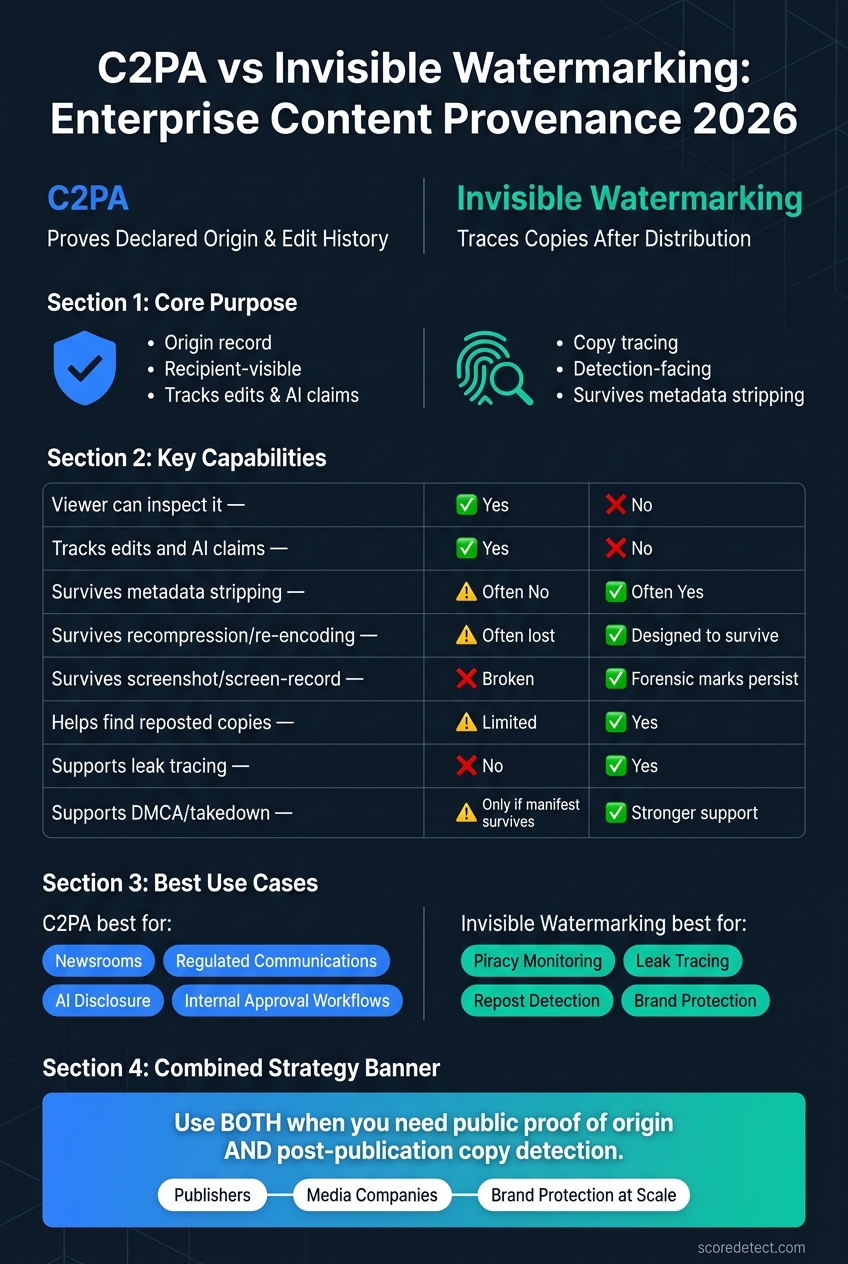
C2PA vs Invisible Watermarking: Enterprise Content Provenance Comparison 2026
Claude AI Watermarks Explained: Will Your Writing Be Flagged?
sbb-itb-738ac1e
Quick Comparison
| Criteria | C2PA | Invisible Watermarking |
|---|---|---|
| Main job | Origin record | Copy tracing |
| Viewer can inspect it | Yes | No |
| Tracks edits and AI claims | Yes | No |
| Survives metadata stripping | Often no | Often yes |
| Helps find reposted copies | Limited | Yes |
| Helps with leak tracing | No | Yes |
| Best for | Transparency and audit trail | Monitoring and enforcement |
The rest of the article turns that simple split into a clear setup choice for images, video, audio, documents, and text.
C2PA and invisible watermarking: what each method actually does
At the implementation level, the difference is pretty simple: C2PA records origin, while invisible watermarking helps keep content traceable after it spreads online.
C2PA Content Credentials: signed provenance, declared edits, and AI assertions
C2PA adds a signed manifest when content is created or exported. That manifest can record the creator, timestamp, tools used, edits, and any AI involvement. In a viewer that supports C2PA, recipients can check that chain of custody.
That said, C2PA has limits. It doesn’t verify whether something is true. It doesn’t prove ownership. And it won’t survive every platform change or file transformation.
Put another way: C2PA is recipient-facing, while watermarking is detection-facing.
Invisible watermarking: persistent identification after reposting, compression, or metadata loss
Invisible watermarking places an imperceptible signal inside the content itself. Because the signal lives in the asset, identification can still work after compression, re-encoding, cropping, or metadata stripping.
This makes it a backend detection tool. Viewers don’t see provenance information from it, but teams can use it to match unauthorized copies back to the protected master asset. If a watermarked file shows up on an unauthorized site, a detector can still link it to the protected master even when the metadata is gone. The match still needs review, but the detection log helps support enforcement.
That’s why watermarking is useful for takedowns and redistribution monitoring.
What enterprises need to run each method
C2PA needs signing keys and C2PA-ready tools. Invisible watermarking needs protected master assets, secure detector access, and testing to make sure detection still works after common file changes.
| Requirement | C2PA | Invisible Watermarking |
|---|---|---|
| Primary purpose | Declared provenance and edit history | Persistent identification and copy detection |
| Core mechanism | Signed manifests and credential governance | Signal persistence and detector matching |
| What it needs | Signing keys and C2PA-ready capture/export tools | Protected master assets and secure detector access |
| Resilience testing | Validation of the manifest and signing chain | Testing across compression, cropping, re-encoding, and reposting |
| Outputs | Signed provenance record | Detection logs, timestamps, and chain-of-custody records |
Those mechanics shape how each method holds up once content gets edited, reposted, or stripped of metadata.
C2PA vs invisible watermarking: the enterprise comparison
The enterprise question is simple: which method solves the business problem in front of you? This is where the nuts and bolts turn into a decision. Do you need proof of ownership, leak tracing, cross-platform tracking, or support for enforcement?
C2PA answers questions about origin and declared history: who says they made the asset, whether AI played a role, which tools touched it, and what edits were made. It is built for recipient-facing proof of origin and edits.[1]
Invisible watermarking answers questions about post-publication detection and persistence: can you identify the asset after it has been reposted without permission, which account leaked the file, and can you find unauthorized uses at scale even when metadata gets stripped.[1]
When both sets of questions matter, the strongest fit is a combined setup. C2PA provides the provenance record. Invisible watermarking keeps detection working after redistribution.[1]
The table below shows what each method actually answers.
Which method answers which business question
| Business Question | C2PA | Invisible Watermarking |
|---|---|---|
| Who claims to have created this? | ✅ Yes – signed provenance records creator identity | ❌ No – identifies the asset, not the creator’s declared claim |
| Was AI involved in creating this? | ✅ Yes – AI assertions can be included in the manifest | ❌ No |
| What edits were made to this file? | ✅ Yes – edit history can be recorded in the chain | ❌ No |
| Can recipients inspect a provenance record? | ✅ Yes – in C2PA-aware viewers | ❌ No – detection happens behind the scenes |
| Can we identify this asset after reposting? | ⚠️ Often not – metadata is frequently stripped during re-encoding | ✅ Yes – the signal is designed to persist through compression and re-encoding |
| Which account leaked this file? | ❌ No | ✅ Yes – forensic marks can trace a leak back to the source |
| Can we find unauthorized copies at scale? | ❌ No – C2PA is not a detection tool | ✅ Yes – matching and scanning support large-scale monitoring |
| Can we support a DMCA or takedown claim? | ⚠️ Only if the signed manifest survives distribution | ✅ Stronger – it helps support enforcement when copies are found |
Asset type changes the answer, especially after upload and re-encoding.
How images, video, audio, documents, and text hold up after redistribution
| Media Type | C2PA | Invisible Watermarking |
|---|---|---|
| Images | High – native support in Adobe tools and some C2PA-capable cameras and devices | High – perceptual hashing can survive cropping, resizing, and compression |
| Video | Emerging – supported in some capture and export tools; often stripped by platform re-encoding | Very high – forensic marks can survive re-encoding and screen recording |
| Audio | Limited – standard exists, but metadata is often lost in distribution | Moderate – acoustic fingerprinting can survive transcoding and compression |
| Documents | Moderate – signed PDFs can preserve edit history in supported tools | Low – highly dependent on implementation |
| Text | Low – no widely adopted C2PA text standard exists | Low – requires specialized linguistic watermarking; performance varies by length and transformation |
Just as important as file type is the path the file takes after publication.
Expected outcomes by transformation type
| Transformation | C2PA Outcome | Invisible Watermark Outcome |
|---|---|---|
| Edited in credential-aware tools | Manifest updates; the change is recorded | Usually survives if edits are not heavily transformative |
| Edited in tools that do not preserve the manifest | Manifest is dropped | Usually survives |
| Recompressed or transcoded | Often stripped by platform encoding pipelines | Designed to survive; remains detectable |
| Cropped or resized | Broken if metadata is stripped in the process | Survives – perceptual hashing identifies visual structure, not file data |
| Screenshotted | Broken – creates a new file with no original metadata | Often survives with forensic watermarking |
| Screen-recorded | Broken | Survives with forensic watermarking |
| Re-encoded or metadata-stripped on upload | Usually lost | High survival rate for detection and matching |
| Redistributed without permission | Hard to verify unless the manifest survives | Detection remains functional; supports enforcement workflow |
This gap matters most once content leaves a controlled channel. That is what shapes how the stack should be put in place.[1]
How enterprises should choose in 2026
The comparison tables above lay out the technical side. This section turns that into a practical call for leadership, legal, content operations, and brand protection teams.
Choose C2PA first when transparency and recipient-facing provenance matter most
Pick C2PA first when recipient-facing provenance and auditability are the top priority. It works best when your publishing workflow already uses signed credentials and recipient-visible provenance.
Newsrooms and regulated communications teams get the most from signed credentials that a recipient can read and verify. C2PA is also a better fit for internal approval workflows, where teams need a clear record of who handled a file, which tools were used, and whether AI played a part at any point.
If the file also needs to hold up after redistribution, add watermarking after export.
Choose invisible watermarking first when persistence and copy detection matter most
If your main goal is piracy monitoring, leak tracing, and takedown support, start with invisible watermarking. It makes the most sense when files are likely to be reposted, compressed, or stripped of metadata after release.
Watermarking stays in place when metadata disappears. For brand protection teams that manage licensed image libraries or trace pre-release leaks back to specific subscribers or sources, that staying power is what makes enforcement possible.
If you also need public proof of origin, pair it with C2PA at publication.
Choose a combined strategy when provenance, monitoring, and enforcement must work together
When content needs to be trusted in public and tracked in private, use both. This setup fits cases where you need public provenance and post-publication detection. C2PA shows what was published; watermarking helps find what was copied.
| Situation | Best Fit |
|---|---|
| Newsroom publishing, regulated communications, AI disclosure | C2PA alone |
| Marketing assets, licensed media, pre-release leak tracing | Invisible watermarking alone |
| Publishers, media companies, brand protection at scale | C2PA + invisible watermarking combined |
Practical implementation with ScoreDetect and InCyan
After you choose a provenance strategy, the next step is simple in theory but messy in practice: which layer proves origin, which layer keeps the evidence intact, and which layer finds copies once the file starts moving around?
ScoreDetect and InCyan support a layered workflow built for that handoff. In this setup, C2PA handles recipient-facing provenance, ScoreDetect handles timestamped registration, and InCyan handles persistence, discovery, and enforcement after redistribution.
Where ScoreDetect fits: timestamped version evidence and certificate-backed registration
ScoreDetect sits in the registration layer. After C2PA signing, ScoreDetect records a timestamped version certificate before publication. That gives teams an external proof layer, which matters a lot if the file later ends up in a DMCA dispute [1].
Here’s the practical point: C2PA manifests can get stripped out during distribution. When that happens, the recipient-facing proof may disappear. ScoreDetect’s timestamped evidence record does not depend on that manifest staying attached, so the proof trail still exists.
Once the asset leaves controlled channels, the job changes. At that point, registration matters less than detection.
Where InCyan fits: watermarking, matching, discovery, and takedown workflows
InCyan handles what happens after release: watermarking, matching, discovery, and takedown workflows.
Tectus adds invisible forensic watermarking for images and video that can survive common redistribution transforms [2]. That matters because copied media rarely stays untouched. It gets re-encoded, compressed, cropped, reposted, and shuffled across platforms.
Idem extends matching across transformed media, and Idem Text does the same for written content. So even when an asset has been altered, the system can still help find reused versions.
Indago supports search monitoring and de-indexing for unauthorized listings, while Blueprint supports rights and asset management.
| InCyan Tool | Role | What It Handles |
|---|---|---|
| ScoreDetect | Registration & evidence | Timestamped certificates and version proof |
| Tectus | Invisible watermarking | Forensic marks that survive re-encoding, compression, and heavy cropping |
| Idem / Idem Text | Multimodal matching | Finding copies across images, video, audio, and text |
| Indago | Monitoring and de-indexing | Monitoring and de-indexing unauthorized listings |
| Blueprint | Rights and asset management | Royalties, licensing, and digital asset management |
Deployment choice: when to use one layer or both
The deployment choice comes down to what your workflow needs: public proof, private monitoring, or both.
FAQs
Can C2PA prove copyright ownership?
C2PA can help prove copyright ownership by giving you a cryptographically signed, tamper-evident record that links your identity to an asset at the moment it was created or captured. It can show the creator, the timestamp, and the edit history.
That said, C2PA depends on metadata, which can be fragile. If a platform strips metadata during resizing or recompression, that record may be lost. Because of that, C2PA works best when you pair it with invisible watermarking or blockchain-based timestamping.
Will invisible watermarking survive social media reposts?
Yes – if the watermark is built to survive the usual platform changes. Unlike C2PA metadata, which often gets stripped during re-encoding, pixel-embedded invisible watermarks can stay in place through compression, resizing, cropping, and format changes.
Think of them like a hidden serial number that sticks with the image. No watermark is impossible to remove, but modern recovery-based detection can still spot these marks after the everyday editing and transcoding that happens on social media.
When should I use C2PA and watermarking together?
Use C2PA and invisible watermarking together when you need layered provenance and protection.
Here’s the simple way to think about it: C2PA records creator identity, edit history, and provenance in signed metadata. That gives you a clear trail of where a file came from and what happened to it.
The catch? That metadata is often stripped during reposting, compression, or re-encoding. Once that happens, the provenance record may disappear from the file that keeps circulating.
Invisible watermarking handles a different part of the problem. It stays in the media itself and can remain detectable after common edits.
So the two methods do different jobs that fit well together:
- C2PA gives you transparent provenance
- Invisible watermarking keeps a persistent identifier when metadata is removed
That layered approach helps when files are likely to be copied, reposted, or altered as they move across platforms.