Invisible watermarking embeds undetectable signals into media like images, videos, audio, and documents to protect ownership and authenticity. Unlike visible watermarks or metadata – which can be removed during editing or transcoding – this method ensures the watermark remains intact even after transformations like translation, format changes, or compression.
Key Insights:
- Resilience Across Formats: Works through layout changes, text reflows, or media compression.
- Preserves Quality: Protects content without altering its appearance or user experience.
- Legal Proof: Provides ownership evidence through blockchain-enhanced watermarking.
Invisible watermarking is an effective solution for safeguarding multilingual content, ensuring it remains protected across different platforms and regions.
Benefits of Invisible Watermarking for Multilingual Content
Maintaining Content Integrity Across Languages
Distributing content globally comes with its own set of challenges. When translating and localizing, elements like text length, fonts, and formats often change. For example, switching from English to German can lead to text expansion due to longer compound words, while Cyrillic or Arabic scripts may require different fonts. And when it comes to videos, transcoding for regional bandwidth requirements can further complicate things. Invisible watermarking solves these issues by embedding directly into the media signal. This creates a persistent identifier that remains intact, no matter how the content is altered in terms of layout, font, or format.
Modern systems rely on "blind watermarking", which allows ownership verification on any platform without needing the original, unwatermarked file [1]. This feature becomes essential when monitoring vast amounts of content across international social media platforms, where you have little control over how the content is processed or displayed. By offering resilient identification, invisible watermarking ensures content stays protected while remaining unaffected by these transformations.
Protecting Content Without Affecting User Experience
One of the greatest strengths of invisible watermarking is that it safeguards content without disrupting the audience’s experience. Unlike visible watermarks, which can obscure text, clash with local designs, or reduce readability on smaller screens, invisible watermarking works behind the scenes.
Algorithms embed watermark signals into image textures or low-sensitivity audio frequencies [1]. This means a marketing video translated into multiple languages retains its visual and audio quality across all versions, while each still carries a unique identifier. Platforms like InCyan‘s Tectus use blind watermarking to provide undeniable proof of ownership without compromising the content’s quality – an essential factor for brands running multilingual campaigns where audience expectations can vary widely. Beyond preserving the look and feel of the content, this technology strengthens legal claims, as discussed below.
Legal Support and Proof of Ownership
Invisible watermarking plays a key role in establishing a reliable chain of custody for copyright disputes across borders. When content is distributed internationally, enforcement becomes tricky. Different countries have varying requirements for evidence, and proving ownership of translated or reformatted content can be challenging, especially when social platforms strip metadata.
"When platforms strip or ignore provenance metadata, robust invisible watermarking becomes a critical safety net that can help link assets back to their origin and licensing state." – Nikhil John, InCyan [1]
sbb-itb-738ac1e
Invisible Watermarking: Content Provenance for Videos at Scale | Wes Castro, Meta
How to Implement Invisible Watermarking for Multilingual Content
How Invisible Watermarking Works: Implementation Process for Multilingual Content
Selecting the Right Watermarking Tools
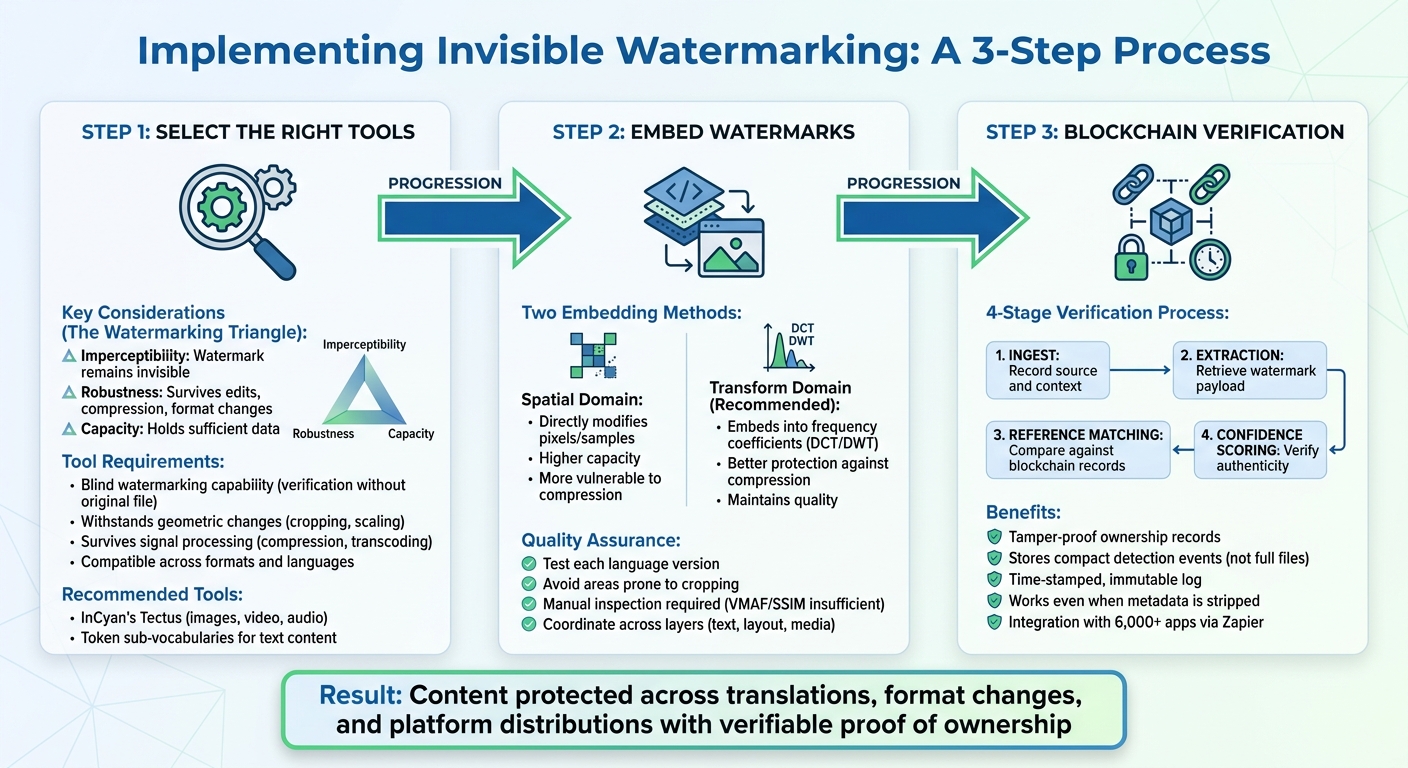
When choosing a watermarking tool, it’s essential to balance three key factors: imperceptibility (ensuring the watermark remains invisible), robustness (surviving edits, compression, and format changes), and capacity (holding enough data to be useful). This balance, often referred to as the "Watermarking Triangle", ensures your content stays protected across various languages and platforms [1]. For multilingual content, these criteria are especially important, as translation and formatting changes can challenge watermark integrity.
Blind watermarking is particularly effective in this context. It allows ownership verification without needing the original file, making it invaluable for monitoring content on international social media platforms where you can’t control how files are processed [1].
For professional workflows, tools like InCyan’s Tectus specialize in embedding machine-readable signals into images, video, and audio. These signals act like a hidden serial number, ensuring compatibility across formats and languages [1].
When evaluating tools, look for ones that can withstand common global distribution challenges, such as geometric changes (cropping, scaling) and signal processing (compression, transcoding). For text-based multilingual content, modern systems often rely on "red" and "green" token sub-vocabularies, embedding detectable signals without altering readability or meaning [4].
Once you’ve selected the right tools, the next step is embedding the watermarks effectively while keeping quality intact.
Embedding Watermarks While Maintaining Quality
Embedding watermarks without compromising quality requires precision. You can choose between two main embedding methods: spatial domain (directly modifying pixels or samples) and transform domain (embedding data into frequency coefficients using techniques like DCT or DWT) [1]. While the spatial domain offers higher capacity, it’s more vulnerable to compression. The transform domain, on the other hand, provides better protection against standard compression codecs [1].
In November 2025, Meta introduced a new approach that reduced bitrate regression to nearly GPU-level performance while maintaining watermark integrity. This was achieved through a novel frame-selection method and a CPU-only pipeline [2].
"Traditional video quality scores are insufficient for invisible watermarking: We learned that metrics like VMAF and SSIM do not fully capture the perceptual quality issues… necessitating manual inspection." – Wes Castro and Zeki Yalniz, Meta [2]
Metrics like VMAF and SSIM often fail to detect subtle artifacts caused by watermarks [1][2]. For multilingual campaigns, it’s crucial to test each language version to ensure the watermark doesn’t interfere with design elements or text rendering specific to each region.
To avoid issues, refrain from embedding watermarks in areas prone to cropping or editing. For documents distributed in multiple formats (e.g., PDF to ePub), coordinate watermarking across layers – such as text, layout, and embedded media – to maintain persistence through format changes [1][5].
Once watermarks are embedded securely, blockchain can add an extra layer of verification and timestamping.
Using Blockchain for Verification and Timestamping
Blockchain technology provides a tamper-proof way to verify and timestamp your content. Instead of storing large media files on-chain, services like ScoreDetect store compact records of detection events and cryptographic hashes of the content [1]. This approach ensures both privacy and performance while offering immutable ownership records.
"Many organizations now complement traditional evidence management systems with cryptographically verifiable ledgers inspired by blockchain designs. Rather than storing media content on-chain, these ledgers store compact records of detection events and key evidence hashes. The result is a time-stamped, tamper-evident log that can be shared with partners and regulators." – Nikhil John, InCyan [1]
The blockchain verification process involves four stages: Ingest (recording the source and context), Extraction (retrieving the watermark payload), Reference Matching (comparing against blockchain records), and Confidence Scoring [1]. This process creates a defensible chain of custody, documenting how evidence was collected, accessed, and used – critical for legal enforcement across jurisdictions, especially for multilingual content distributed globally.
ScoreDetect’s timestamping system captures a checksum of your content, ensuring proof of ownership even when metadata is stripped during translation or platform distribution. The service integrates with over 6,000 web apps via Zapier, automating workflows for multilingual content protection. For WordPress users, the official plugin automatically timestamps every published or updated article, creating verifiable ownership records on the blockchain.
Industry Applications and Case Studies
Examples from different industries highlight how watermarking techniques are being used to safeguard multilingual content effectively.
Media and Entertainment
Meta offers a compelling example in the media world. Their engineering team implemented an invisible watermarking system for video content on platforms like Instagram Reels. This technology helps identify the original uploader and detect AI-generated content. By using custom filters, they managed to optimize processing, achieving near GPU-level performance on CPUs while keeping bitrate increases in check [2].
This solution is especially valuable for protecting multilingual content shared across global markets. Unlike metadata, these watermarks remain intact even after transcoding and editing [2].
"Invisible watermarking presents a superior alternative [to metadata] due to its persistence and imperceptibility." – Wes Castro and Zeki Yalniz, Meta [2]
Academics and Education
In August 2023, researchers Xuandong Zhao, Yu-Xiang Wang, and Lei Li introduced the GINSEW method at ICML 2023. This approach protects language generation models by embedding secret signals during the decoding process [3]. Later, in 2025, another team unveiled StealthInk at ICML – a multi-bit watermarking technique designed to combat academic plagiarism. By embedding provenance data into text generated by large language models (LLMs), it ensures reliable traceability even when content is altered [7].
These innovations are particularly useful for multilingual educational materials shared among international institutions. They provide a reliable way to track unauthorized redistribution and uphold academic integrity across language barriers.
The advertising industry has also adopted these advanced methods to secure its global campaigns.
Marketing and Advertising
Marketing agencies deal with unique challenges when managing multilingual campaigns across international markets. During testing, Google’s SynthID-Text system watermarked 20 million text responses to set a benchmark for identifying AI-generated content [8]. This ensures transparency for B2B clients by clearly differentiating between human-created and machine-generated content.
Agencies now use advanced watermarking tools to protect their campaigns. For instance, InCyan’s Tectus embeds machine-readable, imperceptible signatures into both text and visual assets. These watermarks endure transformations like transcoding, cropping, and format changes [1]. Paired with ScoreDetect’s blockchain timestamping, agencies can establish immutable ownership records for their assets. This combination makes it easier to prove provenance, even when content is remixed or redistributed without permission across international markets.
Conclusion
Invisible watermarks stand out as a resilient solution for protecting digital content. Unlike metadata or visible logos, these watermarks can survive transcoding, cropping, and localization, essentially embedding a "serial number" directly into the media signal [1]. This durability makes them particularly effective for content shared across different languages and regions, where traditional protection methods often fail.
As Nikhil John from InCyan puts it, "When platforms strip or ignore provenance metadata, robust invisible watermarking becomes a critical safety net that can help link assets back to their origin and licensing state" [1]. This balance of being undetectable, durable, and efficient ensures that multilingual content remains safeguarded, no matter the jurisdiction or platform.
InCyan’s tools provide a practical approach to this challenge. Their Tectus solution embeds machine-readable, invisible signatures into various media types – images, videos, audio, and documents – that remain intact even after format changes or extensive edits. For ownership verification, ScoreDetect leverages blockchain timestamping to create unalterable records without storing the actual content. This allows rights holders to prove ownership, even when their work is remixed or redistributed.
The growing adoption of invisible watermarking reflects a significant industry shift. With many users turning to tools like ScoreDetect for proof of ownership [6], this technology has moved from being experimental to a crucial element in digital content protection. It offers creators and organizations the ability to maintain aesthetic integrity while ensuring forensic traceability – an essential need in today’s interconnected digital world.
For creators and rights holders navigating a landscape of rampant copying and synthetic media, invisible watermarking has become an indispensable tool for safeguarding their work.
FAQs
Can an invisible watermark survive translation and reformatting?
An invisible watermark can endure processes like translation and reformatting when applied with robust techniques. This might involve altering pixel values in images or tweaking text tokens. These approaches help the watermark stay intact, even after transformations such as transcoding or editing.
How can I verify ownership without the original file?
Invisible digital watermarking offers a way to confirm ownership even without the original file. This technique embeds a machine-readable signal directly into the media. Specialized tools can detect and verify this signal later, ensuring ownership can still be proven, even if the original version is missing.
What should I test to avoid quality issues in multilingual content?
To maintain high standards in multilingual content, it’s crucial to thoroughly test translated media files. Start by verifying that the invisible watermark stays intact, even after edits like adding subtitles or localized graphics. Make sure it also withstands compression, resizing, or format changes. Pay attention to the clarity of localized text – check that characters display correctly and align with local cultural norms. Finally, confirm consistent playback quality and reliable watermark detection across different devices. These steps help ensure both the integrity of your content and the effectiveness of its protection features.