File matching alone misses too much. If a stolen asset is cropped, compressed, remixed, screen-recorded, or turned into a meme, you need to match the content itself across video, audio, images, and text.
Here’s the short version:
- Multimodal matching links formats together in one system, so a clip, screenshot, caption, and soundtrack can point to the same asset.
- Late-fusion models beat single-signal tools when pirates change content on purpose.
- Audio fingerprinting can still perform well: one framework reported 0.952 TPR at 1% FPR and 0.957 AUC.
- Transformer-based video copy detection helps with short reused segments, reaching 77.32% F1 on VCDB and 67.17% on VCSL.
- Detection is only step one. You still need watermarking, rights records, and takedown steps to turn a match into action.
- Speed matters: one 2026 study found a median reupload time of 18 hours, so slow review flows can miss the window.
If I strip the article down to its main point, it’s this: the best anti-piracy setup is layered. I’d use multimodal matching to find altered copies, watermarking to trace files, and timestamped ownership records to support disputes and removals.
| Layer | What it does | Where it helps most |
|---|---|---|
| Multimodal matching | Finds reused content across formats | Discovery and triage |
| Watermarking | Traces media after distribution | Leak tracing and source checks |
| Ownership proof | Shows who had the asset first | Disputes and escalation |
| Enforcement workflow | Moves from flag to takedown | Revenue-loss control |
So if you manage video, audio, images, or text at scale, the takeaway is simple: match, verify, then enforce.
Core research methods in multimodal piracy detection
Fingerprinting, feature extraction, and similarity scoring
One of the main methods here is fingerprinting. The idea is simple: take a file and turn it into a compact signature that still holds up after common edits.
For images and video, researchers often use perceptual hashes like pHash and dHash. These methods usually hold up well against scaling and compression, which makes them useful for messy, edited copies. But they’re not magic. Heavy cropping or large overlays can still throw them off [2].
For audio, the process often goes deeper. A strong setup combines MFCCs (Mel-frequency cepstral coefficients), chroma features, and spectral contrast into one fingerprint. The HashWave framework merged all three and posted an AUC of 0.957 and a True Positive Rate of 0.952 at a 1% False Positive Rate, while also using less CPU than deep embeddings [5]. DTW is then used to align time-shifted audio and video features, which matters when copied media has been trimmed, delayed, or slightly shifted [5].
When fingerprinting stops working on heavily changed files, embedding-based matching steps in.
Cross-modal embeddings and shared vector search
Shared embeddings push detection past one-file-to-one-file matching. In these systems, text, images, audio, and video are mapped into one shared embedding space, and the system compares those vectors with cosine similarity [1].
That matters because piracy doesn’t always stay in one format. A clip may become a meme, a transcript, or a remix with new audio. If everything lives in one vector space, the system has a better shot at linking those pieces.
Transformer attention improves this setup even more. By using self-attention and cross-attention, these models build similarity maps that are especially good at finding short copied segments inside longer videos. A multimodal video copy detection framework built on this approach reached an F1-score of 77.32% on the VCDB dataset [4].
Detecting composite and mixed-format reuse
This is where multimodal detection starts to earn its keep. The toughest case usually isn’t a clean copy. It’s composite reuse: content that gets mixed, reformatted, clipped, and partly changed across text, images, audio, and video.
To deal with that, researchers are using late-fusion systems that combine several signals at once, such as:
- perceptual hashing
- audio fingerprinting
- vision embeddings
- NLP signals like Sentence-BERT (SBERT)
Recent studies show that this kind of multimodal late-fusion does much better than single-modality systems when content goes through adversarial transformations [2].
Researchers also watch for suspicious network-level patterns. That includes odd account clusters and unusual link structures, which can act as extra evidence of coordinated reuse [2].
There are still weak spots. SBERT and similar semantic models can struggle with very short text, like single-word hashtags, and they may miss specialized terms [2]. That’s why composite detection works best when text is checked alongside visual and audio evidence, not on its own. In piracy, mixed-format reuse is common. It’s not some rare corner case.
sbb-itb-738ac1e
What recent studies say about accuracy and detection limits
Handling cropping, compression, partial reuse, and remixing
The hard part isn’t spotting a clean copy. It’s spotting a copy after someone has cropped it, compressed it, screen-recorded it, or swapped out the audio. That’s how pirated content usually shows up in the wild, so researchers test these systems against hostile edits, not just untouched files.
Late-fusion systems do much better than single-modality tools when content has been changed on purpose. If a pirate replaces the original soundtrack with a synthetic voiceover, audio fingerprinting gets a lot weaker. Late-fusion helps by dialing down the audio signal and leaning more on the visual side. And when someone tries to hide reused content through screen-recording or screenshot recapture, researchers can still detect it through spatial-pattern analysis, which spots sub-pixel geometry artifacts created during the recapture process [1].
Here’s how common evasion tactics line up with the methods that hold up best:
| Transformation | Detection Challenge | Effective Technique |
|---|---|---|
| Cropping / Resizing | Pixel-level data changes | Vision embeddings & perceptual hashing [2] |
| Pitch / Time shifts | Distorted harmonic structure | DTW & multi-feature hashing (MFCC, chroma, CQT) [5] |
| Screen-recording / recapture | Moiré / pixel noise | Spatial-pattern analysis [1] |
| Subtitle insertion | Obscured visual frames | Hierarchical verification with metadata and rights data [3] |
| Synthetic voice overdubs | Original audio replaced | Late-fusion with visual-channel prioritization [2] |
How researchers measure detection effectiveness
Detection is only useful if the error rates are low enough to act on. False positives can create legal problems. False negatives let pirated material stay live and keep making money for someone else.
One metric matters a lot in enterprise use: true positive rate at 1% false positive rate. The HashWave audio piracy detection framework reached a TPR of 0.952 at 1% FPR and an AUC of 0.957 [5]. Put simply, it catches about 95% of infringing audio while keeping false alarms low enough for enforcement.
Researchers are also seeing gains on short copied segments, which is a weak spot for visual-only systems [4]. A transformer-based multimodal framework published in February 2026 by researchers from Northeastern University and Nanyang Technological University reached an F1-score of 77.32% on the VCDB dataset and 67.17% on the VCSL dataset for segment-level copy detection [4]. On VCSL, that same study reported a 7.175% average video-level false reject/false accept rate [4]. That number matters when you’re scanning millions of clips, because even a small miss rate can add up fast.
Speed matters too. HashWave processes 10-second audio segments with sub-second latency on standard CPUs [5]. Its blockchain-linked verification averaged 0.017 seconds for upload and 0.044 seconds for contract execution [5].
Those thresholds decide whether a match is strong enough to use as evidence, trigger automated takedowns, or stop a revenue leak. They also shape how detection performance turns into ownership proof and enforcement action.
How multimodal matching fits into an enterprise anti-piracy workflow
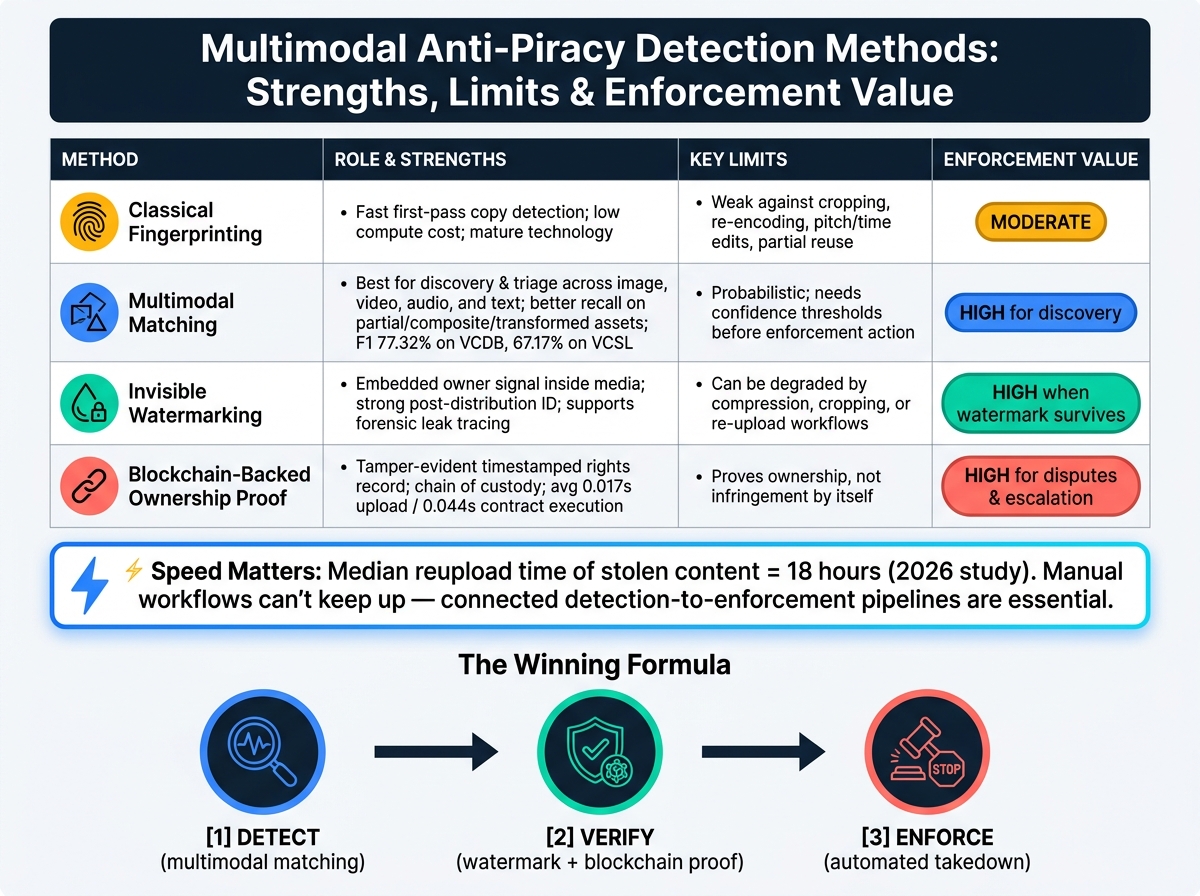
Multimodal Anti-Piracy Detection Methods: Strengths, Limits & Enforcement Value
Detection alone doesn’t protect revenue. A match score only tells you that something suspicious may be out there. It doesn’t tell you who owns the original, whether the evidence will hold up, or what action should happen next.
That’s why detection has to connect to proof and enforcement.
Comparing matching and proof methods side by side
No single method does every job equally well. Each one fits a different stage in the workflow. In practice, the key question is simple: which layer turns a match into evidence you can actually use?
| Method | Role | Strengths | Limits | Enforcement value |
|---|---|---|---|---|
| Classical fingerprinting | Fast first-pass copy detection; weak on transformed files | Fast, mature, low compute cost | Weak against cropping, re-encoding, pitch/time edits, and partial reuse [5] | Moderate; useful for first-pass screening |
| Multimodal matching | Best for discovery and triage across image, video, audio, and text | Better recall on partial, composite, and transformed assets [3][4] | Probabilistic; needs confidence thresholds before enforcement | High for discovery and triage, not sufficient alone |
| Invisible watermarking | Embedded owner signal inside the media file | Strong post-distribution identification; supports forensic tracing | Can be degraded by compression, cropping, or re-upload workflows | High when the watermark survives; useful for leak attribution |
| Blockchain-backed ownership proof | Timestamped rights claim, checksum, chain of custody | Tamper-evident ownership record [5][6] | Proves ownership, not infringement by itself | High for evidence support, dispute resolution, and escalation |
This is where teams often get tripped up. A strong match is useful, but it’s not the same thing as proof. Multimodal systems are great at finding suspicious reuse, especially when an asset has been clipped, remixed, or stitched into something else. But before enforcement starts, someone still needs to answer: Do we own this, and can we show it clearly?
From proof of ownership to enforcement action
Once a match is found, ownership proof becomes the next gate. A match finding is only as strong as the ownership record behind it. After a multimodal system flags suspected reuse, the next question in a legal dispute or platform review is straightforward: can you prove you owned this first?
That’s where blockchain timestamping comes in. ScoreDetect, InCyan’s blockchain timestamping product, handles this by taking a checksum of a content asset and registering it on a public blockchain, without storing the underlying file itself. In plain terms, it creates a record you can verify later. ScoreDetect turns that into an ownership record that can support disputes, delisting, and escalation.
Where InCyan products fit in this stack

InCyan sets up its tools as a layered stack, not one all-in-one product. That lines up with how researchers describe anti-piracy systems that work in practice.
Here’s how the stack maps out:
- Idem for multimodal matching
- Tectus for invisible watermarking
- ScoreDetect for blockchain timestamping
- Indago for search de-indexing
- TorrentWatch for BitTorrent monitoring
- Txtmatch for text infringement
- Blueprint for rights-aware asset management
Used together, these tools move a case from discovery to proof to takedown. That matters because anti-piracy work rarely fails at detection alone. It usually breaks somewhere between “we found it” and “we acted on it.”
Why integration drives better revenue protection
The 2026 Frontiers freebooting study found a median time-to-reupload of just 18 hours for stolen social media ad content [2]. That’s a tight window. Manual workflows often can’t keep up.
When matching, ownership proof, monitoring, and takedown execution sit in one connected workflow, high-confidence matches can trigger automated delisting, while edge cases can move to human review. That shortens the path from detection to action.
And that’s the point: similarity scores don’t stop piracy on their own. A connected workflow does.
Conclusion: Key takeaways for businesses
At this point, the issue isn’t whether piracy exists. It does. The real question is which signals still catch it.
Piracy rarely depends on exact file copies. And that matters, because cryptographic hashes only match identical files. Even small edits can break them [6].
That’s why transformed-content detection matters so much for fast enforcement. Late-fusion models beat single-modality detectors when content has been manipulated. If a system can’t catch altered versions, it can miss the very thing it’s supposed to stop.
The next piece is just as important: how you judge match quality. A flashy accuracy number can sound good, but it doesn’t tell the whole story. Look at TPR at a 1% false positive rate and AUC instead. Those metrics show whether a match is strong enough to act on without wasting time on bad flags.
For organizations that manage high-value digital assets, this is a revenue-protection problem. Counterfeiters can reuse popular content to sell dupes without paying production costs. If transformed content slips through, that opening stays there.
The strongest enterprise setup combines:
- multimodal matching
- invisible watermarking
- blockchain-backed proof of ownership
InCyan’s stack follows that layered model: Idem for multimodal matching, Tectus for blind watermarking, and ScoreDetect for blockchain timestamping. Put simply, the model is: detect, verify, and enforce. For enterprises, the winning play is layered: match, verify, then enforce.
FAQs
How does multimodal matching find altered copies?
Multimodal matching finds altered copies by looking at the meaning behind the content, not just the file itself. Instead of relying on exact file details, it turns images, video, audio, and text into embeddings that reflect the core idea of what’s there.
That matters because those embeddings can stay fairly consistent even after someone crops an image, adds a filter, pitch-shifts audio, or paraphrases text. So the system can still connect the changed version back to the original.
It also gets extra help from cross-modal redundancy. In plain English, that means it can compare several types of data at the same time, which makes matching altered content more dependable.
Why isn’t a match score enough for enforcement?
A simple match score often isn’t enough. Modern piracy tends to involve small but effective edits like cropping, frame-rate changes, pitch shifting, or platform-specific compression. Those tweaks can slip past detectors that rely on just one signal.
Hash-based methods can break after minor edits. And single-modality features may miss adversarial changes or dubbed content. InCyan’s Idem tackles this with multimodal matching built to hold up under major transformations.
Which metrics matter most for piracy detection?
The most important metrics look at similarity across multiple modalities, not just file hashes. That matters because a match may still be a match even if the file was cropped, re-encoded, or changed in some other way.
Key metrics include F1-score, which balances precision and recall, along with FRR and FAR to gauge overall accuracy.
Systems also rely on cosine similarity thresholds, such as 0.75, and coherence vectors to confirm matches across audio, video, or text. In plain English, they’re checking whether the underlying signal still lines up, even when the file itself doesn’t look exactly the same anymore.