When it comes to protecting digital content, two major challenges can weaken detection systems: natural performance degradation and adversarial attacks. Here’s the difference:
- Natural degradation happens unintentionally during processes like compression, resizing, or re-encoding. Over time, these changes reduce detection accuracy by altering the original file’s structure.
- Adversarial attacks are deliberate manipulations designed to bypass detection systems. Examples include deepfakes, metadata removal, or pixel-level tweaks.
Both issues threaten the reliability of content-matching systems, but they require different solutions. Tools like InCyan’s Idem and ScoreDetect use AI-driven matching and blockchain technology to address these challenges. Idem identifies content even when only 10% of the original remains, while ScoreDetect anchors file integrity with blockchain-based timestamps.
Key Takeaways:
- Natural degradation causes gradual accuracy loss; adversarial attacks are precise and sudden.
- Solutions include AI-based multimodal matching, adjustable detection thresholds, and blockchain-anchored verification.
- A layered approach combining watermarks, AI, and blockchain ensures stronger protection.
Natural Performance Degradation: Causes and Effects
What Causes Natural Performance Degradation
Natural performance degradation happens gradually as digital content undergoes processing and sharing. It’s not about malicious interference but rather the cumulative effects of actions like compression, resizing, re-encoding, or sharing. Each of these steps subtly alters a file’s digital structure, which can reduce the accuracy of content-matching systems over time.
One major contributor is platform transformations. For instance, when a video is uploaded to social media, the platform often compresses the file, replacing the original with a modified version. These altered copies, referred to as "raw signals" by engineers, are harder to standardize and match accurately [4]. This issue isn’t limited to videos – it also affects audio files, scanned documents, and other types of media.
Text content isn’t immune either. Changes like paraphrasing, translating, or applying aggressive formatting can disrupt the structural patterns that matching systems rely on. Even something as simple as removing embedded metadata during standard JPEG recompression can break the chain of provenance [5].
Over time, these small alterations add up, weakening the ability of detection systems to maintain precision and accuracy.
How Degradation Affects Content Matching Systems
Degradation primarily impacts two critical metrics in content-matching systems: precision (the percentage of correct matches) and recall (the percentage of actual infringements detected). As content drifts further from its original form, both metrics tend to suffer.
This is particularly problematic for statistical detection systems that rely on confidence scores, such as "72% likely" or "87% match." When degradation lowers these scores, legitimate infringements might slip below detection thresholds, while false positives could increase. To manage this, optimized systems typically aim for a false positive rate between 5% and 15%, ensuring that human reviewers can effectively handle flagged cases [4].
"When discovery is unreliable, each group solves a different part of the problem in isolation, which leads to duplicated effort and gaps in coverage." – Nikhil John, InCyan [4]
Another challenge is that outdated detection models may struggle to keep up as distribution methods evolve, making confidence scores less reliable over time.
How to Reduce Natural Degradation
There are several ways to address the challenges posed by natural degradation. Regular updates to detection algorithms are essential. As InCyan explains: "Our algorithms are continuously refined as the threat landscape evolves, keeping your protection ahead of new forms of infringement." [2]. Treating these systems as dynamic tools rather than one-time deployments ensures they remain effective.
Two additional strategies can strengthen this approach:
- Multimodal fingerprinting: This technique uses AI models tailored to different media types – images, video, audio, and text – to maintain high accuracy, even when content has been heavily altered. For example, InCyan’s Idem engine can trace source content even if only 10% of the original asset remains [2].
- Adjustable similarity thresholds: These allow operators to fine-tune detection sensitivity based on the type of content and its risk profile, helping to catch subtle misuse that might otherwise go unnoticed [3].
For long-term reliability, combining these techniques with blockchain-anchored verification adds another layer of security. Tools like ScoreDetect use blockchain to capture checksums, creating an immutable record of the original file. Even if metadata is stripped or corrupted during distribution, the blockchain provides a timestamped, verifiable ground truth [1][2].
sbb-itb-738ac1e
Adversarial Attacks: A Deliberate Threat
What Are Adversarial Attacks
Adversarial attacks are intentional efforts to undermine detection systems. Unlike natural degradation from compression or re-encoding, these attacks are designed to bypass protections entirely. Attackers carefully analyze how detection systems work and craft manipulations to erase any trace of identifiable content or its source.
These methods focus on disrupting the statistical patterns and embedded identifiers that AI detection models rely on. By targeting these elements, attackers can cause detection systems to either miss the content entirely or return a low confidence score. This deliberate precision sets adversarial attacks apart from other forms of media manipulation.
Common Attack Methods
Attackers have a range of techniques at their disposal:
- Geometric distortions: Cropping, scaling, or altering the aspect ratio disrupts spatial alignment, which recognition systems depend on.
- Signal-level manipulation: Techniques like aggressive re-encoding, applying color filters, or adding adaptive noise strip away metadata and degrade media signals.
- Temporal attacks on video: Speed changes or pitch shifts can throw off audio-video synchronization fingerprinting.
- Text manipulation: Paraphrasing, summarizing, or translating text disrupts the statistical patterns detection models use to identify AI-generated or derived content.
"Statistical patterns are reset by paraphrasing. Detectors cannot identify AI-summarized content as derived from a specific source." – Encypher [5]
Another common method is AI-assisted watermark removal, which targets embedded identifiers. Static watermarks are particularly vulnerable since their fixed patterns can be learned and erased. Dynamic watermarking, which shifts patterns across keyframes, offers more resistance to these attacks [8].
How Adversarial Attacks Affect Detection Systems
Unlike natural degradation, adversarial attacks are sudden and precise, often causing detection systems to fail dramatically. A system that performs well under normal conditions can see its accuracy plummet when faced with a well-executed attack. This poses serious risks, especially in high-stakes scenarios like pre-release films or music leaks, where manipulated versions can spread quickly before being detected.
The financial impact is staggering. For example, content leaks cost an average of $10 million per incident in lost sales and recovery efforts. Annually, companies lose tens of billions of dollars to piracy and intellectual property theft [7]. A notable case was the August 2024 leak of Arcane Season 2 on Netflix, which led to multi-million-dollar losses in recovery costs and staff hours. This incident highlighted the limitations of traditional encryption and access controls once content is outside a secure system [7].
The probabilistic nature of AI detectors is a key vulnerability. Detection systems often generate confidence scores, such as "72% likely a match." Skilled attackers can fine-tune their manipulations to push these scores just below the detection threshold, effectively bypassing the system. This binary weakness contrasts with cryptographic watermarking, which provides definitive evidence of tampering.
"The act of removal is itself evidence of tampering in a legal context – a signed content item that loses its manifest has been intentionally altered." – Encypher [5]
USENIX Security ’23 – Squint Hard Enough: Attacking Perceptual Hashing with Adversarial Machine…

Performance Degradation vs. Adversarial Attacks: A Direct Comparison
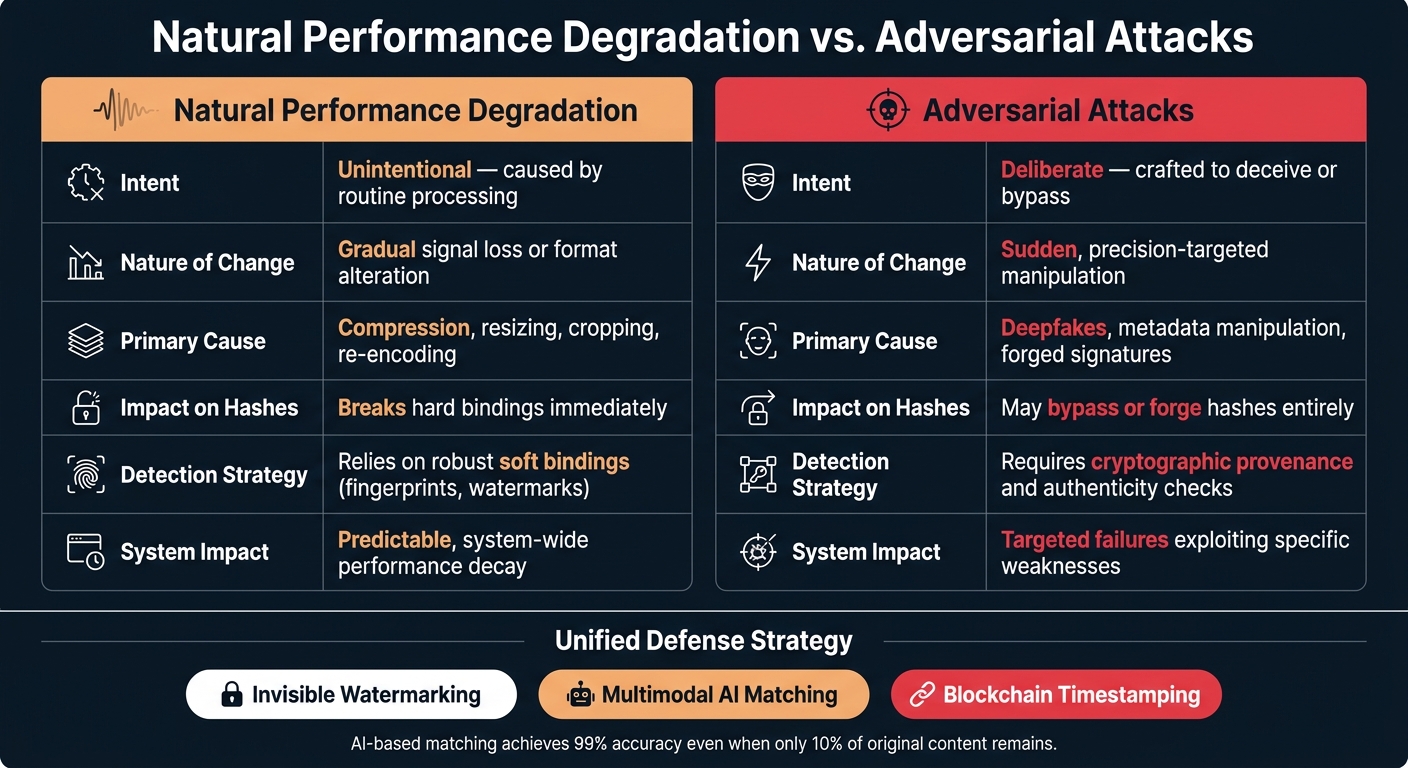
Natural Performance Degradation vs. Adversarial Attacks: Key Differences
Key Differences Between the Two Threats
When comparing natural performance degradation and adversarial attacks, the most striking difference lies in intent. Natural degradation occurs passively as a result of routine processes – think of how content changes during compression or re-encoding. Over time, this leads to a gradual decline in matching accuracy. Adversarial attacks, however, are deliberate. Here, an attacker studies the system’s mechanics and crafts manipulations specifically designed to bypass detection.
This difference in intent also leads to contrasting failure patterns. Degradation causes a predictable, system-wide decline in performance. For instance, confidence scores may drop steadily as content undergoes standard transformations. Adversarial attacks, on the other hand, are targeted: a single piece of content can shift from being fully detectable to completely undetectable after a calculated manipulation.
Another key distinction lies in the systems or structures each threat targets. Natural degradation typically disrupts hard bindings, such as cryptographic hashes, which are sensitive to even the tiniest byte-level changes. Adversarial attacks focus on soft bindings like fingerprints or watermarks, or they exploit the trust framework itself, potentially forging or misrepresenting ownership [6].
| Feature | Natural Performance Degradation | Adversarial Attacks |
|---|---|---|
| Intent | Unintentional; caused by routine processing | Deliberate; crafted to deceive or bypass |
| Nature of Change | Gradual signal loss or format alteration | Sudden, precision-targeted manipulation |
| Primary Cause | Compression, resizing, cropping, re-encoding | Deepfakes, metadata manipulation, forged signatures |
| Impact on Hashes | Breaks hard bindings immediately | May bypass or forge hashes entirely |
| Detection Strategy | Relies on robust soft bindings (e.g., fingerprints, watermarks) | Requires cryptographic provenance and authenticity checks |
| System Impact | Predictable, system-wide performance decay | Targeted failures exploiting specific weaknesses |
These differences highlight the need for distinct approaches to testing and mitigation.
Testing for Resilience Against Both Threats
Given their unique failure patterns, testing strategies must be tailored to each threat. Regression testing is the go-to method for assessing resilience to natural degradation. This involves running protected content through common transformations – like compression, resizing, re-encoding, or cropping – and verifying the detection system still performs reliably. Cutting-edge AI-based matching systems can achieve 99% identification accuracy even when only 10% of the original content remains [2]. This sets a high standard for regression tests.
Testing for adversarial attacks requires a different approach. Adversarial robustness testing involves simulating intentional attacks, such as deepfakes, pixel-level tweaks, metadata stripping, or watermark removal, to identify vulnerabilities. Fine-tuning similarity thresholds (e.g., setting a threshold of 20/100) is critical here. It ensures subtle misuse is flagged without overwhelming reviewers with false positives [3].
Since these threats evolve differently, their testing schedules also differ. Degradation testing is relatively static because the set of standard codecs and transformations doesn’t change rapidly. Adversarial testing, however, must be continuous. Attack methods evolve quickly, meaning a system that passed robustness tests six months ago could now have exploitable gaps. Regular updates and testing are essential to stay ahead.
Building Content Matching Systems That Hold Up Over Time
Layered Protection Through Redundancy
Relying on a single protection method is risky. For instance, cryptographic hashes fail when a file is re-encoded, and digital fingerprints can be thwarted by deliberate manipulation. The solution? Layered redundancy. By combining multiple protection methods, you ensure that if one fails, others remain intact.
A defense-in-depth approach typically includes three layers: invisible watermarking, multimodal AI matching, and blockchain timestamping. Invisible watermarks are designed to endure common transformations like compression, cropping, and resizing – issues that usually break hash-based systems. Multimodal AI matching tools, such as InCyan’s Idem, can identify content even when as little as 10% of the original asset remains intact [2]. This is especially useful for detecting cases where watermarks have been removed or severely degraded.
Under U.S. copyright law, willful infringement can lead to statutory damages of up to $150,000 per work [5]. Embedding cryptographic watermarks in distributed copies serves as formal notice to any party handling the content [5]. Pairing this with blockchain timestamping creates a strong evidentiary record, proving both ownership and the exact time of creation.
This multi-layered strategy forms the backbone of InCyan’s integrated tools, ensuring protection at every stage.
How ScoreDetect and InCyan Tools Work Together

By integrating these layers, ScoreDetect and InCyan’s tools create a cohesive protection ecosystem. ScoreDetect handles the blockchain timestamping layer by generating a SHA-256 checksum of your content and anchoring it to the blockchain in just 3.5 seconds [1]. The result? A verification certificate containing the hash, a public blockchain URL, and a public ledger URL – a permanent, independently verifiable record of ownership that doesn’t rely on any single vendor.
"ScoreDetect allows you to capture and store a checksum of your digital content on the blockchain… This certificate serves as evidence of the content’s timestamp and integrity." – ScoreDetect [1]
This timestamp layer integrates seamlessly with InCyan’s broader suite of tools. For example:
- Tectus: Adds durable blind watermarks to various media formats.
- Idem: Performs multimodal matching across different types of media.
- Txtmatch: Offers forensic-level precision for matching text-based content.
- Indago: Can de-index unauthorized links in under 60 minutes [2].
Together, these tools create an end-to-end pipeline that spans from content creation to enforcement. This eliminates platform switching and reduces vulnerabilities that adversaries could exploit.
Day-to-Day Best Practices for Long-Term Protection
Protecting your content isn’t a one-time effort – it’s an ongoing process. Start by watermarking content as soon as it’s created to establish an undeniable provenance trail [6]. For organizations managing large volumes of content, batching multiple content hashes into a single blockchain transaction using Merkle trees can help keep costs reasonable while still allowing individual asset verification [6].
Continuous monitoring is critical. New adversarial tactics can emerge, potentially undermining even the most robust systems. By implementing regular monitoring and adaptive testing, you can counter both gradual wear and targeted attacks. Simulating adversarial conditions and adjusting detection thresholds as needed will help keep your system effective.
Finally, a modular approach ensures flexibility. You can easily upgrade models or add new detection layers without overhauling the entire system. This adaptability helps your protection stack stay resilient as both threats and technology evolve over time.
Conclusion: Key Takeaways
Natural performance degradation and adversarial attacks both weaken content matching systems, but they do so in fundamentally different ways. Degradation happens unintentionally – it’s the byproduct of routine processes like compression, resizing, or re-encoding, which gradually reduce detection accuracy. Adversarial attacks, on the other hand, are deliberate – they involve intentional efforts to bypass detection, such as removing metadata, altering provenance markers, or paraphrasing content. These distinct threats demand equally distinct defensive strategies.
To counter these challenges, safeguarding content with digital watermarking is crucial. As Nikhil John of InCyan explains:
"Blockchain anchored records will provide a resilient spine of timestamped, signed assertions that can be audited over long periods." [6]
This principle is at the heart of combining ScoreDetect‘s blockchain timestamping with InCyan’s invisible watermarking and multimodal matching tools. As discussed earlier, natural degradation causes a slow decline in performance, while adversarial attacks can result in sudden detection failures. Together, ScoreDetect’s blockchain-anchored checksum and InCyan’s tools – such as Idem and Tectus – allow content identity to persist, even when as little as 10% of the original content remains [2]. This dual-layered approach addresses both gradual degradation and abrupt disruptions caused by attacks.
The legal implications further highlight the importance of robust content protection. Under U.S. copyright law (17 U.S.C. § 504(c)), willful infringement can lead to statutory damages of up to $150,000 per work [5]. Stripping a signed content manifest doesn’t erase liability; instead, it creates a secure evidence trail that can strengthen legal cases by proving intentional tampering.
No single method can provide complete protection. File-level hashes fail under normal transformations, watermarks alone can’t establish timing, and blockchain records can’t withstand content alterations. Only a multi-layered defense – combining invisible watermarking, multimodal AI matching, and blockchain-anchored timestamping – can offer the long-term resilience needed to safeguard content matching systems.
FAQs
How can I tell if a mismatch is degradation or an attack?
To figure out whether a mismatch stems from normal wear and tear or something more sinister, like an attack, you need to look closely at the type and extent of the changes. Natural degradation – things like compression or resizing – leaves behind predictable patterns. These can often be confirmed using tools such as blockchain anchoring or invisible watermarking. On the other hand, adversarial attacks are a different story. They involve subtle, calculated tweaks designed to slip past detection systems. Using advanced tools and examining provenance data can help determine if the changes fall within expected boundaries or point to malicious tampering.
What similarity threshold should I set for my content type?
When determining the ideal similarity threshold, it’s important to consider the type of content and the level of precision you’re aiming for. For text-based content, a default threshold of 20 often works well. However, you can tweak this based on your needs – set it higher for stricter matches or lower if you want to catch more subtle instances of misuse.
A moderate range, such as 20–30, is generally a good starting point for text. This helps strike a balance between identifying potential infringements and avoiding unnecessary false positives. Ultimately, the threshold you choose should align with your enforcement goals and your tolerance for risk.
How does blockchain timestamping help if the file changes?
Blockchain timestamping creates a secure and permanent record of a file’s state at the exact moment it is timestamped. By storing only the file’s checksum – a unique digital fingerprint – on the blockchain, any alterations to the file can be easily identified, as even the slightest change will produce a completely different checksum. This method ensures content integrity and makes detecting modifications straightforward.