Video piracy is a $10 billion problem annually, with a single leak costing up to $10 million. To combat this, two key anti-piracy technology solutions are used: video fingerprinting and color space detection. Here’s a quick breakdown:
- Video Fingerprinting: Creates a digital signature to identify videos, even after edits like cropping, compression, or re-encoding. It’s ideal for finding pirated content across platforms.
- Color Space Detection: Analyzes color data (like RGB or YUV) to detect tampering, such as grading shifts or format changes. It’s best for verifying alterations in video integrity.
How They Differ:
- Fingerprinting identifies content, even heavily altered.
- Color space detection flags visual changes but doesn’t confirm identity.
Quick Comparison:
| Feature | Video Fingerprinting | Color Space Detection |
|---|---|---|
| Purpose | Identify original content | Detect visual alterations |
| Resilience | Survives heavy transformations | Limited to color-related changes |
| Use Case | Piracy detection | Forensic video verification |
| Cross-Platform Matching | Yes | No |
Both methods work better together: fingerprinting identifies content, while color detection spots modifications. Combining them strengthens anti-piracy efforts and ensures better protection for your video content. Implementing a comprehensive IP copyright protection solution is the most effective way to safeguard your assets.
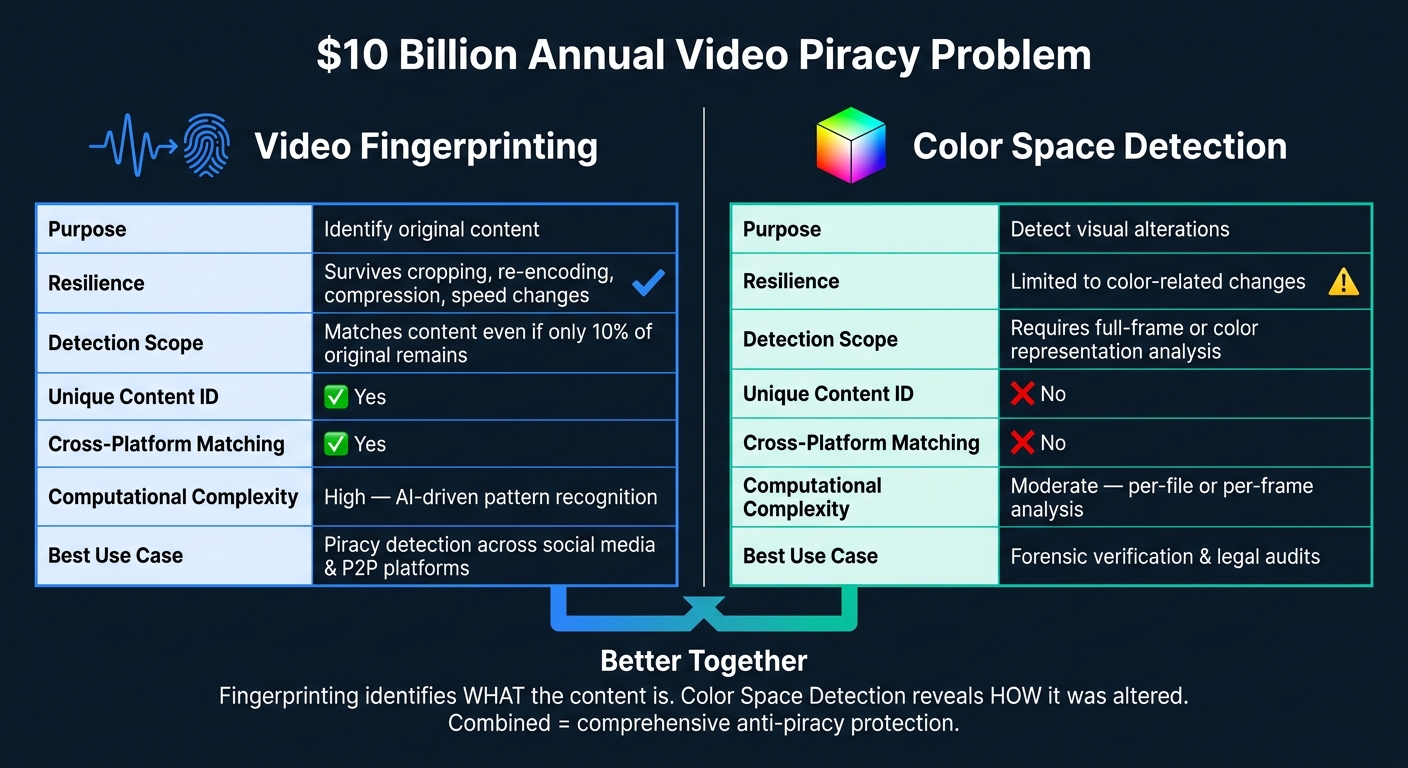
Video Fingerprinting vs. Color Space Detection: Side-by-Side Comparison
Video Fingerprinting: How It Identifies Content
How Video Fingerprinting Works
Video fingerprinting works by analyzing key perceptual features – like motion patterns, spatial details, and temporal relationships – to generate a unique signature that represents a video’s core visual and audio elements. Unlike traditional file hashes, which break down when a video is re-encoded or compressed, these fingerprints are tied to the content itself, making them far more resilient [1][4].
A great example of this technology in action is InCyan‘s Idem engine:
"InCyan’s Idem engine delivers 99% accuracy at forensic grade and can match content even when only 10% of the original remains. It survives cropping, re-encoding, compression, speed changes, and other transformations beyond the capability of conventional hash-based tools." – InCyan [4]
Modern systems take this a step further with multimodal matching. By running AI models on video, audio, images, and text separately, they ensure that even heavily altered or partially manipulated clips are identified. For instance, removing an audio track or tweaking a frame won’t be enough to bypass detection [4]. This adaptability makes video fingerprinting an essential tool for protecting digital content across industries.
Where Video Fingerprinting Is Used
Video fingerprinting plays a critical role in industries that face risks from unauthorized content distribution, such as music, stock media, live events, e-commerce, and journalism.
In the music industry, companies like BPI Limited have adopted AI-driven fingerprinting to streamline and secure their media operations, replacing outdated manual methods prone to errors [4]. Similarly, in the stock media business, Shutterstock uses InCyan’s technology to monitor how its assets are used online. This has helped them improve enforcement and monetization strategies:
"Gaining visibility into how content is utilised across the internet has truly been invaluable. We now have the automated intelligence needed to make smarter decisions, increase revenue through improved monetisation and enforcement, and maintain strict control over our assets." – Director, Shutterstock [4]
Beyond these examples, fingerprinting is also used in live events to control real-time distribution, in e-commerce to detect counterfeit product videos, and in journalism to verify the authenticity of news footage [3][4].
Strengths and Limitations
One of the standout strengths of video fingerprinting is its ability to withstand various transformations. Whether a video has been compressed, cropped, sped up, or altered with color filters, the technology can still identify the content [4]. When paired with automated enforcement systems, fingerprinting can even trigger actions like search engine delisting in under an hour [4].
However, scaling this technology comes with its own set of challenges. Managing databases with billions of assets requires significant computational power and financial resources [1]. To address this, many organizations now rely on cloud-based solutions with API access, which distribute the processing workload and eliminate the need for costly on-premises hardware [4].
sbb-itb-738ac1e
Color Space Detection: Identifying Changes in Video Representation
The Basics of Color Spaces
Videos represent color using models like RGB (common for computer displays) and YUV (widely used in broadcast systems). These models are governed by standards such as BT.709 and HDR, which define how color is encoded and decoded. Any changes to these encoding methods leave detectable traces in the video’s structure, making it possible to track alterations quantitatively.
How Color Space Modifications Are Detected
Color space modifications are identified by examining embedded metadata and analyzing color channel statistics. Shifts in gamma or format conversions alter luminance curves and disrupt the relationships between the Y, U, and V channels. These changes create measurable patterns that can reveal tampering [5]. For example, deliberate format conversions or heavy color grading – often used to obscure a video’s origin or erase embedded identifiers – leave behind detectable anomalies [5].
Modern forensic systems enhance detection by embedding invisible identifiers directly into the video’s structural geometry. This method strengthens resistance against attempts to bypass detection through color-space manipulation [5]. While this technique is effective at spotting alterations, it works best when paired with other methods that verify the content’s identity.
Strengths and Limitations
Color space analysis is a powerful tool for detecting tampering. It can identify when a video file has undergone format conversions, re-grading, or other processing inconsistent with its claimed origin. This makes it particularly useful for integrity verification in workflows like broadcast monitoring and content authentication.
However, the method has a notable limitation: it cannot uniquely identify a specific piece of content. For instance, detecting a gamma shift confirms alteration but doesn’t provide information about the video’s true identity or ownership. To address this gap, content-level identifiers, such as video fingerprinting, are essential. These techniques complement color space detection by providing the unique identification capabilities that the latter lacks.
| Capability | Color Space Detection |
|---|---|
| Detect format conversions | ✅ Yes |
| Identify gamma or grading shifts | ✅ Yes |
| Flag metadata anomalies | ✅ Yes |
| Uniquely identify specific content | ❌ No |
| Survive heavy re-encoding | ❌ Limited |
| Match content across platforms | ❌ No |
Video Finger Printing Technology
Video Fingerprinting vs. Color Space Detection: A Direct Comparison
Building on the earlier discussions about digital content protection strategies, this section focuses on when to use video fingerprinting versus color space detection.
Side-by-Side Comparison
Video fingerprinting excels at identifying content even after significant transformations, while color space detection is designed to flag visual alterations. Choosing the right tool depends on your specific needs.
| Dimension | Video Fingerprinting | Color Space Detection |
|---|---|---|
| Primary Goal | Identify content’s identity and source | Detect changes in color encoding or representation |
| Robustness | High – withstands cropping, re-encoding, speed changes, and compression [4] | Low – targets detection of those very changes |
| Feature Scope | Global monitoring and copyright enforcement across platforms [1] | Forensic analysis and tamper detection |
| Computational Complexity | High – relies on AI-driven pattern recognition and large-scale database indexing [1] | Moderate – involves per-file or per-frame analysis |
| Detection Scope | Matches content even if only 10% of the original remains [4] | Requires full-frame or color representation analysis |
| Best Use Case | Detecting unauthorized uploads on social media and P2P platforms | Verifying if a video has been filtered, graded, or manipulated |
| Unique Content ID | ✅ Yes | ❌ No |
| Cross-Platform Matching | ✅ Yes | ❌ No |
This breakdown highlights that while both methods are powerful, their strengths lie in very different applications.
When to Use Each Method
The choice between these methods depends on your content protection goals.
Video fingerprinting is ideal for broad content discovery. If you’re monitoring platforms like social media, streaming services, or peer-to-peer networks for unauthorized uploads, this is your go-to tool. Advanced fingerprinting systems, such as InCyan’s Idem engine, are designed to handle extensive transformations, such as cropping, compression, or mobile edits. They can even detect content when as little as 10% of the original material remains [4]. This makes fingerprinting particularly effective in combating piracy, where files are often altered to escape detection.
Color space detection, on the other hand, shines in forensic and technical workflows. It’s the right choice when you need detailed proof of how a file was altered. For instance, it can confirm unauthorized downgrades from HDR to SDR or identify color grading applied to obscure embedded markers. This method is less about finding content and more about verifying its integrity – making it a precision tool for legal cases or technical audits. This evidence is crucial when seeking to protect digital content through copyright laws.
Combining Video Fingerprinting and Color Space Detection in Anti-Piracy Systems
A Multi-Layered Detection Approach
Using multiple detection methods creates a more robust defense against piracy. Video fingerprinting and color space detection work hand-in-hand: fingerprinting identifies the content itself – answering the question, "What is this content?" – while color space detection highlights any alterations made to it. For instance, if a pirate alters a film’s color grading to evade detection, fingerprinting can still recognize the core content, while color space analysis flags the alteration. Together, these methods cover gaps that one alone might miss.
At the core of this layered approach is InCyan’s Idem engine, which excels at identifying altered content. Its AI-powered multimodal matching can detect content even after transformations like cropping, compression, or edits made on mobile devices – recognizing material even when only 10% of it remains [4]. Paired with Tectus, InCyan’s blind watermarking solution, the system embeds an invisible identifier into the media signal. This ensures that content can still be traced even after extensive color processing or format changes.
"Working with InCyan has completely transformed how we handle our media operations. The ability to centralize, secure and protect our content has turned a previously chaotic workflow into a streamlined process." – Director, BPI Limited [4]
This layered system – discover, identify, verify, enforce – creates a proactive protection strategy rather than a reactive takedown process. For example, InCyan’s Indago platform can de-index infringing search results in under 60 minutes [4]. This speed relies on the upstream detection layer, which confirms matches with forensic precision. Additionally, the system integrates blockchain-based verification for a comprehensive anti-piracy workflow.
How ScoreDetect Supports Content Protection

To complete the multi-layered approach, ScoreDetect adds a tamper-proof trust layer that strengthens content verification. It does this by creating a SHA-256 checksum of your video asset and timestamping it on the SKALE blockchain, with an average transaction time of just 3.516 seconds [2]. Importantly, ScoreDetect never stores the actual file – only its cryptographic hashing – ensuring your digital assets remain secure. In cases of rights disputes, this blockchain record acts as verifiable proof of ownership, supporting actions like DMCA notices, legal filings, or takedown requests.
"ScoreDetect does not store any digital assets or content. It only stores the checksum of the content on the blockchain. This means that your digital assets are safe and secure with you." – ScoreDetect [2]
In a multi-layered system, ScoreDetect serves as the trust layer, providing the cryptographic proof needed to back up detection findings. Fingerprinting identifies the pirated copy, color space analysis documents any manipulation, and ScoreDetect confirms the original content’s precedence. Additionally, ScoreDetect connects seamlessly to over 6,000 web apps via Zapier [2], allowing timestamping to integrate smoothly into existing production and publishing workflows. Together, these tools create an end-to-end system that not only detects and flags piracy but also provides irrefutable proof of ownership.
Conclusion: Picking the Right Tools for Video Content Protection
No single method, like fingerprinting or color space detection, is enough on its own. Fingerprinting shines when it comes to identifying content across platforms – modern AI-powered fingerprints are designed to withstand common transformations [1]. On the other hand, color space detection steps in to catch deliberate color-grade changes meant to sidestep fingerprinting. Together, they address two critical questions: What is this content? and Has it been altered?
Combining these techniques with strong enforcement tools offers the best protection for your video content. For instance, InCyan’s Idem ensures identification that’s resistant to evasion, Tectus embeds invisible watermarks that endure even heavy edits, and Indago swiftly removes infringing content from search results, enabling quick action when needed.
A key element of this system is verifiable ownership. ScoreDetect provides this by timestamping a SHA-256 checksum of your content on the SKALE blockchain in just about 3.516 seconds. This creates a tamper-proof, non-invasive record of ownership [2]. With this cryptographic proof, identifying your content becomes enforceable evidence.
"ScoreDetect is exactly what you need to protect your intellectual property in today’s digital age. Truly an innovative product, I highly recommend it!" – Imri, Startup SaaS, CEO [2]
The most effective approach combines detection methods, invisible watermarking, AI-powered identification, and blockchain-backed proof of ownership to deliver comprehensive protection for your video content.
FAQs
Can fingerprinting still match a clip if it’s heavily edited?
ScoreDetect’s fingerprinting and watermarking technology is designed to remain effective, even after major alterations like compression, cropping, re-encoding, color grading, or packaging for multi-bitrate streaming. This means that even clips that have undergone extensive transformations can still be reliably matched to their original protected source.
What types of tampering can color space detection prove?
Color space detection focuses on spotting tampering related to changes in a video’s color representation, such as adjustments from color grading or the application of filters. By identifying measurable differences between the original and modified versions, it plays a key role in ensuring content integrity. Using ScoreDetect, this approach remains effective even after edits like compression or format conversions. It also provides robust evidence by linking the asset to checksums and blockchain-based, timestamped certificates.
How does ScoreDetect’s blockchain timestamp help in a piracy dispute?
ScoreDetect uses blockchain timestamps to offer tamper-proof evidence of content ownership. Here’s how it works: a cryptographic checksum of your digital asset is created and recorded on the blockchain. This process ensures an unalterable record of the file’s integrity and the exact time it was created. Importantly, this approach strengthens legal claims by providing verifiable proof of ownership – without the need to store the actual file on the blockchain.