Invisible watermarking embeds hidden data directly into media files like images, videos, and audio. Unlike visible watermarks or metadata, it integrates with the media’s actual structure, making it difficult to remove. This technology is crucial for tracking and protecting digital content, especially when files undergo compression, transcoding, or editing.
Key points:
- Resilience: Neural watermarking survives heavy compression, resizing, and even screen recording.
- Tracking: Watermarks can identify the source of leaks by embedding unique identifiers for recipients or channels.
- Detection: AI-powered tools can extract watermarks from edited or modified media in milliseconds.
- Integration: Best applied at the master file stage to ensure traceability throughout the distribution process.
Watermarking combined with AI content matching and fingerprinting and blockchain timestamping strengthens content protection, ensuring media remains traceable even after significant alterations.
Invisible Watermarking: Content Provenance for Videos at Scale | Wes Castro, Meta

sbb-itb-738ac1e
Technical Foundations of Invisible Watermarking for Compressed Media
This section dives into how neural watermarking works to embed, endure, and be detected in media, even after compression and transcoding.
How Invisible Watermarks Are Embedded
Traditional watermarking techniques, like those using the Discrete Cosine Transform (DCT) or Discrete Wavelet Transform (DWT), embed data into the frequency components of media. While these methods aim to keep the watermark hidden, they often struggle under heavy compression or aggressive re-encoding. To address these limitations, neural watermarking has emerged as a more resilient solution. By using deep learning models, neural watermarking modifies pixel data in ways that can better withstand these challenges.
For video, systems like A/B segment sequencing in HLS/DASH pipelines create unique playback experiences for each viewer. Instead of re-encoding the entire video for individual users, these systems adjust playlist pointers to serve distinct segment sequences. This approach embeds a forensic signature tied to the viewer without altering the visible stream or requiring additional storage [1].
Let’s explore how these watermarks resist removal attacks and maintain their integrity through various transformations.
How Watermarks Hold Up Under Compression and Editing
Watermarks must remain intact even after extreme modifications like compression or editing. Neural watermarking is specifically designed to endure JPEG compression, resolution changes, format conversions, and aggressive re-encoding while staying detectable [3].
Some systems use 64-bit signature embedding combined with layered metadata. This ensures the watermark survives even with changes like aspect ratio adjustments or the application of color filters [1]. Tests have shown that watermarks remain detectable even after heavy cropping or significant alterations [3].
One major challenge is the "analog hole", where content is re-captured through methods like screen recording or photography. By embedding watermarks directly into pixel data (rather than as overlays), advanced sub-pixel integration ensures the watermark can survive the transition from physical to digital formats, such as screen captures or recordings [1][5].
How Watermarks Are Detected in Modified Media
Effective detection methods are crucial for tracing watermarks, even in heavily modified media. Detection can be categorized into two types: non-blind and blind. Non-blind detection compares the watermarked file with the original, while blind detection relies on statistical analysis to extract the embedded signature without needing the original file.
Modern AI-powered detection tools can confirm the origin of watermarked media in under 100 milliseconds, even after multiple rounds of editing or transcoding [4]. These systems identify distinct patterns in pixel data that correspond to the embedded watermark, enabling detection even when only fragments of the original content remain.
A growing approach combines invisible watermarks with C2PA cryptographic manifests for dual verification. The C2PA manifest acts as a tamper-proof record of the file’s creation and editing history, while the invisible watermark serves as a persistent identifier that stays intact even when metadata is stripped or file formats change [3][6]. Together, these techniques form a layered system for protecting content.
How Watermarking Works in Media Pipelines
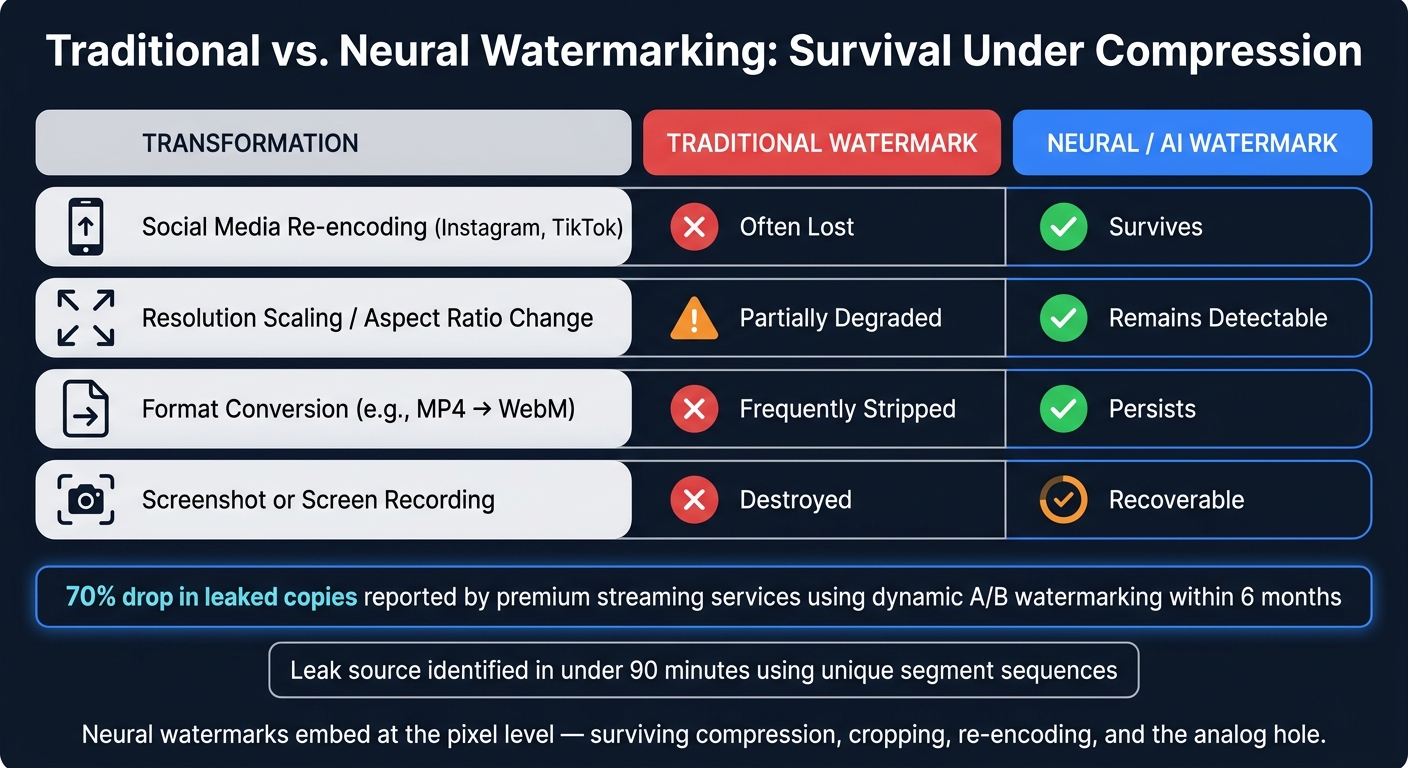
Traditional vs. Neural Watermarking: Survival Under Compression
Where to Embed Watermarks in a Media Pipeline
One of the key decisions in a watermarking strategy is determining the right stage to embed the watermark. The best practice is to add watermarks at the master file stage – before any compression, transcoding, or distribution occurs. This ensures a consistent chain of custody throughout the pipeline.
For forensic tracking, embedding a unique watermark for each recipient or distribution channel is critical. This approach allows you to trace leaks back to their source, even if the file has undergone significant modifications. A generic watermark applied across all copies doesn’t offer the same level of traceability.
In streaming workflows, A/B watermarking in HLS/DASH pipelines takes this concept further. Instead of re-encoding video for every user, the system adjusts playlist pointers to serve each viewer a unique sequence of pre-encoded video segments. This embeds a forensic signature tied to the viewer’s session, all without requiring extra storage or causing visible changes to the video.
Next, let’s dive into how transformations like compression and transcoding impact watermark integrity.
How Compression and Transcoding Affect Watermark Integrity
Watermark survival can vary significantly depending on the method used and the transformations applied. Traditional frequency-domain methods, such as those based on DCT (Discrete Cosine Transform) or DWT (Discrete Wavelet Transform), tend to degrade under aggressive re-encoding. Neural watermarks, on the other hand, are more resilient because their signal is embedded directly into the image’s pixel data.
Here’s a comparison of how different transformations affect watermark integrity:
| Transformation | Traditional Watermark | Neural/AI Watermark |
|---|---|---|
| Social media re-encoding (Instagram, TikTok) | Often lost | Survives |
| Resolution scaling / aspect ratio change | Partially degraded | Remains detectable |
| Format conversion (e.g., MP4 → WebM) | Frequently stripped | Persists |
| Screenshot or screen recording | Destroyed | Recoverable |
Platforms like Instagram and TikTok use their own compression algorithms when content is uploaded, often stripping metadata and degrading frequency-based watermarks. Neural watermarks, however, have shown consistent resilience during practical tests, surviving even aggressive compression.
Examples of Watermark Persistence Across Use Cases
Real-world applications demonstrate the effectiveness of embedding watermarks early in the media pipeline. For instance, premium streaming services using dynamic A/B watermarking reported a 70% drop in leaked copies within six months [1]. When leaks did occur, the unique segment sequence embedded in the stream pinpointed the source account in under 90 minutes [1].
Social media uploads also highlight the importance of robust watermarking. David Kim, Security Lead at MediaStack, explained how their team tested watermark durability:
"The robustness benchmark sold us. We tested it ourselves – cropped, compressed, screenshotted, ran it through Instagram. The watermark came back every time." [3]
Screenshots are particularly challenging because they involve exiting the digital pipeline and re-entering as a completely new image file. However, advanced sub-pixel embedding ensures that the watermark signal survives even this transformation. Alex Turner, Lead Engineer at ImageFlow, shared his team’s experience:
"We watermark every image our platform generates. Three lines of code, and our compliance team stopped asking questions after we showed them the detection demo working on a screenshotted image." [3]
These examples highlight a clear takeaway: embedding watermarks at the pixel level and tailoring them to each recipient delivers far better results than legacy methods applied later in the workflow.
How to Implement Invisible Watermarking for Compressed Media
Defining Your Watermarking Requirements
Start by outlining clear goals for watermarking based on the type of media and its distribution channels. Each media type comes with its own challenges, so it’s crucial to identify which transformations your watermark should withstand. These might include transcoding, resizing, cropping, format conversion, and even surviving the "analog hole" – where content is recorded off a screen using a camera. Real-world tests on specific platforms are essential to ensure the watermark’s durability across various compression pipelines.
Another important factor is deciding on tracking granularity. A static watermark simply identifies the creator, while a forensic or dynamic watermark embeds a unique identifier for each recipient, session, or channel. This allows you to trace leaks back to their source. While forensic watermarking may add complexity, it’s often a worthwhile investment in commercial scenarios. Additionally, some industries may require compliance with standards like the EU AI Act‘s Article 50, which mandates machine-readable markings on AI-generated content by August 2026, or the emerging C2PA standards for content provenance.
| Requirement | Key Question | Technology to Match |
|---|---|---|
| Durability | Can the watermark survive transformations? | Neural/AI-powered watermarking |
| Traceability | Do you need IDs for users or channels? | Forensic/dynamic watermarking |
| Authenticity | Do you need tamper detection and proof? | C2PA manifests + blockchain timestamping |
| Performance | Does embedding need to be in real time? | GPU-optimized or A/B sequencing |
Once you’ve defined your requirements, the next step is to integrate these solutions seamlessly into your workflows.
Integrating Watermarking into Asset Pipelines
To ensure effective implementation, watermarking should be integrated early in your media pipeline. Many modern platforms provide libraries in programming languages like Python, TypeScript, Go, and Rust, making it possible to embed watermarks into your existing CI/CD workflows or media processing jobs without needing a major infrastructure overhaul.
Start by watermarking at the master file stage – before any compression or transcoding. This allows you to embed a unique payload for each copy and store its details in a secure database. This forensic ledger ensures that any detected watermark can confirm the content’s origin and trace the source of leaks, even through heavy media transformations.
For high-volume workflows, batch endpoints and Kafka streaming are useful tools to manage the process efficiently [3]. For AI-generated content, newer platforms now support MCP (Model Context Protocol) servers, enabling AI systems to watermark assets automatically during content creation [3]. Tools like InCyan’s Tectus are designed for large-scale watermarking across images, video, and audio. They provide invisible proof of ownership that holds up in copyright disputes without degrading the viewer’s experience.
Monitoring and Detecting Watermarked Content
Embedding watermarks is only half the battle. Continuous monitoring is essential to ensure the integrity of your watermarks and to trace any unauthorized use.
Detection typically involves two main approaches. First, web scraping helps uncover unauthorized reposts on platforms like Telegram, Rumble, and Dailymotion. Second, API-based verification allows you to submit suspected infringing files to a detection endpoint, which extracts and verifies the embedded payload. Batch detection endpoints can handle up to 50 files at once, making large-scale monitoring feasible [3]. Maintaining a comprehensive database of your watermarked master files and their payload IDs is critical – without it, you won’t be able to confirm matches or establish a legal record.
To strengthen your claims, confirm matches using a blockchain-timestamped extraction report. This creates a clear chain of custody, linking the detection to enforceable legal evidence. As Nikhil John of InCyan explains:
"A watermark by itself says nothing about when it was embedded, who performed the embedding, or what legal rights were in force at the time. Without an independent record, parties may still argue about the timeline." [2]
Tools like ScoreDetect address this issue by recording a cryptographic checksum of your content on the blockchain at the time of registration. This immutable, timestamped record provides independent proof of ownership, ensuring that detection events hold up as legal evidence. Combining pixel-level watermarking with blockchain timestamping transforms your detection efforts into actionable results.
Combining Watermarking with Other Technologies for Stronger Protection
Building on the resilience of watermarking discussed earlier, this section explores how adding other technologies can create a more secure content protection system. By combining invisible watermarking with AI-based content matching and blockchain timestamping, you get a layered defense that addresses various vulnerabilities. Let’s dive into how these technologies work together to strengthen content security.
AI-Powered Content Matching as a Backup to Watermarking
Watermarks are robust, but when content undergoes extreme edits, additional detection tools become necessary. This is where platforms like InCyan’s Idem shine. Using an AI-powered multimodal matching engine, Idem can identify content even when only 10% of the original asset remains. It’s effective against transformations such as cropping, compression, mobile edits, and even memes – scenarios that would typically bypass standard watermark detection.
The advantage here is speed and scalability. AI detection systems can quickly verify the origins of images and videos, enabling continuous monitoring of high-value content rather than waiting to respond after a leak. In essence, watermarking can reveal who accessed the file, while AI matching can uncover where the file ends up – even if it’s been heavily altered.
"True Content Leak Protection requires the ability to attribute, trace, and understand leaks, not just block them." – Steg.AI [5]
To complete the picture, blockchain timestamping provides the legal evidence necessary to enforce ownership rights.
Blockchain Timestamping as Proof of Ownership
Blockchain timestamping adds another layer of protection by creating a tamper-proof, time-stamped record of ownership. Platforms like ScoreDetect use a SHA-256 checksum to record this information on the blockchain, producing a certificate that confirms authorship and timestamp – without storing the actual file [7].
This is particularly valuable in legal disputes. While a watermark can show who distributed the file, a blockchain certificate demonstrates prior ownership. ScoreDetect completes this process in just 3.516 seconds on average [7]. For added convenience, its WordPress plugin automates the process for every published or updated article, enhancing transparency and even contributing to Google E-E-A-T signals by verifying content authenticity. As Imri, a SaaS startup CEO, notes:
"ScoreDetect is exactly what you need to protect your intellectual property in this age of hyper-digitization. Truly an innovative product." [7]
Crafting a Multi-Layered Content Protection Strategy
The strongest protection strategy integrates all three technologies: invisible watermarking for identifying leaks, AI content matching for tracking unauthorized copies, and blockchain timestamping for irrefutable proof of ownership. Each layer addresses a specific weakness of the others, creating a well-rounded defense system.
Here’s how these layers work together:
| Layer | Primary Role | Key Strength |
|---|---|---|
| Invisible Watermarking | Traces the source of a leak | Survives compression, cropping, and re-encoding |
| AI Content Matching | Detects unauthorized copies online | Identifies content even after heavy modification |
| Blockchain Timestamping | Proves original ownership | Provides immutable, independent legal evidence |
Conclusion: Keeping Media Traceable with Invisible Watermarking
Key Takeaways
Invisible watermarking has proven to be one of the most reliable ways to trace media, even after compression and transcoding. Unlike visible watermarks, which can be cropped or blurred, invisible ones are embedded at the pixel or bitstream level. This makes them resilient to JPEG compression, social media re-encoding, and even screenshots. Neural watermarks, for example, can remain detectable even when over half of an image is cropped or when 80% of its content is altered [3].
The best practice is to embed watermarks right at the point of creation or initial distribution – not later. Pairing this with unique identifiers for each recipient allows you to track the exact source of any leaks. Stress tests, including cropping, compression, screenshots, and Instagram re-encoding, have shown that these watermarks can withstand all these transformations [3].
For organizations managing valuable assets, InCyan’s Tectus offers a blind watermarking solution tailored for images, videos, and audio. This technology provides invisible proof of ownership that can stand up in enforcement scenarios.
These strategies lay the groundwork for a strong content protection plan. By applying these principles, businesses can better safeguard their digital assets.
Next Steps for Businesses
Begin by identifying where your media assets are most at risk – whether it’s pre-release screeners, licensed image libraries, premium streaming content, or published editorial work. Once you’ve pinpointed vulnerabilities, choose a watermarking solution that fits your operational needs, such as API integration with a DAM system or a managed enterprise service.
To strengthen your protection, consider integrating blockchain timestamping with ScoreDetect. This service creates an immutable, time-stamped record of ownership and processes transactions in an average of 3.516 seconds. It’s a quick and efficient way to produce court-ready proof of prior ownership. Plans start at $11.31/month (billed annually), and a 7-day free trial lets you test it within your workflow before committing.
For larger-scale requirements, including 24/7 content monitoring, automated takedown services, and invisible watermarking across various media formats, InCyan provides a comprehensive suite of tools. These include Idem for AI-powered multimodal matching, Indago for search enforcement, and TorrentWatch for BitTorrent surveillance. Together, these tools create a multi-layered protection strategy, ensuring that any gaps in one system are covered by another.
FAQs
How do invisible watermarks survive heavy compression?
Invisible watermarks are subtly embedded into content at a pixel or even sub-pixel level, making them tough to erase through compression, cropping, or re-encoding. These watermarks stay intact and detectable, even after heavy alterations, due to advanced methods like neural watermarking and AI-based embedding. By weaving data directly into the content’s structure, they provide a reliable way to maintain traceability and safeguard content, even when subjected to the intense compression algorithms of social media platforms or digital re-encoding processes.
Can a watermark still be detected after a screenshot or screen recording?
Advanced invisible watermarking techniques are built to withstand various alterations, including screenshots, screen recordings, cropping, and compression. These technologies are designed to maintain content traceability, ensuring the watermark remains detectable even after such modifications.
What’s the best point in a media pipeline to add watermarking?
The best time to incorporate invisible watermarking is right at the beginning of the content creation or production process, well before distribution or public release. Adding watermarks at this stage ensures they are embedded directly into the media, making them more resistant to alterations such as compression, cropping, or re-encoding. This early integration helps maintain traceability and strengthens copyright protection throughout the media’s entire lifecycle.