If a watermark fails after re-encoding, clipping, screen recording, or loudness normalization, it does not help much. My main takeaway is simple: for video and audio, the best setup is a layered one that combines invisible watermarking, blockchain timestamping, forensic leak tracing, and AI matching.
Here’s the article in plain English:
- Tectus adds a hidden ownership signal to video, images, and audio, then checks it without the original file.
- ScoreDetect does not mark the media. It stores a file checksum on-chain to show when a claim was made and which file was claimed.
- Forensic watermarking is for streaming leaks. It links a copy to a user or session.
- Audio watermarking focuses on keeping ownership data readable after MP3/AAC conversion, trimming, normalization, and remixing.
- AI multimodal matching helps when watermark recovery is weak or missing by matching altered audio and video across a database.
- The article also points out one hard metric: Idem can still identify content when only 10% of the original asset remains.
Bottom line: I would not rely on one method alone. I’d use one layer for ownership proof, one for file-origin records, one for leak tracing, and one for matching edited copies.
Invisible Watermarking: Content Provenance for Videos at Scale | Wes Castro, Meta
sbb-itb-738ac1e
Quick Comparison
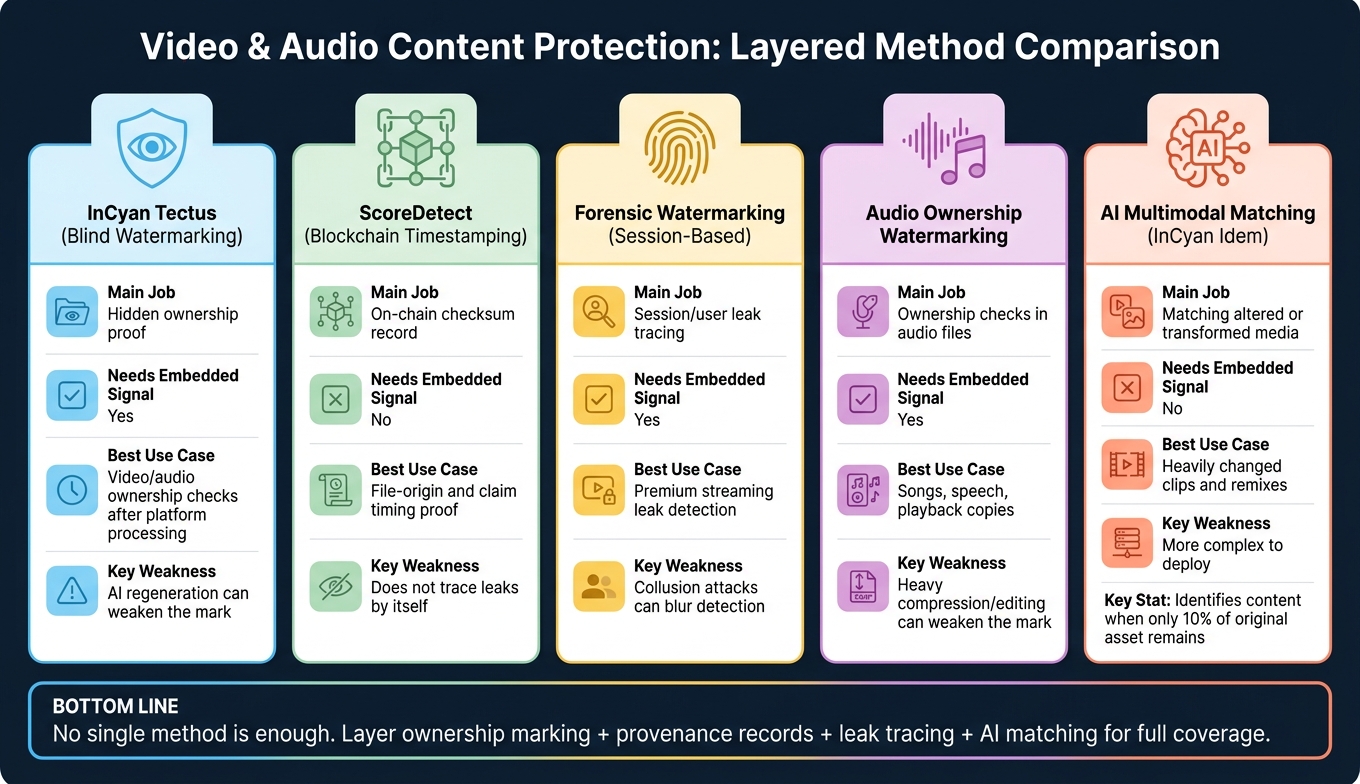
Video & Audio Watermarking Methods Compared: Which Layer Do You Need?
| Method | Main Job | Needs embedded signal? | Best use case | Main weakness |
|---|---|---|---|---|
| InCyan Tectus | Hidden ownership proof | Yes | Video/audio ownership checks after platform processing | AI regeneration can weaken the mark |
| ScoreDetect | On-chain checksum record | No | File-origin and claim timing | Does not identify leak source by itself |
| Forensic watermarking | Session/user leak tracing | Yes | Premium streaming | Collusion can blur detection |
| Audio ownership watermarking | Ownership checks in audio | Yes | Songs, speech, playback copies | Heavy compression/editing can weaken the mark |
| AI multimodal matching / Idem | Matching altered media | No | Heavily changed clips and remixes | Setup is more involved |
If you want proof that survives platform handling, this comparison shows that ownership marking, provenance records, leak tracing, and matching each solve a different part of the problem.
1. InCyan Tectus
Tectus combines fragile tamper detection with strong ownership verification.[1]
TAFM aligns frames during embedding to keep visual quality intact.[1] It’s built to survive recompression, resizing, transcoding, cropping, and screen recording by using frequency-domain methods and spread-spectrum techniques, with detection and verification built into the workflow.[2] That kind of resilience is the real test when platforms reprocess video before playback.
The next comparison looks at whether other watermarking methods hold up as well under platform handling.
2. ScoreDetect
ScoreDetect does not embed a watermark. Instead, it records a cryptographic checksum on the blockchain as tamper-evident proof of ownership. In plain English, ScoreDetect works as a provenance layer, not as the watermark itself.
That difference matters. A watermark changes or marks the media. ScoreDetect doesn’t touch the file. It records when the file existed and who claimed it. When you pair that record with watermark detection, enforcement gets much stronger. If a watermark later shows up in an unauthorized upload, the blockchain record can help establish durable provenance and support claims under DMCA §1202 or similar copyright laws [2].
Use ScoreDetect as the provenance layer in a broader watermarking and monitoring workflow [2][3].
This is also why metadata alone is often too fragile for high-value assets. Many platforms strip metadata, including C2PA Content Credentials. ScoreDetect avoids that weak spot by anchoring ownership to the file’s cryptographic fingerprint instead of removable metadata [2]. The original asset is not stored – only the checksum – so the record remains durable without keeping the media file itself.
3. Forensic Watermarking for Streaming Video
Forensic watermarking for streaming video answers a very specific question: which subscriber or session leaked it? That’s the whole point.
A copyright watermark says who owns the content. A forensic watermark does something different. It carries a unique ID tied to a given subscriber or session, then checks whether that ID can survive ABR delivery, re-encoding, compression, and even screen recording. Put simply, the watermark has to make it through the platform’s full delivery chain and still be readable.
That’s where things get hard. A watermark can look fine in a lab, then fall apart once the video goes through the mess of streaming pipelines. Modern systems deal with this by training encoder-decoder networks with differentiable distortion layers that mimic ABR delivery, re-encoding, and screen capture. The encoder learns how to place the mark so it can still be detected after platform-level processing [1].
In August 2024, researchers published V2A-Mark, a deep visual-audio watermarking framework that showed robust copyright extraction after H.264/AVC compression and tampering [1]. That’s the line between a neat demo and something that can hold up under actual streaming conditions.
Forensic systems usually use two mark types together:
- Fragile marks break after any edit, which helps show where tampering happened. That matters when the output may be used as court evidence.
- Robust marks survive re-encoding and work as leak-tracing tools.
In production, teams often use both [1].
The enforcement path is pretty direct: embed a session-specific token during delivery, detect a leak, recover the payload, and trace it back to the account. If payload recovery is only partial, content matching algorithms become the fallback layer [2].
4. Ownership Watermarking for Audio
Audio runs into the same platform-processing mess as video, but the damage looks different. With audio ownership watermarking, the job isn’t forensic tracking. It’s proving that a specific song or spoken-word file is yours, even after another platform has transcoded it, trimmed it, normalized it, or mixed it into something else.
The hard part is survivability. MP3 or AAC transcoding can change the signal. Loudness normalization can reshape the waveform. Remixing can add new layers that throw off a weak watermark. To deal with that, newer systems use sample-level embedding, which inserts ownership identifiers at a fine-grained level inside the audio waveform. That setup can still verify ownership and spot tampered segments [1]. That’s a big deal on platforms that compress, normalize, and remix audio before playback.
Some research frameworks use Degradation Prompt Learning (DPL) to help the decoder model distortion caused by transcoding and delivery [1]. And when the audio gets hit hard by distortion, cross-modal recovery can strengthen verification by connecting audio and video signals to rebuild the ownership identifier [1].
In practice, enforcement systems usually return one of three results:
- No watermark detected
- Watermark detected with tampering
- Watermark detected with no tampering [1]
That third result carries the strongest evidentiary weight in a copyright dispute. At the end of the day, the main test is simple: does the mark still verify after platform processing?
5. AI-Powered Multimodal Matching Systems
When watermark recovery is partial or not available, matching becomes the next line of defense. If there’s no watermark to check, AI-powered multimodal matching can still spot reused or edited content, even without embedded signals.
These systems rely on passive forensic analysis to look for temporal and spatial anomalies that point to tampered regions [1]. They also use cross-modal verification, which means audio and video can back each other up when one track has been changed or damaged. That still works after common platform changes like cropping, compression, remixing, and screen capture.
There’s a catch, though. As AI-generated media gets more lifelike and leaves behind fewer artifacts, passive detection becomes less dependable. That shift is pushing the field toward embedded-signal forensics [1].
At enterprise scale, InCyan’s Idem uses multimodal matching to find altered assets across image, video, and audio. It matches digital assets against a multimodal database and stays effective after cropping, compression, and other transformations.
The difference between these methods matters. Some systems look for signs of tampering. Others verify content authenticity by checking embedded signals. And some handle both jobs.
| Detection Method | Embedded Signal Needed | Primary Strength | Localization |
|---|---|---|---|
| Passive forensics | No | Detects tampered or reused regions by analyzing traces in the content itself | Pixel-level visual, sample-level audio |
| Embedded-signal forensics | Yes | Authenticity verification via embedded audio-video signals | Precise localization |
| Cross-modal matching | No | Matches altered media across audio and video streams | Multimodal |
Platform Resilience, Detection, and Enforcement Comparison
Not all watermarks make it through the same delivery chain. And that matters, because video and audio almost never reach people in their original form. Platforms re-encode, compress, resize, clip, normalize, and convert media before it goes live. Every one of those steps can weaken an embedded signal. So the main issue is simple: which detection method still works after all that handling?
Modern watermarking is built with platform distortions in mind. Systems are trained to deal with compression, screen capture, and frame-rate shifts. For time-based changes, temporal alignment modules help keep marks decodable across nearby frames. From there, the choice between deterministic extraction and AI-powered multimodal matching depends on the kind of proof you need for enforcement.
Deterministic methods tend to work best when conditions are controlled and predictable. But once a file goes through heavy re-encoding, output quality can still drop [2]. AI-powered systems are better suited to rougher conditions because they combine signals across media types. In plain English, the audio and video can back each other up. That changes the comparison a bit. It’s not just about how the system was trained. It’s about how much proof it can still give you when the file has been altered.
Robust marks stay intact through platform processing and can prove ownership. Fragile marks do the opposite by design: they break when someone edits the file, which helps show where tampering happened [1]. Use both at the same time, and one file can carry ownership proof and a tamper map [1].
| Platform Event | Robust Watermark | Fragile Watermark | AI Multimodal Matching |
|---|---|---|---|
| H.264/AVC re-encoding | High resilience [1] | Breaks cleanly [1] | AI-assisted recovery [1] |
| Frame-rate change / clipping | Adjacent-frame recovery [1] | Breaks at altered frames [1] | Cross-modal recovery [1] |
| Loudness normalization / audio edit | Sample-level embedding preserves ownership bits [1] | Identifies tampered segments [1] | Audio-video cross-verification [1] |
| Screen capture / screen-to-camera | Resilient through screen capture training [1] | Often breaks under capture | Cross-modal recovery [1] [2] |
For enforcement, InCyan’s Tectus uses blind watermarking across video and audio to create invisible proof of ownership that survives platform processing. This process is often reinforced by establishing ownership with timestamps to create a permanent record. If watermark recovery fails, InCyan’s Idem adds multimodal matching to identify content even when only 10% of the original asset remains.
That’s the split in practice: some systems are better for ownership proof, some for tamper evidence, and some for leak tracing as part of broader technology solutions to stop digital piracy.
Pros and Cons
These methods handle different parts of the enforcement problem. But each one breaks down under a different kind of pressure. So the right pick comes down to what you need most: ownership proof, leak tracing, tamper detection, or extra support during enforcement.
InCyan Tectus gives you invisible, blind ownership proof across video and audio. Its main weak spot is simple: regeneration attacks can remove or weaken the embedded signal [2].
ScoreDetect stores a content checksum on the blockchain as a tamper-evident registration record. That helps prove when something was registered. But on its own, it won’t tell you where a leak came from.
Session-based forensic watermarking fits premium distribution well when leak tracing is the goal. It can tie a leak back to a session or recipient. The catch is collusion attacks, where several users mix marked copies together to blur or weaken detection [2].
Audio ownership watermarking is tough enough to survive consumer playback and re-recording. Still, heavy compression or audio editing can weaken the signal. And it isn’t built for exact tamper location.
AI-powered multimodal matching (InCyan Idem) stands out when files have been heavily changed. That’s a big plus if the content has been transformed, clipped, or reworked. The tradeoff is deployment: it takes more effort to set up, so it often works best when blockchain enhances digital watermarking as part of a layered strategy.
The table below boils it down to the part that matters most: what each method does best, and where it stops helping.
| Approach | Best For | Key Limitation |
|---|---|---|
| InCyan Tectus (blind watermarking) | Invisible ownership proof across video and audio | Vulnerable to AI-based regeneration attacks |
| ScoreDetect (blockchain timestamping) | Tamper-evident registration record | Does not trace leaks by itself |
| Forensic watermarking (session-based) | Leak tracing in premium streaming | Susceptible to collusion attacks |
| Audio ownership watermarking | Anti-piracy in consumer playback environments | Signal can weaken under heavy compression or editing |
| AI multimodal matching (InCyan Idem) | Detecting heavily altered or transformed content | More complex to deploy |
If you want coverage across a real distribution chain, one method usually isn’t enough. Layer ownership watermarking, forensic tracing, and multimodal matching so each tool covers the gaps left by the others.
Conclusion
No single method covers every platform shift. Across platforms, the pattern is the same: invisible watermarking works best inside a layered system, because regeneration attacks and platform processing can still weaken any one signal. The three failure points covered in this article – watermark survival, provenance, and detection – each need a different tool.
That’s why enterprise protection works best as a layered system. InCyan brings together blind watermarking, multimodal matching, and blockchain timestamping in one protection stack. You get embedded watermarks that can survive reprocessing, AI-powered matching for heavily changed content, and ScoreDetect blockchain timestamping to support ownership claims under U.S. copyright law, including 17 U.S.C. §1202 [2]. For U.S. video and audio pipelines, layered protection is the only durable enforcement model.
FAQs
How does invisible watermarking survive re-encoding and screen recording?
Invisible watermarking sticks around after re-encoding and even screen recording because it hides signals inside the file itself or in the frequency domain, not in metadata that can be stripped out. That makes it much harder to wipe away during transcoding or compression.
It can also survive cropping and geometric shifts by spreading data across frequencies or using sub-pixel integration. With blind detection, teams can spot those hidden markers without needing the original file.
Why is blockchain timestamping useful if it does not watermark the file?
Blockchain timestamping gives you an independent, verifiable record that a file existed at a certain point in time and was tied to a given owner. It works alongside invisible watermarking, not in place of it.
Here’s the simple version: a watermark is embedded in the media file so you can trace where it came from or how it was shared. Blockchain, on the other hand, stores a secure checksum of the content. That means you get proof tied to the file without putting the actual asset on-chain.
Used together, tools like ScoreDetect from InCyan help protect content and give you immutable proof of existence and ownership.
When should I use AI matching instead of watermark detection?
Use AI matching when a digital asset has been changed so much that the embedded watermark may not hold up anymore. That often happens after cropping, compression, meme edits, or quick changes on a phone.
Invisible watermarking works well for leak tracing and ownership claims. At the same time, InCyan’s Idem can still identify content even when only 10% of the original is left. In plain terms, watermarking helps prove where something came from, and AI matching helps find it after it’s been chopped up, reposted, or altered.
That’s why Idem works well alongside watermarking, not in place of it.